
The LO—previously, the ‘Little One’—is my now-nine-year-old daughter. I say ‘previously’ because the LO has now decided (and both her father and I agree) that she’s too old to be called ‘little’. “How about Loved One instead?” she said, and I agreed. The LO is now the Loved One. She always has been, actually.
For those who’ve read previous travelogues on this blog, you’d know that the LO is quite a one for travelling. Much like her parents, really: all three of us like nothing better than to go new places, explore new cultures, experiment with new foods.
This time, our summer vacation was not really a completely new experience. My husband and I have been to Shimla before, and the LO has been to Himachal too. But she hasn’t been to Shimla, and that, we figured, needed to be corrected. Also, it had been fifteen years since the two of us had been there last. High time for another trip.
From Noida, it’s an easy two-day journey up to Shimla. This travelogue is about our trip up to Shimla and back; Shimla itself will be covered in Part 2 of this travelogue.
On our first day, we drove from Noida to Chandigarh in easy stretches, arriving in Chandigarh sometime in the late afternoon. We stayed at the Novotel, and the LO was very excited to discover that the hotel lobby houses a Porsche showroom! She couldn’t stop ogling the cars.

Given that we had some free time, it would be a waste to not go sightseeing. When in Chandigarh, Nek Chand’s Rock Garden seemed the obvious choice. My husband and I had visited this fifteen years back, but every time since then, we’ve been in Chandigarh with the LO and not had a chance to revisit it. This was a good occasion, we thought, to take the LO there.
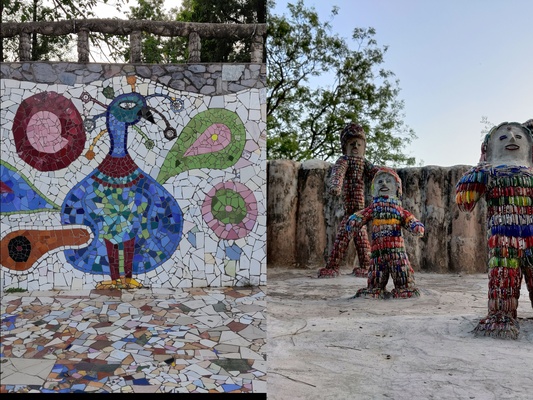
Nek Chand was a self-taught artist and sculptor who had arrived in Indian Punjab from Pakistan in the wake of Partition. Around the time Chandigarh was established (in the early 50s) Nek Chand got a job there, and soon found himself dealing with a massive amount of waste material from demolition projects and other debris. This gave him the idea that would go on to result in the Rock Garden: Nek Chand began to put together bits of broken glass and tile, electrical odds and ends, scrap metal and more to form artworks.
These artworks, originally over a spread of some 18 acres, are now believed to cover up to 40 acres, and it’s a mad labyrinth of narrow corridors, canyons, waterfalls, water courses and dozens of other creations.
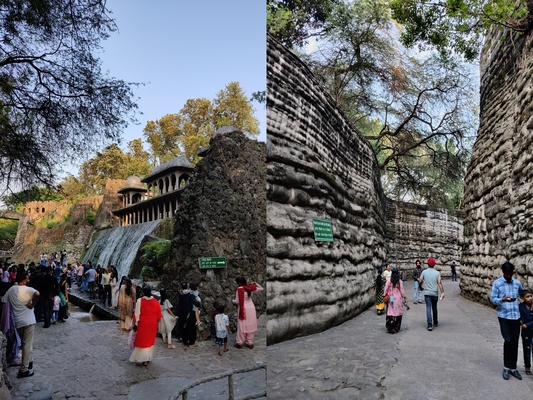
Stylized figures—of humans, peafowl, monkeys—decorated with colourful broken bangles stand in ranks. A vast and colourful mosaic covers the amphitheatre. Contorted shapes, of trees and figures, sprawl here and there.
The LO, to be honest, got a bit bored after a while. The idea of recycling is all very well, but she couldn’t, beyond a point, gush over one more figure covered with broken tiles. She was fascinated, though, by the igneous rocks that formed the canyons we had to walk through. And when we reached the amphitheatre, there was more in store for her.
‘Laughing mirrors’, for one (these are those mirrors, common enough, that distort your reflection): the LO was in splits of laughter at these. Then, there were the many swings, enough for lots of children to have their fill.
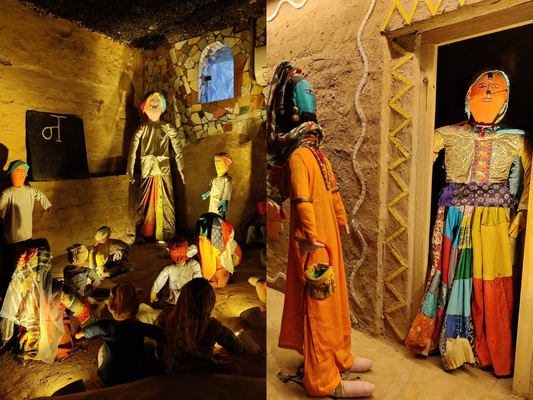
And there was an interesting Dolls Museum: large rag dolls positioned to represent life in a Punjab village. A village teacher with a class; a woman milking a buffalo; a farmer ploughing a field; a group of young people on swings—and everything, from humans to animals to objects, made of colourful stuffed rags.
A little less than a week later, on our way back home from Himachal, we again stopped at Chandigarh for the night; this time, we thought we might visit Sukhna Lake. But me, doing some research online, came upon a mention of the Japanese Garden. The LO, peering over my shoulder, saw some photos of the garden, and zeroed in on one. A bright yellow dragon that was a slide.
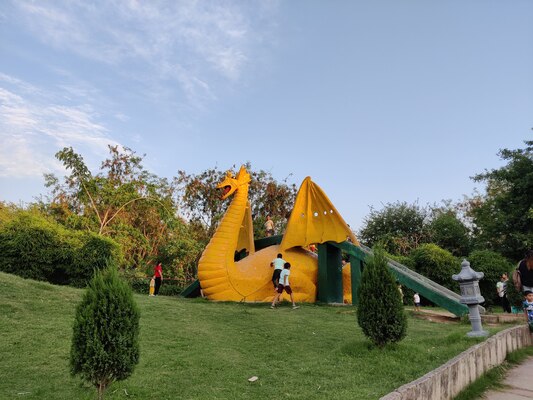
Sukhna Lake stood no chance after that. It had to be the Japanese Garden. And that dragon.
The Japanese Garden turned out to be a damp squib as far as any authentic Japanese-ness goes; it was crammed full of rather kitschy paint-and-plaster representations of not just Japanese motifs but Chinese ones too. A stocky Buddha statue. A yin-and-yang symbol. Lots of dragons. Pagodas. ‘Stone lanterns’ made of metal painted grey.
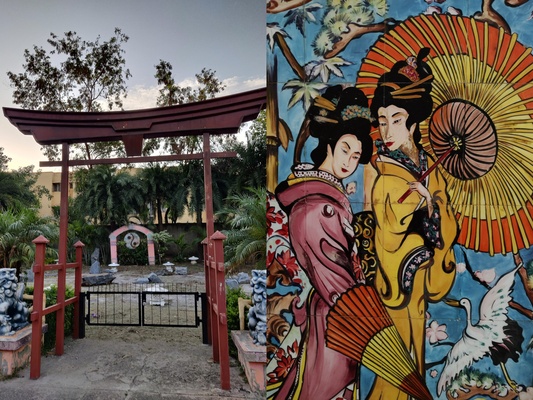
But the dragon slide was much appreciated, and the greenery of the garden was classic North Indian city park: quite nice.
So that was Chandigarh.
The next day, on our way back from Chandigarh, we decided we had to see at least some of the immensely historic sites along the Grand Trunk Road (National Highway H19 and 44, more prosaically). For one, we stopped briefly at one of the unmissable kos minars along this stretch: a short, tapering tower made of brick that was used to mark a kos (a distance of about 3.2 kilometres). This kos minar, near Karnal, was erected under the orders of Jahangir.
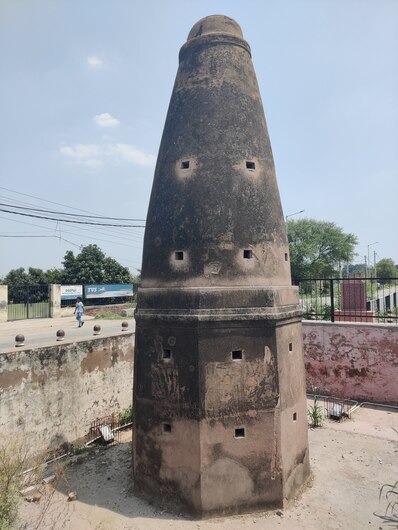
The LO was suitably impressed, especially as, just a few days earlier, she had been shown one of the kos minars in Delhi.
Further on from Karnal, we stopped at Panipat to see the Tomb of Ibrahim Lodhi. Ibrahim Lodhi was defeated by Babar at the First Battle of Panipat in April 1526, and died on the battlefield. His tomb is a simple one, a cenotaph on a brick platform. Restoration and conservation work was carried out here by the British in 1886, and I’m assuming they were the ones who also put up the plaque, inscribed on white marble, that stands beside the cenotaph.
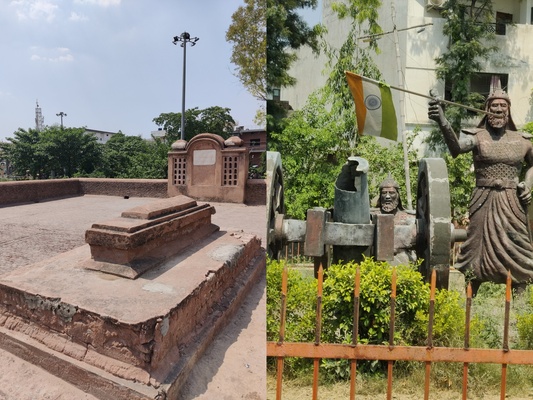
The rather tacky metal sculpture, of three figures that I suppose are meant to represent Ibrahim Lodhi and his generals in battle, is obviously much newer.
The LO did not seem to much care for this tomb. It was a hot day, and though she was kitted out in sun hat and goggles, all she wanted was to get back into the air-conditioned comfort of the car. Fortunately, there’s really not much to see at this tomb: the park in which it is set is the typical small-town North Indian park, not very attractive, with junk and piles of debris lying around here and there, even though there were some shady trees, lawns and flowerbeds.
Anyway, that was what we saw in the plains. Before that, we had been in the hills. After our first day in Chandigarh, we were headed for Shimla. We had planned to take detours for a few attractions along the way, and the first of these came up on Day 2, a few hours out of Chandigarh: the historic hill station of Dagshai.
Dagshai’s name, it is believed, is derived from ‘Daag-e-Shahi’, ‘royal brand’. The story goes that during Mughal times, prisoners would be branded, then released in the vicinity of this village, far away from civilization, so to say. Whether that’s true or not is I suppose open to conjecture, but quaint and very pretty Dagshai has another claim to fame: it houses a 19th century British Indian jail that holds the distinction of being the only prison that’s hosted both Mahatma Gandhi and Nathuram Godse.
The Dagshai Jail (and the museum attached to it) were top priority for us, even though Dagshai has several other sights, including a couple of churches and cemeteries. We had thought we’d stop by at the others, time permitting, once we’d finished seeing the jail. But then, on our way uphill, we came upon the Roman Catholic and European Cemetery, and decided we may as well have a look.
A worn old plaque on a gatepost of this hillside cemetery informed us that the cemetery was established in 1845 and had its gravestones repaired in 1893 by the 93rd Highlanders. The 11th Battalion of the Madras Regiment maintained it till 2018, but the cemetery now looks forlorn and untended, grass growing all over, many gravestones broken or toppled over.

The gate was locked, so we couldn’t go in, but we peered over the low boundary wall and had a look, while the LO admired (!) some cows wandering past.

Walking along the boundary wall, I found wild mock strawberries (thank you, Harvey, for correcting that!) at its base, and pointed them out to the LO, who went enthusiastically foraging. On a little outcrop, we also discovered some bushes (very prickly) of Himalayan golden raspberries, which were added to the stash. Bottled water was used to rinse off all the fruit before we had it. “The strawberries don’t have any flavour,” said the LO. “And the raspberries are sour.”

From the cemetery, we went on to the jail.
Dagshai Jail was built in 1845, and consisted originally of 54 cells. Some of these were turned into staff accommodation, but the others—ranged on both sides of a long, high-ceilinged hall and restored some years back—can be seen. The floors are all of teak, which (along with those sound-amplifying high ceilings) would have made it well-nigh impossible for a prisoner to have attempted an escape without being heard.
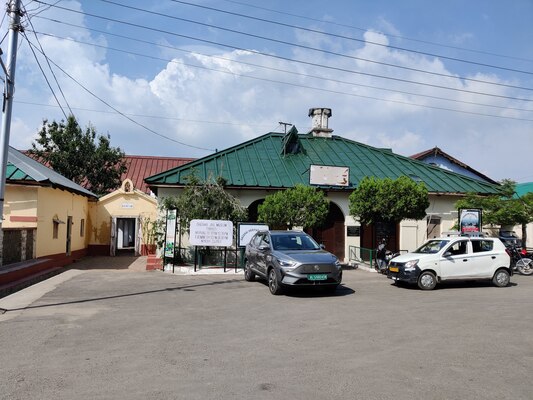
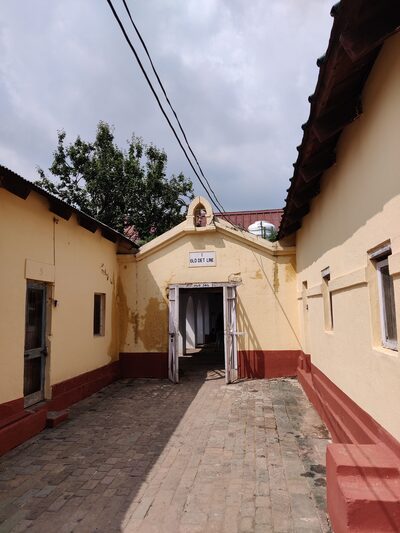
Among the cells closest to the main door is that of Nathuram Godse, who was housed here for a night when in transit to Shimla, where he was tried for the assassination of Mahatma Gandhi.
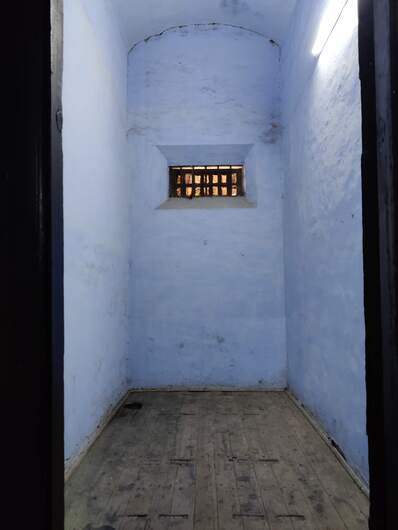
In an adjacent row of cells—these more claustrophobic, with next to no daylight, the cells for solitary confinement—Mahatma Gandhi himself had stayed for a night. This, however, was at Gandhi’s own request: when the Irish soldiers of the Connaught Rangers mutinied at Jalandhar in 1920, they were arrested and incarcerated at Dagshai. Gandhiji came to meet them and, at his request, was housed here. The cell where he stayed is a double one, two cells with a doorway in between. “And there’s a fireplace too!” the LO remarked, duly impressed.


The jail has other attractions: a tiny one-room ‘museum’; a 19th century hydrant; and a torture chamber. This was one of the solitary confinement cells, rigged out with rusted chains hanging from a rusted iron bar on the wall: the LO was thrilled. So chilling!
We spent a while exploring the grounds of the jail, which are pretty interesting in their own way: masses of hydrangeas, wandering cows, outcrops of wildflowers. A pear tree grew in one yard, and was being assailed by a small troop of monkeys. According to a sign outside, the Jail Museum (next door, also part of the building but otherwise inaccessible) would open at 4 PM, and we had timed our trip here to enable us to see that.

But 4 PM came and went. We mooched around. The LO, with unerring instinct, discovered a small children’s park slightly downhill, and utilized her time by checking out each slide, each climbing frame, everything.
Eventually, a shopkeeper at a nearby shop told us that the museum’s caretaker wouldn’t be turning up today. Another local shopkeeper said they would. We, already getting a little late, decided we couldn’t wait. We had an hour’s drive (at least) ahead of us, to Kasauli. Dagshai is small and has limited accommodation options, so we’d booked into a hotel (WelcomHeritage Glenview) in Kasauli.
We spent the night at Kasauli, and drove the next morning to Shimla, via Arki. The tiny town of Arki is home to an early 18th century fort which supposedly has some magnificent murals. I was very keen on this—history and art are two of my greatest loves—so we braved the very bumpy ride up to Arki Fort, only to discover that it was locked, closed for renovations. (I have since discovered that it is probably in the process of being converted into a hotel). Online research had informed us that the Arki Fort is home to several restaurants as well, and we had intended to have lunch here too.
With that impossible, we thought of eating in Arki town. But this area, somewhat offbeat, is not exactly teeming with attractive places to eat. We had had a heavy breakfast before setting off, so we weren’t irredeemably hungry. A banana bread I’d baked and carried came in use. We stopped the car on a shady, green stretch of road, ate banana bread, and thanked God for Himachal.
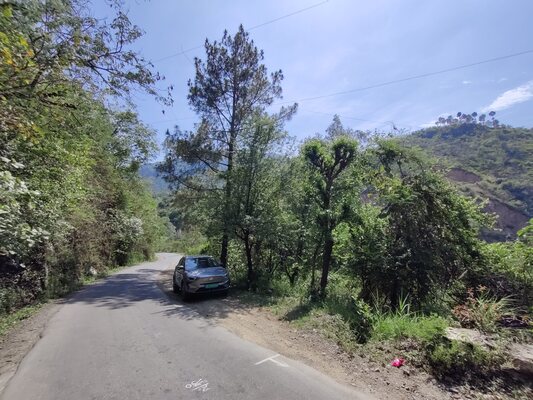
Then we continued, to Shimla.
(Watch this space for Part 2 of this travelogue).
 Dustedoff
Interesting and well written as always.
Will it be too much to expect the LO to pen a few lines of her own.
Though Loved One is facile it doesn’t quite substitute Little One.
LikeLiked by 1 person
My sister gifted the LO a travel journal last Christmas – it has a beautifully designed format, which covers a lot of the most well-known tourist destinations across the country, arranged statewise. Each section also has enough blank space for the child to write their own notes about travels to that place, and the LO complied on this trip. I will ask her if I can photograph some of what she wrote for Shimla and post it when I do the next part of the travelogue.
LikeLike
That would be nice.
Look forward to it.
LikeLiked by 1 person
Interesting! We went to Dagshai in 2017, en route to Shimla, and spent some time wandering around the jail. My friend’s husband, Anand Sethi, a retired professor whose passion is history, is the man who restored the jail and started the museum, and I would have given you my friend’s number if I had known that you were going there. The pictures in the museum are fascinating, including one of Mahatma Gandhi in the uniform of the British Army, during the War. He was part of the Medical corps.
LikeLiked by 1 person
Wow! That’s such a coincidence. I do wish we had got the chance to see the museum – it sounds so wonderful. I hope I get an opportunity sometime to revisit Dagshai and actually see the museum. Thanks for telling me, Lalitha.
LikeLike
Yayyy! Nice to end the week with one of your posts! Enjoyed it! 😊 Looking forward to Shimla..! Been a while since I was there!
LikeLiked by 1 person
I am so glad you enjoyed this. Thank you!
LikeLike
wow! u were so near to my home.
this was agood post, hope your daughter enjoyed !!
LikeLiked by 1 person
My daughter loved it, thank you! And I didn’t know you were nearby – where do you live, if you don’t mind telling me?
LikeLike
why would i mind? :)
I live in Yamuna Nagar, border region of haryana, its an hour’s journey to chandigarh. Though not that near, at the throw of a stone, stiill near!!
Actually all my vacations went uneventful. I could not go anywhere so your blogwas both delighful and sort of jeaulous,(sort of, i repeat), that ppl are enjoying vacations and see yourself, you gonna endup in these 4 walls. Lol.
well! i never knew about the girl, young sweet LO,as you call her! i’d love to meet the daughter of a film buff.
LikeLiked by 1 person
Ah, Yamunanagar :-) We passed by on our way. You’re lucky, to live so (relatively) close to the mountains. I was telling my husband we should seriously consider moving to Chandigarh so that we could explore Himachal more!
The LO, though the daughter of a film buff, hardly shares my taste in cinema. Yet! I am working on it.
LikeLike
A very good travelogue post, Madhu. Enjoyed it a lot. The photographs were lovely, and even the jail was picturesque ! Looking forward to your post on Simla , which was shown in many movies of the 1960’s. I wonder if it’s still as beautiful as it was in the sixties or if it’s become congested and crowded ? I keep going through your posts often . Just a suggestion , why don’t you do a post on the swimming pool songs of the 50’s and 60’s ? Or have you done that already ?
LikeLiked by 1 person
I am glad you enjoyed this, Pradeep. Thank you. In fact, while Shimla is very crowded (with tourists), there’s actually so much beauty around – both natural as well as built, in the form of colonial buildings, it’s worth the crowd. Also, I suppose, for us the crowd wasn’t as horrific as in Nainital last year, when we visited around the same time, in summer. Nainital was really congested and claustrophobic, Shimla was crowded but there was no maara-maari.
I have indeed done a post on swimming pool songs. Here you go:
https://madhulikaliddle.com/2018/04/04/ten-of-my-favourite-swimming-pool-songs/
LikeLike
I’m glad Simla has retained its charm. Waiting for your post on it. I’m sure the LO enjoyed her stay there. I heard there are lots of book shops there selling old and second hand books, very cheap, and plenty of children’s books too. I feel pretty sure the LO is an avid reader, like you and I were.Reading broadens one’s horizon. I’m sorry I missed the swimming pool post you did, your “Lists I made” is no longer showing. But I went to the link you sent and it is interesting.
LikeLike
Yes, we did come across a couple of those wonderful old bookshops (one, in fact, with my sister’s latest book displayed in the window), but resisted the temptation to buy more – all of us, including the LO, have a big backlog to get through!
I wonder why the ‘Lists I’ve Made’ button is not showing for you. That’s how I accessed the swimming pool songs list; it was showing fine for me. Strange are the ways of WordPress… :-(
LikeLike
Chandigarh has changed alot, back in 2017, when i was a 6Th class kid, we went to chandigarh and the rock garden wasn’t such as is evident from your pictures.
And shimla! my memories of it are very blurry and obsolete also. charm of those memeories didnt dwindle, because it wasn’t any!! I remebe my parents saying we visisted shimla in 2011, haha! 12 years sgo, i was 5 year old kid, how would i remember any thing, but i wish that i am able to go once again, i want to enjoy the place. Your visits made me dust off long abandoned memories, thankyou!
LikeLiked by 1 person
I am glad you enjoyed this! And yes, Chandigarh has changed quite a lot in these past few years. We have gone there several times over the past decade, always en route to Himachal (and once to Chandigarh itself – I had gone for a lit fest), and its progress is quite astounding. In fact, in 2008, my husband and I had visited the Rock Garden, and even from then, while it fundamentally is the same, it’s changed too.
Will post the Shimla travelogue tomorrow. Then you can see what Shimla looks like now. :-)
LikeLike
A lovely post on Chandigarh and special thanks for the wonderful pictures.
I had been to Chandigarh a few times in the last 25 years, last trip being 7 years ago.
The planned design of the city was really impressive in th first trip.
Remember going to the Rock garden, Rose Garden, Govt. Museum, Dolls Museum and also going to Pinjore Gardens.
From your writeup, it does look like lot of things have changed/progressed..
Its time to visit Rock Garden again. Will also plan to visit Dagshai, seems an interesting place.
And just to mention – Chandigarh has one of the premier medical institutes of India run by central Govt., it is considered one of the best multi-specialty referral center especially of North India – the Post-Graduate Institute of Medical Education and Research.
Look forward to the Shimla trip post.
LikeLiked by 1 person
I hadn’t known about Chandigarh having such a good medical institute. A big plus point for the city. :-)
Oddly enough (perhaps because I always tend to pass through Chandigarh in summer, en route to Himachal?) I have never been to the Rose Garden, though I have heard much praise for it. Also Sukhna Lake… must amend that sometime.
Thank you for reading and for commenting. I am glad you enjoyed this post.
LikeLike
I haven’t been to this part of the world at all. Thanks for the lovely post, photos are nice too. I think I must plan to visit some time soon.
LikeLiked by 1 person
I am so glad you enjoyed this. Thank you! And yes, do plan a visit – Himachal, especially, is very beautiful and has a very rich cultural and historic heritage.
LikeLike
What fun to read your travelogue, dear Madhu!
I enjoyed it. The Kos Minars were completely new for me.
As for the strawberries you ate. They are mock-strawberries. The botanical name is Potentilla indica.
The wirld strawberry is Fragaria vesca. The fruits of the former are roundish and mostly upright. The fruits of the wild strawberry are oval and drooping.
As you have already discovered the fruits of the Indian strawberry are watery and not sweet.
Looking forward to reading the second part.
LikeLiked by 1 person
Dear Harvey, thank you so much for reading, and for correcting that! Actually, I must admit I had my doubts; I did see some yellow flowers among these plants, and recalled that wild strawberries have white flowers. I wondered if this was some sort of subspecies or something, but didn’t realize it was completely different. The leaves too are uncannily like those of strawberries. Thank you for helping me learn something more. Will correct it in the post.
The second part has already been posted, here:
https://madhulikaliddle.com/2023/06/24/the-lo-goes-to-himachal-part-2-the-mall-in-shimla/
LikeLike
The best thing in Chandigarh is the core of Corbusier’s monuments viz High Court, State Legislative Assembly, Tower of Shadows [and couple of others]. However, exceptionally few people visit them. Govt conducts three/per day free guided tours of those complexes. One needs to go and present an ID card to see it. When I went, there were only 6 people including me [and 3 were foreigners].
Stark contrast to Sukhna Lake [which has been hyper commercialized and where boating was useless].
Rock Garden is, I think, the most visited amongst conventional monuments there. I also visited the Museum [which also houses the Architecture Museum] and another one dedicated solely to Corbusier’s works.
The Rose Garden was okayish and Air Force museum slightly over-rated [they didn’t even take cash for some reason].
One thing I disliked about Chandigarh was that it essentially lacks a native cuisine of it’s own [unlike cities like Lucknow or Delhi] and is instead filled with pizzeries and cafes. And not to mention exceptionally expensive all of them are.
The city is beautifully designed though even if not everyone followed the traffic signals when I visited.
LikeLike
I would think Punjabi cuisine might be considered representative of Chandigarh…? But then the sort of Punjabi food that is now readily available across North India (and further afield) is so standard, it’s utterly predictable. It would be interesting if chefs tried highlighting some of the lesser-known (possibly from rural Punjab?) dishes that get completely overlooked.
LikeLiked by 1 person
Chandigarh seemed to be dominated by cafes [like one Backpackers Cafe even had a waiting queue outside even though there wasn’t anything distinctly unique].
I ate inside the Airforce Museum. The owner seemed quite interested in conversation but it was still 1k for pizza + coffee.
In contrast, Old Delhi has much older shops selling at a fraction of the price. At Lucknow’s most famous eateries, one can’t spend upwards of 500 Re per person [or even half that] even if one wants to simply because rates can’t scale up that much.
Amritsar I have heard of quite much, though never visited. From their distinctive naans to Amritsari fish, I would one day wish to visit there and see/eat.
LikeLiked by 1 person
I have actually been to Amritsar and had some very nice Amritsari machhi. Here:
https://madhulikaliddle.com/2018/12/11/a-weekend-in-amritsar/
LikeLike