
September was a busy month for me. Unusually (for me) I had to travel on work; and that, not once but twice. On September 15th, I was discussing the Delhi Quartet at The Literary Table’s festival of arts and literature at Dehradun; the next weekend, on September 21st, my sister Swapna (who is a historian) and I were speaking, for the first time in a session together, at the Odisha Literary Festival in Bhubaneshwar.

And if you’re travelling all that way, whether to Dehradun (where my husband and daughter accompanied me, making it an enjoyable little road trip for us all) or to Bhubaneshwar (my first time in Odisha)—you can’t skip the sights. At least a little bit of sightseeing is in order. Also in order is the documenting of the sights we saw, and all that we wish we could have seen too.
First up, Dehradun. Bhubaneshwar will be covered in the next post.
Dehradun, given that it’s relatively close to the National Capital Region, is a town we’ve been to before, even with our daughter. The last time we visited, in 2019 (when I’d gone for another lit fest), we’d visited the Dehradun Zoo (yes, you do that when you’re with a small child) and—not quite so appealing to the child, but worth visiting anyway—the Forest Research Institute. I had been under the impression that I’d seen most of Dehradun’s sights, but in the years since, I’ve learnt of two more, which I was eager to see.
One was the Guru Ram Rai Darbar Sahib. Ram Rai was the son of Guru Har Rai, the seventh Sikh guru. As such, Ram Rai was sent by his father as an emissary to Aurangzeb; however, at the Mughal Emperor’s court, when Ram Rai was asked to quote from the Guru Granth Sahib, he chose to distort a word from the sacred texts in order not to cause offence to Aurangzeb. While this won Ram Rai personal favour with Aurangzeb, it brought down on him the wrath of his father. Guru Har Rai was so angry at what he construed a betrayal of the faith that he excommunicated Ram Rai.
Ram Rai ended up setting up a new, breakaway sect of Sikhism, and settled down with his followers in this valley. This event, actually, is what gives Dehradun its name: ‘dera’ = ‘camp’, + ‘doon’ = ‘valley’, in the local Pahadi dialect. Therefore, ‘the camp in the valley’ is what the name of the city means.
Ram Rai, encouraged by a substantial grant of funds from Aurangzeb, built a large gurudwara here, starting in 1699, though some of the buildings were completed in later years, after his death. The complex consists of five core buildings, around which, in later years, have been erected other subsidiary buildings. Heavily influenced by Mughal architecture, the core complex is all white marble, domes, scalloped arches, and a charbagh-design garden.
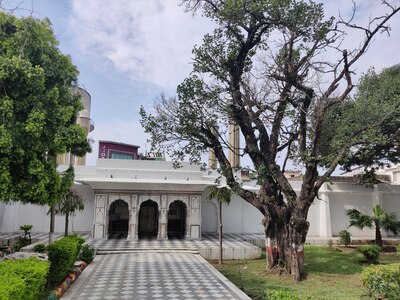
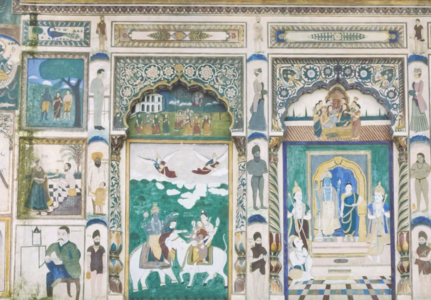
What sets Guru Ram Rai Darbar Sahib apart are the absolutely stunning murals—some 500 of them—that cover pretty much every inch of wall. There are scenes from the lives of Sikh gurus; there are Radha and Krishna, flowers galore, and much, much more.
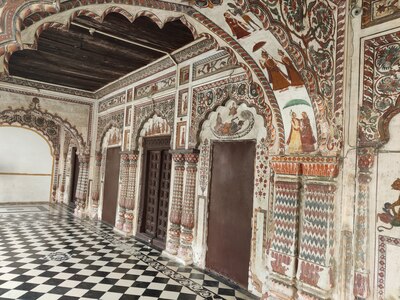
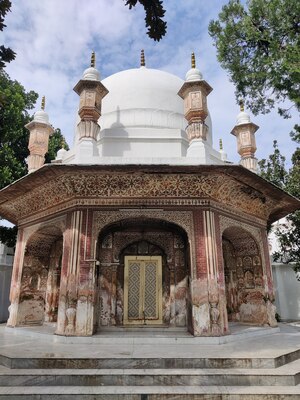

The murals at Ram Rai Darbar Sahib were (like the buildings) also created over a period of time, and therefore show a transition in artistic styles and influences. At the main gate, for instance, the façade is decorated with panels of intricately painted figures—including Europeans.

Paltan Bazaar, where the gurudwara is situated, is a beehive of activity, but the gurudwara is in sharp contrast: tranquil, cool, peaceful.
Also peaceful, though in a markedly different way, is the other sight we visited in Dehradun: the Mindrolling Tibetan Monastery in Clement Town. Clement Town, if you’re at all familiar with the area, is a suburb of Dehradun, a very far cry from the busy roads and commercial hum of the city. It’s green, with the Shivaliks looming beyond, and at this time—the monsoon still not quite gone—there were lots of butterflies and birds around, blue skies above.
Named for the original Mindrolling monastery (in Tibet), this one was established in 1965 by Buddhist monks fleeing Tibet. Over the years, it has grown into one of the foremost colleges for the study of Tibetan Buddhist theology. For tourists like us, however, the main reason to visit is the beauty of the area, which is set off by some spectacular structures.
For one, there is a giant statue of the Buddha, all gilded and serene, that stands at one end of a large garden. The garden is ringed by stone-paved pathways on one side of which hang rows of prayer wheels. You walk along the path, going clockwise around the Buddha and twirling the prayer wheels (also clockwise)—an action that is supposed to send prayers floating up from the rotating prayer wheels.
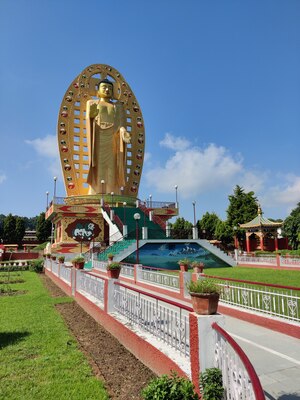
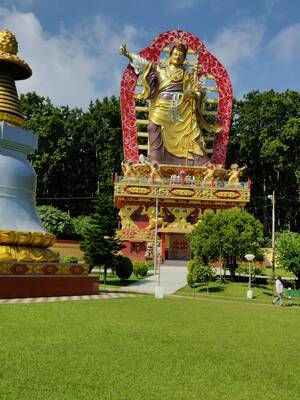
Adjacent to this garden, in a separate enclosure, is the other massive structure of Mindrolling: a giant stupa. This isn’t even the only structure here that is awe-inspiring: there is also a giant statue, all gilded and painted, of the Tantric Buddhist guru, Guru Padmasambhava:
There are other (smaller) stupas too, depicting the eight styles of stupa architecture: details about these (though, I will admit, somewhat esoteric and hard to understand) are to be found at the entrance to the complex.

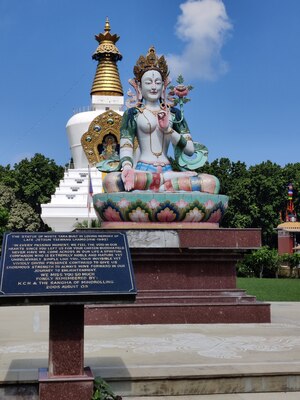
There are huge prayer wheels housed in pavilions, and there’s a Rolls Royce that was gifted to the Dalai Lama and used by him for several years. We didn’t have the time to visit the chambers underneath the main stupa, but we did pause briefly near the entrance, where a lovely statue of a white Tara commemorates the memory of a deceased member of the Buddhist community here.
That, therefore, was Dehradun. Very rushed, of course, but then, this was really a business trip for me, not a leisure one. So whatever I could see was a bonus. And the Ram Rai Darbar Sahib was especially exquisite.
Bhubaneshwar follows, in the next post. Watch this space.
 Dustedoff
I enjoy reading your travel posts. Looking forward to the
Bhubhaneshwar post.
Since Delhi Quartet was mentioned, let me add: I’m reading the books
in jumbled order I read Unholy Drought early Sep, really enjoyed
it. Now I am reading The Garden of Heaven, and enjoying it even
more. (Maybe 3 and 4 will be next out of step too, for me.) I love the
historical fiction genre, and you have done a wonderful job making the
characters come alive. Your social commentary is also very
insightful. Thanks for all the writing!
LikeLiked by 1 person
Meena, you have made my day. Not just because you read and commented on this post, but more because of your kind words regarding my books. You have no idea how happy this makes me! Thank you so very, very much.
LikeLike
Madhuji,
Incidentally, I have seen both the places you mention. I saw Dehradun way back in 2003, when it was less concretised. I remember going to Guru Ram Rai Durbar. The architecture of FRI is also impressive. But yes when work and pleasure are coupled, it becomes difficult to do justice to both in equal measure.
LikeLike
Yes, indeed the architecture of FRI is impressive. Plus, of course, all the fabulous trees you can see across the campus! I am fascinated by trees, and this was a treasure trove for me. Personally, I found the museums at FRI a little underwhelming – perhaps most of them were a little too technical for the average visitor. There’s only so many moth-eaten specimens of tree parasites and insects and fungi that you can view. But one particular exhibit really impressed me: a cross-section of a massive old deodar trunk on which they had mapped a timeline of India’s history. Just remembering that gives me gooseflesh.
LikeLiked by 1 person
hiya! I’m very envious, Dehradun and Bhubaneswar in a week! Haven’t been to either.
are there any videos of your literary sessions in each place?
LikeLike
Bhubaneshwar was a first-time experience for me too, and I loved it. It’s very green, and (possibly because it’s a planned city?) with good wide roads, and none of the clutter one often sees in so many Indian towns.
I don’t think the people at Dehradun recorded our session, but the one at Bhubaneshwar, featuring my sister Swapna and I, is here:
LikeLike
Thanks!
LikeLiked by 1 person
Madhulika, Thank you for sharing one of the places in Dehradoon that I missed; I was not aware of it until I read this blog of yours. I have been to Dehradoon twice. Last time was in Nove 2017. If I’m not wrong this was the first time that lit fest was being organized or may be second year and also where bloggers meet ws organized, which I attended. I had no clue about this beautiful Gurudwara. I did visit both FRI and monastery. Next time I will visit this Gurudwara which is historic. Thanks for sharing this, Madhulika.
LikeLike
Yes, 2024 was the first year this particular lit fest was organized. It was held again last year, and I went again to Dehradun – and again to Guru Ram Rai Darbar Sahib. This time I managed to get more time there, and was able to explore it more at leisure. It’s really beautiful.
LikeLiked by 1 person
I will surely visit next time I’m in Doon!
LikeLiked by 1 person