
(This is part 2 of a two-part travelogue. Click here to read part 1, which covers the Ajanta and Ellora Caves, Daulatabad Fort, and Khuldabad).
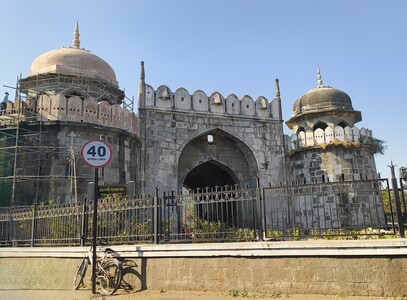
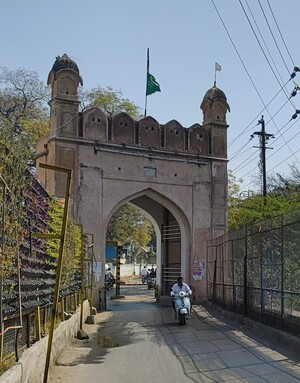
Most people tend to think of Aurangabad only as a base for exploring the two famous UNESCO World Heritage Sites in its vicinity. But Aurangabad (now renamed Chhatrapati Sambhaji Nagar, if I have to be accurate) is a historic city, and has several sites worth visiting. While I’ll get to those from the next paragraph onwards, I want to mention how intrigued I was by the many historic gates that dot the city. Aurangabad originally had 52 gates, of which I was told that some 15-odd gates still exist. I am familiar with gates of this type (Shahjahanabad, or Old Delhi, was similarly designed with a wall surrounding it, and gates like Delhi Gate, Kashmiri Gate, Ajmeri Gate and Turkman Gate still stand).
But Delhi’s gates are nothing compared to Aurangabad’s. So many gates. Whenever we drove anywhere (mostly by Uber auto, within the city: we found those the most reliable), we’d end up passing at least a couple of gates. Delhi Gate, Barapullah Gate, Bhadkal Gate, Mahmud Gate… no wonder Aurangabad is known as the City of Gates. The largest and oldest of the gates is Bhadkal Gate, built by Malik Ambar to mark his victory over the Mughals in 1612.
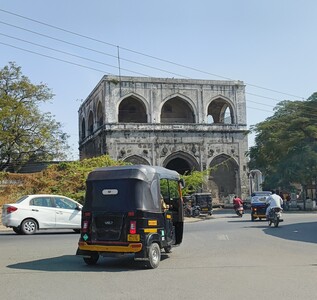
Most of the other gates, from what I could gather, were built during the reign of Aurangzeb, when he fortified the city and built a wall around it.
Aurangzeb also contributed to the city’s architectural landscape by giving it one of the most interesting Mughal tombs of later years, the Bibi ka Maqbara. This is the tomb of his wife, Dilras Banu Begum, aka Rabia-ul-Durrani, a mausoleum (tellingly) known as ‘The Taj Mahal of the Deccan’. It is located on the outskirts of the city, with the hills rising beyond and the tomb set amidst gardens.
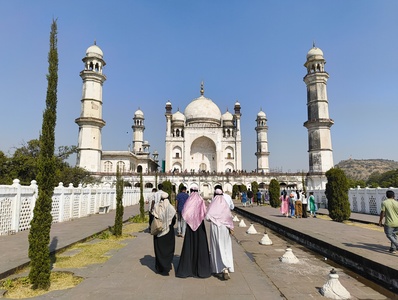
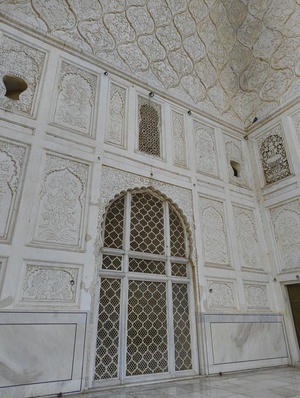
At first glance, you can see the resemblance to the Taj Mahal (even though the proportions are wonky: the building looks as if it’s been squeezed). The same white façade, the same careful carving, the same intricate jaalis or stone filigree. It’s when you get close that you realize that this isn’t white marble, it’s all white plaster. Rabia-ul-Durrani died in 1657, the year before Aurangzeb ascended the throne; he simply couldn’t afford an ostentatious building.
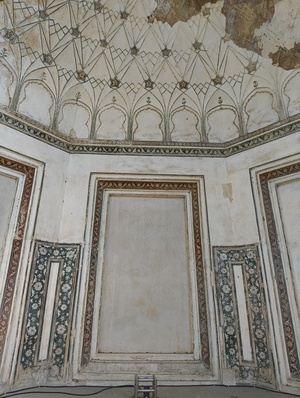
Despite that, it’s actually quite beautiful, and it’s amazing to see how skilled Indian craftsmen were at recreating stone carving in plaster.
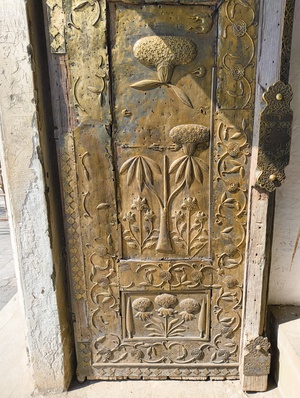
Oddly enough, my favourite part of the building wasn’t the plasterwork, but a beautiful door with panels made of beaten brass: exquisite.
At the Taj Mahal, if you enter the mausoleum, you can see the cenotaphs of Mumtaz Mahal and Shahjahan at ground level. These are the false cenotaphs: they don’t actually mark the graves of these people. The crypt underneath (now off-limits to ordinary visitors) is where their real cenotaphs are situated, with the bodies of course having been buried beneath those.
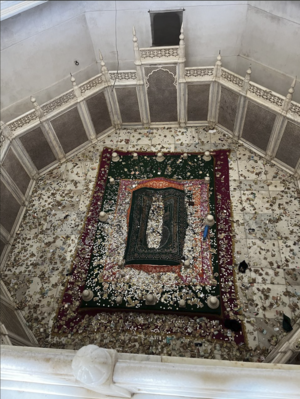
In Bibi ka Maqbara, the design and placement of the cenotaph dispenses with one level. At ground level, you enter the mausoleum, and you’re basically coming into a balcony that rings a sort of well in the centre of the chamber. The well houses the cenotaph, marking the spot where Rabia-ul-Durrani is buried. There were thousands of coins and currency notes here, scattered by devout (or wish-seeking?) tourists. The LO, peering over the railing, also counted five pairs (at least) of sun glasses, and a bright blue plastic toy gun.
Fairly close to Bibi ka Maqbara but nowhere as popular are the Aurangabad Caves. These pale into insignificance when compared to Ajanta and Ellora, but are actually quite beautiful. Like their better-known counterparts, these caves too are spread across hillsides, a path leading to one set of caves on the right while another path leads to caves on the left (each set of caves has its own ticket counter at the beginning, so if you want, you can visit only one set of caves and leave it at that).
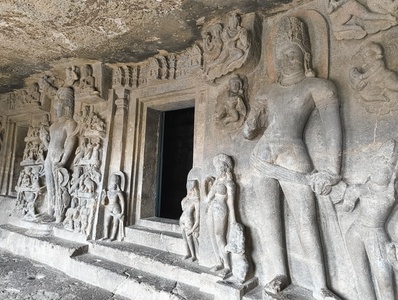
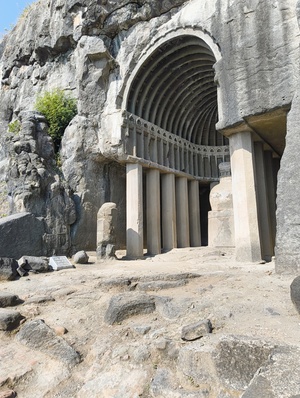
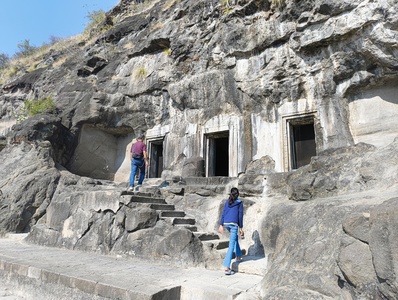
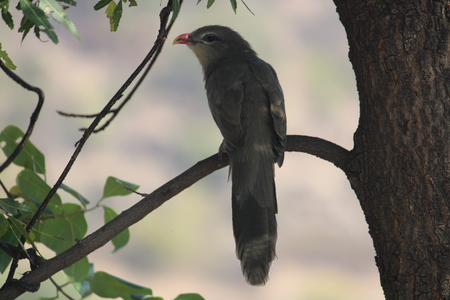
We however visited all the caves, and enjoyed them a lot. Also, given that there were very few people around, and lots of birds (and not just parakeets, either: we saw a beautiful sirkeer malkoha, for instance)… we liked this a good deal.
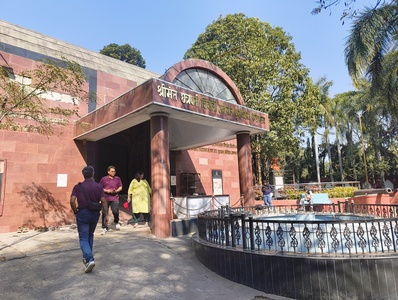
Somewhat less inspiring were the other places in town. One was the Chhatrapati Shivaji Maharaj Museum, of which the less said, the better. A state museum in a city which boasts of such a rich and vibrant history ought to have been much better-planned, better-curated, and better-maintained. This one was so bad, it was embarrassing.
Slightly better was the Panchakki, a 300-year-old water wheel installed by a Sufi saint named Baba Shah ‘Musafir’. Baba Shah migrated to Aurangabad from his native town of Gazdavan (near present-day Bukhara, in Uzbekistan) and set up his hermitage here. Later, after his death, he was buried here as well, and his dargah is situated in the same complex as this water wheel installed in 1744. Baba Shah took this initiative to provide for the poor: the force of the water would power a mill to grind grain to feed those in need.
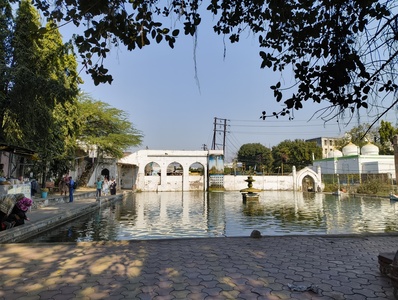
The water for the Panchakki was drawn from the nearby hills, channelled through earthen pipes which, propelled by the slope, burst onto a turbine and kept it turning. This continues to this day, with the turbine turning in a ‘window’ beneath, and powering a grinding stone just above. No grain is ground here now, it’s just for show.
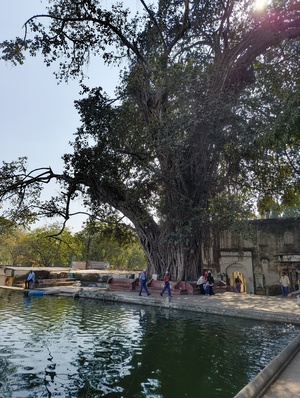
We admired an impressive 600-year-old banyan tree beside the large water tank here, had a peek at Musafir’s tomb, and were taken around by a ‘guide’ who probably thanked his lucky stars he had found tourists so gullible they got taken in by his spiel! (Incidentally, both within Aurangabad and on our excursions outside the city, Panchakki was the only place where we were able to get a guide. None were available at Ajanta, Ellora, or Aurangabad Caves).
I had wanted to see the Sunheri Mahal, which, from what I could gather, is a 17th century palace that now houses a museum; this, however, was closed for renovations, so we couldn’t visit. Another 17th-18th century historical space, though, was close to our hotel, so we went here, eager to explore: Himayat Bagh Biodiversity Heritage Site. This is home to the Fruit Research Station and Nursery, which is apt, given that Mughal gardens typically were full of fruit trees.
I had expected (given the photos displayed on the official website) something at least slightly like one of the more famous Mughal gardens. If not those at Srinagar, perhaps something like Pinjore? Our first blow struck when the Uber auto-wallah seemed to have no clue where Himayat Bagh was. Then, when he figured it out, he took us down a very pot-holed dirt road, to a broken-down door set into an arched gateway, where we entered.
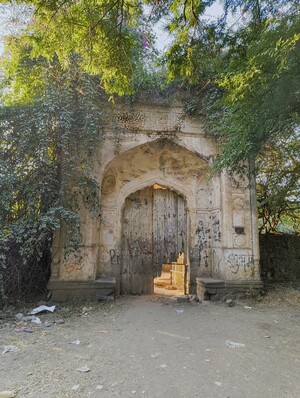
Frankly, I was disappointed with the (very few) historical structures that still remain within the area. They’re mostly in ruins, and there are no signs whatsoever: not to explain which structures are what, or which path leads where. My husband tried to check on Google Maps, but even this proved fruitless.
… but the nature lover in me rejoiced. Himayat Bagh is huge, and it is full of grand old trees. They soar up into the sky, their canopies spreading majestically. We saw birds, we passed a grave (obviously much revered), we walked on till the periphery, which abutted a row of small huts whose resident kids were very eager to make conversation and to find out the LO’s name.
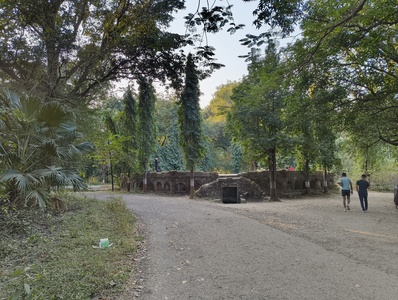
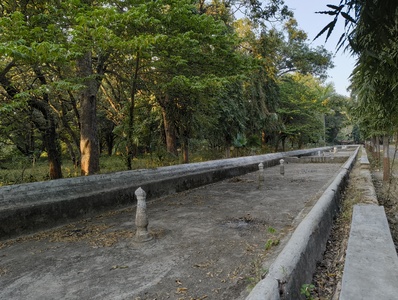
Himayat Bagh turned out to be a dud for the heritage lover in me, but it thrilled the nature-lover in me.
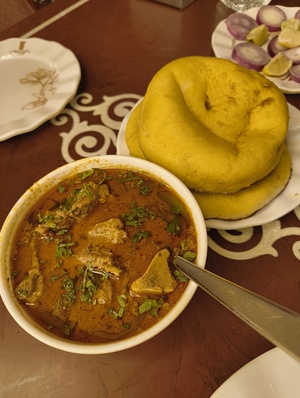
And, of course: I cannot not write about the food we discovered. I had not realized that Aurangabad had a rich culinary heritage, but we got to savour some delicious food, a lot of it pretty meaty. Aurangabad is known for its naan-khaliya (or qaliya), which we enjoyed at Great Sagar Restaurant, which also had an excellent mutton dum biryani.
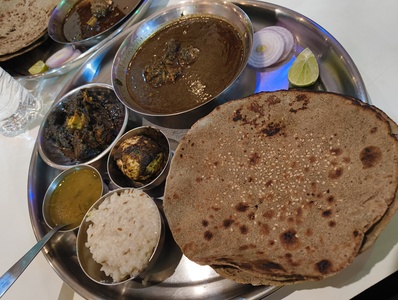
At Mannu Fish Restaurant, the prawn koliwada, fish curry, and prawn biryani were all uniformly excellent, and at the Best Hotel Saavji Kitchen, we discovered Saavji cuisine, which I’d never even heard of before. The Saavji community inhabits the areas where Maharashtra shares borders with Karnataka, Telangana and Andhra Pradesh, and their food is considered one of the spiciest in India. Typically, Saavji curries are made with a blend of 32 (yes, thirty-two) spices, and with linseed oil added. The food was super-spicy, but also super-delicious. I was worried that the LO, not a lover of spicy food, would baulk at eating it, but she managed. And admitted that she enjoyed it.
(If you would like a more detailed look at the food, check out this post I wrote on Substack, which is all about the food we had in Aurangabad).
So that was Aurangabad. It was hectic, it was tiring: but it was also very memorable, in a good way.
 Dustedoff
My first thought was not about your writing but, “Gosh, LO is growing so tall!” :)
My second was bitter disappointment that even heritage sites don’t seem to be maintained at all, forget ‘maintained well’!
And the third thought was you write so well about these places that I want to trace your footsteps at once! (Instead, I’m shivering in temperatures that are -17 to -25 degrees Celsius!)
LikeLiked by 1 person
Anu, you are very kind! Thank you so much. :-)
And yes, it’s such a shame that a country that (paradoxically?) seems to be on this ‘our glorious ancient heritage’ band-baaja does zero to actually preserve that ancient heritage.
The LO, by the way, is nearly up to my shoulder now. If only she would begin to behave that big too…!
LikeLike
Thanks for the travelogue, dear Madhu.
I had never before heard of the Aurangabad caves. Of course there are so many caves in Maharashtra to be seen. I was glad about your visit to Bibi ka Maqbara, since we chatted about it on your post on songs at Mughal sites. And yes, I think I was as fascinated by the brass door as you. I enlarged it and looked at it from various angles. It has such an intricate design with flowers on it. I was particularly fascinated by the tree depicted and was wondering what it could be. Sadly much of it is lost, but I presume the side branch on the right side is repeated in the middle (more prominently) and on the right side. Even the creepers on the side are lovely. Pretty and fascinating at the same time.
The homepage of Hinayat Bagh does raise one’s hopes of seeing a well-laid Mughal garden, but was glad that nature compensated for the false promises.
LikeLiked by 1 person
I am glad you liked this, Harvey. Himayat Bagh looked so promising on the webpage, but sadly… however, the trees were a joy to behold. Look at this gorgeous tamarind, for instance. The wall over which it’s draped is about five feet high, so you can imagine the size of the tree. So beautiful, I think I took about half a dozen photos of it before my family prevailed upon me to move on!
Also, yes: I too was wondering what tree that was supposed to be, in beaten brass. The bunches of flowers look somewhat like sita ashoka (Saraca asoca) and I think the leaves below would be stylized representations of the leaves of the same tree. The creeper looks more like a made-up one (the Mughals were fond of combining realistic representations with imagined ones), but the plants below the tree look very like irises.
LikeLike
I was curious to know what you think the flowers are. Irises were quite common in Mughal architecture and they depicted them perfectly. That is why I don’t think they are irises. They remind me more of marigolds from there structure. But they also can be borrowed motifs, which have then been integrated and modified. Here they look more like gigantic, globular cock-combs. They also remind me of thistle inflorescences. Thistles are common in arid regions.
LikeLiked by 1 person
I don’t know what I was thinking or reading. Yes, the flowers of the plants below the tree look like irises, though the leaves do not at all. But it is quite probable that the local artisans either had never seen an iris plant or were just shown the flower patterns or both. They look beautiful nevertheless.
LikeLiked by 1 person
No worries, Harvey! Hota hai. :-)
Yes, you’re right, the leaves aren’t those of irises at all. Also, I think the flowers on the creeper do look a lot like marigolds. Again, of course, there’s artistic liberty at play here, since marigolds of course aren’t creepers, nor do they have leaves like that… but whatever it is, it’s beautiful.
LikeLike
Enjoyed both the parts. It has been more than a decade since I visited Chatrapati Sambhajinagar. But I distinctly remember the Ajanta caves. The painting are beautiful. We were told that the restoration of the painting was to be started soon. Did the guides mention anything about it? We were shown a small part of one of the painting where the restoration was done and the colours and brightness were restored.
And obviously I liked the Kailash temple, the monolithic wonder of Ellora.
I wish if I could have come there too, so as to meet my guru. So far I feel like eklavya, who has never met his mentor. But I’m sure someday I will meet you.
Anup
:-)
LikeLiked by 1 person
Thank you for reading, Anupji! I am so glad you enjoyed these travelogues.
Unfortunately, we weren’t able to find any guides, either in Ajanta or Ellora (or for that matter anywhere! – The only rather informal guide was at Panchakki, where we realized there was actually no need for a guide). But to be honest I couldn’t tell whether any paintings had been restored. Might have been. I do hope they do some of that – it would be lovely.
Someday, hopefully, we will get to meet. I had presumed you lived in Aurangabad; where do you actually live? (If I may ask; don’t answer if you’d rather not :-))
LikeLike
oh!
No guides at all. I dont know if it’s a bliss or deficit. When I went they were so many, almost annoying. And we can’t guess who’s actually knowledgeable.
I should revisit to see if any restoration work has been done or not.
I have sent a mail to you about my city.
:-)
LikeLiked by 1 person
Yes, that doubt about whether a guide is genuine or not always remains in most Indian sites… the sad part is, too many guides also feel that they have to cater to visitors who expect sensational ‘facts’ about sites. The tall tales we have heard in various places, uff!
LikeLike