A Short Story Published

There was a young man down in the street, labouring away at the kebab stall. From two storeys up, I couldn’t see his face; just his back and arms as he went about his work. He had kneaded the keema and I had watched his shoulders moving, wide and muscular, as he worked the meat. His muslin kurta stretched across a broad back as he chopped onions and mint, pounded masalas, reached out to pour oil into the heavy iron kadhai, and pumped the kerosene stove, arms moving rhythmically back and forth, back and forth.

I drew back, breathing deeply of kebabs and kerosene, roses and sweat. A glorious bit of maleness there. Glorious from a distance of twenty feet, in the gathering gloom of a Ramzan twilight. At close quarters, the attraction would probably fade into nothingness. He probably sniveled. Or had a harelip. Or wasn’t interested in girls anyway.

I opened my eyes and looked up at the clock above my bed. It had once been Ammi’s clock, Ammi’s room. I remembered her standing there, just as I was now, waiting for seven o’clock. Always seven. ‘Ameena, don’t step out of this room when they come. Do you hear me?’ Her voice cracking with stress, her eyes grey like mine, scared and bitter.

Yes, Ammi. I hear you.

I hadn’t gone out of the room; they’d come in when Ammi died. But they rarely came in now, because there was no need. Well trained, that’s what I am, like one of those dancing monkeys I had once seen. The monkey-man, his face pinched and hungry, would jerk the string, flinging it up, and the monkey, perfectly trained, would pirouette in unison…

Those are the opening sentences of my latest short story to be published. One Night’s Work is, as the title suggests, about a night’s work—in a setting both modern and historical: the heart of contemporary Shahjahanabad, the busy, sometimes-sleazy, sometimes-charming (often both at the same time) area that most Dilliwallahs refer to as ‘Old Delhi’. Here, while the faithful get ready for an iftaar during Ramzan, as the markets bustle and heave with excitement, an orphaned girl, trapped in a job she hates, is escorted out on yet another assignment.

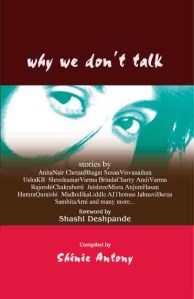
One Night’s Work has been published by Rupa Publications as part of an anthology titled Why We Don’t Talk. Compiled and edited by Shinie Antony, this is a collection of short stories set in contemporary urban India; stories by writers such as Anjum Hasan, Amit Varma, Jahnavi Barua, Rajorshi Chakraborty and Chetan Bhagat, among others. The book was released in Delhi in August, and costs Rs 295. You can ask for it in major bookstores, or buy it online at the Rupa website and at Rediff Shopping (yes, Rediff have got the details mixed up a bit, but the book’s the right one).

Update, two days later: The Times of India has published a brief review of Why We Don’t Talk: A ‘short and sweet’ collection of 27 stories, some by well-known Indian writers. This volume is like a breath of fresh air – poignant, serious, funny, bitter-sweet and quirky. Amit Varma’s ‘Urban Planning’ is a hilarious account of how politicians, media and the police are foxed by the mysterious movement of landmark buildings in Mumbai. Anita Nair’s ‘Trespass’ tells the story of a chance meeting between two women, one of whom is the mistress of the other’s husband. Samhita Arni’s ‘My Great-Grandaunt’ is one of the best of the lot. A great collection with a brilliant mix of stories.
A ‘short and sweet’ collection of 27 stories, some by well-known Indian writers. This volume is like a breath of fresh air – poignant, serious, funny, bitter-sweet and quirky. Amit Varma’s ‘Urban Planning’ is a hilarious account of how politicians, media and the police are foxed by the mysterious movement of landmark buildings in Mumbai. Anita Nair’s ‘Trespass’ tells the story of a chance meeting between two women, one of whom is the mistress of the other’s husband. Samhita Arni’s ‘My Great-Grandaunt’ is one of the best of the lot. A great collection with a brilliant mix of stories.

TEC: Going Places… hopefully!

A few quick updates for those who liked The Englishman’s Cameo (and for those who didn’t: Haaah!). But seriously, these are all very encouraging bits of news for a newbie author writing in a genre that the literati seems to generally frown upon.

First of all, The Englishman’s Cameo (or, as Hachette and I refer to it, TEC) has been long-listed for the Vodafone Crossword Book Award in the Fiction Category. All right, nomination and long-listing seems to be synonymous this year, but still. The competition’s very stiff; there are 72 other books in the running, with entries from both stalwarts as well as new authors. TEC needs all the luck and good wishes it can get (not to mention votes).

Secondly, a bit of good news for those who live in the UK and have been waiting to lay their hands on the book: Little, Brown will release TEC in UK stores in October 2010. The book’s already been featured on the UK-based book site Curious Book Fans and by the time the book’s on the shelves in the UK, you can hope for more: a review, an interview, etc.

Lastly, something that’s really not that much in the way of literary recognition, but hey, so what. The Indian National Parliament Library purchased The Englishman’s Cameo in February 2010. And Arti Jain of Friends of Books assures me that ‘they’re very discerning’. So I take that as a pat on the back!

Upcoming Event: Books, Travel, Reading

For everybody who lives in Delhi and is fond of books, here’s an opportunity to indulge… on Sunday, March 28, 2010, Friends of Books is organising an event that promises to be enjoyable (and I’m not saying that simply because I happen to be one of the authors who’ll be reading at the event)!

In the words of Arti Jain, of Friends of Books:

Programme:

Ongoing : Book Swap (6:00-8:15 P.M).

6:00-6:30 Madhulika Liddle reads from her travel writing and novel followed by Q&A

6:30-:7:00 Puneetinder Kaur Sidhu reads from Adrift followed by Q & A

7:00- 7:30 Mridula Koshy reads from her forthcoming novel set in Kerala and in the US Midwest.

7:30-8:15 Open Mic

Entry Fee : Free!

The authors featuring at the event are women who at some point chose to take a slightly different path, as authors and as people.

Puneetinder Kaur Sidhu cut loose from the pressures to conform and decided to travel through Europe-alone and for the cost of a dozen beers. Madhulika Liddle, a one time corporate employee left it all behind to wear many hats. A blogger and an author, Madhulika Liddle writes both about her journeys to far off places and about an excursion back into history with her evocative thriller set in Mughal era Delhi. She also takes a jaunt down cinema’s memory lane with her popular blog https://dustedoff.wordpress.com. Mridula Koshy has been a cashier at a Kentucky Fried Chicken, swap-meet sales clerk, backstage dresser at fashion shows, waitress, polisher of silverware, writing adviser, a professional advocate of multiculturalism, a house painter, receptionist at a law firm, collator of tax forms, union organizer and community organizer. She has also made life-altering journeys between two continents and woven her experiences into stories.

At the ‘Open Mic’ session, share your own stories about places far and close or read from your favorite travelogue or memoir, take us to another era- past or future. Take us on a journey.

Join us for the Book Swap where you get to take back as many books as you bring to the table. Sharing is caring! (Note that any books you bring must be in good condition).

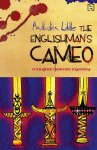
The Englishman’s Cameo

My first novel, The Englishman’s Cameo, published by Hachette India, is a detective story set in 17th century Delhi. — “Muzaffar Jang is that rare creature in Mughal Emperor Shahjahan’s Dilli – an aristocrat with friends in low places. One of whom, Faisal, stands accused of murder. When the body of Mirza Murad Begh is found stabbed in the chest, lying in a water channel in the Qila, poor Faisal is the only one around. But what of the fact that, right before his demise, the victim had stepped out of the haveli of Shahjahanabad’s most ravishing courtesan? Could not the sultry Mehtab Banu, and her pale, delicate sister Gulnar have something to do with the murder? Determined to save his friend, Muzaffar decides to investigate, with only a cup now and then of that new-fangled brew – Allah, so bitter – called coffee to help him…” Continue reading