
(This is part 2 of a two-part travelogue. Click here to read part 1, which covers the Ajanta and Ellora Caves, Daulatabad Fort, and Khuldabad).
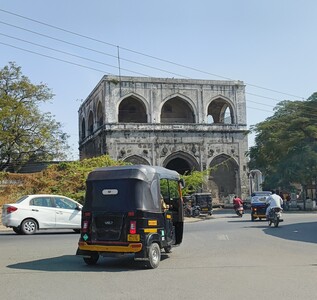
Most people tend to think of Aurangabad only as a base for exploring the two famous UNESCO World Heritage Sites in its vicinity. But Aurangabad (now renamed Chhatrapati Sambhaji Nagar, if I have to be accurate) is a historic city, and has several sites worth visiting. While I’ll get to those from the next paragraph onwards, I want to mention how intrigued I was by the many historic gates that dot the city. Aurangabad originally had 52 gates, of which I was told that some 15-odd gates still exist. I am familiar with gates of this type (Shahjahanabad, or Old Delhi, was similarly designed with a wall surrounding it, and gates like Delhi Gate, Kashmiri Gate, Ajmeri Gate and Turkman Gate still stand).
But Delhi’s gates are nothing compared to Aurangabad’s. So many gates. Whenever we drove anywhere (mostly by Uber auto, within the city: we found those the most reliable), we’d end up passing at least a couple of gates. Delhi Gate, Barapullah Gate, Bhadkal Gate, Mahmud Gate… no wonder Aurangabad is known as the City of Gates. The largest and oldest of the gates is Bhadkal Gate, built by Malik Ambar to mark his victory over the Mughals in 1612.
 Dustedoff