
(This is the third and final part of a three-part Rajasthan travelogue. The first post, about our trip to Sariska National Park, can be read here, and the second part, about four forts—Bhangarh (on the border of Sariska) and Jaigarh, Nahargarh and Amber, in Jaipur—is here).
The forts of Jaipur take up a major chunk of sightseeing time, not only because they sprawl, but because of the time involved in getting to them, and then (if you, like us, happen to be visiting in peak season) fighting the crowds at each fort.
While we admired the forts of Jaipur, it was, frankly, also with a certain amount of relief that we looked forward to seeing some of Jaipur’s less touristy spots.
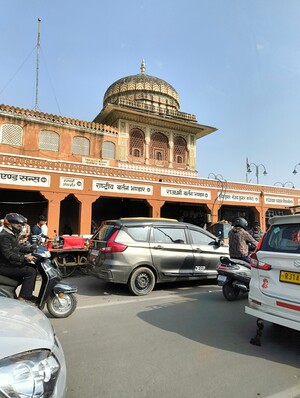
In 1876, the Prince of Wales (later King Edward VII) visited Jaipur as part of a tour of India. In honour of him, the maharaja, Sawai Ram Singh II, had the city painted a deep salmon pink. The ‘pink city’, as Jaipur came to be known after that, is still the core part of Jaipur. Driving along these roads—the shops with uniform black-and-white signboards and matching façades, the occasional temple or gate or other interesting old building still fitting in perfectly with the look—was great fun, and since many of the shop signs are in Devnagari (and the LO loves reading signs), she got to practise her Hindi.
 Dustedoff