
Happy Diwali!
With Diwali around the corner, it seemed appropriate to post a little ‘did you know’ about the festival, since the Mughals celebrated this festival with a good deal of enthusiasm.
That might surprise those who associate the Mughal emperors with being staunch Muslims, but it’s worth remembering that what with the number of marital alliances made with the families of Hindu rulers—especially the Rajputs—over the years, many of the Mughal queens and secondary wives were Hindus. They would bring their own religious festivals and traditions into the mahal sara (the women’s quarters), and, by extension, into the Emperor’s life. In addition, a large number of the people who served the Emperor—as soldiers, servants, slaves, and so on—were Hindu. Celebrating a festival important to them, and participating in it, was a way of exhibiting benevolence and thus encouraging loyalty.

The Mughal Emperor Muhammad Shah (1702-48 CE) watches a display of fireworks.
The result was that while festivals such as Eid and Nauroz were celebrated with great joy, Holi, Dussehra and Diwali were not ignored either. Dussehra, for instance, besides the usual festivities, had militaristic connotations in the Mughal court. The horses from the imperial stables used to be ceremonially paraded before the Emperor, and a hawk used to be placed on the Emperor’s wrist.
But it was Diwali for which some of the most vibrant festivities were reserved. Water used to be brought from seven wells for the Emperor to bathe in (a ritual that also marked Holi). Diyas, chiraghdaans (lamp stands), jhaads (hanging chandeliers) and faanooses (pedestal chandeliers, atop a stand) were used to specially illuminate the palace. Trays of sweets used to be sent from the Emperor to the salatin (the Emperor’s many relatives, including some fairly distant ones) who lived within the fort.
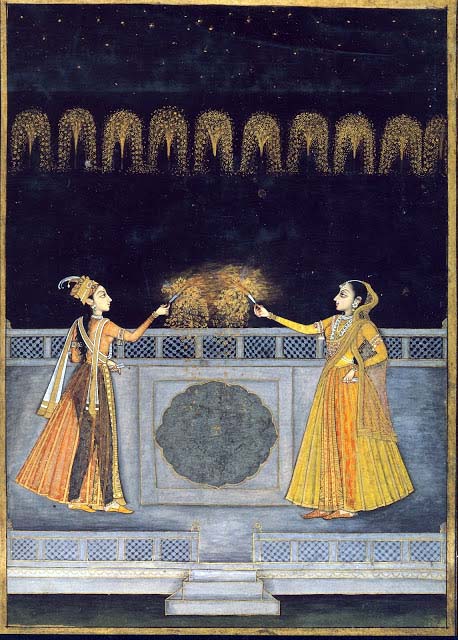
In this painting (circa 1740), two Mughal ladies celebrate with sparklers.
Among the more unusual traditions associated with Diwali was the ritual sacrifice of buffalos. 19th century accounts of Diwali festivities at the Red Fort mention that a buffalo used to be killed at each of the fort’s gates. Meat, along with bowls of sherbet and wine, used to be placed at the bulging bastions dotting the fort walls.
Less bloody and more fun-filled were traditions such as the closing of the mahal sara doors to all men for three days. There was, of course, as today, much feasting and a lot of fireworks to mark the occasion. And, for the Hindu ladies within the mahal sara, pujas to mark the occasion.
 Dustedoff
Thank you for this informative documentation. Wish you a very happy DIWALI.
LikeLike
What a lot of lovely information. Nice to learn all these details about Mughaliya Diwali.
Hope the next Muzaffar book contains a Diwali scene.
LikeLike
Arindam: Thank you! And a very happy Diwali to you and yours, too.
LikeLike
Ava: “Hope the next Muzaffar book contains a Diwali scene.”
Ah, that’s an idea. ;-) Thank you – my mind’s already racing, trying to figure out something around that.
LikeLike
want to study present condition of salatin.a detail one.calling for their present statuts.want to dedicate myself for their study.pi. guide me. give me a roadmap.
LikeLike
I am sorry. No idea – but you could do a Google search for descendants of the Mughals. I remember coming across newspaper articles about how people who are descended from the Mughals now do things like run a tea stall in Kolkata. There have been several articles in newspapers and magazines about this.
LikeLike
Pingback: Why these Hindus celebrate the Muslim festival of Moharram - The Washington Post