
What if you were to wake up one morning to find that your life had been switched with that of another? That the people closest to you were all dead, and that the people now claiming to be your friends and family were all strangers, or pretty much so?
This is how Bahaaron ki Manzil begins: with Radha/Nanda (we don’t know who yet; Meena Kumari) waking up one morning. As she stirs, we can hear her mind: she’s happy, looking forward to her wedding—because today is her wedding day. When she gets up, though, she looks down at the tinselly sari she’s wearing, and is puzzled. She doesn’t have a sari like this. And there’s a wound on her forehead…

Radha’s/Nanda’s gaze goes to the maid who has just entered the room and is going about her work. Radha/Nanda is taken aback: who is this woman? Where is Yamuna, her maid? The woman (Shefali) nervously explains that she is Rosie, and that she has been working for them these past four years. There is no Yamuna around.

Radha/Nanda gets very upset at this and shoos Rosie out. She puts on the shoes beside the bed (not her shoes, she thinks: she doesn’t own a pair like this), and goes out of the room. Where is this? This doesn’t look like Bombay, where she lives…
She asks a gardener who’s pottering about among the plants in the garden, and he tells her: this is Darjeeling.
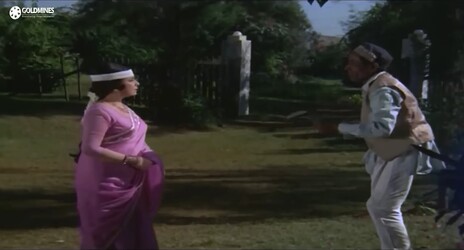
Darjeeling? Radha lives in Bombay. How has she reached Darjeeling?
To complicate matters further, a young woman (Farida Jalal), playing a piano and singing in the house now addresses Radha/Nanda as ‘Ma’, and insists that she (the young woman) is Nalini, Nanda’s daughter.
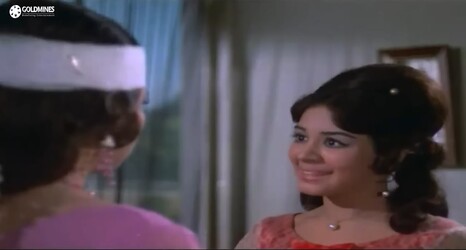
Nanda, yes, as Nalini’s father Subodh Rai (Rehman) insists, when he comes in. Nanda is his wife, Nalini’s mother. But the woman in question is aghast and denies everything vociferously. She is not Nanda; she is Nanda’s younger sister, Radha. And Subodh is her jeejaji, her brother-in-law; not her husband at all. Nalini is not her daughter. What is happening, why is she in Darjeeling, and not in Bombay?

There is one thing, though, that Radha sees as a link to a past she distinctly remembers: the wound on her head. She had a wound back then, too, she recalls…
Subodh calls their family doctor (Mirza Musharraf), who comes to check on Radha. He’s been their family doctor for years, but Radha doesn’t recognize him. On his way out, the doctor tells Subodh that it might be better to send for Dr Rajesh Khanna, an eminent psychiatrist: he might be better equipped to understand what is happening to Radha.
So Dr Khanna (Dharmendra), who is also known to Subodh, is sent for. Subodh tells him how Radha got the wound on her head: last night had been Nalini’s engagement, and amidst the celebrations, there had been exploding fire crackers. The bursting crackers startled Radha (whom, of course, Subodh goes on referring to as Nanda) and she fell down a flight of stairs.
Dr Khanna examines Radha, tries to calm her down, and reassures her that all will be well. They’ll see later, how things pan out.
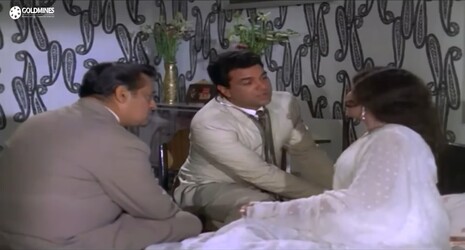
Once the doctor is gone, Radha—still insistent that she is Radha, not her sister Nanda—books a trunk call to Ram Kumar in Bombay. Ram Kumar, she tells Subodh (who is sitting beside her), is her fiancé. She’s supposed to be marrying him tonight.

But the operator calls back. There is no Ram Kumar at that number.
By now Subodh, mostly patient and gentle, is beginning to lose patience. When a distressed Radha asks him why she’s in Darjeeling, where is her family, her parents, and her elder sister Nanda, Subodh snaps at her. She is Nanda. Her entire family, parents and younger sister included, died in a horrific fire sixteen years ago.
Still confused and very disoriented, Radha gives in later that evening, when Subodh insists on taking her to the club. He says it’ll be good for her to get around and about. But at the club, Radha refuses to put up any sort of façade of normality. She outright refuses to recognize any of their closest friends, and within minutes, rumours are circling wildly: Nanda Bhabhi has lost her mind.

The next morning, a guest turns up just as Subodh is sitting down to breakfast: it’s Nalini’s future father-in-law (Wasti), who has heard about all the rumours floating about and now wants to break off his son’s match with Nalini. Subodh assures him that everything will be all right. There is nothing wrong with Nanda. He also quite pointedly promises his future samdhi that all his (Subodh’s) wealth will be Nalini’s, and of course, as her father-in-law, he will get to administer it…
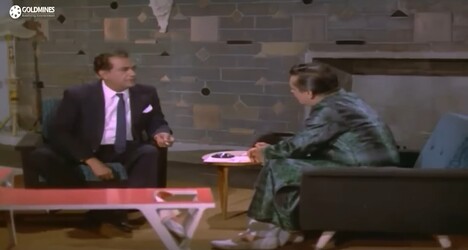
The man is greedy enough to accept, and drops the idea of breaking the engagement.
Meanwhile, Nalini tries to reach out to Radha, to assure her that even if Radha doesn’t think of Nalini as her daughter, Nalini at least regards her as her mother. Radha somewhat reluctantly accepts (and to some extent reciprocates) Nalini’s affection, but it’s obvious that she doesn’t really feel any sort of maternal love for the young woman.

That evening, to divert Radha, Subodh takes her out again. This time to a floor show, where the song-and-dance ends up distressing Radha so much, she gets up and leaves. As it happens, Dr Khanna is also sitting nearby: he sees Radha leave, and follows her. Which is just as well, because Radha is so upset, she drives madly away, and ends up banging her car into a tree—just on the edge of a cliff.
Dr Khanna rescues Radha and takes her to his clinic, where he conducts an EEG. He then takes Radha back to her home, where he meets Subodh (who of course has been very worried about where his wife has disappeared to). Dr Khanna reassures Subodh: the EEG has proved there’s nothing wrong with Radha; there is no cause for worry.
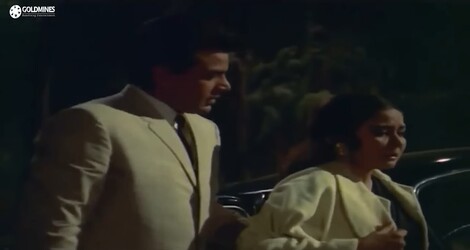
While Dr Khanna and Subodh are downstairs, talking, Radha goes up to her room. Without turning on the lights, she opens the cupboard to put away her coat, and out of the open cupboard falls the corpse of a woman, clad in white. Radha, screaming, goes running for the door.
But by the time Subodh, Nalini, and Dr Khanna enter the room, turn on the lights, and reach the cupboard—there’s no corpse there. Nothing. Radha, hysterical, insists that she saw what she saw, but nobody’s believing her.
What is happening? Has Nanda, or Radha, or whoever she really is, lost her mind? Or is she at the heart of an elaborate farce?
Years ago, on bollyviewer’s blog, I read a review of this film, and filed it away as something I should watch sometime soon. Later, Anu Warrier too reviewed it, and then I actually did go and bookmark the film. It’s taken me a long time to get around to Bahaaron ki Manzil, but I’m glad I finally did watch it: it’s a suspenseful, generally well-scripted film, and really ought to be more prominently listed among the great suspense thrillers of Hindi cinema.
What I liked about this film:
The story, which is well-plotted. Yes, there are some holes (more on these in the next section, about what I didn’t like), but nothing so unforgivable that it came in the way of my enjoyment of the film. The direction (by Yakub Hassan Rizvi) is mostly taut, and the fact that there are very few songs means that the focus remains on the mystery that surrounds the lead character.
Then, there’s Meena Kumari. Though she was past her prime by the time Bahaaron ki Manzil was made (and looked it), her acting remains top-notch: she is so very believable as the confused, suspicious Radha/Nanda, frustrated because nobody seems to believe her, and at the same time puzzled because she does not know what has happened. Meena Kumari, despite that ‘tragedy queen’ tag so many people love to pin onto her, proves again how very versatile she was as an actress. The rest of the cast, especially Rehman and Dharmendra, are good too, but Meena Kumari, to me, holds centre stage.
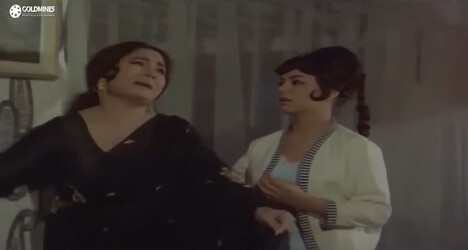
And, Nigaahein kyon bhatakti hain. Its lyrics written by Majrooh Sultanpuri, with music composed by Laxmikant-Pyarelal, this is the first of four songs in the film. The other songs I didn’t much care for, but this one is beautiful: haunting, suspenseful, and a good reflection of the film.
What I didn’t like:
The inane and completely unnecessary comic side-no-plot involving the maid Rosie and the Rais’ cook (Polson). Given that Rizvi otherwise does such a good job of focussing on the suspense, even keeping the songs in control, I find it odd that he couldn’t resist the temptation to bung in what is definitely not comic relief.
And, as I mentioned earlier, the plot holes. There aren’t too many of these, but there are some. For instance, how come even Dr Khanna (who is genuinely concerned about his patient, to the extent of falling in love with her…) doesn’t think of even asking her once what she thinks might have happened? His diagnosis that all is well is based on an EEG, no more (and, as someone who has gone through EEGs, I can testify that an EEG result doesn’t come through that quickly; it takes time). Basically, some rather shaky medical science at work here, which is probably par for the course for Hindi cinema.
But, all said and done, an enjoyable and engrossing film. I liked this one a lot.
 Dustedoff
I have also reviewed it. And I’m in agreement with your assessment of it. I have watched it more than once but the first viewing (in February 2008, on Doordarshan) was a sensational experience as the revelation was something I could not thought of while going through the intriguing proceedings taking place on the screen. Besides, everything hasn’t been explained clearly in the end. The viewer has to read between the lines and understand himself what’s not been told. Thanks for the review which was, I feel, long overdue.
LikeLiked by 2 people
Yes, the proceedings are really intriguing, and it’s hard to figure out what is happening. I liked, actually, that everything is not clearly spelled out – it shows a respect for the viewer’s intelligence! :-)
I am glad you liked this review, thank you.
LikeLiked by 2 people
Glad to read this review. Among all the Dharam-Meena movies, Bahaaron Ki Manzil is the only one that I like.
Actually, it was the picturization of the song Nigahen kyon bhatakti hai which made me see the movie.
An interesting story, and overall a well-made tight and fast thriller, something different for those times.
It been quite a while ago that I had seen the movie and I recollect that I felt that the timelines and the intervening period needed more clarity.
But it was refreshing to see that the supporting star-cast was limited and no elderly characters (parents /relations) complicating or making things melodramatic.
In fact, I consider it a progressive movie since the doctor did not seem to have any social/moral questions while getting close to his patient. Apparently, her being married or having stayed long with a married man did not bother either of them.
LikeLiked by 2 people
I totally agree with your assertion that it’s a progressive movie. Indeed. Given that she isn’t even married to Subodh, and that she has therefore (even if unwittingly) been ‘living in sin’, so to say, with him, isn’t raised as a question. The doctor values her for who she is, not for whatever morality society might tout as being proper.
LikeLiked by 2 people
I watched it many-many years ago on Doordarshan. I really liked it, mainly because of the psychological tension. It was such a unique plot for that time, I think. Now, the memory loss thing is a bit cliched and yet very intriguing. I have read several memory loss novels and watched a couple of films too.
Some old movies were really mysterious, like, there’s a movie called Anita. Then Mera Saaya. And Dhundh (perhaps?).
Nigahen kyon bhatakti hain…I remember this song.
One thing: Meena Kumari was looking forward to her own wedding and now a young woman says she is her daughter who is old enough to get engaged. Confused about the age difference.
LikeLiked by 2 people
I agree, the memory loss thing is cliched, but the film still manages to be intriguing. The script overall is very well done, it manages to keep the suspense going. And yes, that struck me too: how Meena Kumari’s character doesn’t seem to be able to understand that if she has a daughter old enough to be married, she cannot be getting married herself. I put it down to her being so confused and disoriented, she can’t see what is obvious.
Anita and Mera Saaya are among my favourites. Also Humraaz, another good one. Have you seen that? Dhund is also great.
LikeLiked by 1 person
Sunil Dutt and Vimmi starrer? I don’t remember watching it. There’s a popular Mahendra Kapoor song from this film, I think.
LikeLike
Yes, that’s the one. It’s a good film, and Mahendra Kapoor sang some of his career’s best songs for it – Neele gagan ke tale, Na moonh chhupaake jiyo, and Kisi patthar ki moorat se.
LikeLike
Madhuji, I watched Baharon Ki Manzil probably a year ago and found the movie very gripping. There is a good mix of crime and suspense. I also remember Tun Tun playing a small role of a gullible woman. Basera (1981) is another movie which is slightly similar but has no crime; only lots of tyaag and balidaan. The ending is different. You may like to watch it.
LikeLiked by 1 person
I remember Basera surprisingly well, given that I last watched it when I was a teenager – it is quite interesting, though I did find all that tyaag and balidaan quite melodramatic! :-) The title song used to be quite popular back then.
LikeLiked by 3 people
Oh!
Sounds so intriguing. And I too like the song, Nigahen kyun bhatakti hain. Planning a song list of haunting melodies for long! Couldn’t get doing it actually. Will do now!
I perhaps need a push from someone for song lists,
😀
Bookmarked it.
How was Farida Jalal in this movie? I like her a lot. Very cute and innocent and a good actress of course. Perhaps had a very small role in this film.
LikeLiked by 1 person
Yes, Farida Jalal did have a smallish role here, but pretty much like in most of her other films from the 60s (I think Aradhana and Mahal are the films where she has the biggest roles). I like her a lot too – she’s very sweet and innocent.
Looking forward to your list of haunting melodies, Anupji! Do please compile that.
LikeLiked by 1 person
I am so glad you finally watched this film. My only peeve (apart from the comic side plot and the editing (which could have been tauter) was that Dharam-Meena don’t have any chemistry together. And she can act the pants off him, ill as she was.
Shalini and I wondered what this movie would have been like with a younger Meena and either Dilip or Dev in Dharam’s role, and helmed by say, Vijay Anand.
LikeLiked by 2 people
True, there was no chemistry between Meena Kumari and Dharmendra here at all, which is such a shame.
A younger Meena Kumari with a Dilip Kumar or a Dev Anand would’ve been good, but for the woman’s age – given that she’s been Nanda these past 16 years, puts her current age at at least in her mid-to-late 30s. While Meena Kumari does look a little too raddled to be that age (she looks older, TBH), a younger Meena might look too young. :-)
LikeLiked by 1 person
Nice review. Will try to watch it. So Dharm became Dr Rajesh Khanna!! They must have wanted Rajesh Khanna’s name some how in the film, if not the man, at least his name !!
LikeLiked by 1 person
Yes, I did wonder at that. They must have really wanted Rajesh Khanna to be part of the film. But given that he was making films left, right and centre at that time for United Producers, perhaps he couldn’t find the time for this one!
LikeLike
Lovely post! I’d assumed the song ‘kabhi toh milegi, kahin toh milegi, baharon ki manzil, raahi’ must be from this movie…but of course, I was wrong.
Agree about Baseraa…I never understood why all that farce. Why not just tell the older lady what had happened and why? Simple enough.
LikeLiked by 1 person
“Why not just tell the older lady what had happened and why?”
Because half the friction and plot in Hindi cinema comes from unnecessary deceptions and keeping people in the dark! Seriously, this is a question I’ve asked countless times. :-)
LikeLiked by 1 person
Ha ha, true!
LikeLiked by 1 person
Ha ha, so true!
LikeLike
your review prompts one to watch the movie 🎬 thank you 😊
LikeLiked by 1 person
If you watch it, do tell me what you think of it. :-)
LikeLiked by 1 person