
A couple of years ago, my husband and I took our daughter (whom I refer to as the ‘LO’: the ‘Little One’, though given that she’s now ten and no longer little, she suggests that that now be ‘Loved One’) to Corbett National Park. The LO had been on wildlife safari before, but this one was special: she was deep in the jungle, she was old enough to appreciate it all and to retain memories of it. We decided we had to notch up more wildlife adventures. ‘Visit one Indian wildlife sanctuary or national park every year,’: that was a goal we set for ourselves.
This time, I decided to do something different: not a jungle, not a place we might see a tiger. Instead, I suggested we visit the Little Rann of Kutch. And since all of us are very interested in history, we figured it would be good to combine that with a stopover at Ahmedabad: the historic walled city of Ahmedabad is on the UNESCO’s list of World Heritage Cities, and its list of stunning old monuments seemed too good to pass up.
Our flight from Delhi to Ahmedabad arrived early enough for us to be able to get to our hotel (the Taj Skyline) by noon. Since this was just a week after Christmas, the lobby was still all decked up for Christmas, with a tree, a gingerbread house, and more. The LO was in seventh heaven.

Ahmedabad has a good network of app-based taxi services (Ola and Uber), besides auto rickshaws as well as a bus service. Ola and Uber, we realized, were our best bets. Over the few days we spent in Ahmedabad, we pretty much used either of these to go around. What we visited besides the old city is explained in the next blog post; this one focuses on the medieval monuments that we went to.
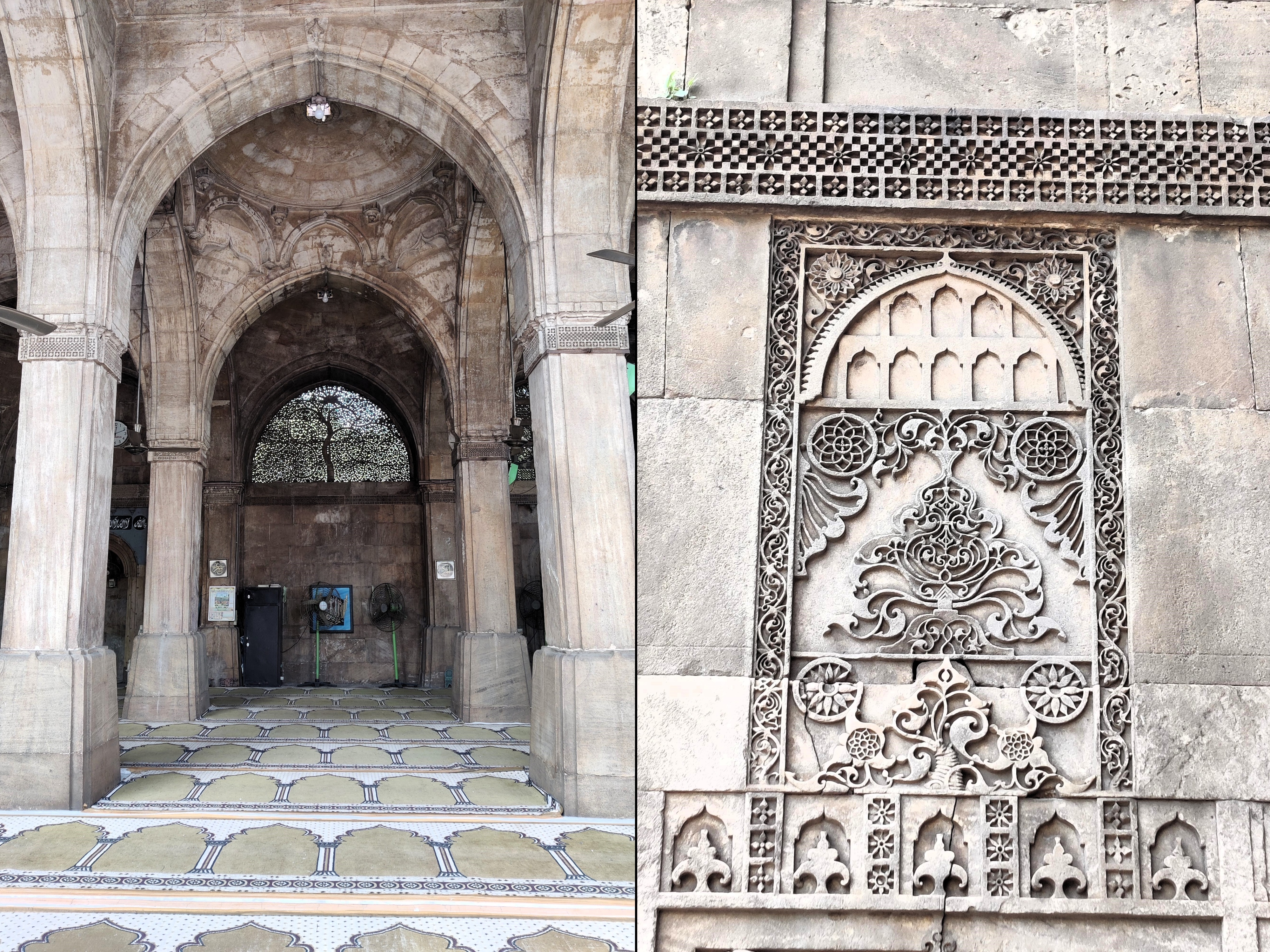
The first and foremost—the one I was most eager to see—is the Sidi Saiyyed Mosque. The man who commissioned this small but exquisite mosque was a Sidi, an Abyssinian named Saiyyed, who came to India by way of Yemen and took up service under the then Sultan of Gujarat, Nasiruddin Mahmood III. Sidi Saiyyed had this mosque built in 1572, and when he died in 1576, he was buried here.
The Sidi Saiyyed Mosque sits on what is, to all purposes, a large traffic island: cars and autos, bikes and scooters whizz by on the roads around the mosque and the small park adjoining it. The mosque itself, when we got off our cab and saw it for the first time, didn’t look terribly impressive.

It’s only when you get closer that can you appreciate the fine (but very restrained) carved stone in the mosque. There are carvings along the pillars, for instance, and around the arches that form the façade; but the most iconic piece of carving here is on the screens at the far end of the prayer hall: the ‘Tree of Life’. These stunningly intricate stone screens are so beautiful, they have become almost lore: IIM Ahmedabad uses a stylized version of the Tree of Life from Sidi Saiyyed Mosque as its logo, and in 1890, wooden copies of the carving were taken to museums in London and New York, to enable stone replicas to be created.


Unfortunately, women aren’t allowed into the prayer hall of the mosque, so the LO (most indignant about being a ‘little lady’ and therefore forbidden, as she put it) and I had to wait outside while my husband went in and had a closer look at the screens.
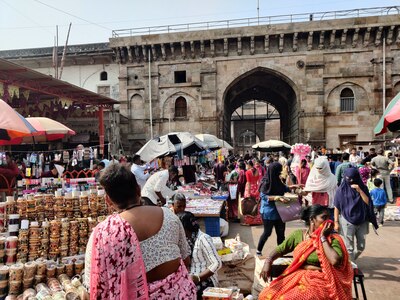
From the Sidi Saiyyed Mosque, the next place on our list was, it turned out, just 5 minutes’ walk from the mosque: the Bhadra Fort. When Ahmed Shah I founded Ahmedabad (in 1411 CE), he built this compact but solid-looking fort, which is known after a Bhadrakali Temple which was supposedly within its premises.
Our first glimpse of Bhadra Fort was more of the teeming, very colourful temporary market surrounding it. On stalls, on tarpaulins spread on the pavement, and on handcarts, people sold everything from pink-fleshed guavas to trinkets, tinselly clothes, nail polish, shoes, and much more. All that glitter appealed to the LO so much, she dug in her heels and wanted to buy a souvenir for a friend back home. It took a lot of persuasion to convince her that this stuff was very poor quality and might not be a good choice as a gift.

We could not go into the fort beyond a few yards of the front gate, because a large-scale restoration project is underway. We pottered around here, took a few photos, and headed out again, to the main gate.
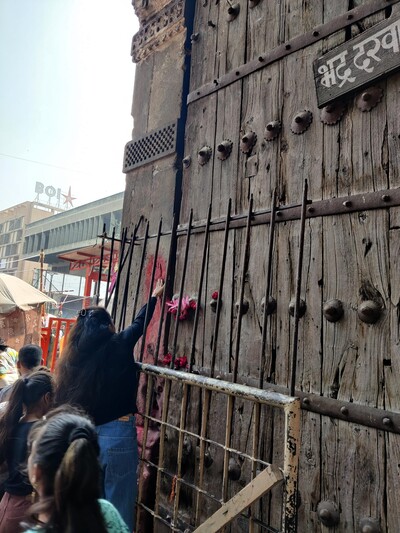
Here, on the stone wall that forms one of the gate posts, is a handprint that is believed by the devout to be that of the goddess Bhadrakali. (I suppose) devotees believe that if you press your hand onto the handprint, the goddess will bless you, so there was a small crowd of women and girls here, climbing onto the railing beside it to reach for the handprint.
From the Bhadra Fort, the next site on our itinerary—the Jami Masjid—was just about 10 minutes’ walk, so we set off walking. This, unlike the more modern, swanky parts of Ahmedabad (like where the Taj Skyline is located) is old, crowded, and very smelly. The LO, crinkling up her nose and looking quite aghast, grabbed my hand and hurried along, past stalls crowding the road so close that only one auto rickshaw at a time could get through.
We made our way through the Teen Darwaza, a beautiful three-arched gate that spans the street:

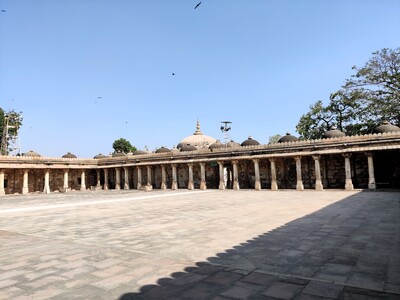
… and beyond, to the Jami Masjid. Built by Ahmed Shah I in circa 1424 CE, this large mosque was one of the most important buildings of old Ahmedabad. It has a huge sehan (courtyard), surrounded by a corridor all around.
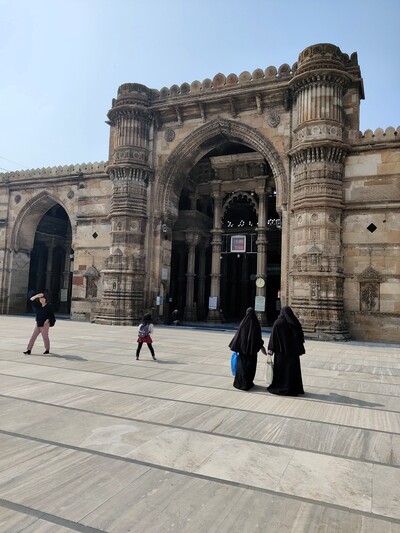
A wazu tank (for ritual ablutions) is in the centre of the sehan, covered with a green plastic roof: the LO was keen to dip a hand in, until she discovered that there were fish in the water. Wazu nowadays is done from freshly piped water near the main entrance, so I suppose it was decided to put this tank to other uses.

The prayer hall here, as at Sidi Saiyyed Mosque, has some lovely stone carving—and is off-limits for women. “And little ladies,” the LO added, peeved. But we satisfied ourselves with posing beside the beautifully carved pillar-like structure that stands in the sehan.

There were two other historic mosques we visited in Ahmedabad. One is known, not for the mosque itself, but for the minarets that are its highlight. ‘Jhulta Minar’ (‘shaking minaret’) is the name given to the twin minarets of the Sidi Basheer Mosque: it’s said that when one of the minarets is shaken (how? This is solid stone, and large), the other shakes in unison, even though there’s no apparent connection between the two minarets that would allow this.
This, I will admit, was very confusing. We were taken to what Google Maps insisted was Jhulta Minar, but there was no sign to say that the mosque where we ended up was indeed the Sidi Basheer. The place was very smelly (there was a stinky toilet right beside the gate), and since there wasn’t anybody around except a dauntingly serene-looking Japanese tourist, we couldn’t ask, even, if we were at the right place. Let alone request a demo of the shaking minarets.
The minarets are intricately carved and very impressive, but that was it. We had to take Google’s word that this was the Jhulta Minar. Also, I never quite figured out why the minarets wouldn’t shake in unison: they are linked, after all, by a sort of stone bridge: but perhaps that is an architectural feature of which I don’t understand the dynamics.

The other mosque we visited was also, like the earlier one, a Jami Masjid (note: the word ‘Jami’ or ‘Jama’ is often incorrectly interpreted as ‘Jumma’, to mean ‘Friday’; but it’s not—it implies a congregational mosque). This Jami Masjid is part of a much larger complex known as Sarkhej Roza, the dargah of a Sufi saint, Sheikh Ahmed Khattu Ganj Baksh. Ganj Baksh was a friend and adviser to Sultan Ahmed Shah I of Gujarat; when Ahmed founded the city of Ahmedabad, Ganj Baksh took up his abode in the village of Sarkhej, and when he died, his tomb (‘rauza’) was built here.
The saint’s impressive, single-storeyed tomb is still the most-visited, most-revered monument in the complex of Sarkhej Roza…

…but there are plenty of other interesting buildings around as well. In later years, the Sultan Mahmood Begada turned the area around Sarkhej into a large complex of palaces centred round a huge pool of water. The ruins of the palaces can still be seen across the dried expanse of what was once the tank, and several tombs are situated about the rim of it, including that of Mahmood Begada.

This man, while a very important personage in the medieval history of Gujarat—he captured large territories and added to his empire, which he ruled for over fifty years—was a man with a prodigious appetite. The main thing I remember reading about him (in a school textbook from when I was in Class XI) was that he would sleep with two huge platters of keema samosas on either side of his bed, to ward off hunger at night!
When we arrived at Sarkhej Roza, I had had no idea that Mahmood Begada was buried here. Entering the complex and seeing his tomb right there, I went into a little whirl of excitement. The LO and her father were told (in a hushed, elated whisper) about Mahmood and his samosas, and the LO was suitably impressed. Sadly, neither of us could step into the chamber where his cenotaph (a huge one, draped in tinselly purple cloth) is situated: ladies were not allowed.
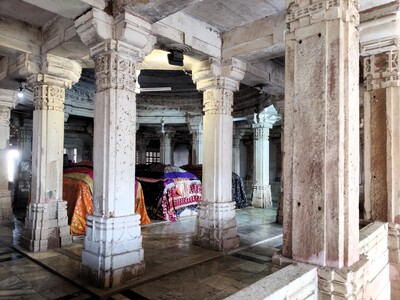
Also part of the Sarkhej Roza complex is the aforementioned Jami Masjid, a far less imposing and much plainer one than the grand Jami Masjid that stands near Bhadra Fort.
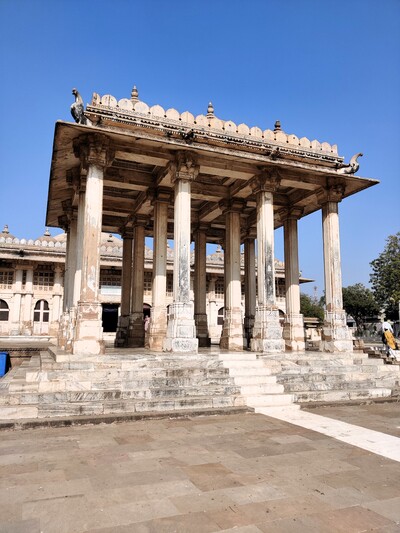
And, one very unusual and interesting structure: the Baradari, or pavilion, that stands in front of Ganj Baksh’s dargah. This was unlike any of the baradaris I’ve seen before; in fact, it looked more like a Greek building than an Indian one (the resemblance to the Acropolis, for one).
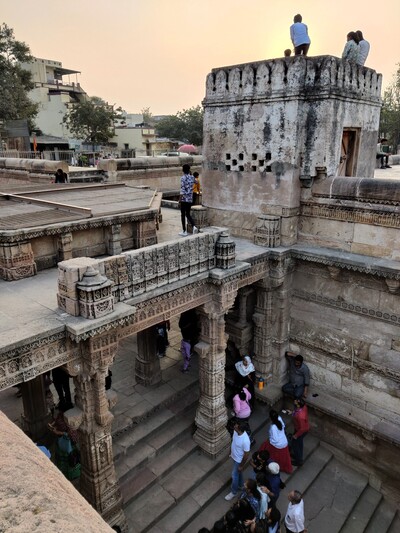
There was one last structure we visited that dated back to the time of the Sultans of Gujarat: the beautiful Rudabai Adalaj ni Vaav. Stepwells, known in Delhi as baolis and in Gujarat as vaavs, are a particular favourite of mine, and I had heard high praise for the vaavs of Gujarat (yes, Rani ni Vaav coming up in the next blog post). This one, therefore, was on our itinerary.

The Rudabai Adalaj ni Vaav (often referred to simply as Adalaj ni Vaav) was built in circa 1498 CE, by a certain Rudabai, the wife of Virsinh. It’s a stunning stepwell, five stories deep and each story decorated with beautifully carved pillars, jharokha-like structures on the side, and more. We happened to visit here on a Sunday evening, and it was pretty packed with tourists as well as locals.
We saw much more in Ahmedabad, and then, on our way out to the Little Rann of Kutch. That is covered in the sequel to this post. Watch this space.
 Dustedoff
Noting carefully, for a future visit.
LikeLike
You must visit. Lots here to like and love!
LikeLike
Madhu,
Nice travelogue. This year’s winter has been so severe that my friends have seriously started talking about going off to Ahmedabad or Goa at least for a month. Even though the purpose is escape, once we stay on that long we are bound to do a good deal of sightseeing.
AK
LikeLiked by 1 person
You’re right, AK – the winter this year has been particularly brutal. Ahmedabad or Goa sound like a very good idea indeed. And lots to see in both places, so if you’re going for a month, at least some sightseeing would be in order.
LikeLike
Very good travelogue as usual. Enjoyed Ahmedabad with you.
Waiting for the second part
Should plan a trip there.
:-)
LikeLiked by 1 person
I am glad you enjoyed this post, Anupji! I would certainly recommend a trip to Ahmedabad. We liked it a lot, the LO never wanted to come back. :-)
LikeLike
I didn’t know that Ahmedabad had such treasures in store. Thanks for introducing them to me. I particularly liked the Tree of Life. Looking forward to the next part.
LikeLiked by 1 person
The Tree of Life is very beautiful. There are actually two versions of it, one which features in the photo I’ve put here, and another version which is a stylized version of a palm tree.
LikeLike
A palm tree! I have read that the Prophet Mohammed mentions the date palm quite often in the Quran, so it must be, I presume, a stylised version of a date palm
LikeLiked by 1 person
This is it:
LikeLike
Never knew Ahmedabad is such a treasure trove. The tree of life sounds amazing!
Thanks for a wonderful travelogue.
LikeLiked by 1 person
Thank you so much. I had mainly wanted to visit Ahmedabad because I had seen photos of the Tree of Life and it looked stunning. But to discover that there was so much more, too: I was pleasantly surprised.
LikeLike
Wonderful pictures BTW
LikeLiked by 1 person
Thank you!
LikeLike
Ahmedabad indeed has a lot to offer . I hope you managed to get some food experiences as well. And the textile market. But maybe all a bit much to cover in a couple of days. Not to mention the modernist architecture icons of the city. And some of the older Havelis in the old city (very close to the Siddi Saiyyed Mosque)
Also, the pillar-like structure is most probably a ‘Chabutra’ or a bird-feeding pillar, very very noticable in Gujrat. Some are beautifully done in stone, like the one you saw, or intricately carved in wood. You can see one at the Crafts Museum in Delhi (if it is still there). The old city in Ahmedabad has a lot of them.
LikeLiked by 1 person
Ah, so that was a bird-feeding pillar! How interesting. Now that you mention it, I have seen photos of these (and, if I recall correctly, yes: the one at the Crafts Museum too).
We did, indeed, have some wonderful food in Ahmedabad – at Vishalla, especially, which was amazing. I’ve written about it in my follow-up blog post, here:
https://madhulikaliddle.com/2024/01/28/the-lo-goes-to-gujarat-part-2-more-ahmedabad/
LikeLike