
(Part 1 of this travelogue, Historic Ahmedabad, can be read here).
Our sojourn in Ahmedabad stretched across most of four days: a day and a half after we landed in Ahmedabad from Delhi, and another just-over-two days before we left again for home. In between, we did a memorable trip to the Little Rann of Kutch (about which I’ll be posting in next week’s blog post, the last of these travelogues).
Ahmedabad is a city of extremes. On the hand, there are parts of it which, frankly, looked far more upscale and posh than even Delhi: wide boulevards, stylish malls and boutiques, fancy restaurants serving global cuisines.

On the other hand, there are the poorer parts of the city, so ramshackle and filthy that it makes one wonder. After all, the UNESCO World Heritage City tag is for old Ahmedabad, not new; and it didn’t seem to me as if the administration was doing very much to make old Ahmedabad very appealing to tourists… while crowded and busy areas don’t put me off so very much, stinky toilets, sewage spilling across streets, and general filth does.
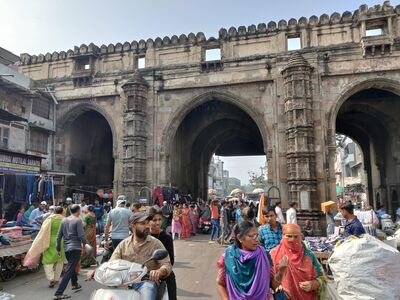
The very smelly public toilets, by the way, were there even outside the Sabarmati Ashram, which was the first site we visited in Ahmedabad. In 1915, Mahatma Gandhi had first set up an ashram in Ahmedabad’s Kochrab area. A couple of years later, he shifted the ashram to the bank of the Sabarmati River, and this was to be his home—and the home of many of his followers—till 1930. Today, the entire area has been made into a series of museums and galleries showcasing Gandhiji and the life of the ashram.
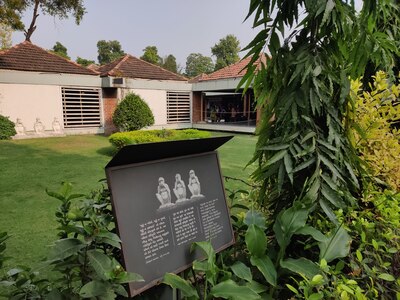
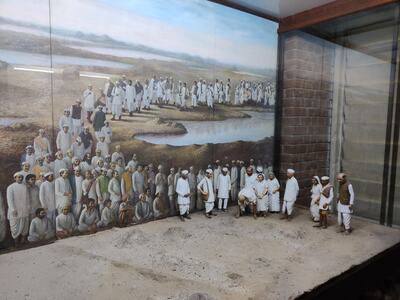
We began here with a museum which explains the timeline of the ashram. Here, through a series of photos, reproductions of Gandhi’s letters, illustrations, and more (including a diorama depicting the Dandi March), the freedom struggle and satyagraha are explained. The LO was especially impressed by a bust of Kasturba, and by the diorama (which, two days down the line, she tried to emulate at the Rann of Kutch, bending to gather ‘salt’ as Gandhiji had done at Dandi).

Another small museum here is devoted to the charkha, the spinning wheel that Gandhi was convinced was the way to reach out to the masses, and to alleviate their poverty. There are lots of different charkhas here, as well as ancillary equipment like spindles and a cotton gin. There are spools of thread, and photos of everybody from Nehru to Vinoba Bhave spinning away like mad.


There are gardens, lots of spaces (and freedom) for people to sit around, for children to play, and so on. There is also a scenic promenade along the Sabarmati, which is pleasant. Facing the river, too, is a tiny hut named Vinoba-Mira Kutir, where Vinoba Bhave had stayed when he lived in the ashram for a few months. Much later, an Englishwoman named Madeline Slade (whom Gandhi called Mira) lived in this hut during her stay at the ashram.
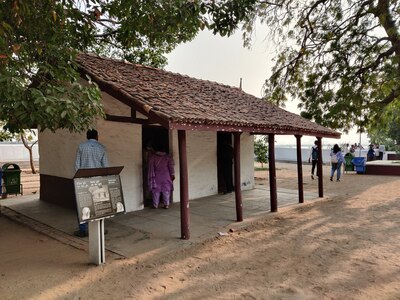
Just opposite Vinoba-Mira Kutir is the cottage named Hriday Kunj, where Gandhi and Kasturba lived for over a decade. Some original belongings of theirs, as well as some replicas, are housed in what was once the kitchen; Gandhi’s office is off-limits but you can peek in from outside.

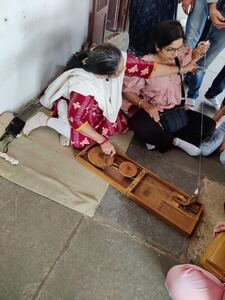
In the verandah of Hriday Kunj sat a lady who demonstrated the use of a charkha, and invited interested bystanders to try their hand at it. The LO was intrigued (as were we, I must admit), but she chickened out. ‘I’m too shy,’ she said.
The LO, shy or not, is able to invariably put on her best behaviour in front of outsiders. At home she may be a little hellion, but outside? We usually end up receiving praise for the good manners and charm of our child. This happened also at the Calico Museum of Textiles.
Established under the aegis of the Sarabhai Foundation (and housed in a sprawling mansion called the Sarabhai Haveli, surrounded by a magnificent garden complete with peafowl, ibises, and even mongoose), the Calico Museum is a fine collection of textiles, as well as other works of art: South Indian bronzes, Buddhist thangkas, and more. There is even, here, a 200-year-old Jain temple, made of finely carved and painted wood, that was dismantled and shifted to the Sarabhai Haveli, where it was re-assembled.
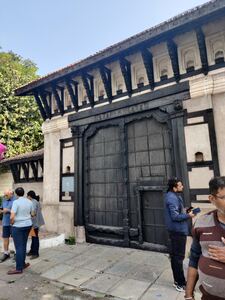
The problem is, the Calico Museum is very hard to visit. They have extremely strict rules: you can visit only as part of a guided tour, of which two are held daily. You have to register for the tour at least a month in advance. You have to bring along the confirmation they send you, when you come for the tour, otherwise they won’t let you in (but the confirmation may not arrive till the last moment, and when you phone, nobody answers; and if you try visiting, the security staff turn you away…). It was very stressful coming here. And, once we arrived, we were also told that absolutely nothing except a wallet of money can be taken on the guided tour. Everything else must be deposited at the entrance. No cameras, no phones.
And, no children below ten.
The LO was going to turn ten five days after our visit to the Calico Museum. ‘Never mind, if anybody asks, you tell them you’re ten,’ I said. She was horrified at the dishonesty I was trying to perpetrate, but thankfully for her sense of righteousness, nobody asked. Nobody even doubted that she was a dignified and proper little lady. Of the group, two other participants complimented her on her good manners. The elderly and somewhat forbidding lady who conducted the tour seemed to have taken a liking to the LO and always motioned her into the optimum place to stand for each little lecture as we went along.
The Calico Museum was good, the exhibits interesting and the tour informative, but overall, the attitude of the staff was so off-putting, I didn’t enjoy this. I would much rather recommend the National Crafts Museum in Delhi, which has a fabulous collection (some of it much older than the one at the Calico Museum, and far more diverse), without any of the stressful red tape surrounding a visit.
Ahmedabad has a glut of sights to see, and while the stepwells and the Gujarat Sultanate-era monuments are aplenty, there’s more historic stuff too. One of these we visited on our first full day in Ahmedabad, before we left for the Rann of Kutch: the Hutheesing Jain Temple. Named after Sheth Hutheesing Kesarisnh, a Jain billionaire of Ahmedabad, the temple was commissioned by him in the 1840s. When Hutheesing passed away, the task of having the temple completed was taken over by his widow. It cost Rs 10 lakhs at that time, which is, in today’s terms, something to the tune of 75 crores.

The Hutheesing Temple sits in a large paved area, with a carved tower (very reminiscent of the Vijay Stambh at Chittorgarh) in the foreground. The outside of the temple building, made all of stone, is richly carved: deities, elephants, human beings and more decorate every square inch. We spent several minutes admiring the outside before taking off our shoes (there’s a rack nearby where you can leave your footwear) and going inside. Unlike the many Jain temples of Delhi’s Chandni Chowk area—which I’m familiar with—the Hutheesing Jain Temple caretakers don’t require you to leave belts, wallets, and other leather objects outside. As long as you don’t take photographs inside the temple, you’re good to go.

The main shrine sits in the middle of a paved courtyard, with a covered corridor ringing it. Placed in the corridor are a series of smaller shrines, each with bejewelled statues of (I am guessing) the Jain tirthankars. The main shrine, in the centre of the courtyard, is of as intricately carved stone as the outside of the temple, and the floor of the space just in front of the sanctum sanctorum is covered with multicoloured stone inlay. While her parents admired the beauty of the craftsmanship, the LO was busy playing with the many palm squirrels here. She found them utterly enchanting.
The LO wasn’t quite as enthusiastic about the local wildlife in another place we visited: the Dutch Tombs.
The Dutch Tombs had not really been on our itinerary, but on our last day in Ahmedabad, finding ourselves with a few hours free, we decided to check these out. Google Maps marked the tombs as being part of the Kankaria Lake Front complex, so we paid the tickets to enter the complex, then spent the next 15 minutes trying to find our way to the Dutch Tombs—and eventually realized that the tombs aren’t situated within the complex, but abutting it, in a small but separate park. The entrance to this park is just to the left of Gate #1 of the Kankaria Lake Front complex.
The path to the Dutch Tombs is overhung by trees, several of which were festooned with hundreds of large bats. It was dusk by the time we arrived, and they were beginning to stir, much to the LO’s disgust. She couldn’t wait to get past them.
Fortunately, the tombs were fairly interesting, and helped her get over her horror of the bats.
During the days of colonial trade along the west coast, Dutch merchants in Gujarat were more numerous in Surat, but Ahmedabad had a small community. This tiny cemetery was where they were buried, and the cluster of tombs is quite interesting. The tombs are of various architectural styles, some topped with spires, others enclosed in a domed pavilion.

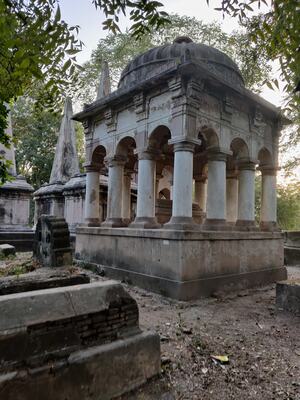
The tombs are inscribed in Latin and Dutch, and one of these, its lettering relatively clear, dated back to 1699.
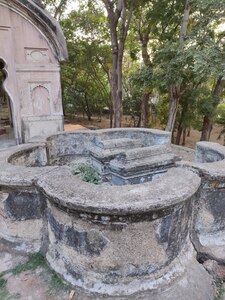
A few tragic little graves, obviously of children, were also there, enclosed in what looked (from a distance) like a well. The LO was initially a little shaken: children died? Of what? We explained to her the sad fact of infant mortality back in the days before modern medicine (and of course how poverty and poor rural development still cut off many people from medicine). This seemed to pacify her a bit, at least enough to make her beg me to take a photo of her standing beside one of those graves! (Yes, the LO can be a little macabre at times).
Since we had anyway bought tickets for the neighbouring Kankaria Lake Front, we went in and had a look. This is a sprawling area, a promenade around Kankaria Lake. It’s scenic, a pleasant place to hang out, and there are other attractions: a food court; various stalls selling ice cream and soft drinks; a charming toy train which chugs along the lakeshore. The LO had one look at this and made up her mind that she wanted to go on it.
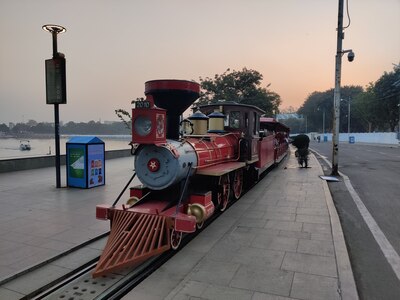
We couldn’t manage that. There were long queues for it, and it looked like no seats would be available for the next couple of rides, at least. We did see a Butterfly Park sign and (given that we’ve had some wonderful experiences at another Butterfly Park, some years ago), we decided to give this a try. This required more tickets to be bought, and we saw not a single butterfly.
After that, we weren’t keen on trying out much more of Kankaria Lake: not the play area (though the LO was quite keen on it), and not the Nocturnal Zoo. Or anything else, for that matter. We wandered along the waterfront for a while, though: pleasant enough. (And the LO, who earlier this year had read an essay on Lal Bahadur Shastri as part of her Hindi textbook, was chuffed to see a familiar face).

One last bit of information regarding our stint in Ahmedabad: the food. The only other time I’ve been to Gujarat was way back when I was in college and had gone on a whistle-stop tour of the state with my parents. The one thing I remembered vividly from that trip was the food: all vegetarian, and all excellent. This time, I was looking forward to having some good Gujarati food, and ended up ordering thalis at several of Ahmedabad’s more popular eateries. The first of these was an iconic restaurant named Vishalla, which one of my teachers back in college (in the early 1990s) had told me about.
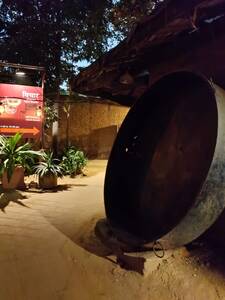
Vishalla has an interesting—and vast, in terms of size of collection—museum of utensils, as part of the restaurant complex. This, with some amazing examples of metal and earthenware, was very impressive:

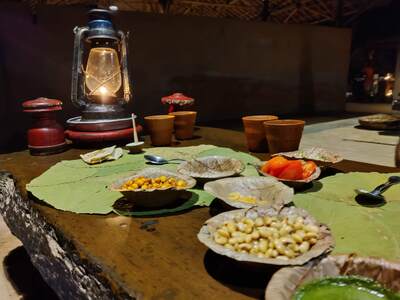
… but, eventually, it was the food that blew us away. Served at low tables around which we sat cross-legged on the floor, these thalis were served on dried leaf platters. A whopping sixteen relishes, pickles, chutneys and salads were spread out, with chhaas; and then the rest of the food came: dhokla, papad, khichri, several types of rotis, dal, kadhi, undhiyu, sheera, jalebi… by the end of it (and after a nice ice cream), we could barely rise from the floor and make our way out, through tree-lined paths, to the main gate.

We had a Gujarati thali also at Kamla Café (run by SEWA, aka Self-Employed Women’s Association), which offers a similarly tree-filled al fresco dining experience; and at Swati Snacks, but Vishalla, we all agreed, was in a class by itself.
And then we headed off to the Little Rann of Kutch. Watch this space for more on that.
 Dustedoff
Lovely article; interesting details and very nice photos. I haven’t been to Gujarat (I don’t travel much but I really enjoy watching travel videos/photos and reading travel articles).
‘Never mind, if anybody asks, you tell them you’re ten.’ and LO’s reaction made me smile. :)
LikeLike
I am so glad you enjoyed this, thank you for reading!
And, yes: the LO. Uff. So much self-righteousness, there. It took a lot of explaining (“little kids can create a ruckus or may get bored, and that can disrupt the tour,” etc etc) for her to be persuaded to connive! ;-)
LikeLike
Equally fascinating! Enjoyed the second part too. I know very little about this part of the country. So many things were new for me.
:-)
LikeLiked by 1 person
I too know next to nothing about Gujarat – I remember having gone many years back with my parents, but it was a very rushed trip, and all I recall of it was the daal we ate, and a brief tour of Gir, where the lions looked doped to me. :-(
This was a much better trip!
LikeLike
Interesting post as usual. The toy train made me smile after the children’s tombs.
I don’t know much about this part of the world, but your post makes me wanna visit.
LikeLiked by 1 person
I too knew very little about Gujarat before this trip. The one time I’d gone before, many years ago, was so hurried that very little stayed with me. It is really worth visiting, very interesting and enjoyable.
LikeLiked by 1 person
BTW I meant to ask you, do you get notification of my blog now?
LikeLike
Yes, I do! Thank you. Looking forward to another book review from you. :-)
LikeLiked by 1 person
Planning to do one very soon, thanks
LikeLiked by 1 person
Both the parts of the Ahmedabad travelogue are excellent and informative, complemented with such clear and well-taken pictures. I have been to Ahmedabad a number of times for work and have done the usual sight-seeing rounds. But I realized, I have lot more to see especially the historical places. I am scheduled to visit again later this year for a medical conference and will plan to spare couple of days just for sightseeing.
I have always enjoyed the food there during my trips, going to the joints serving Gujarati Thali with rich and tasty dishes. Have been to Vishalla too, couple of times and enjoyed there. Though, my local colleagues feel it is too touristy and they go there only when they have to take visitors for dinner at a traditional setting.
LikeLiked by 1 person
Thank you, I’m glad you enjoyed these posts. And yes, I agree with your Ahmedabad friends that Vishalla is touristy – very much so! In fact, I was telling my husband something similar when we visited: I was comparing it to Jaipur’s Choki Dhani, which is very much the same sort of set-up, and unashamedly touristy. I suppose all that ‘traditional’ stuff, everything at one place, appeals in particular to the foreign clientele. For me, the food was the main draw – if I could get that fabulous thali in a mundane setting, I’d be just as happy!
LikeLike