
We ushered in the New Year this time in Ahmedabad (see my blog posts, on Historic Ahmedabad and on more around Ahmedabad). But Ahmedabad, really, was just on the way—for a place I’d been looking forward to visiting for a while now: the Little Rann of Kutch, which is home to the Wild Ass Sanctuary, India’s largest wildlife sanctuary.
The Little Rann of Kutch is just about 95 km from Ahmedabad along a very good highway, so it can take less than two hours to cover the distance. We had booked a cottage at a resort (in the village of Dasada) named Rann Riders by Kaafila, and had arranged for them to have us picked up from Ahmedabad. Given that we are interested in history, we opted to take a longer route to get to Dasada: through Patan and Modhera, which are home to some of Gujarat’s most iconic historical structures.

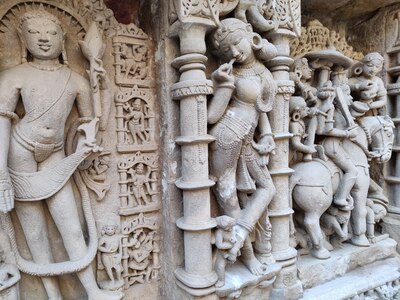
Patan was once a very important place: it was the capital of the Chaulukya/Solanki dynasty, and a significant centre of trade and culture. In Akbar’s time, Patan was part of the suba or province of Gujarat, and this, sadly, was also where Akbar’s former regent, Bairam Khan, was murdered after he fell from grace. Interestingly, Bairam Khan’s son (who became Akbar’s stepson after Bairam Khan’s widow married Akbar), Abdul Rahim Khan-e-Khanan, came to Patan as subedar of Gujarat very early on in his career as a courtier.
Bairam Khan, so I was told by a historian, was assassinated very close to what is the biggest attraction in Patan: the magnificent step-well known as Rani ni Vaav. Udayamati, the consort of the Solanki King Bhimadeva I, had this built in the 11th century, in memory of her husband. The step-well had become inundated by silt and other debris over the centuries, till nothing of it could be seen. It was only in 1958 that the ASI excavated it, restored as much of it as they could, and opened it for public viewing. Today, the Rani ni Vaav is a UNESCO World Heritage Site.
And what a site, too. After about three hours in the car, we were pretty stiff by the time we got out, but the huge, landscaped park in which the step-well is set was pleasant. At first, we couldn’t see the vaav; it is enclosed, at the top, by a very mundane-looking brown-painted railing. But once we got there, we came to a standstill, it was so awe-inspiring.
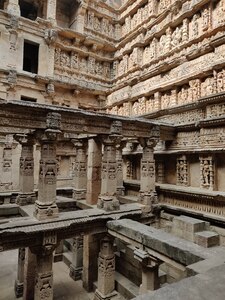
The vaav is massive, five stories deep, but actually with many more stages along the way. The steps descend in a criss-cross pattern, little blocks of five steps each before you walk a few feet, and then take the next lot of steps down.
The carving is spectacular. The walls (duly protected by that same ugly railing) are richly carved, mostly with deities (Vishnu’s ten avatars are especially prominent), but there are other deities, human and animal figures, mythical creatures, and more.

There is even a panel of geometric shapes that (I overheard a guide telling a group) was the inspiration for the ‘double ikat’ patola sarees that originated in Patan.

Visitors to the vaav can only go till a certain point, after which it’s all barricaded. A guard who was standing there got chatting with my husband, and pointed out that, if you peered closely, you could see the far end of the step-well, where a carefully-placed slit allowed one to see the wall opposite, carved with a depiction of a reclining Vishnu.
After Rani ni Vaav, we stopped briefly for lunch in Patan, then drove on, about an hour, to Modhera. Modhera is the home of the Sun Temple, considered to be the country’s finest temple to the sun, after the more famous one at Konark in Odisha. The Sun Temple at Modhera has a connection with the Rani ni Vaav: it was built (in about 1026 CE) by King Bhimadeva I, the husband of the Rani who built the vaav in his memory.
Our first encounter with this temple was off-putting: since it was January 1, some bright spark had had the idea that thousands of people should gather here to do suryanamaskar to set some sort of world record. While that was over, hideous props were still all around, not yet cleared, and looking thoroughly ugly against the otherwise impressive backdrop of the temple.

Fortunately, once we were past these, it was much better. The temple consists of three separate sections: farthest from the gate is the garbhagriha or sanctum sanctorum, which has a narrow corridor ringing it, to allow circumambulation. Next to that, adjoining the water tank (with steps leading down to it), is the sabhamandapa, where assemblies might be held.
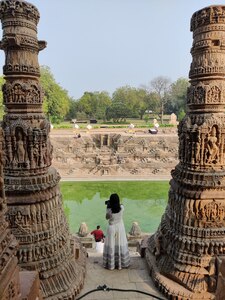
All three (the garbhagriha, sabhamandapa, and tank) are richly carved, every inch of stone covered with sculpture. Very impressive.

After a quick look at the ASI Museum in the grounds of the temple (it’s tiny, but has some very good ancient sculptures), we got back into the car and headed for Rann Riders, in the village of Dasada.
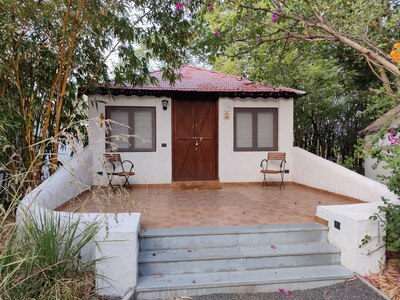
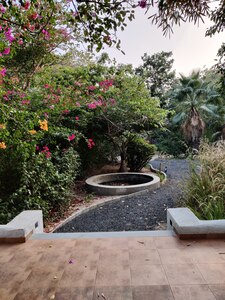
Rann Riders spreads out across a large expanse, bordered by fields, with a series of cottages scattered between trees, tall grasses, and a waterbody. We fell in love with the tastefully decorated cottage that was ours, and all three of us especially liked the very pleasant little verandah in front, where we would sit with books to read and laze when we weren’t busy exploring the wild.
And exploring the wild was top priority. The Wild Ass Sanctuary lies about 45 minutes’ drive from Dasada, and we hired a driver-cum-naturalist from Rann Riders to take us on a tour. It was like no other wildlife safari we’ve ever been on. Not just because this included a picnic breakfast (more about that later) but because the wildlife experience here was so different.
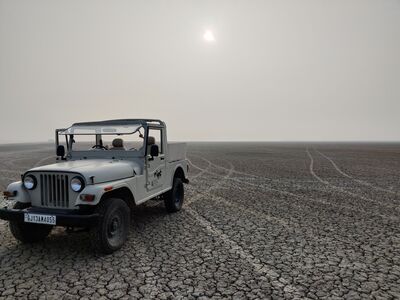
Because the Wild Ass Sanctuary is so huge (at almost 5,000 sq km) and the terrain so hostile, there is really very little of the organised sort of protection and care-taking one sees in areas like Kaziranga and Corbett. There is only one gate near Dasada, the Bajana Gate; and this is the only place where you can stop for a toilet break (very stinky because there’s no water!). Inside the sanctuary, there are no toilets, no watch towers, no roads, even. Nothing but wide, flat plains.
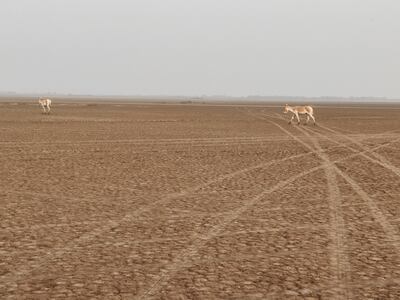
Our guide was a young man named Naman, who, it turned out, had been training to be a chartered account before he decided to chuck it up and follow his primary interest, of nature. The LO, who had once cherished a dream of being a ‘wildlifer’ but gave it up after she realized it might involve coming in close contact with creepy-crawlies, was impressed. Naman told us that a seasonal river named the Rupen wends its way through this part of the Little Rann of Kutch, and when it’s in spate during and after the monsoon, it completely inundates the area, wiping out all traces of any dirt tracks etc. After the water has receded, jeeps like Naman’s remake the ‘road’, so to say, by travelling along these plains.
How they manage it, I cannot imagine. There are a few short stone pillars and various manmade mounds (to allow birds to nest when the area is flooded), but that’s it; finding your way here requires loads of experience, a fantastic sense of direction, and just pure courage.
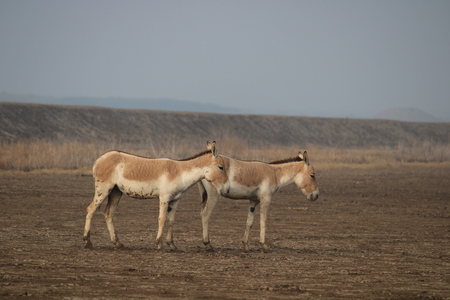
That said, what a fabulous time we had. We saw the wild asses, of course.
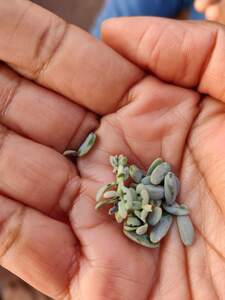
And a common herb, a saltwort locally known as morad, which is a favourite of the asses. Interestingly, the morad was formally documented in scientific circles just six months back.
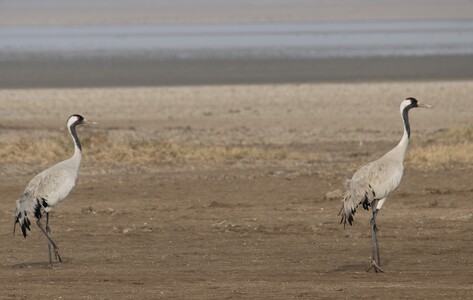
We also saw loads of birds. Swifts and martens darted about the jeep, whizzing about constantly around us in a dizzying dance of movement. Common cranes tip-toed in the grass, and geese waddled by.
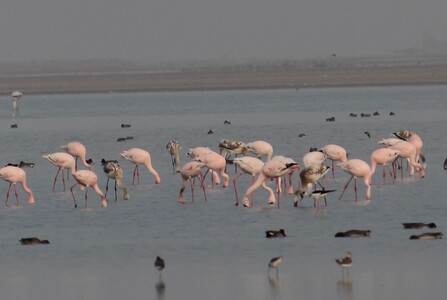
Most spectacular of all were the flamingos. Naman stopped our jeep beside a huge water body covered, not just with the flamingos (greater and lesser), but also many other species of water birds: geese, cormorants, ducks, stork, etc. He set up a spotting scope for us, pointed out lots of species, explained stuff (why flamingos ‘dance’, for instance) and left us, especially the LO, to birdwatch while breakfast was laid out, right there. Sandwiches, boiled eggs, nankhatai, coffee (and Bournvita for the LO): it was the best meal-and-entertainment I’d ever had.
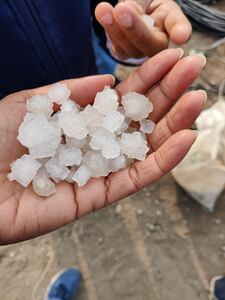
Before we turned back and headed home to Rann Riders, Naman showed us one last interesting element of the sanctuary: the salt pans. 70% of India’s salt, we were told, comes from the Rann of Kutch, and there are a few families here, in the depths of the sanctuary, who hold a lease to harvest it. They use solar panels to operate a pump that draws up saline water from deep underground and spews it into the salt pans, where it crystallizes into salt.

The salt crystals are taken away to be refined and processed, but these people use the crystals as they are in their cooking. It’s so salty, we were told, that they dip a crystal of salt into whatever food they’re cooking, then fish it out, set it aside, and reuse it.
We repeated the snacks-and-coffee routine later that day, when, for a sunset safari, Naman drove us to a wetland known as Nava Talaw. This isn’t part of the Wild Ass Sanctuary, and the terrain is not quite so forbidding. But there were just as many birds, and of many more species as well. All the geese, all the ducks and cranes and flamingos and what not, but also several of the terrestrial species that we hadn’t seen at the sanctuary: coucals, bee-eaters, hoopoes, and so on.
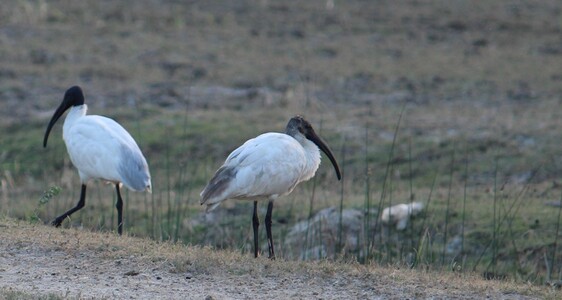
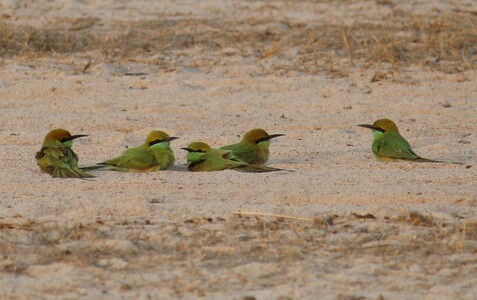
Two safaris in one day might seem like a lot, and we were tired, but also very contented with all we’d seen.
The next day, then, we saw more: and differently. Not from a jeep, but on our own two legs. Morning and evening, Naman took us on nature walks, through the fields that abut Rann Riders. Each time, we first stopped at the resort’s own stables, where they have race horses (Naman informed us that the idea had initially been to use these horses to allow visitors to go on horseback safaris; but the horses would see open ground and set off at a gallop, so now they’re kept only for when race meets are held somewhere). The LO adored the horses—they’re Kathiawadi, the tips of their ears touching above their heads—and, supervised by Naman, made friends with them, patting them, feeding them, and generally making a fuss over them.
Our nature walks, about three hours each, went past fields of castor (the oil is used in Gujarat to rub on stored grains to ward off vermin), arhar dal (pigeon peas), cotton, cumin, and isabgol (psyllium). There were no mammals to be seen here, though we saw signs of several, including neelgai and jungle cat. Naman showed us neelgai droppings, and pointed out how local farmers keep these marauding creatures out of their fields: by stringing glass bottles on wires and scarecrows (the wind makes the bottles clink, a human sound which can deter them); by hanging silver foil (or more commonly, bits of discarded packaging) on fences (it gleams in the moonlight), and so on.
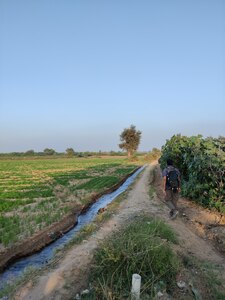
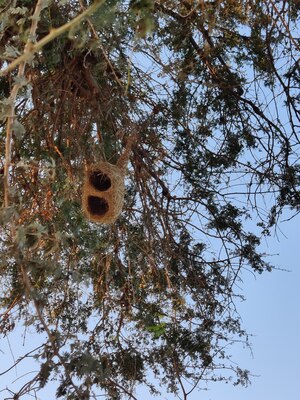
Naman patiently pointed out loads of interesting things to the LO. Why a bush festooned with dozens of spider webs had them all pointing the same way (to catch the wind, and therefore insects borne along on it). What a little dimple of sand meant (an ant lion). What this little funnel-like bit of cobweb was (a funnel web, of course). How to tell which bird was likely to have made those particular footprints. How a baya weaver makes its nest.
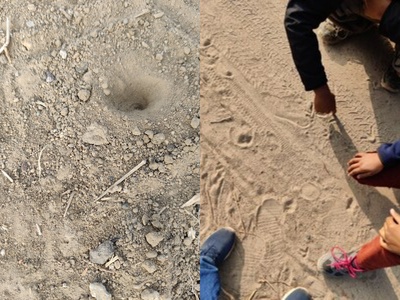
And oh, so much more. By the end of it all, the LO was I think regarding Naman with something close to hero worship. When we got back into our cottage that evening, she sat down and made a thank you card for Naman to give to him the next day on our way out.
She still says that the Rann of Kutch is the best place ever. We too agreed that it has been one of the most unusual and most rewarding nature experiences: so different from any of the more ‘jungle’ ecosystems which most people generally tend to associate with wildlife sanctuaries and preserves in India, and so simply unforgettable.
 Dustedoff
Superbly written, especially loved all the little details both historical and natural. The Rann has been on my travel list for a long time. Now I must make it happen. Thanks, Madhulika
LikeLiked by 1 person
Thank you, Sharmila. I’m so glad you enjoyed this! The Rann of Kutch is indeed fascinating – despite all I’d heard of it, all the photos I’d seen, I still wasn’t quite prepared for the beauty of it. It was quite surreal, and nothing like anything I’ve experienced before. Definitely worth visiting.
LikeLike
What a beautiful description! It all came alive.
Thank you so much for introducing us to this little known Runn of Kutchh.
:-)
LikeLiked by 1 person
Thank you so much, Anupji! Glad you enjoyed this blog post. :-)
LikeLike
So much to catch up on! This was such an interesting read, Madhu. I have always wanted to go to the Rann of Kutch… your write-up has just increased that desire.
LikeLiked by 1 person
I am so glad we were finally able to go to the Rann of Kutch – I too have long wanted to visit, and I was happy that it actually exceeded my expectations!
Thank you for reading, Anu. And for the words of appreciation. :-)
LikeLike
Rann of Kuchh looks like a very impressive and fascinating place (particularly the Vaav)! And some interesting stories…I almost imagined you writing historical fiction based on the history of this place. ☺️
And such a lovely cottage!
LikeLiked by 1 person
Coincidentally (this wasn’t planned), the new book I’d begun writing in December has a part where a character travels to Gujarat as part of Rahim’s entourage when he is appointed subedar… now, after having visited Patan, I’m toying with the idea of changing that a bit and making Patan much more prominent in the narrative. :-) The vaav is stunning.
LikeLike
That’s interesting!
Rann of *Kutch*…sorry. 🙈
LikeLike
:-D
LikeLike
Wow, this sounds like heaven.
The step-wells were so fascinating and the sun temple too.
I didn’t know about the new Salsola species, but then I am hardly in touch with Botany nowadays.
It is so true that people associate only lush forests as nature and forget that particularly so-called barren landscapes can have a greater bio-diversity.
It was so touching to see the LO taking to Naman and his knowledge. Good for her, that she gets exposed to such knowledge so early in life. God bless!
Thanks for the interesting travelogue. Looking forward to more.
LikeLiked by 2 people
Thank you for reading, Harvey! This was heaven, it was such a fabulous experience. Easily one of the most satisfying nature trips we’ve ever had. The LO was initially very sceptical about wildlife in a desert area, but I think this was a fruitful trip for her, too: so important to understand that there are different types of ecosystems!
LikeLike
Madhuji,
This travelogue is really interesting. I have visited many of the places you have listed about 8 years ago. While the Rann is enthralling, so are the tribal villages like Dhordo around the Rann. The handicrafts and the embroidery of the place are stunning! I must also say that Rajasthan and Gujarat have a lot in common when it comes to architecture and water conservation.
LikeLiked by 1 person
We didn’t get the time to visit any of the tribal villages, but yes, I have seen some of the beautiful embroideries they do, and they’re stunning. Some of the women from the local village of Dasada (where Rann Riders is located) did come by everyday with handicrafts etc for sale to people staying at the resort, but we weren’t interested in doing any shopping. :-)
LikeLike
Wonderful pictures and fascinating history as well as nature. Gorgeous carvings!! What more could you ask for!! Thanks for this.
Gujarat is amazing it seems, must try and visit. Rann of Kutch is on my bucket list. BTW the step well is fantastic.
LikeLiked by 1 person
I am so glad you enjoyed this post, thank you so much! And yes, Rann of Kutch is absolutely recommended. Photos or descriptions cannot do it justice.
LikeLiked by 1 person
Just read up your blog on your trip to the Little Rann of Kutch.. as usual, it instantly conjured up images, sights, and strangely enough, even sounds and scents.. making it a beautiful and vivid graphical experience! You are gifted Madhulika – really admire your artistry with words! You would do great writing travelogues and promoting tourism!
Actually the Sun Temple at Modhera has been on my bucket list since some time, and after reading your post, it appears that the Vaav and the Rann are close at hand, making it a real attractive package trip! Will do it one day soon, God willing! Coincidentally my wife and I did the little circuit of Rajkot-Dwarka-Somnath-Junagadh (Girnar) in end Jan too. Our country is just too beautiful! Looking forward to more travel related posts!! Thanks for a great read!
LikeLike
Thank you so much for your very kind words – you’re really encouraging! Yes, I would strongly recommend doing these together, they make for a very good package. I would love to do the Girnar-Rajkot-Dwarka-Somnath tour someday; that would be also quite amazing, I should think.
Over the past couple of years, we’ve decided we should really show our child much more of India than venturing abroad. There is so much to see here, such a very wide and varied range of attractions, a lifetime would be incomplete to experience a fraction of it.
LikeLike
My thoughts exactly, Madhulika! One lifetime is too short to see India itself! Over the years we have traveled much of the world, and still do, on business, but I can say with great pride that there is no country as diverse, as hospitable and as spectacular as ours! My wife and I have taken a decision to first explore India through and through. Last year alone, we traveled to Odisha, did a 12-day temple tour of Tamil Nadu, and then Gujarat. I am big on temple architecture, which is why I’m very keen to see the Sun Temple in Modhera. I will certainly plan a trip along your route, hopefully soon!! 😊
LikeLiked by 1 person
The Odisha trip, in particular, sounds very enticing (because I have never been to Odisha, though I have certainly seen some beautiful temples in Tamilnadu). I am generally quite enthralled with any form of old architecture, temple, mosque, fort, palace, step-well, tomb, anything. So if a place is historic structures, I do want to see. Odisha has been on my bucket list for a while now, and after some family friends visited it a couple of months back, I’m even more eager to go.
By the way, thank you. Your comment has been very inspiring. It inspired me to do a series of temple posts on Instagram and Facebook. My Facebook network is restricted, but if you’re interested, you can have a look, on my Instagram feed. I began today, with the Saas-Bahu Temples in Gwalior.
Madhulika Liddle (@madhulikaliddle)
LikeLiked by 1 person
Great to know about your interest in temple architecture, Madhulika! Just saw your pics on Instagram.. they’re brilliant! Honored to be mentioned! 😉 While this post is about the Rann, and I don’t want to digress.. but Odisha was awesome and you must go! Puri of course.. but I specially loved the Sun temple in Konark (and it’s legends), and Bhubaneshwar with some mind blowing temples like the Lingaraj, Parashurameshwar, Rajarani, Mukteshwar, Siddheshwar and many more. I’ve done a small montage of pics from our Odisha trip and will send it to you on mail. Just one last question.. have you been to the Chennakeshava temple in Belur (Karnataka)? That’s one MUST-see temple – simply phenomenal..!
LikeLiked by 1 person
Ever since my friends went to Odisha, and I heard all their praise, Odisha has definitely moved way up in my list. I will certainly plan for that soon! (and keep your recommendations in mind, thank you).
And yes, I have been to Chennakeshwara. We went on a day long-trip from Bangalore to both Belur and Halebidu, and it was truly memorable.
LikeLiked by 1 person