
(The first part of this series of travelogues, about Sariska National Park, is to be found here).
On our last day in Sariska, we were scheduled to go on a morning safari, and had to wake up at an unearthly hour in order to get to the park booking office by 7 AM. The previous afternoon, we’d all got wet when it rained during our safari. In any case, it was freezing and we were tired. Was it a surprise, then, that we forgot to set an alarm, and overslept?
Frankly, none of us—not even the LO, who gets into a snit about things like this—were seriously disappointed. But this meant that we’d have the day completely free. I suggested we go to Bhangarh.
The 16th century Rajput hill fortress of Bhangarh is located on the edge of Sariska, about an hour and a half’s drive from where we were staying. It was built under the aegis of Maharaja Bhagwant Das of Amber (the father of Mirza Raja Man Singh, one of Akbar’s ‘nauratnas’). After his death, Bhangarh passed to his son Madho Singh. It’s a sprawling fortress, now alas mostly in ruins—and, according to all accounts, the most haunted place in India.
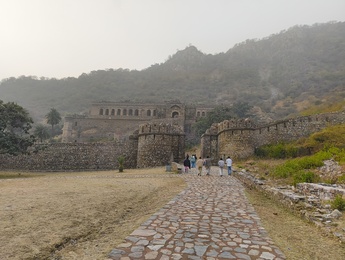
This is perhaps what draws crowds of curious tourists; we had not expected it to be quite so busy a place. But from the parking lot (where a girl about the LO’s age asked us if we’d like to hear the ‘story’ of Bhangarh) to the fort itself, where a passing village woman also offered to tell it to us, there seems to be a concerted effort to capitalize on the spookiness of Bhangarh.
There are two myths regarding the haunting of Bhangarh: one has it that a beautiful princess, who spurned a sorcerer, found herself—and her native Bhangarh—at the receiving end of his ire; he cursed the fort with all manner of horrors. Another version puts the blame on an incensed sadhu, who cursed Bhagwant Das and his fort after the Raja, despite having promised the sadhu that the fort’s shadow would not fall on the sadhu’s hut, was unable to keep his promise.
Whatever the background of it, people now say that the fort is haunted: with nightfall, it is supposed to come alive with all manner of sounds: weird music, shrieks, crying children, singing women (this sounds straight out of Noor Mahal, Mahal, et al). The ASI, who control the fort, don’t allow anyone in after dark for this reason. The ASI actually does close up pretty much all its monuments after dark, so this sounds a little doubtful to me.
Bhangarh did seem a little eerie to me, despite the hordes of tourists. Perhaps it was a combination of the cold, the mistiness, and the ruins. The ruins, especially: the marketplace, for instance, with the occasional arch still standing, but otherwise dead.
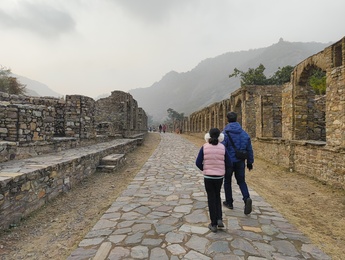
Or the palace that once towered seven storeys high but is now only four storeys: right at the top, there are all these broken bits and pieces, some with traces of fine carving or stucco work still to be seen.
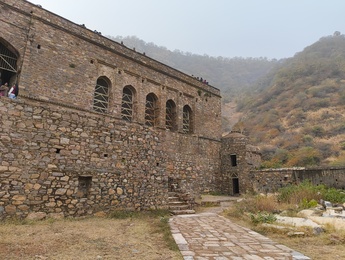
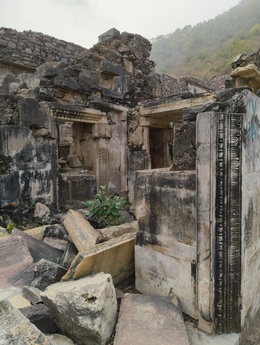
Perhaps the massive banyans—the most gargantuan I’ve seen, in many years of admiring banyans—add to the atmosphere. Check this out; it stretches right across the path that passes beneath. That isn’t two trees (or three) on either side of the path; it’s one tree, all across.

Perhaps, too, there’s something about the dilapidated Gopinath Mandir (no idol in its sanctum sanctorum any more).
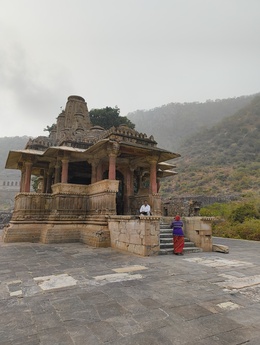
Bhangarh’s paranormal status, such as it is, had not attracted us; but as a historic fort, it was satisfying enough.
Over the next couple of days, while in Jaipur, we visited three more forts, all known more for their grandeur and majesty than anything spooky. In fact, just the day after we visited Bhangarh, we drove from Sariska to Jaipur. Having checked into our hotel (Novotel, quite nice), we hired a cab and went to Nahargarh, the first of these forts.
Built in the 1730s, Nahargarh, like the other primarily defensive fort of Jaipur, Jaigarh, lies well outside the city. Since Novotel is outside the city at the other end, this was a long drive for us: about an hour and a half. Also, since the road is not that wide and the forts (Nahargarh and Jaigarh) are hugely popular, traffic snarls are a real problem.
We realized part of the reason for this popularity soon after we arrived at Nahargarh: several of the palaces in the fort have been given over to other commercial enterprises. There’s a wax museum (à la Madame Tussaud’s, I guess; we saw no reason to shell out their huge entry fee to check it out), several restaurants, and so on.
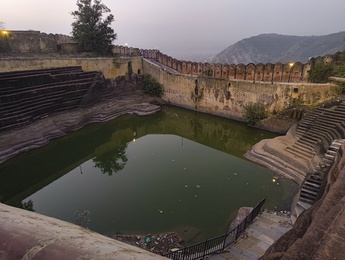
We were more interested in the fort’s historical structures, and these were worth the patience and effort. There is the baori, the huge stepwell, for instance.
And, one of the most gorgeous painted palaces I’ve ever seen, the Madhavendra Bhawan. Built in the late 19th and early 20th century as apartments for the Maharaja and his queens, these palaces are stunningly decorated with frescoes that run the gamut from rather more traditional styles, the sort you’d see in palaces across Rajasthan…
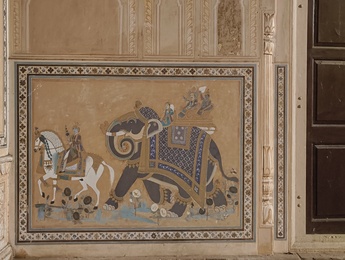
… to something that looked straight out of Europe.
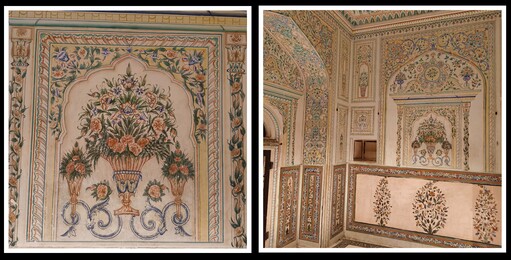
These were exquisite, and because the palaces are illuminated inside and out, you can appreciate them even if (like us) you visit after dark.
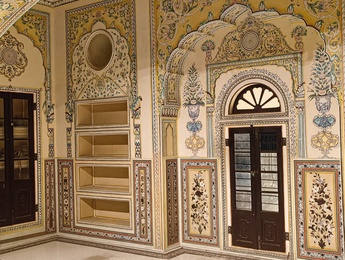
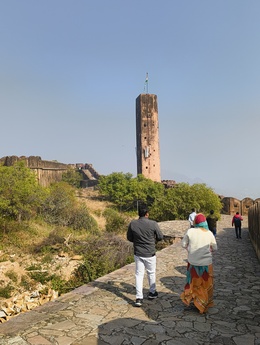
The next day, we added two more forts to our list. In the morning, we again did the long trip from Novotel to the Aravalis outside Jaipur, this time to Jaigarh. Raja Jai Singh built Jaigarh in 1726 on what is known as ‘Cheel ka Teela’ (the ‘Hill of Kites’, though everybody seems to refer to it as ‘Hill of Eagles’); it’s a massive fortification, its ramparts imposing and the current Maharaja’s flag still flying from one of its towers.
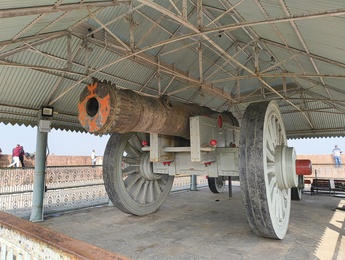
What Jaigarh is known for, though, is the world’s largest cannon on wheels, Jaivaan. Jaivaan was cast in the fort’s very own cannon foundry, and weighs a whopping 50 tons. When it was fired, it needed 100 kg of gunpowder to propel a cannonball weighing 50 kg, and the resultant bang could be heard many miles away. (Actually, the cannon was never really used in battle; it was more a show of power and prestige than anything else).
After Jaivaan, nothing else in Jaigarh could quite measure up, as far as the LO was concerned. She looked a little impressed when we pointed out the huge expanse of the ‘Tanka’, the underground reservoir which was fed by many miles of water channels that snaked over the surrounding hills and into Jaigarh. But since this is underground, and visitors aren’t allowed in, the LO lost interest.

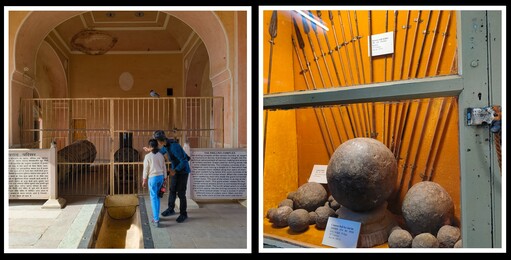
Jaivaan’s much smaller cousin, a cannon called Bajrangvaan, was a damp squib, and though the cannon foundry fascinated us, its mechanics (which her father tried to explain) were lost on the LO. She found the display of weaponry in the Armoury somewhat more interesting, and was surprised that the Jaivaan cannonball—weighing all of 50 kg—should be no bigger than her head.
Jaigarh has the requisite Halls of Public Audience and Private Audience, but these were nothing remarkable.
… not a patch, at least, on their counterparts in the spectacular Amber/Amer Fort, which lies much closer to Jaipur City and is the more ornate fort, the beautiful jewel to Jaigarh’s rugged rock.
Amber has a long history: it was constructed by Mirza Raja Man Singh in 1589 CE, and his successors continued to add to the fort and its palaces all through the following years, right up to the mid-18th century. Because the maharajas of Amber were closely allied to the Mughals, there’s a very strong Mughal influence to be seen in the architecture and art of Amber. Of course, because the Rajput influence is also there, it makes for an opulent and quite gorgeous display of wealth.
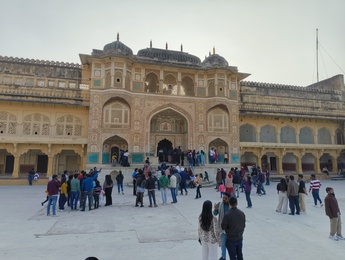
The Ganesh Pol, for instance, has an intricately painted façade that looks very similar to the sort of decoration—both inlay as well as painted plaster—that was used in Mughal buildings in Agra and Delhi. But there is, too, Ganesh painted right at the top, flanked by flowers and tapering cypresses.
The Ganesh Pol, incidentally, has gold leaf used in places. The LO, a lover of all things glittery, was all agog about this.
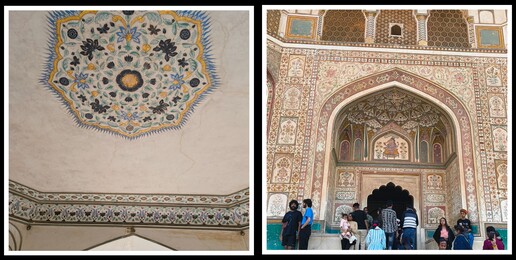
She was even more starry-eyed when we entered the Sheesh Mahal, the ‘palace of glass’. The idea of a Sheesh Mahal (a palace decorated with bits of mirror) is not confined to Amber; this was an architectural innovation that was fairly common across Mughal and Mughal-influenced areas, and we’ve previously seen versions of it in the Red Fort and the Agra Fort (among others): but Amber’s Sheesh Mahal is a class apart. It’s very ornate, and very well-maintained.
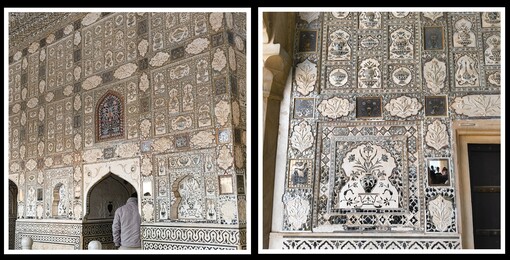
Our guide said: “There was a classic Hindi film named Mughal-e-Azam. You must have heard the famous song from it, Jab pyaar kiya toh darna kya…? That song was picturized here, at the Sheesh Mahal in Amber.”
I thought of telling him no, it was a huge set made at great cost; but then figured he probably wouldn’t believe me anyway, so I let it pass.
The rest of Amber, while interesting, sort of pales when you compare it to the sheer spectacle of the Sheesh Mahal or the Ganesh Pol.
The Zenani Deorhi, a large courtyard surrounded by the palaces of the maharanis, didn’t look as stunning as the ladies’ apartments we’d seen at Nahargarh the previous evening (though it must be granted that we didn’t enter these palaces: we only saw them from down below, so we have no way of actually comparing).
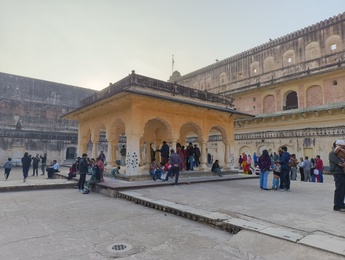
The Diwan-e-Aam, the Hall of Public Audience, bears a passing resemblance—cusped arches, red sandstone and white marble pillars—to counterparts in Mughal forts.
There is a pleasant enclosed garden, too, of the charbagh style, surrounded by palaces on all sides, with parterres, hedges, and paths crisscrossing it. I remarked to the LO that this looked almost a copy of a similar garden we’d seen in Agra Fort, but she’d forgotten about that.

What she did remember as we emerged, an hour later, was that there was a food stall selling (among other things) popcorn, just inside the fort entrance at Chandra Pol. How the kid noticed that among all the crowds milling about, I have no idea; but she calls herself ‘Eagle-eye’ with reason, I guess.
So that was Amber. Tiring, very crowded, but satisfying too.
(Incidentally, if you decide to go to Amber, keep in mind that it isn’t just very popular, it’s also approached by busy, narrow city roads. Traffic around here is even worse than going to Jaigarh or Nahargarh. We hired a cab for the day, and the driver told us that the best time to visit would be either around 8 AM, or after 2—i.e, either before the rush begins, or after the worst of the rush is over. We followed his advice and visited after lunch, but even then, the traffic was pretty bad. The driver informed us that the previous week, tourists he was taking to Amber were stuck for three hours in traffic before they were able to get to the fort).
But Jaipur isn’t just forts. Come back to this blog next week for the last of these travelogues.
 Dustedoff
How lovely! I could visualize these in my mind’s eye, your writing was that descriptive. Rajasthan is a place I very much want to visit; in fact, that was my plan this time, but S looked like a little boy when he said he wanted to see Pedwali. :) Ah, well, next year one hopes!
(Tell LO that she’s not too old to be hugged by me, please.)
LikeLiked by 1 person
I 100% encourage you to visit Rajasthan sometime – it has lots of really beautiful historic monuments, landscapes, and wildlife. We’ve been – minus the LO, before she came along – on numerous trips through the state, and have always been bedazzled.
I do hope you get to see Pedwali and her babies!
(and, don’t worry: the LO is a hugger, she in fact hugs pretty much anybody whom she regards as a parent’s friend… so your hugs will be expected, not merely welcome).
LikeLike
Amber fort also has a lot of secret sliding passages between chambers allowing the King to visit his queens in privacy. I recall seeing them several years ago, not sure if they are still shown to guests.
LikeLiked by 1 person
That’s interesting, I didn’t know about that. In Amber, we took a guide (we don’t usually go with guides, but here it seemed like we’d need one), but he didn’t say anything about that. And didn’t take us anywhere like that – which of course could have been due to paucity of time.
LikeLike
I was actually planning a short trip to Jaipur this month as I was going for a conference there. But as I cancelled the latter, my short trip also got cancelled.
Sad!
Will plan it soon if time permits. Haven’t been to Rajasthan ever.
LikeLiked by 1 person
Oh, that’s a pity that you didn’t get to go. If you get another chance, I would really recommend a trip to Rajasthan. Later today, I will be posting the last of the travelogues for this trip – for Jaipur, other than the forts. Plenty to see even if you’re there only for a couple of days.
LikeLike