
A few years ago, I decided that every year we would visit at least one Indian national park (or wildlife sanctuary). We began with Corbett; then Kaziranga, Little Rann of Kutch, Sariska… and earlier this year, my daughter suggested Nagarhole. The genesis of this suggestion lay in a book, Sutapa Basu’s Murder in the Jungle, which I had gifted the LO (‘Little One’, though we all agree that at 11, she’s no longer little). I had met Sutapa at the book event where I bought this book, and chatting with the author, was told that Nagarhole is one of her favourite wildlife parks in the country. A snippet I passed on to the LO, who was even more enthused after she’d read the book, which is set in Nagarhole.
So Nagarhole it was. But to go halfway across the country just to see a national park, especially when it’s in a part of the country the LO has never been to, seemed pointless. A longer trip, a more detailed itinerary, seemed logical.
I will not waste time and space describing the many iterations our itinerary went through, the many options that we considered before finally settling on a doable journey. We would fly from Delhi to Mangalore, and after staying a day there, we’d drive down to Madikeri (the district headquarters of Coorg). A couple of days would be spent exploring Madikeri and around, and then we’d go to Nagarhole, to spend three days there before heading back to Mangalore to catch the flight back home.
I will admit I knew next to nothing about Mangalore before I began planning this trip. Thanks to some research I’d done some years back on Christmas traditions and Christmas foods (for this book), I knew that Mangalore had been occupied by the Portuguese, who—as in Goa, further down the west coast—had left their mark, in the vibrant Catholic community of Mangalore. I knew, too, that Mangalore has some pretty mouthwatering food.

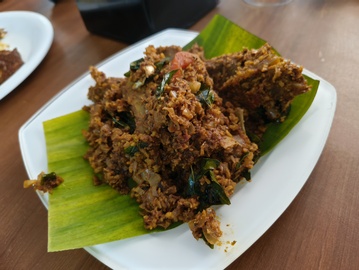
I was looking forward to visiting Mangalore.
I fell in love with Mangalore at the airport itself. It’s an international airport, technically speaking, with two daily flights arriving from the Gulf; and it’s got the facilities and the polish you’d expect of a modern international airport. But there’s a cozy charm to it, in the orchids I saw in a flowerpot inside, in the welcoming life-sized figurine standing at the head of the travelator ramp. In the many sea almond trees lining the road outside.
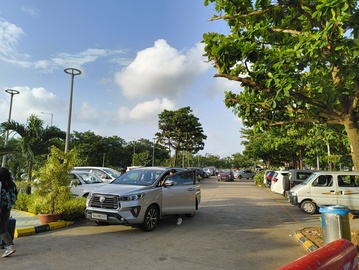
The airport, actually, is very representative of the city itself. Mangalore has the sleekness I’d expect of a much larger city (and, of course, like most cities in peninsular India, it’s far cleaner than urban areas north of the Vindhyas tend to be). It has big brands, well-maintained buildings, great restaurants—but it also has a charm that I generally associate with small towns.
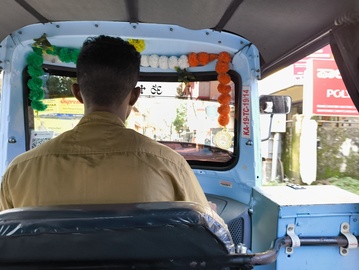
Oh, and a big round of applause for the ease with which one can get around Mangalore as a tourist. Initially, having discovered that Ola and Uber operated in the city, we tried booking a cab; then we realized that the city’s autos are much more reliable. They’re invariably clean and well-maintained; they go by the meter (Noida, Delhi: learn!!), the autowallahs almost never quibble about going someplace, and because it’s not a sprawling (or immensely polluted) city, getting around by auto was, for us at least, a pleasant and economical experience.
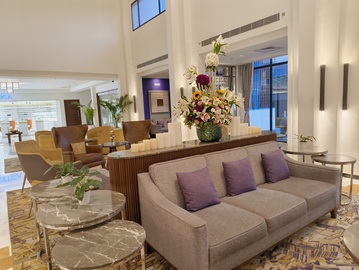
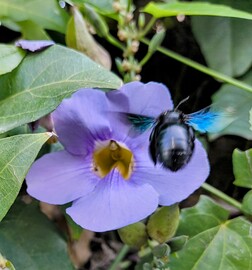
We stayed at the Taj Vivanta, which the LO thoroughly approved of, mostly because her favourite colour, purple, was so much in evidence. From the upholstery in the lobby to the highlights in the carpet and picture in our room, to the carpenter bee (the bhanwra, in case you’d forgotten) flitting about amongst the mauve flowers of the sky vine beside the pool… there was a lot of purple around.
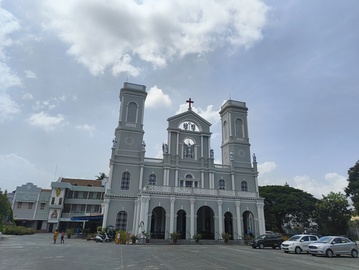
We had arrived in Mangalore in the evening; so our sightseeing could only begin the next morning. We had a few places earmarked to visit, of which the first was an imposing church, Milagres. Milagres Church has an old history, the first building of the name having been built in the 17th century, when the Portuguese established a foothold in Mangalore. The building saw many ups and downs, being destroyed and rebuilt several times over the centuries since.
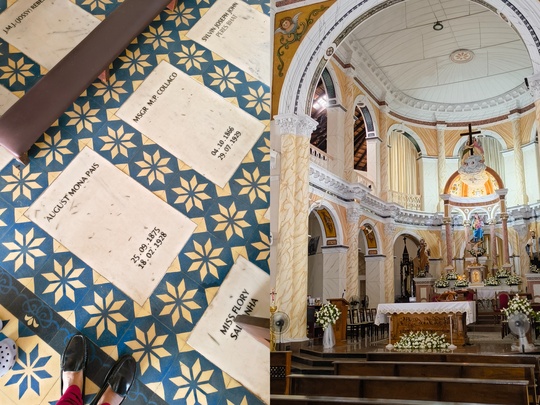
The current building dates back to 1911, and is quite picturesque. Paintings depicting the stations of the cross line the walls, there are ornate statues and chapels, and the floor (which has some pleasing tilework) has white marble memorials to a number of people who have played a part in Milagres’s history: Rt Revd. Thomas de Castro (1674-1684), for instance, who founded the church.
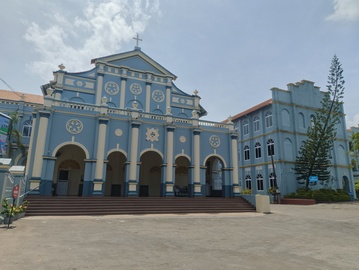
From Milagres, we went to another of Mangalore’s famous churches, the St Aloysius Chapel. This one lies in the heart of a large educational complex, which includes the St Aloysius School and the St Aloysius College. The complex was established by the Jesuits, the college having been built in 1882. The chapel, a pretty blue-and-white building that was constructed under the supervision of Fr Joseph Willy, looked to me—from the outside—like the Milagres Church.
But when we stepped in, it was an eye-opener. My husband and I actually stood gaping in wonder at the interiors of the chapel for a couple of minutes before my husband whispered, “It’s like the Sistine Chapel!” (the LO, not quite so impressed, was busy checking out the holy water in a little receptacle near the door).
Photography is prohibited inside the chapel, but if you scroll through this page, you will get an idea of what we were seeing. Every inch of the walls and the ceiling is covered with paintings: scenes from the life of Christ, illustrations of Biblical themes, the life of St Aloysius Gonzaga (for whom the chapel and the complex are named), and so on. The paintings on the ceiling are canvases, those on the walls are frescoes. It’s huge, it’s fascinating, and it’s very impressive. Equally impressive is the fact that the Italian Jesuit Brother Antonio Moscheni, who was commissioned to paint the chapel’s interiors (in 1889), did so in just over two years, using paints he’d made based on vegetable dyes.
I will honestly say that in all my years of ferreting out old churches across the length and breadth of India, I’ve never seen anything quite so breathtaking. If there’s only one sight you find the time to visit in Mangalore, make it this one.
Next door to the St Aloysius Chapel is the St Aloysius Museum, aka the Aloyseum. This was established in 1912 by a Fr. M Chiapi, with the help of the Collegio Vida in Italy. The museum began life as an herbarium and a collection of minerals and Roman coins; today it’s expanded to a modest-sized gallery that encompasses almost anything deemed to be of some interest.
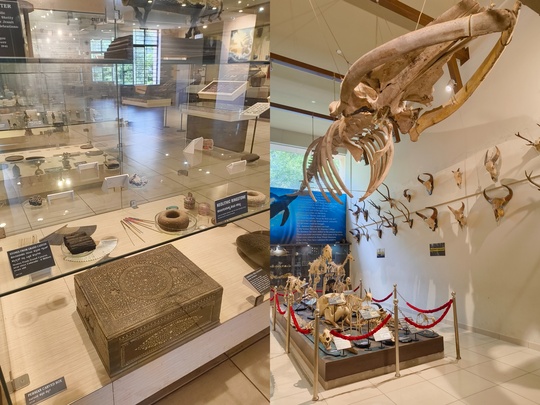
There are old manuscripts here, along with old newspapers; antique furniture, musical instruments, Mangalore’s very first car.
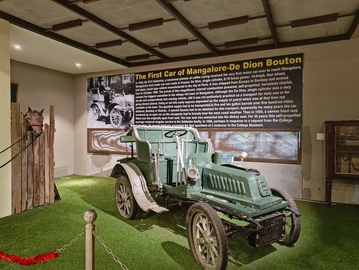
There are collections of various forms of arts and crafts, as well as a small but striking display of animal skeletons. The LO was blown away by the skeleton of a whale here, and couldn’t stop talking about it to any relatives who later asked her what she saw on her vacation.
Very near the whale skeleton was a much smaller creature that I found interesting: a local frog, a species in itself, which is named after St Aloysius College. There is a preserved specimen here, along with a large-scale image and a bit of text, about Euphylictus aloysii. Cool!
The museum also has a fascinating panel, all text, about prominent Jesuits in the fields of science, mathematics and other realms of knowledge. I knew the Jesuits have always been obsessive about knowledge, but didn’t realize just how many of them have really excelled in these fields. And I didn’t know that 38 (yes, thirty-eight) craters on the Moon are named after Jesuits. Wow.
From the St Aloysius Museum, we went to the Kadri Shree Manjunath Temple, located on Kadri Hill and dedicated to Shiva. This temple is supposed to date back originally to the 11th century, but has been added on and renovated so much since then that it’s impossible to discern any historicity in its structures. I am not a Hindu and anyway not very religious, so I entered one of the shrines—dedicated to Ganesh—just out of curiosity. But one look at the brightly painted carved stone pillars, and I didn’t want to see more.
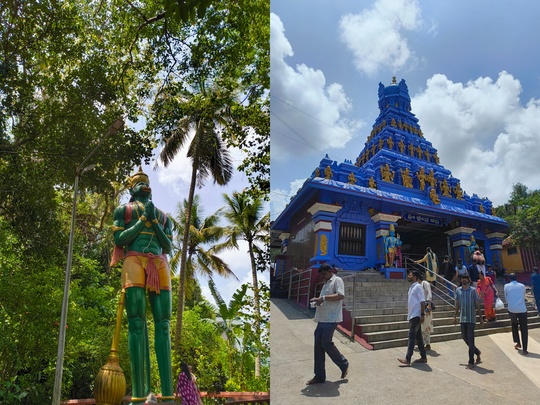
This, really, is a temple for the devout, not for those only interested in old temple architecture. We did go around the complex (which has many shrines to various deities scattered across it, with the main temple in the centre), and even climbed a couple of flights of stairs to a Hanuman Temple. This was of particular interest to the LO, who couldn’t get over the fact that the Hanuman statue outside the temple was a dark, very vivid green in colour.
We had another temple (Kudroli Shree Gokarnanatha) on our list of sights to see, and had been advised (by the autowallah who took us to Kadri Shree Manjunath as well as the churches and museum) that we should visit that in the evening, when it’s illuminated. We ended up not being able to find the time for this, but we did go, in the evening, to a place that’s supposedly quite the ‘sunset point’ of Mangalore: Tannirbhavi Beach.
To get to Tannirbhavi Beach (which is a ‘blue flag beach’, a designation awarded to a beach on the basis of standards pertaining to cleanliness, accessibility, safety, and environmental management), we had to go on a ferry ride across the Gurpur River.
The ferry’s starting point, interestingly enough, is right next door to a Mangalore sight I had heard about before: Sultan Battery, or Sulthan Batheri. Sultan Battery dates back to the time when Mangalore was tossed around between forces. In the 18th century, this port town on the coast of the Arabian Sea was a prize fought over between the British and Haider Ali, the latter capturing the town in 1763 and building a dock here. Though the British were able to wrest Mangalore from Haider Ali just 5 years later, Haider Ali’s son, the famous Tipu Sultan, defeated the British in 1794 and took back the town.
Once he was in control of Mangalore, Tipu built a structure overlooking the Gurpur River, in order to keep a watch on the river—which was an important egress to the city. The structure, since it had cannons mounted on it, came to be known as a battery, therefore ‘Sultan Battery’.

The history of it, and the connection to ‘The Tiger of Mysore’, is rather more intriguing than Sultan Battery itself. The battery is a squat circular tower to which you climb up a flight of broad steps.
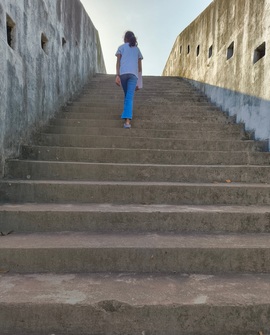
It’s not very high, and once you reach the platform above, there’s really nothing there to see. It’s bare, and when you look out from between the crenellations of the tower, you can see the nearby parking lot and the river beyond.
From Sultan Battery, we took the ferry (a brief ride, about five minutes) across the river. Alighting on the opposite bank, we walked across a stretch of land, past a church and a bunch of shacks, nearly all of them selling fresh-cooked seafood—and then we were at Tannirbhavi Beach. You have to buy tickets here to enter the beach. It’s a pleasant beach, lined with casuarinas and sea cabbage, with a path making its way along part of the beach.
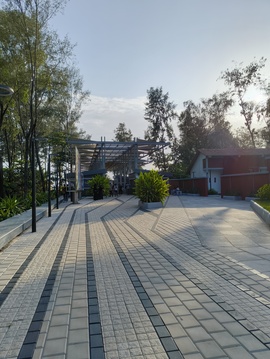
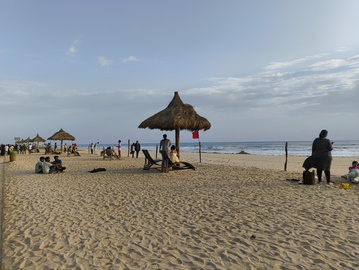
The LO (who is a keen swimmer) was very disappointed that—because the monsoon had arrived—the water was off-limits. I pointed out the fact that she had forgotten to pack her swimming costume, so this hardly affected her anyway, but it was the principle of the thing as far as she was concerned.
She consoled herself by collecting seashells, loads of them.


After which, given that she had nothing to carry them back in, her father had to beg a vendor for a plastic glass (first, of course, we bought two glasses of juice from the man). The LO was a happy camper, and made this glass a receptacle for all manner of natural finds over the course of our week’s vacation, filling it with everything from dried leaves to kingfisher feathers to pebbles and fruit.
And, yes: we ate lots of very good food while in Mangalore. Given that it’s a port town, there’s loads of seafood around, so prawns, fish, calamari and crab were abundant. We also managed to ferret out a restaurant (Mangala’s) that specializes in Mangalorean Catholic food, where we enjoyed local dishes like pork bafat and pork chilli. More about what we ate in Mangalore at this Substack post I wrote.
I loved Mangalore. It was a warm, welcoming city (and the weather was great: neither too hot nor too cold). But we had only a little while here. After spending a full day sightseeing in Mangalore, we left the next morning for Madikeri.
But I’ll get around to that later. Watch this space.


Beautifully capsuled & accurately too
The city & the whole coast had an ethereal quality until the end of 1990s & got spoilt due to industries including a petroleum refinery cum petrochemical complex & unbridled construction activities
Literacy in the coast is more than 95% & wealth is better distributed among all groups in the society due to implementation of land reforms in the early 1970s
LikeLiked by 1 person
I am glad you enjoyed reading this, and thank you for that additional information – it helps provide background to my blog post. Just what it needed!
LikeLike
You were in the town, where my mother was born and where most of my relatives still live, AND you still managed to see in one day more than I have in my entire life.
Loved reading the travelogue, it is as if I travelled with you.
Thank you, Madhu!
LikeLiked by 2 people
Arre, I didn’t know you had a Mangalore connection, Harvey! Small world.
you still managed to see in one day more than I have in my entire life.
I actually don’t find that surprising, because a similar thing happens with me concerning places I have relatives – because every time I visit that city (Calcutta is a case in point; my mother grew up there and we have lots of relatives still there) – we spend all our time just meeting relatives and hanging out with them, not really visiting any of the sights! I guess visiting a place purely as a tourist allows you to focus on the sights.
LikeLike
I really wish to visit Mangalore. I had a reel about Tannirbhavi beach and it’s on my bucket list. I would love to visit that church you mentioned. The weather is also balmy, you say.
LikeLiked by 1 person
You should really visit, Ava, it is such a lovely city! And that church – uff, it’s impossible to describe it, it’s so impressive.
LikeLiked by 1 person
Glad that you liked our city. Recently I had the good fortune to host someone from Mumbai whom both of us know.
LikeLiked by 1 person
I had no idea you lived in Mangalore! Which of our mutual acquaintances visited you, if I may ask?
LikeLike
Dr Rajesh Deshpande.
LikeLike
Ah, okay!
LikeLike
Madhu ji,
Coastal cities have a charm of their own, especially the relatively smaller ones. I remember tasting the Kaju Pak of Mangalore – extremely rich but good…. Goa, Mangalore, Kochi all of them along the west coast, have a lot in common, I feel – the quaint churches, the coconut trees swaying as the wind blows and the beaches.
Anita
LikeLiked by 1 person
I agree, Goa, Mangalore and Kochi (all three of which I have been to – I will also add Pondicherry to that list) have a charm all their own. There’s a quiet beauty to them which I find very attractive.
Didn’t know about the kaju pak! That must be really rich.
LikeLike
Madhuji,
An excellent travelogue describing the beauty of Mangalore and its landmark sites!! Enjoyed reading as it actually takes you there.
Been to Mangalore few times before but only for work or seminars. No sightseeing done.
As mentioned by Dr. Pradeep Shetty, I was there last month to speak at a Medical Seminar. I had a wonderful evening with him, meeting first time in person.
He took me for a delicious dinner at the famous Machli restaurant and the fish thali with fish ghee roast was great.
And then the Pabbas Ice cream, where we enjoyed the signature Gadbad ice cream. I even went there the next day with my colleagues, tried one of their new introductions – Biskoff Sundae.
Next visit, I hope to keep some time for visiting the places you have covered.
LikeLiked by 1 person
Machali was also the first restaurant we visited in Mangalore! Didn’t have the fish ghee roast (though we did have the fish thali), but we had a prawn ghee roast which was delicious. And Pabba’s was delightful. :-)
Yes, the next time you visit Mangalore, do try and see some of the sites. The beach and St Aloysius Chapel, especially, I would highly recommend.
LikeLike
Great post. I saw Mangalore through your eyes.
LikeLike
Thank you! I’m so glad you enjoyed this.
LikeLiked by 1 person
Mangalore Buns! Now I want one! :) Just with tea, like you.
I remember Mangalore fondly; it was even less crowded when I visited (I was a teenager). Thank you for bringing back memories!
LikeLiked by 1 person
Given how charming Mangalore still is, I can imagine how it might have been in gentler, quieter times – sounds idyllic!
Thank you for reading, Anu. I’m glad you enjoyed this.
LikeLike
Loved your article! I was so happy that you visited Mangalore, my home town, and liked it :-)
There are several buildings in Mangalore with Portuguese influence. You mentioned Milagres Church and St Aloysius Chapel. Here’s another one Holy Anglel’s Convent. Unfortunately, this is set to be demolished.
https://daijiworld.com/index.php/news/newsDisplay?newsID=1276588
LikeLike
I loved Mangalore, Usha! I hadn’t known about Holy Angels Convent – it’s such a shame that they are going to be demolishing it. Given that INTACH has done such good work at St Aloysius Chapel (and they’re well-known for having restored much older buildings in other parts of the country), I wonder whether the imminent demolition of this convent is being done with their knowledge.
LikeLike
Some of my friends signed a petition to prevent the demolition and one of them even reached out to the Historical Society in Mangalore. Unfortunately none of these efforts were successful.
I don’t know if Historical Society in Mangalore is the same as INTACH.
LikeLike
No, INTACH isn’t the same as the History Society. This is the Indian National Trust for Art and Cultural Heritage, and they have chapters in different cities. They do a lot of very good work on heritage awareness and conservation in Delhi, and I know that the paintings at the St Aloysius Chapter were also restored by them.
Such a shame that despite the petition by the society, nothing has been done…
LikeLike
Thanks. It’s good to know. It’s a shame that the building got demolished :-(
LikeLiked by 1 person