
(The first part of this three-part travelogue, about our sojourn in Mangalore, can be found here).
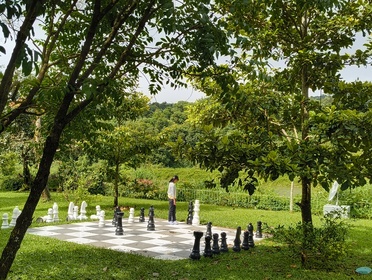
The district headquarters of the hill region of Kodagu (or Coorg, as the British dubbed it) is Madikeri, and this was to be our second halt on our trip through this part of Karnataka. Strictly speaking, we weren’t going to be staying within the town of Madikeri, but just about 15- or 20-minutes’ drive from there, at the Gateway Coorg, a Taj Hotels property. It’s a resort, spreading across 45 acres of land, which—besides the usual buildings, swimming pool, gardens, children’s play area, etc—also included a coffee plantation. And much more, as we soon discovered.

When I’d been doing research and planning this trip, I’d imagined us going into Madikeri for the day and doing sightseeing, perhaps heading out to Abbey Falls and Raja’s Seat (among Madikeri’s more popular attractions) and basically coming back to Gateway Coorg just to unwind. That didn’t happen, mostly because of the weather: it rained on the day we’d allocated to go sightseeing.
On its own, that didn’t deter us. But the driver who was taking us into town informed us that the road to Abbey Falls involved walking for some 300 mt: not something we wanted to do in the rain, when hill slopes can become treacherous.
Raja’s Seat, we were told, was mostly a garden with a fine view. A fine view obliterated by rain, which we therefore decided to skip.
What we could visit, since it was in the middle of town, all level and not muddy, was Madikeri Fort. Dating back to the 17th century and built by the Kodagu ruler Mudduraja, the fort—from what I could gather—has several sights worth seeing. Including a large palace, and a museum.
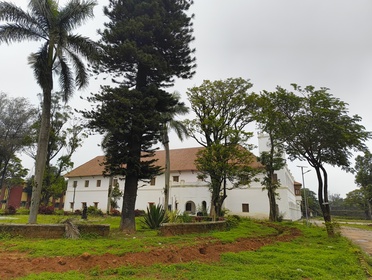
The palace, to our disappointment, was closed off for renovations. The museum was open, and housed in what was obviously a deconsecrated church. The church, according to a sign outside, had been constructed in 1855 and in 1971 was converted into this, the Government Museum of Madikeri.
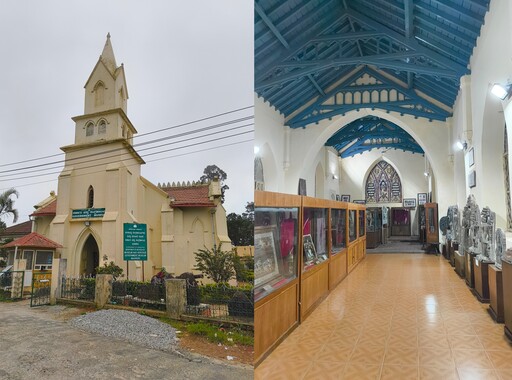
I have never, I think, come across a museum in India that charged an entry fee and was so abysmal. This one had a bunch of artefacts, ranging from 14th century stone sculptures to modern carvings and paintings, but everything was just too haphazard, too badly maintained, and too poorly labelled to make much sense. We had a quick look through the exhibits, spent considerably more time admiring the building itself (nice stained glass, some interesting old plaques, etc), and then exited.

Madikeri itself may have proved a damp squib (very damp), but I hadn’t realized just how satisfying Gateway Coorg would prove to be. Not because we let ourselves be pampered at the spa or paddled about in the pool-with-a-view (the LO was especially unhappy that she had forgotten to pack her swimsuit); but because the place made for so much exploration of nature. The rooms are set right in the midst of all that greenery, so all we had to do was step out into the attached balcony, and we’d see (and hear) birds all around.
Or, we’d walk out onto the path leading to the restaurant, and as we walked along, beside the coffee plantation, we’d be sure to see not just all the lovely flowering shrubs and plants along the way, but also occasional creatures: a bi-coloured frog, for instance; or various butterflies.
The good thing is, Gateway Coorg offers not just the opportunity to immerse yourself in nature thus, but to actually learn about it: they have two in-house naturalists, Ganesh (‘the bird man of Coorg’) and Anoop, who take guests around on various walks, both within the limits of Gateway Coorg and also a little further afield. We had booked three of these walks, and the first one—the coffee plantation walk—started just about half an hour after we arrived.
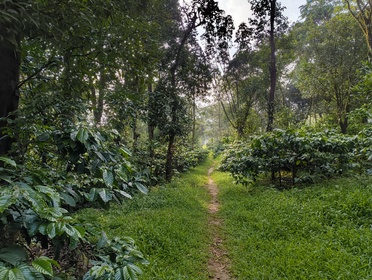
This proved to be fascinating. Ganesh began by telling us the story of how coffee was first discovered in Yemen by a shepherd who found his sheep surprisingly alert, bright-eyed and bushy-tailed after feasting on the red berries of a small tree, and how coffee eventually became so popular in the Arab World that they guarded it fiercely, allowing only the roasted and powdered product to be exported. How ‘the father of Indian coffee’ (as I privately dubbed him), Baba Budan, went on haj and smuggled back, safely ensconced in his beard, seven unroasted coffee beans…
We were shown the two types of coffee plants; arabica (gentler, milder) and the more aptly-labelled robusta (which doesn’t just taste far stronger, it also has larger leaves and a thicker trunk). The coffee-making process, from harvest to processing, was explained. We also learnt that while India doesn’t grow a huge amount of coffee (3% of the world’s production), the bulk of India’s output, around 88%, is grown in Coorg.

I had expected to learn something about coffee. What I hadn’t expected was to learn so much more, see so much more.
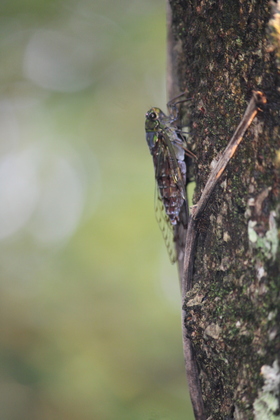
Even before we’d actually got into the coffee plantation, we’d encountered what turned out to be one of the noisiest non-human denizens of Gateway Coorg: the cicadas, whose loud buzzing at times became so loud we found it drowning out other sounds. Ganesh, interrupted in the midst of his talk, showed us where it was, up on a tree trunk nearby (so well camouflaged that it took me a good deal of time to spot it).
Wandering between the coffee trees (which are short and shaded above by other trees, including silver oak), we were shown other trees, especially the spices that are grown all across the more humid regions of peninsular India. Allspice, for instance; and Indian bay leaf. Pepper, which trails in vines up the tree trunks. Ganesh plucked a little string of green peppercorns and handed one each to all of us. The LO, who is not exactly a fan of pepperiness, popped it into her mouth all unknowingly, but then—to my surprise—gamely went on, not uttering a squeak.
The LO, in fact, behaved rather more maturely than we’d expected. On both the subsequent walks we went on (a night walk later that day, a bird walk the next morning), there were other little girls around, mostly of around the LO’s age. Not, however, with as accommodating an attitude towards nature as (I am proud to say) the LO’s.
On our coffee plantation walk, she had no qualms about stroking a cicada which Anoop gently held to show her.
On the night walk, she similarly touched a millipede that had rolled itself up into a ball. And, when the leeches (more about these later) began to appear on our clothes, while the other girl along with us screamed and jumped about hysterically, the LO bore it all with relative fortitude (and later told me, somewhat snootily, that the other girl was a ‘DQ’. A drama queen).
On the bird walk, she directed some very disapproving glances towards a rather loud little girl, whose high-pitched voice tended to scare away pretty much most of the birds we approached. It took some reminders from us, that the LO had been a similarly chatty (and loud) kid in her younger years for her to tone down the snobbishness and consent to help the little girl over a somewhat rough path.
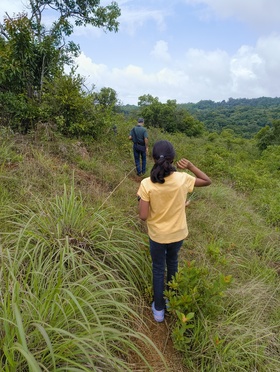
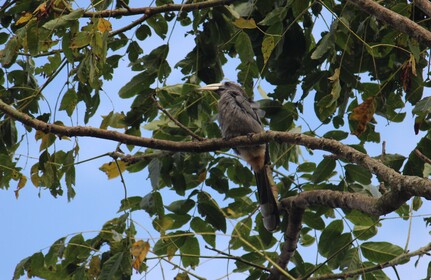
The bird walk, an almost three-hour ramble across the countryside surrounding Gateway Coorg, was actually a little disappointing for the children, at least. Because this is forested area, the birds tend to vanish into the trees. Ganesh lured several birds into responding to him by perfectly mimicking their calls, but despite his best efforts, only a few species actually showed themselves clearly enough to be admired and/or photographed. (Ganesh was pretty much the LO’s hero: she was in awe of his ability to mimic birdcalls, and for much of the trip afterwards, the LO was trying to mimic coucals and koels, and driving me batty in the process).

What the LO really loved was the night walk. This is an occasion to catch a glimpse of the more nocturnal species of Coorg, and we had been told that it would begin at 7 PM. By then, it had started drizzling, so we assumed that the walk had been called off. But no; the walk was still on. We would take umbrellas and go out. Before that, though, we had to be kitted out. Off came our shoes, and over our jeans, we had to pull on long, thigh-high ‘socks’ which were partly plastic (up to the ankles) and partly thick cloth. These had to be then tightened round the legs, and shoes worn. All to keep off the leeches.
Anoop, who is a whiz at the amphibians, reptiles, insects and such that can be seen at night, took over the reins during the night walk. (Eventually, though, the rains took over the reins, forcing a watery end to our walk).

Our walk began, a light drizzle forcing us to open our umbrellas as we followed Anoop and Ganesh through the grounds of Gateway Coorg. We were shown stuff here and there: various frogs, a common Asian toad, the previously-mentioned millipede, a huge fungal growth that had blossomed up beside the path.
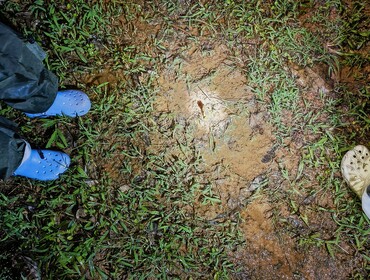
Anoop led us downhill slightly, and then unlocked a large gate that opened out onto the woods beyond. This, he told us, was called ‘Elephant Gate’, because sometimes wild elephants came this way. From here, he led us up into the woods, where (though we didn’t see any elephants, or even signs of any), we did see the hoofprint of a gaur, the massive Indian bison that’s found in these parts. Cutely enough, sitting right in the middle of the hoofprint was a cricket frog.
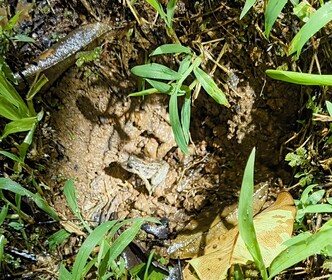
We saw several other species: frogs (the very local Wayanad bush frog, and a huge bull frog, among others), a stem-borer beetle, crickets, a wild cockroach. Anoop stripped some (very tart) fruit off a local Coorg orange tree, and we peeled and ate them while juggling umbrellas and torches.
And then the leeches found us. One of us discovered a leech wiggling its way up a ‘leech sock’ leg and then, when we began examining ourselves (and each other), they began emerging all over. My husband found one on the back of his neck, and (much later that night, when we were back in our room) discovered that one of them had got under his watch strap and left his wrist all bloody.
What with the leeches and the (by then pouring) rain, Anoop finally decided we should head back to the hotel. I was, frankly, rather relieved. My sneakers were soaked through (as were my jeans, shin down); my jacket was also pretty wet, and I had a horrible suspicion that a leech had gone down my back.
It took most of the night as well as the next day for our jeans and jackets to dry out, even though we kept the fan on in our room. My husband volunteered to be the one sitting on his haunches and using a hair-dryer to dry the sneakers (Anoop’s suggestion, and we were so grateful!).
But the LO thought it was the very best part of the Gateway Coorg experience. In fact, when we left Coorg for Nagarhole, she remarked, rather wistfully, that she wished she could have gone on one more night walk before we’d had to leave.
Come back to this blog next week to read the last instalment of this trio of travelogues. That one’s going to be about Nagarhole.
 Dustedoff
May I summon temerity to say that Coorg or Kodagu grows about 35% of coffee produced in India, while Karnataka produces about 72% of coffee grown in India
Coffee came to Chikkamagaluru first & then spread to Hassan & later to Kodagu
Baba Budan, a sufi saint, not only brought coffee, but also ushered in singular syncretism in Chikkamagaluru until a political party decided to spoil it for polarizing people in their quest(lust?) for power
LikeLiked by 1 person
Thank you for correcting that. Ganesh, obviously, got carried away in his praise for Coorgi coffee!
I remember reading, in a biography of Gauri Lankesh (if I remember correctly) about the syncretism surrounding the Baba Budangiri shrine. It’s so disheartening that, in the current atmosphere of power-hungry politicians, such syncretism is swiftly becoming a thing of the past.
LikeLiked by 1 person
This travelogue gave me so much joy (most of which, I must confess, are due to LO’s antics). I have always loved Coorg – we visited it quite often when we were living in Bangalore – and it’s lovely to read of familiar places. No, not the Taj resort, which definitely wasn’t there when we went, nor could we have afforded to stay there had it been. I’d love to revisit Coorg again. Perhaps another time. (And Pondicherry – well, Puducheri now – if you haven’t already been.
LikeLiked by 1 person
Taj actually has two properties in this area now, about 3 km apart from each other – this one is considered the lower rung one, so we could well imagine how utterly out of our league the luxury one would have been!
Coorg was simply divine, Anu. This was the first time either of us had visited, and it was even lovelier than we’d imagined. The LO, of course, completely bowled over both the naturalists with her obvious enthusiasm for nature. Ganesh, when we were leaving, requested a photo with her “because you’re such a good girl”. And Anoop, when he discovered that she’s especially interested in snakes, did a one-on-one 45-minute presentation on snakes just for her. :-) She basked in all their admiration, so it was really all very mutual.
I love Pondicherry too. I’ve been there several times, most memorably for a 2 week-long writers’ residency back in 2009. Wonderful place, and I got to do a day trip to Tharangambadi/Tranquebar, which was absolutely unforgettable!
LikeLike
Your writing about your travels is always interesting and lovely in detail. I did not know you had a youtube channel, but see it has just started. Is the area in which you make your home very “green and natural”?
LikeLiked by 1 person
I have actually had a YouTube channel – as MsDustedoff – for several years now, only for uploading the once-in-a-blue-moon video or piece of music that is specific to me (my uncle’s guitar playing, for instance). I wanted to post this video on that channel, but I think YouTube just grabbed my usual gmail ID and created a channel all on its own. So now I have a channel I never even intended!
LikeLike
I have never been to Coorg. What you have described sounds wonderful and what I’ve heard about it till now was always in superlatives. Maybe someday… Love to see that LO’s passion for nature goes on. Bless her!
LikeLiked by 1 person
We really loved Coorg, Harvey, as you can see. Will definitely and whole-heartedly recommend it, especially for someone who loves nature.
Re: the LO, there was a time, some years back, when she was saying that she wanted to grow up to be a ‘wildlifer’. Now she has more run-of-the-mill ambitions (singer, model) but I am subtly working on nurturing that love for nature. :-)
LikeLike
Madhuji,
I have been to Coorg and have some lovely memories of the place. I am not sure whether you visited the Dubare Elephant Camp. That’s a lovely place to go to, to feed the elephants and see them taking a leisurely bath!
And WordPress is not allowing me to add this comment for your earlier post on Baaz.
Baaz is the only movie where Talat lip-synched for Guru Dutt- Mujhe Dekho Hasrat Ki Tasveer Hun Hai!
Anita
LikeLiked by 1 person
We did go to Dubare too – that, along with Namdroling, will be covered in the final instalment of these travelogues.
I don’t know why WordPress is being so idiotic. :-( I had a look at the spam folder too, wondering if maybe your comment had gone there, but no such luck. Thank you for pointing that out – yes, when that song came on, I was pleasantly surprised, because I hadn’t heard Talat as Guru Dutt’s voice before. I did wonder if there were any other songs of the two, so thank you for answering my unspoken question!
LikeLike