
Not even half an hour into this 1959 British film, directed by Basil Dearden, and I was wondering: “Why isn’t this one better-known? How come I hadn’t heard of it before?”
Having finished watching Sapphire, I think I know the answers to those questions. It’s not as if Sapphire is an obscure film; in Britain, in knowledgeable film circles, it’s probably fairly well-respected, given that it won the BAFTA Award for Best Film in 1960. But here in India, while British cinema of earlier years (Hitchcock’s early cinema, the films of Laurence Olivier and Leslie Howard in the 30s and 40s, for instance) were the stuff of my childhood film-watching—thanks to Doordarshan, which would air the great classics—by the 1950s and 60s, the cinema that seemed to be most popular was Hollywood. I am not talking of what English-language films were actually screened in India back then; I am talking of the 50s and 60s English-language films that were aired by Doordarshan in the 1980s and early 90s, when much of my film-watching was on TV.
Anyway, better late than never, I guess. I finally watched Sapphire (because of a serendipitous discovery on YouTube; the film is available here). And this, I can safely say, is one of the more unusual noir films I’ve seen. While it is a solid police procedural, a whodunnit revolving round a murdered woman, it is, too, a comment on society, on norms, what is right and what is wrong.
The story begins on Hamstead Heath, where two little children, playing with their ball, tumble onto the body of a young woman (Yvonne Buckingham) who’s been stabbed to death. The police are called in, and Chief Inspector Bob Hazard (Nigel Patrick) comes with his team to examine the scene of crime. The young woman’s body is taken away for autopsy.
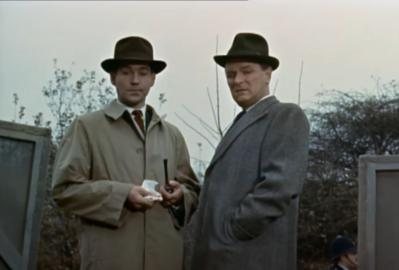
Later, back in his office, Hazard is talking to his junior, Inspector Phil Learoyd (Michael Craig), discussing the case. The dead woman’s clothes have been sent to Hazard, and he is a bit puzzled by what he sees. The tweed skirt is very staid, very respectable; the bright red taffeta shift is quite a different thing altogether. Like the handkerchief (white, very prim and proper) that was found, this too is monogrammed with an S.
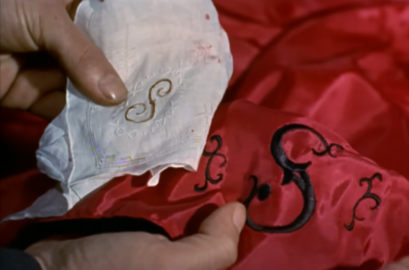
What sort of person was this woman? A free soul on the inside, trying to make sure she conformed on the outside? And what about the man who killed her? Learoyd thinks he was a frightened boy; Hazard disagrees. A frightened person will stab once or twice, no more. This one stabbed repeatedly: was he (literally) in a murderous rage?
This girl was killed in hate, not fear, says Hazard. He thinks, too, that she may have been a student. A student who went away for the weekend, and never came back. Check the colleges and academies in town, Hazard instructs Learoyd, for a student who hasn’t returned after the weekend, and whose name begins with S.
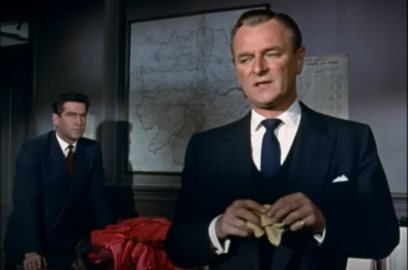
… and sure enough, that is how they find out who the murdered woman was. Her name was Sapphire Robbins, and she was indeed a student, at the Royal Academy of Music. A young man, a friend of Sapphire, is found, who comes to the mortuary to identify the body. David Harris (Paul Massie) turns out to not just have been Sapphire’s friend; he was also her fiancé. They were going to be married.
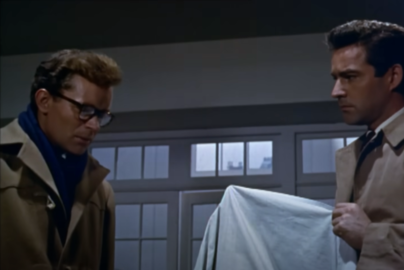
Later, in Hazard’s office, answering questions, David reveals that he last saw Sapphire on Friday night. On Saturday, he had gone to Cambridge to sketch (he’s a student of architecture) so he wasn’t at home. But he was told (presumably by his family) that Sapphire came to visit the family sometime after lunch on Saturday. To Hazard’s questions about his own travels to and from Cambridge, David replies that he hitchhiked back from there, arriving home at about 11 in the night. He doesn’t remember the number plate of the car in which he took a lift, but does remember the make.
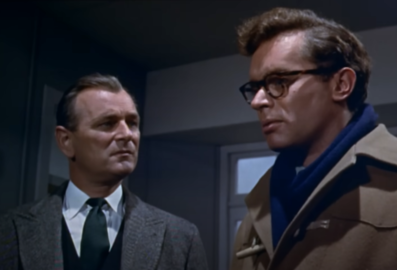
Hazard has already found out that Sapphire has a brother, a Dr Robbins, who lives in Birmingham. Word is sent to him, summoning him to London and to Hazard’s office. While they wait for him, Hazard instructs Learoyd to have radio announcements made to try and find the car driver who gave David a lift from Cambridge to London; they need his testimony.
… and the two police officers go to the room Sapphire rented. It’s rather messy, but the landlady (?), with whom Sapphire had been staying the past six months, doesn’t seem to be fazed by it. That was the way Sapphire was. A gramophone is there, prominently placed: the landlady says that yes, Sapphire was very fond of it; used to listen to it for hours every night.
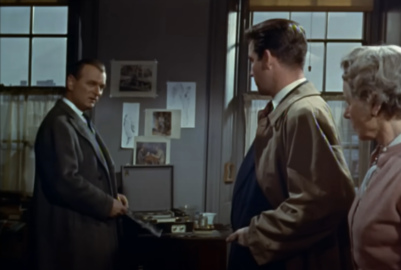
When Hazard starts searching through the chest of drawers in the room, the landlady is reluctant: outright distressed when he is forced to wrench open the lowest drawer, which had been locked. But when she sees what spills out of it—masses of gaudy, flimsy stuff, very like that red shift Sapphire had been wearing under her tweed skirt—the landlady is shocked. This was not the sort of clothing Sapphire wore, not at all.
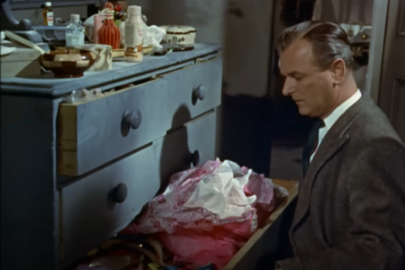
A puzzling picture of the young woman is emerging. Who, really, was Sapphire Robbins? Was she schizophrenic? Did she lead some sort of double life? Hazard and Learoyd are even more bewildered when, trawling through her possessions, they find a photograph that’s been ripped in half. Sapphire, dancing, bright and vivacious, but the man she’s dancing with has been torn out of the photo.

The first glimmer of what Sapphire’s double life might have been about comes to Hazard when he returns to his office later that day. The officer on duty lets him know that Sapphire Robbins’s brother, Dr Robbins, has arrived—and when the man (Earl Cameron) enters Hazard’s office, Hazard is taken aback by what he sees. Dr Robbins is black.
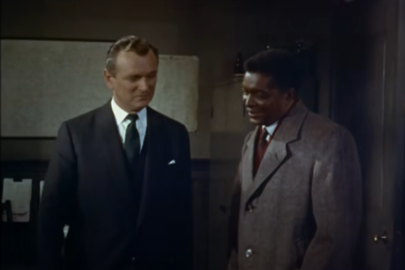
The doctor, from a lifetime (possibly) of experience, can see what’s going through Hazard’s mind, and he explains. His and Sapphire’s parents had a cross-ethnic marriage: their father was white, mother black. He looks like their mother; Sapphire looked enough like their father to be able to pass for white.
Sapphire may have looked white, but she was actually coloured. Did David know this? Did his family—since he and Sapphire were going to be married—know? A further complication now arises, a twist in the tale: the autopsy report of Sapphire comes in, and it reveals that she was about three months pregnant.
Hazard asks David if he knew. Firstly, that Sapphire was pregnant; and (equally significant, if not more) the fact that Sapphire wasn’t white, though she looked it. David says yes to both questions; she was pregnant with his child, he knew it. And he knew that she wasn’t white.
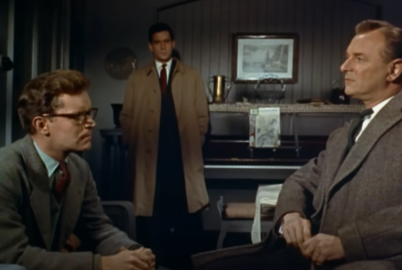
Hazard has realized, especially because of these two unexpected truths about Sapphire, that it will be necessary to call on David’s family—also, of course, to cross-check his statement about having been away on Saturday and returning home only late at night.
Hazard and Learoyd therefore go to the home of the Harrises. David’s father Ted Harris (Bernard Miles) is a guarded sort of man. A man who may—because courtesy demands it, and because his son was going to marry the dead woman—claim to have no objections to David marrying a coloured girl. But when Hazard asks if they knew Sapphire was coloured, and follows up the affirmative answer to that with another question—since when—Mr Harris snaps back that they knew, that was all. He has no intention of saying since when.
David’s mother (Olga Lindo) is a distressed-looking woman who seems to have been struck a bad blow by Sapphire’s death, though she says little. Her daughter, David’s elder sister Mildred Farr (Yvonne Mitchell) is married to a man in the merchant navy. Mildred’s husband is constantly travelling, so Mildred and her two little daughters live, at least for the time being, with the Harrises.

Like her parents, Mildred is tight-lipped about her true feelings regarding David’s relationship with Sapphire. She says all the right things, but from her expression, it doesn’t seem possible that she could have welcomed Sapphire as a potential sister-in-law.
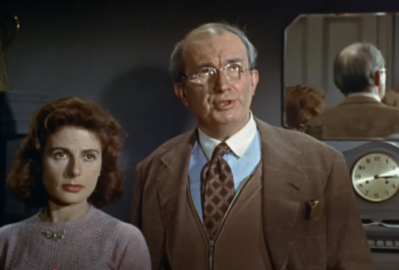
Hazard and Learoyd continue with their investigation. Learoyd, from the moment he’s discovered that Sapphire was coloured, has been prejudiced. He passes snide remarks about Sapphire. For example, when Hazard is trying to find out where Sapphire could have bought her red taffeta slip, Learoyd comments, “Yes, that’s the black under the white, all right.”
As Hazard digs deeper, he finds more of what Sapphire might have faced. More anger, more hatred, more resentment of different kinds. And that’s not all; there is other, equally puzzling, stuff: in David’s behaviour, for instance. Or in that of his father (whom an acquaintance describes as being ‘bigoted’).
Who murdered Sapphire so viciously? And why?
I began watching Sapphire simply because police procedurals are among my favourite crime/mystery genres. It is a solid whodunnit in that sense, a good example of the genre. But, because of the racism angle that is woven into it from the moment that Dr Robbins steps into Bob Hazard’s office (and the police realize that there was more to Sapphire than met the eye)—it becomes something more, far more.
What I liked about this film:
The way the idea of racism is tackled. Racism has been dealt with in several other films of the 50s and 60s, but the best-known films about it (Guess Who’s Coming to Dinner, The Defiant Ones, Imitation of Life, etc) are mostly from Hollywood. To Sir, with Love does have a theme of racism running through it, but the film’s focus is, I think, more on the student-teacher dynamic. Sapphire, in that sense, is different, unique: a British film that looks squarely at racism, makes racism the focus of the story.
And how well this has been done. What a nuanced screenplay (by Janet Green), what hard-hitting dialogue (Lukas Heller’s was the additional dialogue); what superb direction by Basil Dearden. All of it comes together to show the many ways racism manifests itself. On the one hand, there is someone like Learoyd, blindly believing in something so stupidly biased that he doesn’t even stop to think of how illogical he is. He accompanies Hazard to question the doctor whom Sapphire met to diagnose her pregnancy; Learoyd asks the doctor if she said she was coloured, and when a (bewildered) doctor says no, Learoyd chuckles and says, “Bet she didn’t; but you can always tell, can’t you?”
Unlike Learoyd, there are people who know, deep down, that there’s something shameful about their prejudice, which is why they don’t openly express how they feel—but when push comes to shove, that inherent racism surfaces.
There are, too, white people who aren’t racist, but in what varied ways they, too, treat blacks. On the one hand, there is one of Sapphire’s former landladies, who admits that she had to ask Sapphire to leave. Not because she had anything against Sapphire being coloured, but because others—lodgers, neighbours—would protest.
Perhaps this woman’s relative position on the social scale might have something to do with her giving in to other people’s prejudices: she can’t afford it. The doctor (to whom Learoyd addresses that distasteful remark, above) is obviously far more affluent, privileged: enough to be able to swiftly take Learoyd down a few pegs with a remark that neatly demolishes the policeman’s stance.
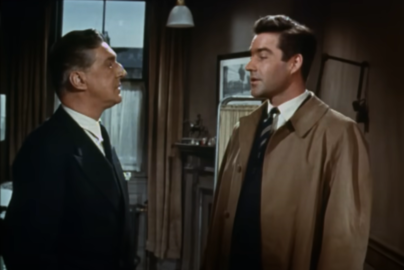
There is, too, an interesting look at the other side of the coin when it comes to racism. There are blacks in this story, and not just Dr Robbins. And their views come through occasionally, in ways which are telling. A very polished, suave young man comes to Hazard’s office to answer the cop’s questions, and adopts a snootiness that he later laughs about when he’s with another black, a woman. They agree that it’s the best attitude to adopt with whites.

Another black, a young nurse, offers an insightful comment on what it might mean to be able to pass for white even though one is technically black.
(Which, of course, is one thing about racism that I wondered about throughout this film, and through similar films like Imitation of Life: the idea that being ‘coloured’ is on the inside; your actual skin colour doesn’t matter. You can pass for white but if you’re actually black, God help you).
What I didn’t like:
There wasn’t very much here to dislike; this was a film that, overall, I found engrossing as well as thought-provoking. It was satisfying as a whodunnit and a police procedural, and as a commentary on society and its schisms, it was hard-hitting and (I think) ahead of its times.
Yet there was one element that jarred: the idea that all blacks must really enjoy music, that black women must always be wearing bright clothing. The fact that Sapphire, in the privacy of her room, puts on her gramophone every night; that under her staid tweed skirt, she wears bright red taffeta—this is racial stereotyping. Sapphire, to pass for white, must cover her loud blackness.
But yes, despite that, an excellent film, and highly recommended.
 Dustedoff
I’ve never heard of it but your review has me intrigued. Will definitely watch it at some poiint.
LikeLike
Whenever you do watch, let me know what you think of it, Soumya.
LikeLike
I was intrigued enough to watch it yesterday. I liked it immensely. Although it was a police procedural it didn’t feel like it. Unlike a whodunit the movie does not provide explanations at each step and does not tie it up in a bow at the end. Some of details as to how the body came to be at the place it was found was not really explained although it was hinted at in some scenes. The racism angle was well handled and woven, sometimes subtly sometimes not so subtly, into the scenes. What I liked was it showed that racism works both ways. The acting was very good, especially by some of the black actors. Yvonne Mitchell was superb in the denouement. Great recommendation Madhu.
LikeLike
I am so glad you enjoyed this one, Soumya. Yes, the deduction angle fell through a bit there, but as you mention, the racism – especially the different ways it’s manifested (including how it works both ways): that is really good. Talking about racism working both ways, that scene where Hazard goes to meet that older man (I’ve forgotten his name now) and is surrounded by his friends, all of them grinning and laughing and crowding around Hazard… that really underlined, for me, the idea of ‘reverse racism’. But then perhaps at least in this case, it’s natural: when they see they’re in the majority, they take advantage of it, even if the man they’re taking it out on is blameless (but then, aren’t victims of racism mostly blameless too). It’s complicated.
LikeLike
I’d never heard of this film either, though I have watched quite a bit of British cinema. Will definitely watch this sometime soon, Madhu. Thanks for the recommendation.
LikeLike
Do watch, Anu. And let me know what you think of it.
LikeLike
First time I am hearing about this movie. It never came up in my feed. It sounds to be quite an interesting movie.
The fact that the movie won a BAFTA, made me have a look at the history of BAFTA Awards. There I discovered that I. S. Johar got a nomination for his role in Harry Black (1959) as British Best Actor. So that means he had British Citizenship. The film Harry Black (1959) sounds very much like the usual exotic-tiger-infested-India sort of a movie.
All the three Apu Trilogy movies also got a nomination for best foreign films in the respective years.
LikeLike
Oh, don’t watch Harry Black and the Tiger! It’s quite bad. :-( I watched it because it sounded like a Jim Corbett-like story (and I like Corbett’s writings a lot); Stewart Granger (a favourite of mine) and IS Johar (who was very good in North West Frontier). But this film is a travesty. There’s a love interest – a woman whom Harry Black used to be deeply in love with, and who’s now married and come to the Indian outpost where Harry Black is stationed, trying to shoot a man-eater. It’s cliched, overly melodramatic, and pretty boring. IS Johar is very good though (IIRC a New York Times review of the film remarked that he was the only highlight of the film).
LikeLike
Don’t worry dear. I had no intention of watching Harry Black and the Tiger. The synopsis of the film on Wikipedia put me off. I would rather watch Sapphire. It seems to have considerably more depth. One week back I would have had time for it. Now it seems a bit difficult. Nevertheless, I will bookmark it and keep it for a rainy day.
LikeLiked by 1 person