
In 2024, I read William Dalrymple’s The Golden Road: How Ancient India Transformed the World. It’s a fascinating, informative book, and I was hooked from the beginning—which contains a very interesting description of the discovery of the Ajanta Caves. A British cavalry officer named Captain John Smith stumbled upon the caves while out tiger hunting in 1819, and the cultural treasure he discovered forms the basis for Dalrymple’s exploration of the wonder that was India.
I have had Ajanta (and Ellora) on my bucket list for God knows how many years, and reading so vividly about the caves spurred me on. I had to go see them. My husband had visited both Ajanta and Ellora many years ago as a child and remembered little of them, and our twelve-year-old, the LO (‘Little One’, though she is by no means little any more) of course has never been. So, in the winter break, between Christmas and New Year’s Eve 2025, we spent five days in Aurangabad.
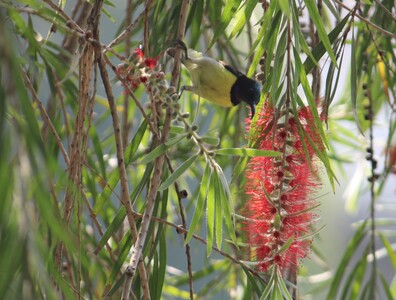
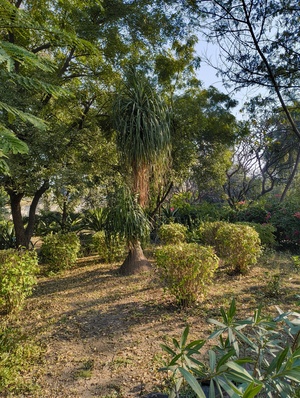
We were booked at the Gateway Aurangabad (formerly the Taj Vivanta, which is the name by which most auto-wallahs in the city still refer to it). A nice hotel, low-rise, and with a fairly large green space at the back. The LO (who, like me, is a nature buff) spent a good bit of free time exploring the grounds with me, oohing and aahing over the trees, the flowers, and the birds. The birds, especially, were a treat.
Our flight had arrived in the evening, and the next morning, we went to visit the first place on our list: the Ellora Caves. Ellora is about an hour’s drive from Aurangabad, and we were informed that since the highway also goes past Daulatabad Fort and Khuldabad (which is home to the tomb of Aurangzeb), we could combine all three sights in one journey.
The Ellora Caves were carved out of rock between the 8th and the 10th centuries CE, during the rule of the Rashtrakuta kings. They are a melange of Hindu, Buddhist and Jain temples, with the most famous and most impressive one, the Kailasa Temple, being situated pretty much right opposite the entrance/ticket counter. Kailasa Temple is in Cave #16, and on either side of it stretch other caves, connected by a path, wide and with a good surface. For those who have mobility issues, wheelchairs are available; but since one needs to climb steps to reach pretty much all of the caves, this isn’t all that useful.
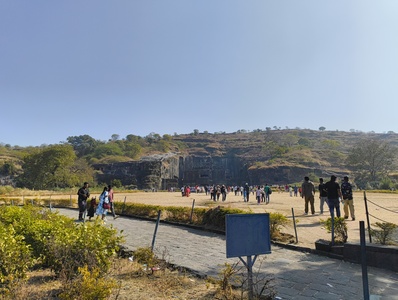
We began by visiting the Kailasa Temple, which is the world’s largest monolithic structure, and stupendous: it is carved out a single block of stone, and that by scooping the rock out of the hillside. The temple—not one structure, but several interconnected ones, spreading across different spaces and different levels, all surrounded by a gallery—is huge, and all of it exquisitely carved (though sadly prone to erosion, since most of it is open to the elements).

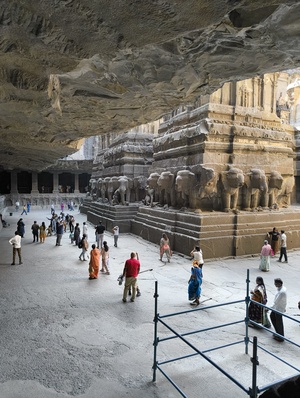
In more sheltered places, we could still see traces of paint covering the carvings. Was all of this once not just carved but painted? I can only imagine how beautiful it must have looked.
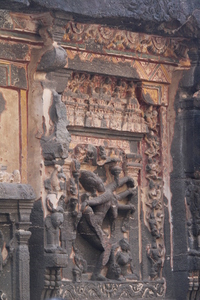
After spending the best part of an hour at the Kailasa Temple, we went along the path to the caves on either side. These are much less ornate, though there is still plenty of beautiful carving to be seen. The trek to left and right of Kailasa was long, it was getting pretty warm by this time (it was past noon), and after a while, all the caves seemed to be blurring into one. Also, the LO was getting tired and cranky, so after we’d seen about two-thirds of the caves, we called it a day.
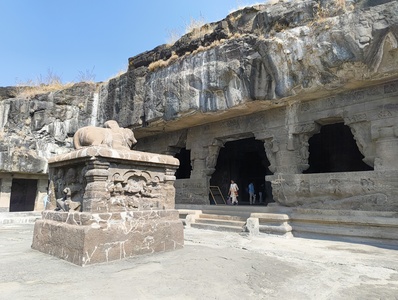
… and we gave Daulatabad and Khuldabad a miss; we’d do them another day.
Incidentally, the day we visited Ellora, the site clocked a record 14,000 visitors. It was very crowded, especially at Kailasa (we got the impression most people come only for Kailasa. The further away you move from this temple, the fewer fellow tourists). Of course, this was in the last week of December—when so many people are on vacation—and this happened to be a Saturday, so it’s hardly surprising.
We were so put off by the crowds, we decided to keep our visits to Daulatabad and Ajanta for Monday and Tuesday respectively. Hopefully the crowd would be a little less.
Accordingly, on Monday, we went to Daulatabad. One of India’s most formidable forts, this was originally built in the 11th century CE by the Yadavas of Deogiri, and so was known as Deogiri Fort. Later, the fort came to the attention of the Delhi Sultanate, and the Khaljis conquered it. Most famously, it was chosen by the mercurial Mohammad bin Tughlaq as his new capital when he decided to shift the court from Delhi to the Deccan in the 14th century (he was the one who renamed Deogiri ‘Daulatabad’). Later still, the fort was ruled by others: the Bahmani kingdom, the Mughals, even the Nizam of Hyderabad.
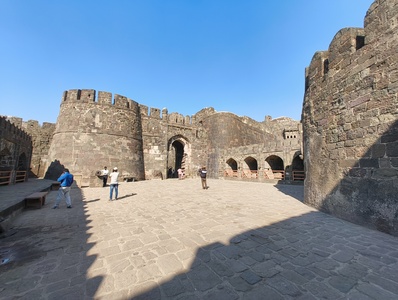
Our driver had told us that it was an hour-long climb to the fort, and an hour back, which was a bit daunting—until we entered and realized that that walk is mostly fairly easy, and the real ‘climb’ is only at the fag end, when you go up many steps to get to the top. The hour it takes to get to this point is mostly because you make detours along the way to see the sights.
There’s a stepwell (the Saraswati Baodi), which—even though I have a soft spot for stepwells—didn’t particularly impress me. There’s also the interesting Bharat Mata Mandir, an ironic reflection of our current obsession with trying to change history. This was originally a Hindu temple, but was (like at Adhai Din Ka Jhonpda in Ajmer, or the Quwwat-ul-Islam Mosque in Delhi) converted into a mosque. It’s now back to being a temple, with a rather gaudy statue of Bharat Mata installed in the sanctum sanctorum.
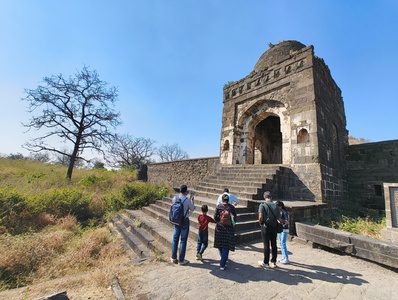
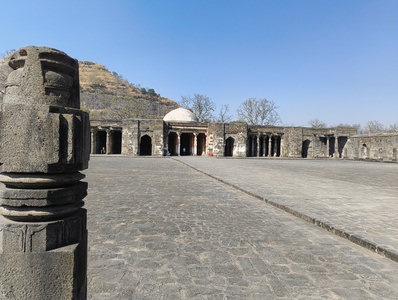
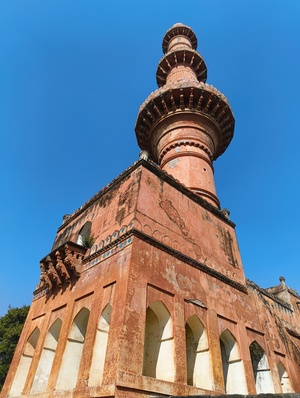
The most visible of the structures in the fort is the Chaand Minar, a victory tower built by Ahmed Shah I of Ahmednagar: it can be seen from afar, and is quite beautiful.
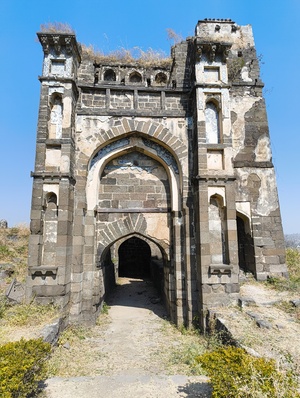
Beyond this, the path climbed steadily to the inner areas of the fort. We admired the Chini Mahal, so named because it was once adorned with tilework (some remnants can still be seen).
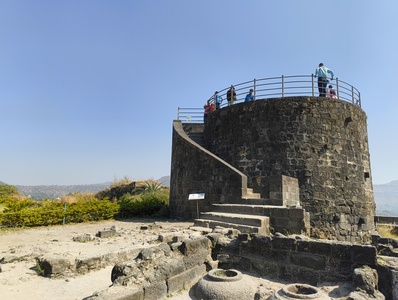
We went up a short bastion to have a look at the Mendha Tope, a cannon forged during the reign of Aurangzeb.
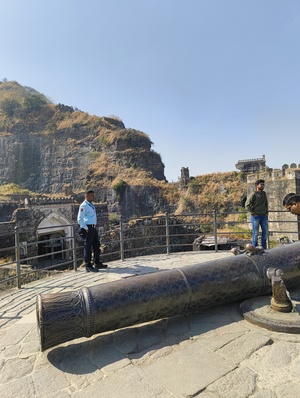
From here, past a moat (its water stagnant, green, and full of discarded plastic), you enter the Kala Kot or inner area, and the Andheri, a series of pitch-dark tunnels and passages that were created to confound and trap infiltrators. Railings have now been put up here, along with lighting, but it’s still rather claustrophobic. The LO and I explored these tunnels for a while during the time my husband (the only one eager to go on) ascended the long, long flight of steps to the top of the fort.
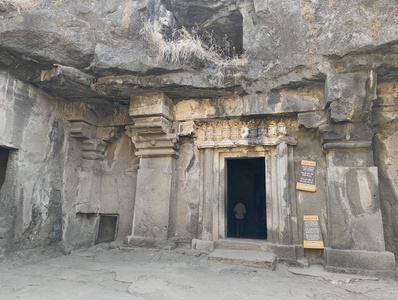

From Daulatabad to Khuldabad is a drive of only about 20 minutes. This is a small town, little more than a village, but it’s home to the tomb of Aurangzeb: his spiritual guru, Sheikh Zainuddin, is buried here, and so Aurangzeb had decreed that on his death, he should be interred nearby.
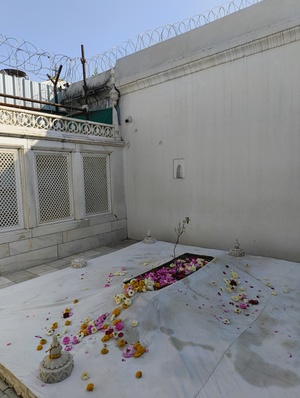
Aurangzeb’s tomb is a far cry from the magnificent mausoleums of much of his clan. According to his wishes for a simple grave open to the skies, there’s no structure here, just the grave covered with a large sheet and strewn with flowers. The marble floor and the pierced marble screen (jaali) around the tomb were added by the viceroy Lord Curzon at the turn of the century.
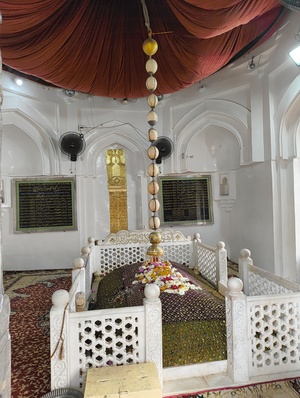
Within the same complex are other tombs as well: those of Aurangzeb’s son Azam Shah and his wife; and of course, of Sheikh Zainuddin. Near the tomb of Sheikh Zainuddin is a space, shielded by a gilded screen, behind which a garment of the Prophet Mohammad is kept; this is taken out for display only once a year, but one of the local caretakers told us about it.
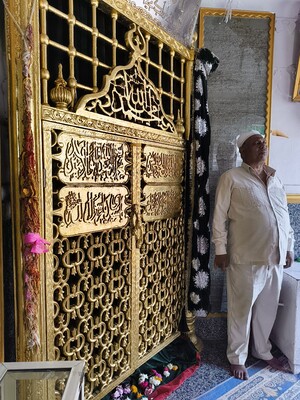
For the LO, the most intriguing element in this complex was a chain that hung above the cenotaph of Sheikh Zainuddin. It consists of ostrich eggs, emptied and cleaned and made into this very unusual decoration.
Last up on our list of sights for which we would have to travel out of Aurangabad was the Ajanta Caves. This was also the furthest out of town we would need to go: a little over 100 km, just over 2 hours’ drive. Most people refer to ‘Ajanta-Ellora’ in one breath, as if they were one and the same, but it’s not so. For one, unlike the mixed religions (Hindu, Jain, Buddhist) of Ellora, Ajanta’s monasteries and prayer halls are Buddhist and were created between the 6th and 2nd centuries BCE. For another, they lie in a different space, nowhere near Ellora.
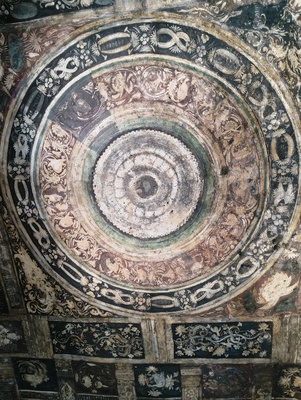
Also, unlike the carvings of Ellora, these are known for their paintings (though there are large sections which are carved, and exquisitely too).

It’s because of the paintings that no fossil fuel vehicles are allowed within a few kilometres of the caves. Our driver dropped us off at the car park, and from there we had to take a bus (electric, I assume?) to the base of the hill from where the path to the caves begins.
This, to be honest, was very annoying. Buses were few and far between, and we were obliged to stand in line for 1.5 hours. The LO and I passed our time admiring the trees in the vicinity, playing word games, etc, but her father (not the most patient of men) was fuming silently through it all.
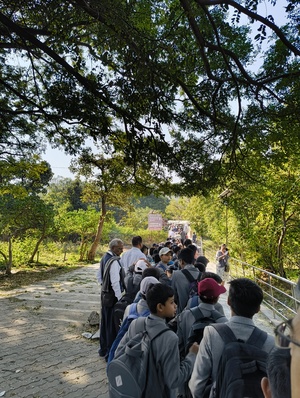
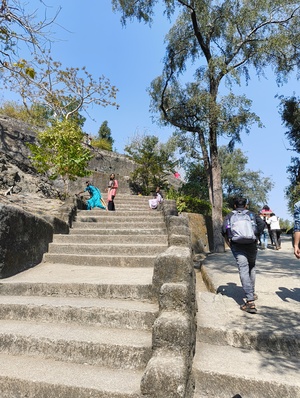
The buses terminate at a large visitor centre, which consists of public washrooms and a guest house, the latter home to a basic but large restaurant which serves thali meals: very useful, we discovered after we got back from viewing the caves. The path to the caves leads from just opposite this guesthouse, and rises steeply, in a flight of broad shallow steps. There were men with sedan chairs around, four men to a chair, and they tried to get us to use their services. ‘Bahut unchaayi hai, saat sau seedhiyaan hain,’ (‘It’s very high, you’ll have to climb 700 steps’). We didn’t take them up on their offer, and just as well. Those 700 steps (if 700 there are; I doubt it) are divided across some 25-odd caves. You go into a cave, you look around for a few minutes, then you come out and (sometimes, not always) you go up or down a few steps in order to get to the next cave. Unless you are really unable to walk or navigate stairs much, the sedan is quite unnecessary.
The crowds here were pretty bad too, but at each of the major caves (that is, the ones with the most extensive and intricate painting and/or carving) they have guards and a sort of turnstile system. The guards let in only a set number of people at a time, so you have to wait your turn.
… and the paintings are stunning. Personally, I found I liked Ajanta a wee bit more than Ellora. Yes, Ellora is lovely (and the Kailasa Temple is truly a wonder), but there’s something about the sheer beauty and skill of Ajanta that left me in awe.
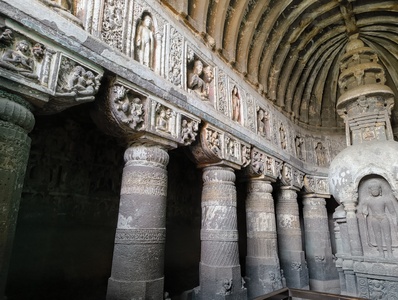
The landscape outside too does it justice: the caves overlook a horseshoe-shaped gorge, through which the Waghora River flows. There are trees, birds (parakeets, in particular) and langurs.
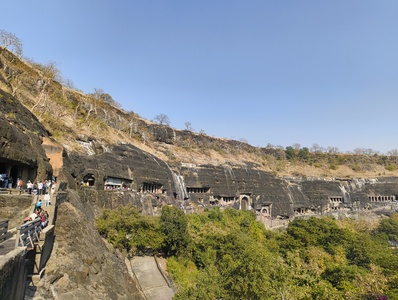
Both Ajanta and Ellora did live up to the hype as far as the caves themselves are concerned. I was, however, rather disappointed with the logistics of both places. These are UNESCO World Heritage Sites, mind you; but the sort of crowd management that keeps things generally sane at places like the Taj Mahal or the Red Fort (for instance) is missing here. Even apart from the crowds, there are other irritants. The buses at Ajanta, for example: so ramshackle and filthy, I would not have travelled in one if I’d had a choice. Then the fact that at both places you are constantly being pestered by hawkers selling postcards, other souvenirs, cut fruit, etc. At Ellora, in fact, you have to exit through a narrow corridor made of thick wire mesh, choked by hawkers who’ve set up stalls all along the inside of the corridor, leaving very little place for visitors to walk.
Anyway, despite those glitches, two extremely impressive sights, and well worth the trip.
Watch this space for the next blog post, which will be about what we saw and did in Aurangabad itself.
 Dustedoff
I am an aurangabadi and loved seeing aurangabad through your eyes .waiting eagerly for the next blog
LikeLiked by 1 person
I am so glad you enjoyed this! Thank you for reading.
LikeLike
This makes me want to visit Ajanta and Ellora right away.
Thanks for the travelogue, Madhu.
Yes, the management of the heritage sites in India can leave one really in tears.
LikeLiked by 1 person
management of the heritage sites in India can leave one really in tears.
It makes me see red! What I find even more annoying is that it’s not as if we lack the expertise or the funds (the latter more so for UNESCO World Heritage Sites, given that the UNESCO provides funding). There are, after all, some really good museums (Humayun Museum in Delhi, Partition Museum in Amritsar, just to name two) and some very well-maintained heritage sites (Qutb Minar, Humayun’s Tomb, the churches of Goa) – not just well-maintained, but well-managed, even though they too have high footfalls.
LikeLike
This travelogue makes me want to pack my bags and go right back to India! The caves at Ajanta and Ellora have long been on my bucket list of places to visit as well.
I have a funny story re: these caves – my sister and brother-in-law visited them when their children were about 6 or 7. After going into quite a few caves, my younger nephew had had enough. He sat on one of the steps outside and refused to move. When his father tried to get him to “come see the next cave”, he mutinously declared – “I’m tired. I don’t want to see buDDha, buDDha, buDDha!” Of course, he meant Budha and not बुड्ढा but it was hilarious. In any case, that was the end of their ‘BuDDha’ viewing. :)
LikeLiked by 1 person
LoL! Anu, that’s such a cute anecdote. I can totally sympathise – after a while, it does tend to blur into a never-ending procession of Buddhas (or Hindu deities, in the case of Ellora), and the long walk does take its toll on little legs. The LO was drooping and demanding Coke well before we had finished.
LikeLike
I’ve always been fascinated by the Ajanta Caves, what inspired you to read The Golden Road? 🤔
LikeLike
A publication wanted me to review The Golden Road for them, which was why I read it. In any case, it sounded interesting, so I was curious about it.
LikeLike