
I have a confession to make: I’ve never actually got around to watching, as far as I can remember, any of Buster Keaton’s films. The great American comedian, a contemporary of Charlie Chaplin’s, is often regarded on par with (if not better than) Chaplin. His The General, about an engine driver who accidentally becomes a Civil War hero, is considered by many to be a masterpiece, with Orson Welles calling it the ‘greatest comedy ever made’ (and ‘possibly the greatest movie ever made’).
It was about time I watched The General. Especially since it’s easily available (it’s in the public domain, you can even watch it on YouTube, here).
The story begins in Marietta, Georgia, in 1861. Engine driver Johnnie Gray (Buster Keaton) has just come into town, driving his beloved engine, which is named The General. The General is Johnnie’s great love, along with the pretty Annabelle Lee (Marion Mack). Johnnie attends to his beloved engine, then goes off to meet Annabelle.

Just then, news arrives that war has broken out. All the men are suddenly eager to enlist, and Annabelle’s father (Charles Henry Smith) and brother (Frank Barnes) hurry off to join up. Johnnie too gets into line—in fact, he’s so eager to enlist, he scurries ahead, breaking the queue to get to the front.
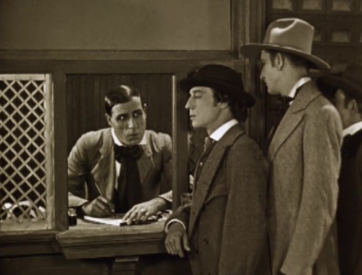
Unfortunately, as soon as the men at the enlistment office discover that Johnnie is an engine driver, they turn him down. He will be far more help to the South as an engine driver than as a soldier. Even more unfortunately, they forget to tell Johnnie why he’s been turned down.
Johnnie, not one to be so easily dismissed, gets back into line. Again and again, trying different, and increasingly desperate, methods of getting a foot in the door. Even to outright stealing the enlistment papers of a man who’s enlisted successfully but whose attention was briefly elsewhere when his papers were being handed over.
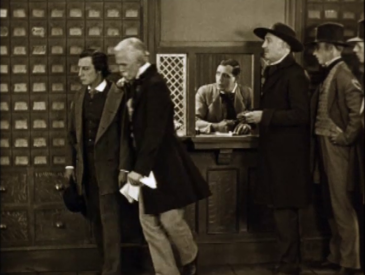
Johnnie ends up not a soldier, and unaware of why he’s being rejected. He’s thoroughly dejected, and even more so when Annabelle comes to know: her father and brother, both now soldiers, are heading off to the front, and she is both disappointed in Johnnie and angry at him for what she sees as sheer cowardice. Annabelle tells him curtly that she won’t speak to Johnnie again until he’s in uniform.
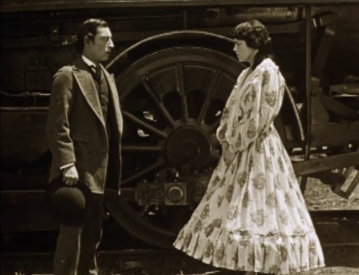
A year passes. Annabelle’s father has been wounded in battle and Annabelle decides to take a train to go to him. The train she’s going in is being pulled along by The General, and Johnnie, of course, is the engine driver.
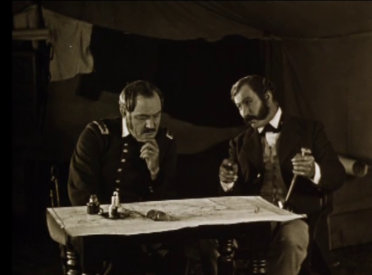
Meanwhile, in the Union camp, plans are being made to sabotage the South. Captain Anderson (Glen Cavender), the spymaster in this part of the states, is in conversation with his boss, the Union general. Anderson has come up with a plan to wreck the South’s supply lines. He shows the general a map, showing the railroad. At Big Shanty (one of the stops along the line), Anderson says, he and his men will steal a Southern train. Having commandeered the train, they will then go down the track, destroying bridges all along the way and thus stopping the Southern troops from pursuing them.
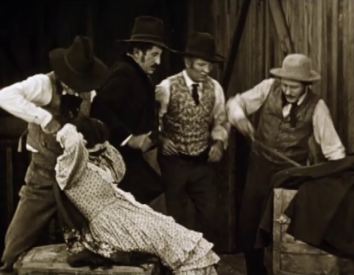
Anderson and his men carry out their plan, descending on the train they’ve earmarked for stealing while it’s stopped for a twenty-minute break at Big Shanty to allow the passengers to have a meal. Anderson’s troops quickly climb into the empty train and move off, discovering only once they’ve started that one of the passengers is still on board. Annabelle was rummaging about in her luggage for something, and when the Union soldiers find her, they gag and truss her up immediately, and take her prisoner.
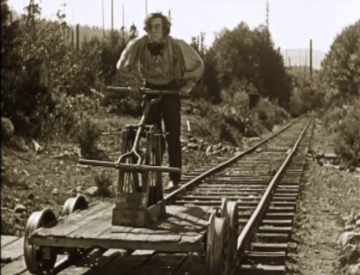
Johnnie is, naturally enough, the first to discover his beloved engine disappearing over the horizon. He runs off after it, first chasing it on foot and then using a handcart and later a boneshaker bicycle, which he’s pinched from the wayside. Neither works as an efficient method of either following or taking over The General, which is by now so far ahead, there seems little chance of Johnnie catching up.
What now? Will Johnnie be able to somehow catch up with, and rescue, the two loves of his life? (Right now, of course, he doesn’t even know that Annabelle is also on the train; all he’s concerned about is his beloved engine).
Buster Keaton didn’t just star in The General; he also co-directed the film (with Clyde Bruckman), and produced it. Sadly, The General fared so poorly at the box office that it ended up costing Keaton quite a bit: he was forced to give up working as an independent film-maker and enter into a deal with MGM that was pretty repressive. It was only in later years that the cinematic value of The General came to be appreciated, to the extent that it is today hailed as one of the greatest American films ever made.
What I liked about this film:
The way it’s put together, the crisp action, the very physical comedy, the entire script. I have known people who’ve said they are wary of watching silent cinema because of the lack of dialogue; The General is so brilliantly choreographed (that’s the only word I can think for it), so well-plotted and thought out, that you don’t really miss dialogues. There are intertitles, but they’re few and far between, and mostly not even needed, because the fun of the story is in the action, in the expressions.
And, the expressions! Buster Keaton, with that deadpan look of his (one of his nicknames was ‘The Great Stoneface’), is simply hilarious. Watching him made me mentally compare his acting to that of popular Hindi comedians of later years (Mehmood and Rajendra Nath, in particular), and it struck me why I find the latter so unfunny: because they’re irritatingly hammy: their overacting takes away from the humour. Buster Keaton is extremely understated, and his funniness lies in that poker-faced look.
A special shout-out, too, for Marion Mack: she’s a great leading lady for Buster Keaton. She doesn’t shy away from some fairly madcap escapades, and manages to be pretty funny in the physical style of comedy that is the hallmark of The General.
One last thing among those that I liked: the scale of it. A lot of money was invested in this film, and it shows, with those trains, the number of extras, the entire set-up. In an era long before CGI and complicated special effects, The General manages to be pretty lifelike in depicting its version of what was a remarkable real-life event (the Andrews Raid, which also inspired a 1956 film named The Great Locomotive Chase, based on a memoir by William Pettenger). The bombardments, the wrecking of bridges, an engine and carriages falling into a river: all of these, and more, are obviously not SFX.

I didn’t not like anything here. A delightful film, and every bit worth the praise that’s heaped on it.
 Dustedoff
The general is still a gem 97 years later.The meticulous planning of the action, “the set pieces” , the precision stunt coordination are all hard to replicate even in this age and time.
I think for those people who still do not know how good this movie is and how it was made I found this article which may be of some note.
This and Marx brothers duck soup are the movies (alongwith angoor , golmaal , kathalika neramillai & MMKR )I go to when I feel down.
LikeLiked by 1 person
Thank you so much for that absolutely invaluable link. So very interesting!
I still check, every few months, if Kathalika Neramillai is now available with English subtitles. Still hopeful that someday, somehow, my patience will be rewarded.
What is MMKR, please?
LikeLike
Michael Madana Kama Rajan. Sorry my bad! Was typing in a hurry so assumed that one would know.( I especially hate all those acronyms that kids use in their texts so sorry once again)
Rather discouraging thatonly a couple of us commented on this masterpiece. C’ est là vie!
LikeLiked by 1 person
Ah, I see. That’s another film I’m yet to watch. Kamal Haasan, isn’t it?
It is a shame only a couple of people found this review interesting enough to read beyond the title – because the film really is a masterpiece. I guess too many people simply comment on films they already have seen.
LikeLike
Recently read about Buster Keaton and realized that someone had made his biopic. The writer of that screen play is Sidney Sheldon, whom people of a certain generation in India know as the writer of steamy novels they read in high school/ undergraduate days! https://en.wikipedia.org/wiki/The_Buster_Keaton_Story
LikeLiked by 1 person
That’s interesting, I hadn’t realized there was a Buster Keaton biopic (not surprising, though, given what a legend he became). Sidney Sheldon did write some fairly off-beat (the ‘beat’ in this case being the sort of books he finally became famous for!) stuff. The Bachelor and the Bobby Soxer was his, among others. Not at all the sort of story I’d have expected from him. :-)
LikeLike
This was Keaton’s finest hour and easily the finest film released in that year. [Potempkin was released a year before I guess]. Along with Lloyd and Chaplin,he formed the triumvirate of comic silent stars.
LikeLiked by 1 person