
Many years back, shortly after I began blogging, this film had been recommended to me. I don’t recall who told me about it, but the recommendation came with a caveat: that it was apt to get melodramatic at times, and the histrionics could seem over-the-top for anybody unused to Tamil cinematic styles of that period. But it was Sivaji Ganesan’s debut film, and not just a classic, a cult classic, a film that defined Tamil cinema and set a benchmark.
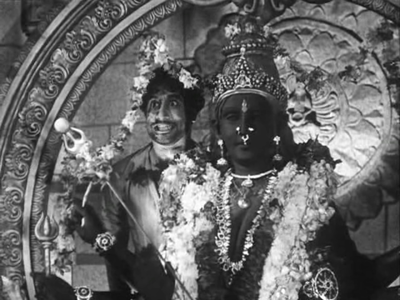
It’s taken me a while to get down to watching Parasakthi (‘The Supreme Goddess’), but better late than never, I guess.
The film centres around the family of the widowed Manickam Pillai (Doraiswamy), who lives in Madurai and whose daughter Kalyani (Sriranjani) is about to get married when the story begins. Kalyani’s three brothers live far away in Rangoon, and it is Kalyani’s dearest wish that they be in Madurai for her wedding.
This is bang in the middle of World War II, and the situation is pretty unstable. Kalyani’s three very wealthy brothers—Chandrashekharan (SV Sahasranamam), Gnanashekharan (SS Rajendran) and Gunashekharan (Sivaji Ganesan)—as well as Chandrashekharan’s wife Saraswati (Susheela) however have made up their minds to travel to Madurai for Kalyani’s wedding.

When Chandrashekharan, however, phones to book passage for them to Madras, he is told that because of the war, it isn’t possible for more than one member of a family to get a booking on the next ship to Madras. Chandrashekharan decides that in that case, Gunashekharan should be the one to go: they will send lots of gifts for Kalyani with him. And, in the meantime, the rest of them will also find some means to travel to Madurai.
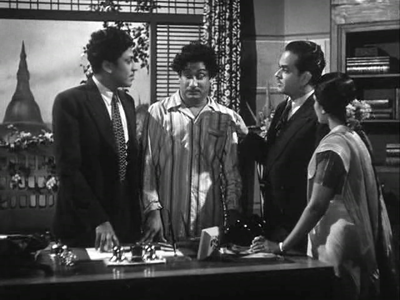
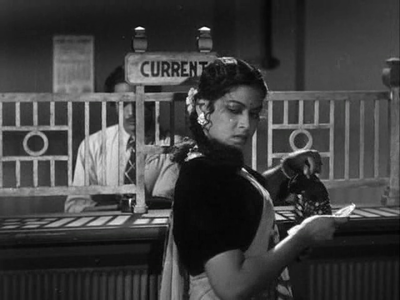
By the time Gunashekharan gets to Madras, the wedding date has gone by and Kalyani is a married woman. But he’s carefree and happy, and goes jauntily about town, withdrawing a large wad of cash from the bank (he’s so carefree, in fact, that he doesn’t even notice that a woman (Kannamma) standing further down the counter is watching him attentively, paying especially close attention to all that money)…
… and then checking into a hotel. Gunashekharan gets the hotel clerk to book a ticket for him on the next morning’s train to Madurai, the earliest train he can get. When Gunashekharan goes up to his room, he finds an intruder: a woman who, it turns out, has made a mistake and barged into his room. Gunashekharan, since he hadn’t noticed her at the bank, doesn’t recognize her. He doesn’t even suspect anything when the woman bamboozles him into sharing his coffee with her.
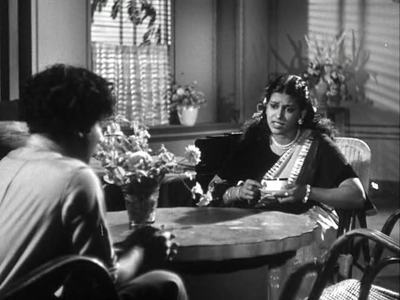
By the time she drags him off to watch a dance performance, Gunashekharan is getting a little restive. He is certainly not too keen on the dance he’s being made to watch, and is distracted enough to quickly swallow the drink he’s offered, without stopping to think. This knocks him out within moments, and the two women (the dancer is in cahoots with Gunashekharan’s stalker) proceed to strip Gunashekharan of every single thing of worth: money, watch, watch-chain, etc.
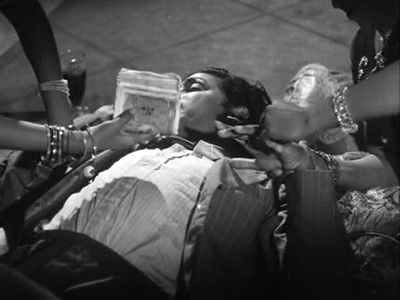
Gunashekharan isn’t the only one going through a hard time; far away, in Madurai, disaster strikes. Kalyani is due to give birth and has gone into labour. Her father Manickam Pillai is told by the attending doctor to get some medicines, for which she gives him a prescription. Kalyani’s husband comes home just then and Pillai gives him the prescription and sends him off to buy the medicines.

Pillai turns back towards the room; a kindly neighbour who has been in attendance comes out to announce the good news: Kalyani has had a son. An elated Pillai runs out to call to his son-in-law, riding away on a bicycle—and is just in time to witness the horrific accident that happens: the man is run over by a car. The shock is too much for Manickam Pillai, and he dies of a heart attack.
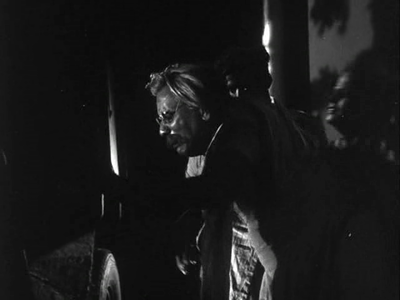
Thus, in one fell swoop, Kalyani becomes both a widow as well as a orphan. Her father had taken on a huge loan to host a lavish wedding for Kalyani and she now has to pay off those debts. There is no sign of her brothers. Kalyani is devastated, but the neighbour advises her: the family still has a small plot of land, build a hut on that and open an idli shop. It will give her at least some means of livelihood.
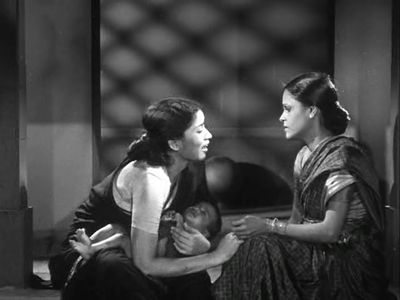
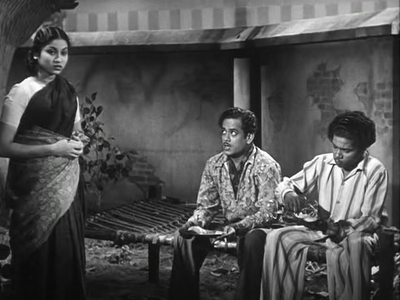
But this, too, Kalyani discovers, is not without its pitfalls. She is obliged to take a loan from the local moneylender as capital for her idli shop. The customers insist on credit, paying her at the end of the month; the moneylender refuses to give her credit for that long. Kalyani is pleading with the heartless moneylender when two fellows, who know Kalyani slightly, come by: by the looks and manner of them, hoodlums. Or rather, chief hoodlum and henchman.
The chief hoodlum comes to Kalyani’s rescue by repaying her debt, Rs. 10, to the moneylender and sending him off with a flea in his ear. The hoodlum then orders idlis from Kalyani and proceeds to tell her that he and his friend will have idlis from her everyday at a nominal price, and she can repay him that way until the ten rupees he loaned her (so to say) has been reimbursed. Kalyani has little choice but to agree, given that the man (at least on the surface of it) behaves in a polite and friendly manner.
Back in Madras, Gunashekharan wakes up on the pavement to find he’s been robbed. Despite many attempts to borrow money from strangers, he finds no-one to help him. He is even reduced to trying to offer his trousers for sale to a man selling second-hand clothes [wouldn’t it have been a good idea to go to the hotel? Didn’t he leave his luggage there, and mightn’t there have been something rather more valuable in it?]. Nothing works.
He is hauled up by a police constable and abused roundly for sleeping on the pavement; he finds himself pushed about, taunted, and treated with contempt wherever he turns.

Desperate and hungry, Gunashekharan finally resorts to outright thievery: when a fruit-seller puts down her basket of fruit near him in order to go off to quench her thirst at a nearby tap, he grabs fruit from her basket and stuffs himself, only (of course) to find himself thrashed and screamed at by the woman when she returns.
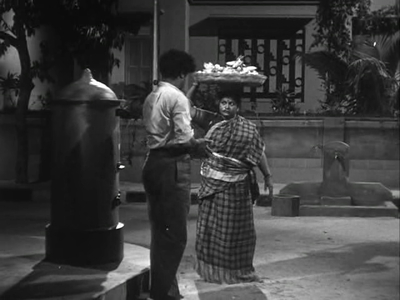
Right after, Gunashekharan is witness to another episode revolving around someone else trying to grab fruit from the woman’s basket. A madman comes by, and within moments, he’s managed to overturn the basket, snatch most of the fruit, and run off, shrieking and laughing all the while. The fruit-seller doesn’t even try to defend her basket: she’s too scared, too distraught.
This is a revelation for Gunashekharan: madmen can have their way, madmen needn’t go hungry. He tries it out, pretending to be mad as he robs a vada-and-murukku vendor of a plateful of goodies, and finds that it works well. From then on, Gunashekharan dons the guise of a madman, and this is his disguise when he finally manages to get to Madurai and learn the truth about his father and Kalyani, from the neighbour who had helped Kalyani initially.
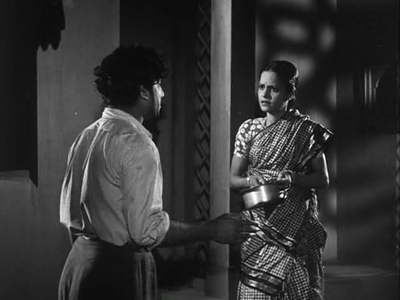
When he goes to Kalyani’s hut, Gunashekharan overhears her singing a sad song about how cruel life has been to her, but how, someday, it will all look up for her baby: his three uncles will come, and will gift him so many fine things… Gunashekharan, who has been reduced to acting the lunatic to feed himself, cannot bring himself to tell Kalyani who he is, so though he approaches her, he pretends to be a stranger, a madman.

Meanwhile, the Japanese have arrived in Burma and have been bombarding Rangoon. Chandrashekharan, his wife and his younger brother Gnanashekharan, unable so far to obtain passage to India, are now forced to evacuate, along with thousands of others, doing the long trek to India.
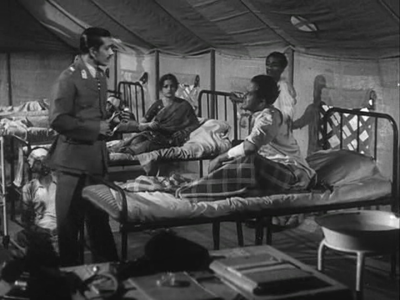
Midway, the contingent is bombed by the Japanese, resulting in many casualties. When Chandrashekharan comes to in a field hospital, it’s to find that nobody knows where Gnanashekharan is. He is missing, presumed dead.
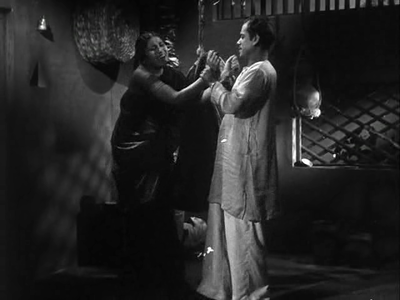
Thus the stage is set. The four siblings have been separated from each other, and two of them—Kalyani and Gunashekharan—become the focus of this story, both of them in exceptionally dire straits. Kalyani is especially desperate: after a while, it becomes obvious that most men, even (especially?) those who are regarded with the most respect—the priests, the ‘high-class’ men, and so on—look on her as easy prey, and are ready to take advantage of her desperation. Because she must keep her baby alive, Kalyani must do whatever it takes to keep body and soul together. Or is there another way out?
The title of this film refers to the goddess, worshipped throughout Tamilnadu (and beyond). The goddess to whom Kalyani calls, begging for relief; the goddess before whom hundreds prostrate themselves, in the fervent belief that she will heal all ills, she will right all wrongs.
But does she? Or does the goddess merely look on, and let humans do what they will?
When it was released, Parasakthi drew a lot of flak for its radical expression. It was criticized for the way it dared to shine the light on the hypocrisy of the elite, the ruthlessness and greed of those regarded as the ‘best’. The film ended up being hated so much by those it lampooned that there were demands that it be banned. It however ended up being such a hit, so much of a commercial success, that it saw an initial run in theatres of over 25 weeks.
What I liked about this film:
The core premise of it, and generally, the message. I suppose it’s not a message that would be regarded as especially radical now, but back then, I can imagine this bold film, daring to speak up against a Brahminical hegemony, the callousness and dishonesty of priests as well as other high-class elite in Tamilnadu, might have been very innovative, very new. Incidentally, the script was written by M Karunanidhi (it was based on a play called Parasakthi, by a scholar named Pavalar Balasundaram), and the emphasis on Dravid culture that was such a focal element of the DMK comes through in the film too, along with social justice and democratic socialism.
Then, the music, composed by R Sudarsanam. While several of the tunes were heavily ‘inspired’ from earlier Hindi film songs (Porule illaarkku is immediately recognizable as Milte hi aankhen dil hua, from Baabul, for instance), overall, the songs are melodious and good.
And, Sivaji Ganesan: yes, I see what the fuss is about. It’s admirable that this was his debut film: he really holds his own, and there is so much energy, so much conviction in his dialogues that you really see the desperation and the anger of Gunashekharan. Two scenes in particular stand out: the one in the temple, when he emerges from behind the idol of Parasakthi; and the courtroom scene. He is superb in both of them, fiery and mesmerizing. I can imagine how this debut might have won him adulation of the kind that it did.

What I didn’t like:
The melodrama and the occasional overacting (even, yes, from Sivaji Ganesan). But, as I was prepared for this, I didn’t really mind it too much.
Also, there are occasional plot holes or gaps that are never explained. For example, that thing about how Kalyani on the one side and her brothers on the other have not seen each other in so many years, they don’t know what the other(s) look(s) like. This is a wealthy family; Rangoon is not all that far (and letters and telegrams seem to travel to and fro, even during war, without any problems); so why hasn’t even one set of photos been exchanged?
There’s another minor hiccup relating to Bimala (Pandari Bai), Gunashekharan’s lady love, and her penchant for boat rides in the moonlight. I won’t say what, since that would constitute a spoiler, but it was hard to believe.
But, all said and done: a memorable film, and rightly so. R Krishnan and S Panju (who directed the film) struck gold with this one.
 Dustedoff
DMK was founded by C N Annadirai, and not by M Karunanidhi.
LikeLike
The DMK was founded by a quintet which included CN Anna Durai, EVK Sampath , VR Nedunchezhian , NV Natarajan & one more person ( don’t remember the name)
LikeLike
Thank you for the correction. Will correct that right now.
LikeLiked by 1 person
Madhuji your review of Parasakthi has been most objective. However, I would like to clarify what Sivaji Ganesan had told about his (over) acting style . Sivaji had said that his acting style was a deliberate act( no pun intended) to reach the last man in the galleries & the remotest place where his movies were screened . The movie was used by the DMK to strengthen the bedrock of their politics, viz, rationalism or atheism, depending on what one trusted it to be. The then CM of Madras (as it was called then), C. Rajagopalachari, who was the most god conscious politician, most democratically allowed the movie to be screened, despite his personal reservations & large public protests against the movie; unthinkable in the current times. Parasakthi hastened the political ascent of the DMK, though Sivaji, who was in the DMK, quit the party & joined the Congress party fed up as he was about atheistic rhetoric & melodrama played out publicly by the Dravidar Kazhagam & the DMK. Sivaji himself was a theist & a god conscious man
LikeLike
This comment had been marked spam by WordPress, and I only just saw it and managed to retrieve it. Thank you for this – interesting background information. And while I do feel that there were shades of overacting in Sivaji Ganesan’s acting, I completely see his point: very subdued or restrained acting would not have made as much of an impact with the crowds.
LikeLiked by 1 person
The movie, Parasakthi, also marked the beginning of the rise of the DMK as a political force essentially on account of the dialogues of Karunanidhi . Karunanidhi wrote dialogues for about 75 movies . Karunanidhi is the only dialogue writer who used to receive thunderous applause from the audience the moment his name appeared in titles of movies for which he penned dialogues
LikeLiked by 1 person
I think of all the old Hindi films, I can think of only a very few (Mughal-e-Azam, Pakeezah) that might have stayed with me for the dialogues. A feat like that, of having written dialogues that could be the mainstay of a film, says a lot for Karunanidhi’s prowess. Even though I had to depend upon subtitles for this film, I could appreciate the intensity of the dialogues here – very hard-hitting.
LikeLiked by 1 person
Thanks for the correction, my source was haywire.
LikeLiked by 1 person
Lovely review. I would love to watch this.
LikeLiked by 1 person
Since I had a father who was basically a closet Tamilian, I grew up with Sivaji Ganesan. :) Parasakthi was indeed a cult classic, and the film that introduced Sivaji Ganesan to me. So glad that you got to see a good print and that you liked it. (And yes, the melodrama is par for the course, but it was much less than the average Tamil film of the time.)
LikeLiked by 1 person
I think for someone like me, who watches so much old Hindi cinema (which of course includes plenty of films made by Madras-based film houses like AVM), melodrama isn’t too hard to swallow. It’s part of the game, so all well. :-)
LikeLiked by 1 person
As you rightly pointed out , in those days , Tamil movies used to have tunes adopted from either successful Hindi movie songs or classical Carnatic music tunes . It was the arrival of MS Viswanathan & TK Ramammurthy which changed the grammar of the Tamil movie music, though MSV considered Naushad as his Guru ,while Naushad himself was full of encomiums for MSV
LikeLiked by 1 person
It’s a good story, overall. And that horrific accident outside the hospital: it made me really sad. So unfair. But I was just thinking that the brother was a little too late to reach home for his sister’s wedding. :))
And you know, last night I suddenly wanted to read something sweet and nice and a little romantic, so I re-read the last chapter of your book Put Asunder. ☺️
LikeLiked by 1 person
And you know, last night I suddenly wanted to read something sweet and nice and a little romantic, so I re-read the last chapter of your book Put Asunder. ☺️
That makes my day! May I please quote this online and tom-tom Put Asunder? A little promotion for a book few people in my circle seem to know is always in order, I think. Thank you. :-)
LikeLiked by 1 person
Oh yes, please. 😊😊
LikeLiked by 1 person
Thank you!
LikeLike