
This is part 2 of two connected blog posts. The first post, about my visit to Dehradun for a literary festival (and, more so about the sightseeing in the city) is here.
After our trip to Dehradun, we got back home on Monday—and on Friday, I took a flight to Bhubaneshwar. Odisha is a state I’ve never been to, though it’s such a historical and cultural powerhouse, I’ve been wanting to go for a long while. Both my sister Swapna and I had been invited to speak at the Odisha Literary Festival, and since we’re both keen on history, we decided we would take advantage of the few hours we’d have in the afternoon of our arrival to go around town a bit and see some of its historical sights.
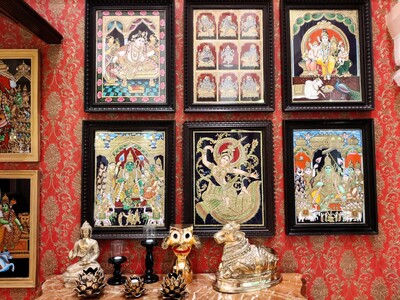
We arrived at our hotel a little after 1 PM. Mayfair Lagoon is one of the most spacious and comfortable hotels I’ve been in—the average hotel room would have fitted easily inside the bathroom, for instance; and there are literally acres of gardens, lagoon (yes, there really is one), pools, fountains, and more here. Also, it has the most wildly eclectic range of artefacts I’ve seen, or will probably ever see. There are stunningly carved antique painted wooden artworks that would fit perfectly into the National Museum…
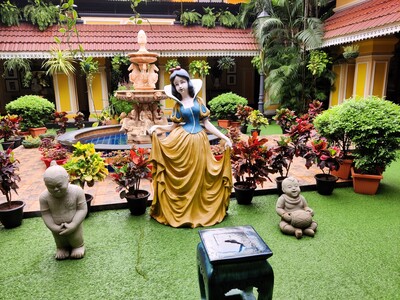
… and there’s Snow White.
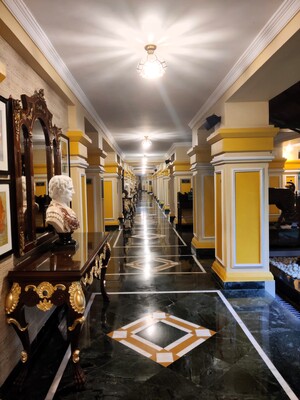
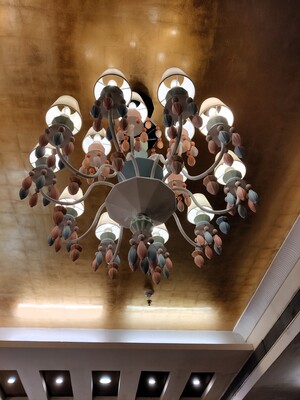
There are busts of Roman emperors, stones painted with animal faces, chandeliers with dripping teardrops crafted from pink and blue rubber (I think. I told Swapna it reminded me of the mobile you hang from a baby’s bassinet, and she agreed. Even the pink and blue are typical).
While Mayfair Lagoon would probably make for some pretty satisfying sightseeing on its own, we were eager to explore Bhubaneshwar, especially its temples, in whatever little time we had. Having checked in and deposited our luggage in our rooms, we hired a cab from the hotel and set off to see the sights.
First up were the Khandagiri Caves/Udayagiri Caves, which were shaped and carved starting sometime in the 1st century CE, though work on them continued over several centuries. Spread across two adjacent hills (Udayagiri and Khandagiri), the caves were intended as dwellings for Jain ascetics, and have been excavated in several levels across the boulder-strewn face of the two hills. This is a ticketed monument under the aegis of the Archaeological Survey of India (ASI; the fee is Rs 25 per Indian adult).
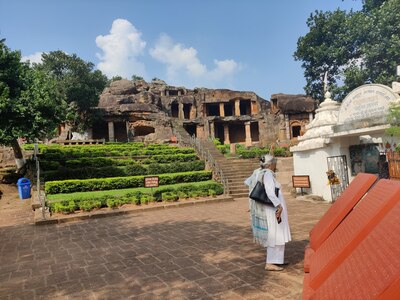
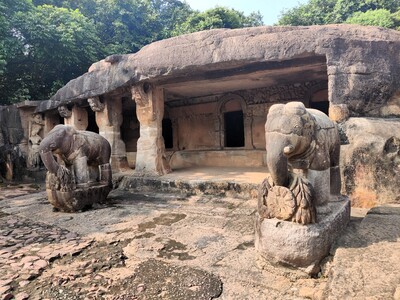
From the base of Khandagiri Hill, there are two paths to get to the top: one is a stone-paved ramp that slopes upward, arrow-straight, on the left; on the right, beyond the caves, a meandering path climbs more gently upward. This was the one we took, because it’s not just easier to manage, but also because it allows one to easily visit other levels along the way. The Ganesh Gumpha, for instance, which has two beautifully carved elephants outside.
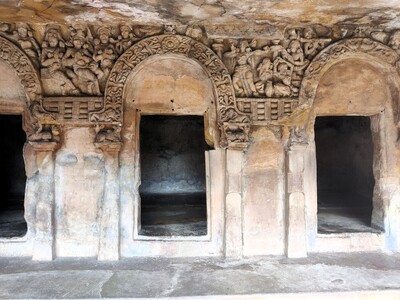
At the base of the hill, though, there’s one cave that’s especially worth visiting: the Rani Gumpha, which has detailed carving along the façade.
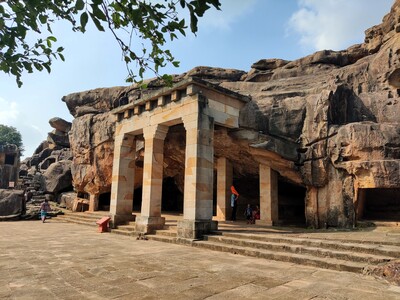
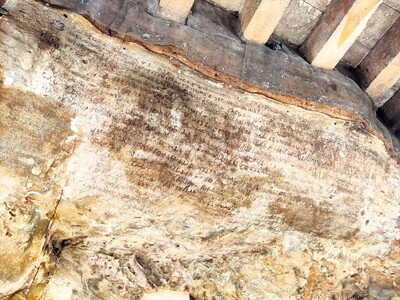
The path uphill is shaded by trees and snakes its way between boulders, emerging suddenly at the top in what is probably this site’s most famous (from a historical point of view) element: the Hathi Gumpha. Now supported by three stone pillars and a lintel, the Hathi Gumpha is renowned for a famous inscription, written in the Brahmi script, by the Kalinga ruler King Kharavela. Kharavela (who got the caves excavated) ruled probably in the 1st or 2nd century BCE, and the inscription is in effect a biography of him, a narration of his rule.
The caves duly admired, we went on to three of Bhubaneshwar’s most important ancient Hindu temples. Bhubaneshwar is one of India’s very few planned cities, but unlike (say) Chandigarh this was laid out in a space that already had a plethora of older structures, so there’s plenty of history around here.
… and some gorgeous temple architecture. The traditional Odisha style of temple design is known as the Kalinga style, with two main elements to a temple: a spire (known elsewhere as a shikhar) that is known here as a deul; and an adjacent hall, known as the jagamohan.
This was an arrangement we saw in the three temples we visited, starting with Parashurameshwar, supposedly the oldest Hindu temple in Bhubaneshwar. It dates back to the 7th century CE and is dedicated to Shiva, as the ‘Lord (eeshwar) of Parashuram’—Parashuram’s devotion to Shiva having won him a boon from the deity. The temple is a modest-sized one, dwarfed by the massive old banyan tree that towers over it. Carvings—intricate, highly detailed friezes, in particular—cover most of the exterior of the temple, depicting various deities (Shiva, Shakti, Ganesh and Karthikeya in particular), mythological creatures, peacocks, elephants, and more.
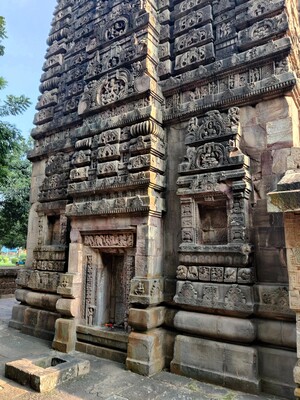
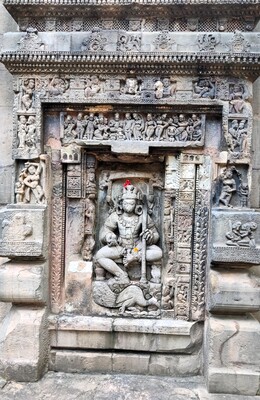
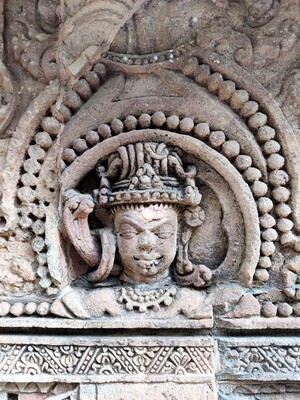
The temple is still in use, but doesn’t seem to be much frequented; a priest was around, but other than two women chatting quietly under the banyan tree and a man making a video of the temple, there was no-one else there.
Just a hundred yards or so from this temple, down a path leading through a garden, is another great temple: Mukteshwara. Mukteshwara was built in the 10th century CE, and sits beside a serene pool of water, surrounded by lovely gardens with flowering shrubs and many butterflies. The main temple is the one that is surrounded by a low wall and fronted by an unusual ‘toran’ gate: an intricately carved arch that shows the influence of Buddhist architecture.
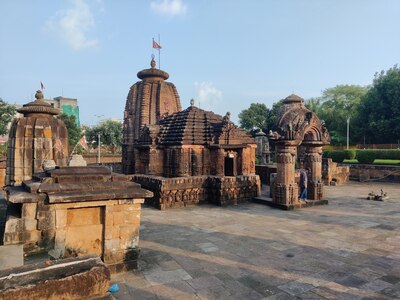
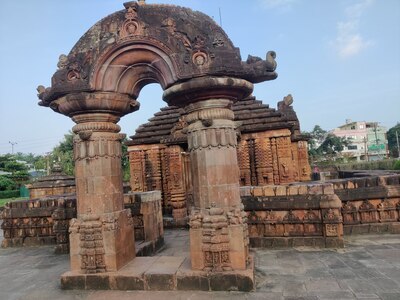
The toran, the wall surrounding the temple, and the temple itself are all lavishly carved: there are sinuous nagas here, and shaalbhanjikas (women standing with an arm reaching up to hold a tree branch overhead); elephants and lions, yakshas, tantric figurines (emaciated bearded figures) and of course plenty of deities.
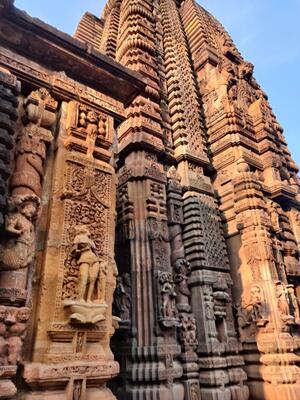
Besides this main shrine, there are several smaller, far less ornate shrines around; but once you’ve seen the main temple, everything else pales into insignificance.
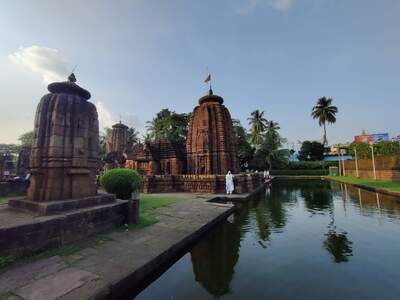
Once we were done with Mukteshwara, we went to the last temple that we still had time to see while there was daylight: Rajarani Temple. Rajarani, which dates back to the 11th century, is—unlike Parashurameshwar or Mukteshwar—no longer in use; there’s no idol here, though it’s believed that the presiding deity had been Shiva. I had thought, when I first heard the name of the temple, that it had something to do with ‘king-and-queen’, though I couldn’t imagine why a temple would be named after lowly humans. It turns out that the ‘rajarani’ of this temple aren’t people; it’s a type of sandstone, locally known as rajaraniya, which was used in the construction of this temple.
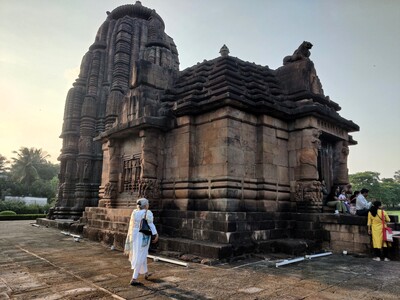
Unlike the other temples we’d seen, the Rajarani Temple is an ASI site (entry is Rs 25 per Indian adult, like at the Khandagiri Caves). The temple building sits in a huge garden, with flowering shrubs dotting manicured lawns, and a laterite path leading to the temple at the end.
Like other temples of the Kalinga form, Rajarani too has the combination of the deul and the jagamohan. When you emerge from the path onto the paved yard in which the temple is situated, what you first see is the jagamohan, the hall that abuts the deul or spire. Compared to the other two temples we’d seen, this one was so plain, I felt a little disappointed (though I must admit that the solidity of the carved naagas here would have been very impressive before they got so weathered). In the hope that the interior may be better, I even went in, but the interior was devoid of any ornamentation.
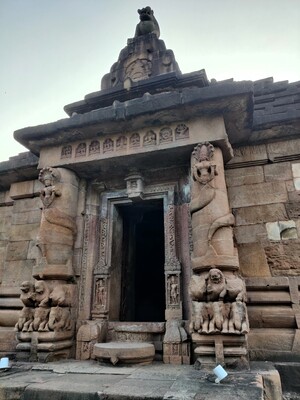
But outside, and a walk around to the other side, and I revised my opinion. The deul is gorgeously decorated, covered all over with sumptuously carved figures, garlands, shaalbhanjikas, and more. It makes up, many times over, for the relatively spartan plainness of the jagamohan.
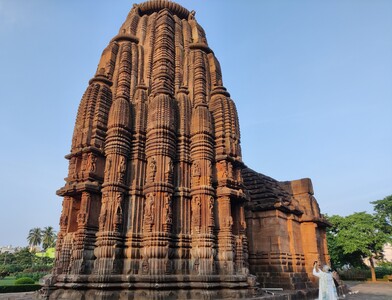
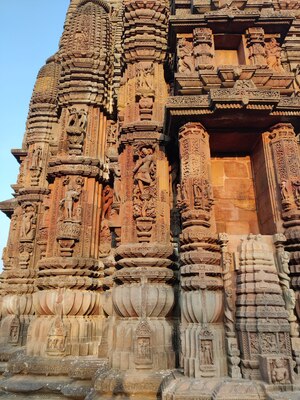
By the time we had finished taking photos and admiring the Rajarani Temple, the sun was well on its way to setting and the light was fading fast. We couldn’t possibly have seen another temple, another sight, even though Bhubaneshwar has many more. Many more ancient temples, and other sights as well, including the Ashokan Pillar at Dhauli. And there are museums galore. Plus day trips and weekend trips to some of India’s greatest sights, from the Sun Temple at Konark to Chilika Lake.
I am now eager to do another, longer, trip to Bhubaneshwar.
(But, before I sign off, I cannot not talk about the food, can I? I make it a point to try out the local cuisine wherever I go, and Odia food was particularly high on my list, because from my limited knowledge of it, it seemed similar to Bengali food, which I adore).
Somebody had mentioned to us that the Mayfair Lagoon Hotel has an Odia specialty restaurant named Kanika—the word refers to a festive rice dish, lightly sweetened and spiced—and this was where we chose to go for dinner. While Kanika does have an extensive à la carte menu, they also offer thalis, set meals that showcase a range of Odia dishes. There’s a vegetarian thali; a non-vegetarian one; and a seafood thali. Both of us chose the seafood thali, and we were in for a treat.
We began with a couple of types of papad and chutneys. A warm kanji was served up as an aperitif, and then came a serving of fish cakes.
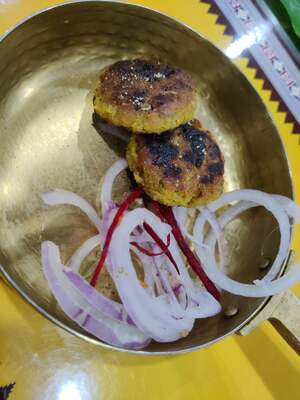
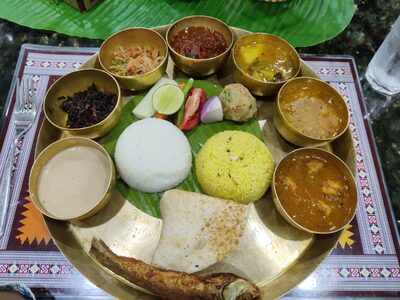
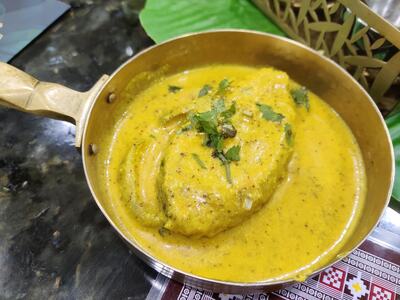
After that, the thali itself, which included kanika, plain rice, salad, tomato chutney, dal, a dish of stir-fried amaranth greens, a rice flour roti rather like an aappam, and a gorgeous bodi chura: deep-fried urad dal bodis, lightly crushed with raw onions, green chillies, salt and mustard oil. Simple, and simply divine. There was, of course, plenty of seafood: a prawn curry, a fried whole fish, and a fish in mustard gravy. Some kheer.
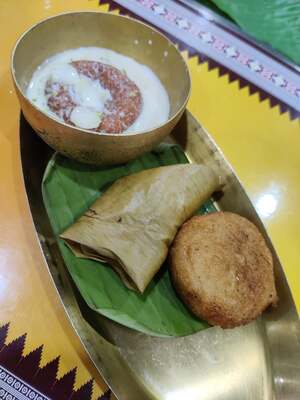
And then a three-piece taster plate of desserts: a rasabali (a ‘doughnut’ dunked in rabri), a deep-fried coconut-stuffed pitha, and an enduri pitha, wrapped in turmeric leaf and steamed.
By the time I’d eaten the sweet paan that ended the meal, I could barely stagger back to my room!


This sounds wonderful! Odisha is on my list of places to visit; I do hope to go there some day. But, in the meantime, I visited vicariously through your post. :)
LikeLiked by 1 person
Thank you, Anu! I’m glad you enjoyed this. And yes, Odisha is definitely a place I want to see more of. What I saw – all too brief – was absolutely wonderful.
LikeLike
You must plan a full trip to Orissa. It’s beautiful. I had been there around 5 yrs back and enjoyed my 4 day trip there.
Konark temple is a must. You can dedicate a separate post to it. Chilka lake is good too. And Bhubaneshwar itself has many other spots to visit including a state museum. The latter is good though not extraordinary.
The nature there is beautiful, you visit Pipli village on route to Puri from Bhubaneswar. The route has picturasque nature and roads are good.
The Bhubaneswar city itself is a cute little one which was yet to have well planned lanes and squares back then, 5 yrs back.
I loved my trip and would go there whenever I could plan again.
:-)
LikeLike
I was really pleasantly surprised by Bhubaneshwar – it’s actually a ‘cute’ little city! The planning shows, but it’s not the somewhat regimented planning of Chandigarh; plus, of course, because there’s so much history around, it’s far more interesting. I am now really eager to go for a longer trip and explore more of Odisha.
LikeLike
and, whenever you plan trip to Ajanta Ellora in Maharashtra, tell me. I’ll meet you there.
😊
LikeLike
I will! In fact, recently I was reading William Dalrymple’s ‘The Golden Road’, which has an important chapter that talks about Ajanta and Ellora, how they were discovered, and detailed descriptions. That really reminded me I need to visit them sooner rather than later.
LikeLike
Odisha is a lovely state. We lived in Rourkela briefly and were fortunate to make trips to Puri and Bhubaneswar. Yes, you should plan for a longer trip since you are a history buff.
LikeLiked by 1 person
I’ll certainly keep that in mind. Some neighbours of ours did a trip to Bhubaneshwar, Konark, Chilika and around early this year and were raving about it. After this all-too-brief snapshot, I am now eager to follow in their footsteps.
LikeLike
Madhuji,
I relived the memories of my Orissa trip which was a good 14 years ago when my older daughter was yet to turn one. This was in fact the first time we went for a long trip after her birth. Chilka, Puri, Konark, Raghuraajpur and Bhuwaneshwar – all of them are wonderful.
The beaches of Orissa – especially the stretch from Puri to Konark were pristine and untouched.
And of course the handloom sarees of Orissa are perhaps something to die for! The Rani Gumpha is also known for its acoustic qualities.
LikeLiked by 1 person
We didn’t know about the acoustics at Rani Gumpha, so missed that. And as for the saris – oh, yes, exquisite! Somebody on my sister’s friends list, on hearing that we were going to Bhubaneshwar, suggested places to buy saris, handicrafts, etc but we had to politely tell them that since we were in Bhubaneshwar for just one day (and half of that at the lit fest), we wouldn’t have time for shopping, much as both of us love saris. :-D
LikeLike