
Given that we live in the National Capital Region, Rajasthan, rich in culture and natural beauty, would seem like the perfect destination for a holiday—but I guess here it’s a case of ghar ki murghi daal baraabar; familiarity breeds contempt. We invariably think of Rajasthan as a place we can always visit, after we’ve exhausted the places further away, the destinations more exciting and more exotic.
Also, I guess, because my husband and I, on multiple trips over the years before our daughter (the Little One, or LO) came into our lives, had visited a good bit of Rajasthan. We weren’t especially interested in revisiting the same places again and again.
But it has struck me recently that the LO really should get to see Rajasthan beyond Bharatpur—Keoladeo Ghana, Abhaneri’s Chand Baori, and the Neemrana Fort Palace, all of which she’s been to. All, by the way, before she turned three, so she has no recollection of any of these. Some more colourful culture, I thought, was in order. And more wildlife.

This last winter, therefore, we finally decided to take the LO (who’s just turned eleven) to Jaipur. And, as part of the wildlife component of our trip, to Sariska National Park and Tiger Reserve. Located in Rajasthan’s Alwar District, Sariska is one of the national parks closest to the national capital. Till some years ago, it was regarded with some amount of scorn by the average Indian who regarded themselves as a wildlife watcher, because it had one lone tiger (which, sad to say, died and left Sariska tigerless). Then some 7 tigers were relocated here from Ranthambore, and since then, the tiger population has grown: the current numbers are 42 tigers, of which 18 are cubs.
The LO, once an aspiring ‘wildlifer’ (she has moved on to other ambitions since: a model, a singer, an Olympic swimmer…), is always game to visit wildlife sanctuaries and such like. She was hopeful (as she has been on previous trips, to Corbett and Kaziranga) that she’d see tigers, but we tried as best as we could to tone down her expectations. Even if there wasn’t a stripe in sight, perhaps there would be other wonders to compensate, we said.
Sariska spreads over some 1200 square kilometres, of which 20% is the tourist zone; the rest is the core wildlife zone, where tourists aren’t allowed. In order to tour the park, you have to book a safari at the park (this can also be done online, well in advance: a highly recommended course of action, since demand seems to outstrip supply, and turning up at the booking window in the hope of getting a seat in a safari jeep is a chancy affair).
We arrived in the vicinity of the park (half an hour’s drive from the Sariska Booking Gate, as it’s called) the previous evening, having driven down from Noida at a leisurely pace. We were booked at a resort called Shahpura Gandharva Retreat, which is owned by a former royal family and has properties scattered across not just Rajasthan, but further afield too.
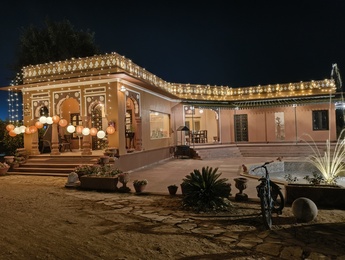
The Shahpura Gandharva Retreat spreads out across an expanse of rather scrubby land, its landscaping neither here nor there. There are ornamental flowering shrubs, exotics like bougainvillea and yellow bells, but also tussocks of local grass, and trees like sangri and sheesham. These, as the LO and I discovered one morning, were home to lots of birds, which were a joy to watch.
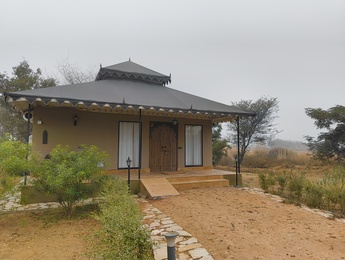
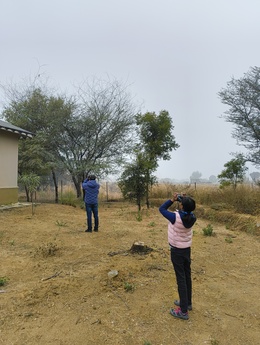
Accommodation here is in the form of cottages that, on the inside, look like tents, complete with lovely block-printed cloth forming the walls and the pyramid-shaped ceiling. We were pleasantly surprised; we hadn’t expected it to be so tastefully done. The LO (who has a soft spot for well-designed, spacious bathrooms, ‘the sort you could play football in’) gave this one a whole-hearted thumbs-up.

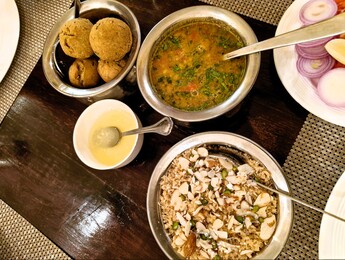
Even the restaurant, where we had all our meals, was pretty decent. When the place is full up, they lay out a buffet; otherwise, an à la carte menu is offered. On our very first day, we chose from this, ordering, among other dishes, the traditional Rajasthani daal-baati-churma. The daal was garlicky and gorgeous (so good, in fact, that I could have dined off bowlfuls of it); the baati, ghee-rubbed dough balls baked in hot coals, had crushed spices mixed into the dough to make it that much better; and the churma, a sweet made by grinding baati and mixing it with jaggery etc, was warming and delicious. We later ate other versions, elsewhere, of daal-baati-churma, but this one was head and shoulders above the rest.
All good, except that it was so bitterly cold. Although we were assured that our tent-cottage was lined with three layers of insulation, none of us thought that was sufficient: it was freezing in there, and not a single heater around. The one blessing was an electric blanket on our bed. Given that we always pack hot water bottles when we travel in the winter, at least with these and the blanket, we slept comfortably.
It was (and this was expected, given that we’ve been on wintertime safaris earlier) not quite so comfortable on our trips into Sariska. Shahpura Gandharva doesn’t offer transport to get to the park, so we drove the half-hour to the park gate in our own car. The large parking lot from where the safaris begin was brimming with people and cars and monkeys (lots of langurs as well as rhesus macaques) even at 7 AM. We huddled into the open jeep we were allotted. Each jeep seats six (besides the driver and the naturalist, who sit in front), and if your group doesn’t fill all six seats, they seat strangers with you. If you don’t like sitting with strangers (or they aren’t able to find any others to fill those seats) you pay more. A good bit more.
Fortunately, that didn’t happen with us. Unfortunately, though, the people we were sitting with—a couple with a daughter about the same age as the LO—had no idea of safari etiquette. They chattered nonstop, the girl being especially loud (and given to shrieks of glee every time she spotted an animal). The LO was most disapproving, fuming mostly quietly, but occasionally directing very black looks at our fellow passengers. The snobbery of those in the know.
‘All they did to us was offer me an apple,’ the LO now explains. ‘A very unappealing apple.’ More to be pitied than to be censured?
(Anyway, later in the day, the LO made other friends: sort of. With a flock of noisy jungle babblers who alighted on our parked jeep when we stopped at a forest checkpost to stretch our legs. Chatterers, all).

In any case, we didn’t see a tiger. Or even a leopard. Loads of peafowl (so many, in fact, that the LO labelled them the ‘pigeons of Sariska’, given that they were as plentiful as the ‘rats with wings’ that crowd our housing society back home. Rufous treepies, bulbuls, and even some deer: spotted (chital) and sambhar, along with nilgai, the largest antelope in Asia. Also a jackal. During our afternoon safari, my husband and daughter saw a huge hyena crossing the road: a sight I missed.
That same afternoon, after a quick lunch, we went off on our second safari of the day. Our fellow passengers this time were somewhat nicer, more knowledgeable about how you should be behaving if you want to have any chance of seeing wildlife (and the said wildlife staying put long enough for you to admire it). Unfortunately, though, the weather was awful, and it started drizzling within minutes of our setting off.
These jeeps, mind you, are open-air, the better to let you view wildlife. At first, our naturalist guide and driver told us to (basically, though not in so many words) grin and bear it. Then, when it got too much and all of us began clamouring for some cover, they got out and unrolled a very dusty, cracked tarpaulin onto our heads. The poles that should have held it above us were missing, so we were obliged to hold up the tarp (which dripped filthy water on us from the cracks) until we could stop at a forest guard check post and broken-off bits of bamboo could be fitted into slots to hold the tarp up. We still had to support it, though, since it was sagging, and water had filled up in the saggy places.
This safari ended up being an extremely uncomfortable experience for all of us: wet, very cold, and just generally pretty miserable. But it came with one major silver lining: wildlife sightings like none I could have imagined. No tigers, of course (that would have been too much to expect, I suppose), but so many deer, so many antelope, after a while they didn’t interest us anymore. They clustered under the trees on either side of the road, seeking shelter from the rain, and our naturalist told us that was common behaviour when it rained: the ungulates herd together under the trees.

Talking of naturalists, I was pretty unimpressed with the ones at Sariska. Yes, I didn’t expect these men (who were government employees, not private-sector employees like the ones who took us on safari in Kaziranga and the Little Rann of Kutch) to be brilliant naturalists, but a certain level of familiarity with the species a visitor might encounter in Sariska would be expected. Our second naturalist, though grumpy, seemed a little more knowledgeable, but the first one, on our morning safari, was more a mammalist than a naturalist: he seemed to know about the mammals of Sariska all right, but when I asked him which bird that was, or what this obviously common tree loaded with striking white flowers was, he pointedly ignored me.
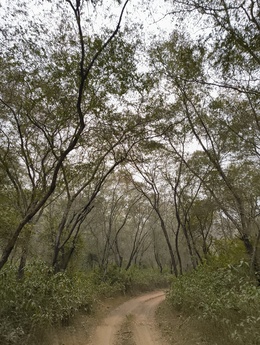
(One thing he did know about trees was that one of the most common tree species in Sariska is the dhok, Anogeissus pendula. They’re all over the place, and when, at the height of the summer, everything else dries up and there’s little vegetation for the many herbivores of Sariska to feed on, the dry dhok leaves are much in demand. The deer and antelope and other plant-eating species eat these dried leaves
“like chips”, as this naturalist told us).
Anyway. We didn’t see a tiger, and we got quite wet. And we missed our third safari (a morning one, which we missed because we overslept), but we still enjoyed ourselves. It was all adventure.
Next up, further travels in Rajasthan. Four forts, in fact: one which is located on the edge of Sariska, and three in Jaipur.
Watch this space.


LO is 11?! Oh, my! Where has time flown?? So you didn’t get to see a tiger after all. :(
Now I’m wondering how our trip to Corbett will pan out. I’d checked out Sariska as well while planning this trip but S is bent on Corbett, especially because of Pedwali, the tiger and her cubs. Keeping fingers crossed that we will actually see one of them!
(p.s. I also read about your trip to Corbett and noticed it’s one of the posts on which my comments have inexplicably disappeared.)
LikeLiked by 1 person
She’s 11, all right, but still a baby in a lot of ways! Don’t be surprised if she plunks herself down in your lap. :D
I do hope you will see a tiger at Corbett, but don’t be too disappointed if you don’t – that’s what we’ve managed to school ourselves to do. To look out for the other interesting things, the birds and smaller creatures. Tigers are awfully elusive, sadly! In all the many trips I’ve made to parks that have tigers, I’ve only ever seen one – and that was way back in 1985.
(p.s. I also read about your trip to Corbett and noticed it’s one of the posts on which my comments have inexplicably disappeared.)
Why on earth does WordPress do this??! Arrrgh.
LikeLike
Good travelogue as usual. I had been to Uttarakhand on May 2023 and Rajaji national park was a part.
Had the same experience! It started raining just before our tour started. The jeep was not covered adequately and most of us got drenched. But got to see dears and peacock a lot. No tiger at all.
:-)
LikeLiked by 1 person
Wah, that’s quite a coincidence! But yes, I have realised that one shouldn’t even expect a tiger. If you start off with big expectations, you’re bound to be disappointed. Better to only think “we will experience the jungle” and leave it to chance. :-)
LikeLike