
(This is the third and final part of a three-part Rajasthan travelogue. The first post, about our trip to Sariska National Park, can be read here, and the second part, about four forts—Bhangarh (on the border of Sariska) and Jaigarh, Nahargarh and Amber, in Jaipur—is here).
The forts of Jaipur take up a major chunk of sightseeing time, not only because they sprawl, but because of the time involved in getting to them, and then (if you, like us, happen to be visiting in peak season) fighting the crowds at each fort.
While we admired the forts of Jaipur, it was, frankly, also with a certain amount of relief that we looked forward to seeing some of Jaipur’s less touristy spots.
In 1876, the Prince of Wales (later King Edward VII) visited Jaipur as part of a tour of India. In honour of him, the maharaja, Sawai Ram Singh II, had the city painted a deep salmon pink. The ‘pink city’, as Jaipur came to be known after that, is still the core part of Jaipur. Driving along these roads—the shops with uniform black-and-white signboards and matching façades, the occasional temple or gate or other interesting old building still fitting in perfectly with the look—was great fun, and since many of the shop signs are in Devnagari (and the LO loves reading signs), she got to practise her Hindi.
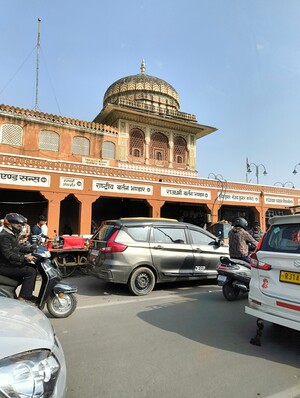
Also, every time we passed by Hawa Mahal, she pestered me to take photos.
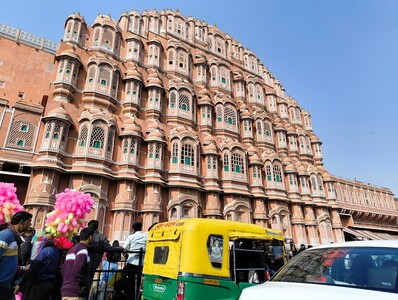
It is beautiful, but actually visiting the Hawa Mahal wasn’t top priority for us, especially after we’d seen the crowds waiting to get in.
Instead, we spent a fruitful couple of hours visiting the nearby City Palace, at the heart of the pink city. Built in 1727 by Sawai Raja Jai Singh II, the City Palace is, even today, the residence of the royal family (the current Maharaja is Padmanabh Singh). The royals live only in part of the palace; the rest of it has been opened to tourists.
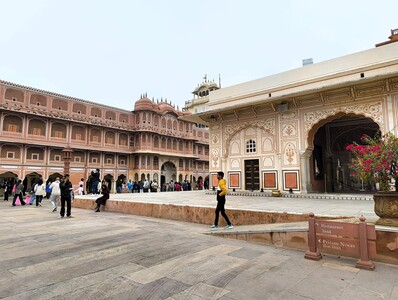
The City Palace is all courtyards and palaces. Among the most prominent (and thronged by the most people) is the Sarvato Bhadra aka the Diwan-e-Khaas, a pillared pavilion which was the venue for religious and cultural celebrations during the time of the maharajas. The LO (and I too, I must admit) was charmed that there was a large and beautifully decorated Christmas tree here—we were visiting just over a week after Christmas—since it was not something we’d expected to find).

What I wanted to point out to the LO was something quite different: a massive urn, taller than me, made out of pure silver. One of two identical urns, this is a ‘Gangajali’, crafted especially to hold holy water from the Ganges. The two Gangajalis were made to accompany Maharaja Madho Singh II when he visited England in 1902 and didn’t want to risk his health—physical or spiritual—by consuming strange water.
Several of the other palaces have been converted into museums. While visitors are allowed in here, photography isn’t permitted, but the collections are fascinating. There’s a gallery of portraits of the royal family; another one dedicated to weaponry—but my favourite was the textiles gallery, housed in the Mubarak Mahal. I had expected the intricate and obviously immensely expensive brocades and such like; but among these were other surprises, such as polo outfits for the maharajas, and an ‘atamsukh’ choga worn by Madho Singh I, supposedly regarded as the most voluminous piece of clothing in the world. “He must have been very fat,” the LO commented.

Some parts of the City Palace were closed for renovations, so we couldn’t see all of it, but what we saw was intriguing enough.
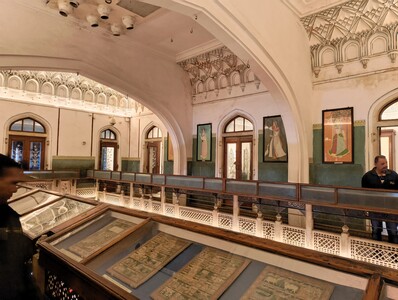
The very same day, we went to what is (in my opinion, from what I saw) Jaipur’s most stunning museum, the Albert Hall. In 1876, when Prince Albert Edward visited Jaipur, he also laid the foundation stone of a building that was to be named after him. Albert Hall was constructed over the next decade, designed by the famous colonial architect Samuel Swinton Jacob, and converted into a museum.
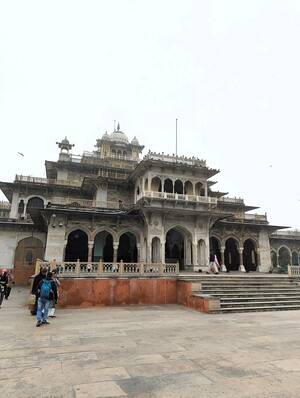
Along with Thiruvananthapuram’s Napier Museum, this is one of those museums that is architecturally impressive as well (even more so than Napier): the tiled floors, the intricate plaster work, the reproductions of famous murals that decorate the walls… all create a jewel box worthy of the treasures it houses.

And, more than Napier, Albert Hall has a superb collection, very well-maintained, well-curated and helpfully labelled. There is art and craft from across the ages and across the world: fine porcelain, carpets, sculpture, an Egyptian mummy, and much more.

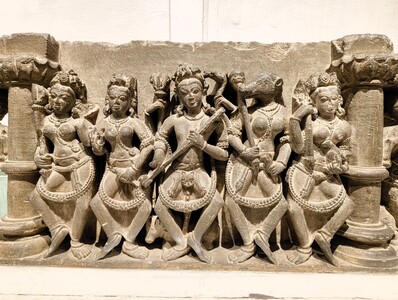

I thought the LO might be particularly intrigued by the mummy, but she seemed a little indifferent to it. What really caught her eye, instead, was a series of small Jain figurines carved out of soapstone. One of them had its foot in its mouth, and the LO couldn’t help giggling over that. (thankfully, she didn’t attempt it when we got back to our hotel later that day).
One last sight among those we visited: the Panna Meena ka Kund. This hadn’t initially been on our itinerary, but our driver had mentioned that it was on the way to Amber. A quick search online and I realized that Panna Meena ka Kund is a medieval stepwell. Stepwells, known as baolis or baoris in North India, are among my many passions, so this was something I wasn’t going to miss.
Nobody seems to be quite sure exactly how old this stepwell is; folklore dates it variously to the 10th century CE, or the 16th. The name and provenance of it are, likewise, disputed. One story has it that it was constructed by a eunuch named Panna Miah, who was a favourite of the ruling maharaja of the day; another names a local king, Panna Meena, as its builder.
Whatever. The good thing about this beautiful stepwell (which somewhat resembles, in the crisscross style of the steps, the famous Chand Baori of Abhaneri) is that it’s not hugely popular. There’s no entry fee, just a couple of hawkers selling bandhini dupattas and suchlike, and only a handful of tourists. In comparison to the crowds at the forts of Jaipur and the City Palace, this was a little oasis of peace.

“But there’s something black and big swimming about in the middle of the water,” the LO pointed out. She was right, and I said it was probably a biggish fish, but the LO was convinced it was an alligator.
Those, then, were the places we saw in Jaipur. We also made a sadly abortive trip to the Kishan Bagh Sand Dune Park in Jaipur; a friend, aware of my interest in nature, had recommended it as a place where there’s been an attempt to rewild the area, to restore its ecological sanctity (so to say) and get rid of all exotic species. It’s a project headed by Pradeep Krishen, which does lend it a certain credibility. Unfortunately, the day we visited—our last evening in Jaipur; we were leaving next morning for home—Kishan Bagh was, for no reason we could discover, closed. But I’ve bookmarked it in case of future visits.
And, one last shout-out: for a restaurant. Among the highly-rated restaurants serving local food were Govindam Retreat and Kokum Bistro, and we visited both, for lunch on the two days we were in Jaipur. Govindam Retreat was a damp squib; very crowded, disorganized, and the Rajasthani thali we ordered, though it looked nice, was quite underwhelming.
But Kokum Bistro was wonderful. A warm, sunny verandah, where we ate the most delicious ghee-soaked baajre ki roti, with a paneer-potato-onion curry. Divine.
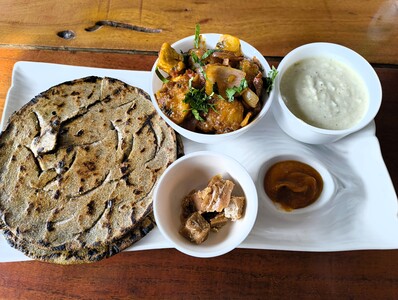
If you go to Jaipur, this is one restaurant I’d totally recommend.


Wonderful post as usual with lovely pics. I read parts 1 and 2 as well. I enjoyed them all. I found Egyptian mummy in Rajasthan intriguing. Its a on my bucket list, and your experience has made me think about it again. Salmon pink buildings look enticing don’t they!
LikeLiked by 1 person
The collection at the Albert Hall Museum is indeed very interesting – an immensely ‘global’ collection, if you know what I mean: it’s not as if this is a ‘Rajasthan’ museum, more like the sort of collection you’d expect to see at the National Museum or the one at Kolkata… I was very impressed.
Do put this at the top of your bucket list. :-) It’s really worth a visit!
LikeLike
I’m bookmarking your posts for when I go to Rajasthan! I keep learning new things – for instance, I’d always thought Jaipur was called the Pink City because of its sandstone buildings. I didn’t know that the ruler had had it painted pink in honour of the Prince of Wales. (Why pink?!)
LikeLiked by 1 person
I remember having read somewhere – I think on one of the Jaipur tourism signs, or the website, I don’t recall – that the pink signifies hospitality. Odd, actually: I don’t usually associate pink with Rajasthan, let alone even India. Red, orange, bright greens and blues, yes; but not orange. At least it’s a fairly pleasing shade of pink. Imagine Barbie-tinted buildings!
LikeLike
Madhuji,
We had gone to Jaipur in September 2023. I also love museums and we spent quite a bit of time at the museum. We also watched a puppet show on the way out. One place that I dragged my family to was Sanganer (not very far from Jaipur) which is very famous for Hand block prints.
Anita
LikeLiked by 1 person
Oh, yes! I do remember that Sanganer is not very far from Jaipur. That must have been a good detour- did you buy some stuff direct from the craftsmen?
LikeLike
Sanganer was good, Madhuji! But craftsmen there are wholesalers. They do not entertain customers like us.
LikeLiked by 1 person
Oh, I see. I had gone to Kota many years ago, and to the village where Kotadoria is made. There too the weavers are primarily wholesalers but they didn’t mind us coming by and buying a couple of saris.
LikeLike
I went to Jaipur recently as well. Amer Fort is very well patronized by both visitors: domestic and foreign alike however the nearby Jaigarh Fort [at quite some height] sees only a trickle [probably due to walking on a gradient/incline ]. There is also the Nahargarh Fort though I couldn’t see that.
The Jaipur Metro ends at Badi Chaupar, from where the old Pink City starts and govt doesn’t seem to be expanding it. The train speeds also were very slow.
I wonder how many people take the full tour of the City Palace [it was err, around ~3k when I visited but I took the normal ticket ]. There is also the Isarlet nearby [basically like Qutub Minar except you are allowed to go up and have a panoramic view of city].
Albert Museum apparently, is one of the oldest in the country and lies opposite to Jaipur Zoo. By the time I visited the museum at evening, I was quite tired. Had a quick browse and also took an image of the mummy from same orientation :p.
In terms of food, I had Rajasthani Jungli Maas [basically a spicy version of mutton; not very different or unique IMO at least at the restaurant I ate] with Bajre roti. I found the humble ‘pyaaz kachori’ to be a better balance of price and taste.
LikeLiked by 1 person
The ‘Isarlet’ was new to me: I have to admit I hadn’t even heard of this until I read your comment. Interesting!
As for jungli maas: my tolerance for mirchi is not that great, so this was something I tend to steer clear of, along with laal maas – but pyaaz kachori is a favourite of mine. Absolutely love that. Also ker-saangri.
LikeLiked by 1 person
Your travelogue is very interesting and reading it refreshed my visit to Pink City last year. Is it a coinicidnce that I did a tour called “beyond forts & palaces”. It was a heritage walk in the pink city by Jaipur retold. I think the essence of the pink city is not in these forts but area around it where you and I both explored on our own. It is buzzing and thriving. I will highly recommend this jaipur heritage walking tour that I did. It was enlightening.
LikeLike
Thank you for reading, and for the comment. I don’t know when I will get to go there again, but will keep your recommendation in mind. Thanks again!
LikeLike
I’m happy to see pictures and narratives from a travelers perspective of my home town. Loved reading this blog, Madhulika.
LikeLike
Thank you for reading! I’m so glad you enjoyed this post.
LikeLiked by 1 person
Sure, I did :)
LikeLiked by 1 person