
I was reminded of this film the other day, because I was lecturing at a Delhi college on historical detective fiction, and ended up mentioning And Then There Were None/Ten Little Indians (no, it’s not historical detective fiction, but I wanted to check how many people in the audience had read this book). The novel, first published in 1939, is Agatha Christie’s most popular book (also, the world’s top-selling mystery book), and one which Christie described as being the most difficult one to write. It has been adapted to screen multiple times, in different languages (in Hindi, as Gumnaam, which sadly did not credit Christie even though the film was very obviously based on the book).
I have reviewed—many years ago—an earlier film adaptation, And Then There Were None (1945), directed by René Clair, and I’ve reviewed Gumnaam too, but decided it was high time I watched a later version. This one, directed by George Pollock.
Ten Little Indians gets off to a flying start, the credits rolling as eight guests arrive by train at a snowy, deserted-looking railway station. They proceed, first by horse-drawn carts and then by cable car, up to a grand (but forbidding-looking) mansion situated high up on a rocky, lonely mountain. There, they are met by a couple of servants: Grohmann (Mario Adorf) and his wife (Marianne Hoppe).
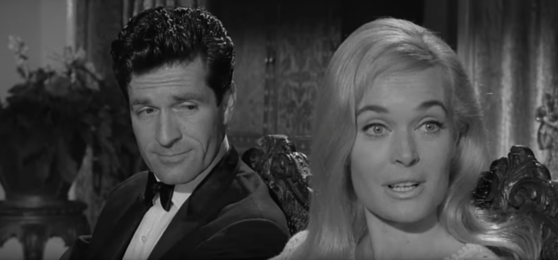
The Grohmanns show the guests to their rooms. None of these guests have ever met each other, though from the curious looks some of them bestow on the others, it’s obvious they’re at least interested. The American Hugh Lombard (Hugh O’Brian) and the host’s newly-appointed secretary, Ann Clyde (Shirley Eaton) seem, for instance, to like what they see.
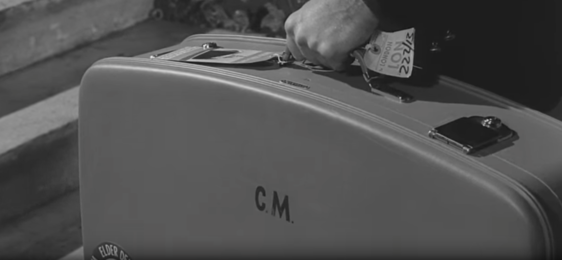
In passing, one of the other guests remarks on the fact that the initials on Lombard’s suitcase are CM, rather than HL. Lombard laughs it off, and says he had to borrow a friend’s luggage in his hurry to make it to this place.
Their rooms, oddly enough, each have a framed copy of the popular rhyme Ten Little Indians. At the dining table, too, is a three-dimensional representation of this rhyme: a circular centrepiece with ten statuettes of Native Americans.
It’s all quite light-hearted right now as the eight guests unwind at dinner and get to know each other. One person is a celebrity and therefore known, at least by face and work, to the others: the famous actress Ilona Bergen (Daliah Lavi).
The flippant, rather silly Mike Raven (Fabian) considers himself something of a celebrity too—he’s an entertainer—but most of the gathering give him the cold shoulder: this young man is just too full of himself.
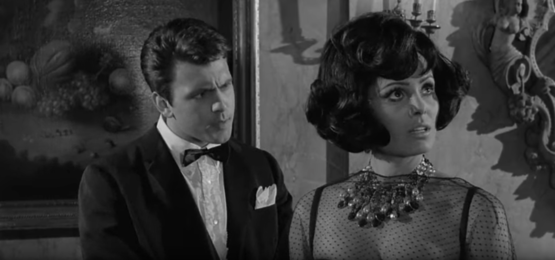
There are other people here who seem to be rather more distinguished: the much-decorated general, Sir John Mandrake, BC (Leo Genn):
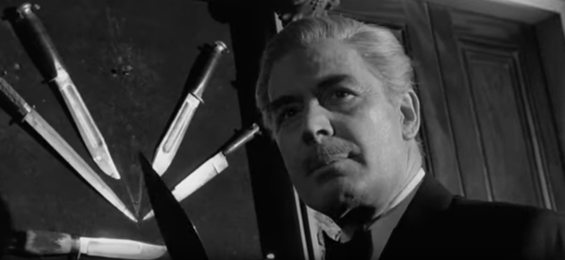
An illustrious judge, Arthur Cannon (Wilfrid Hyde White):
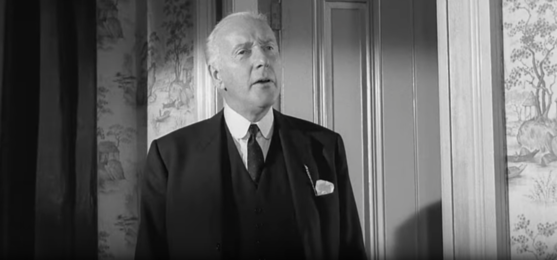
Not quite so illustrious, there’s a doctor, Edward Armstrong (Dennis Price), who drinks on the sly once he’s safely inside his room.
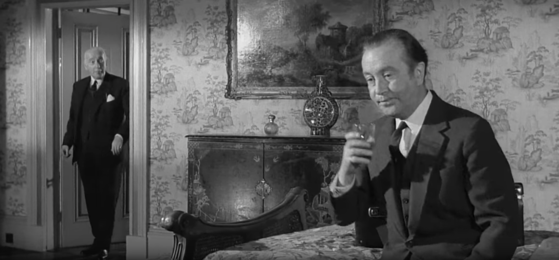
There is also a man named Blore (Stanley Holloway), whom we get to know only later.
They’re all settling in, enjoying their dinner, Grohmann going about serving drinks…
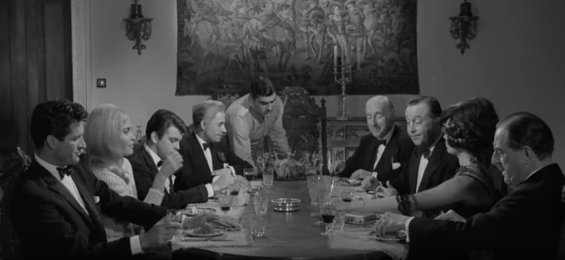
… when suddenly a voice (Christopher Lee’s, though he’s not credited) booms out of nowhere, addressing the eight guests, as well as the Grohmanns. This unseen man introduces himself as their host, Mr UN Owen, and tells them why he’s invited them to congregate here, in this out-of-the-way old mansion: to receive their punishment for murders they’ve committed.
Even as the guests listen on, all of them with expressions of varying horror, shock and indignation, the man spells out the crime each of these people committed. The general sent several men to their certain deaths, well aware that he was doing so. Ann Clyde killed her sister’s fiancé. Ilona Bergen killed her husband. The doctor, operating while intoxicated, caused the death of a patient. And so on, each of them guilty, and wilfully so, of the death of another person.
Almost everybody denies this allegation; men like the judge and the doctor, ‘respectable and upstanding citizens’ written all across their faces, are all righteous indignation. What a preposterous idea!

Hugh Lombard shows a bit of practical common sense and goes searching for clues. Mr Owen’s message was obviously a recorded one, and Hugh finds the speaker as well as the player hidden away in some furniture. Grohmann denies that he knew what it was; he had only been given instructions to turn on the player at a specified time.
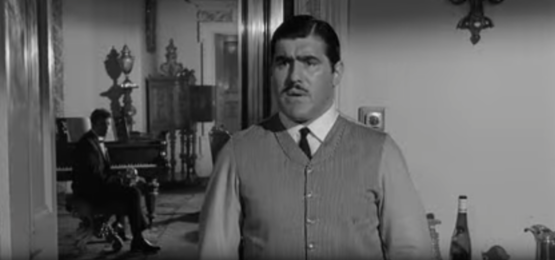
In fact, it emerges that Grohmann has never even set eyes on Mr Owen. The Grohmanns were hired through an agency, and arrived at this mansion just the other day. All the instructions they’ve received so far from Mr Grohmann have been written ones; they’ve never met them. But now, in his broadcast message (so to say) Mr Owen has also accused the Grohmanns—of murdering their former employer. Grohmann is vehement in his denial of the accusation.
So who is this Mr Owen? None of the guests knows. Ann Clyde, like the Grohmanns, was hired through an agency and has never met her employer. Ilona Bergen says she receives many such invitations, from people she doesn’t know (the implication, of course, is a self-congratulatory one: she is a star, she has thousands of admiring fans). The entertainer Mike Raven more or less echoes Ms Bergen’s words; in his case, it’s not perhaps fame, but a chance at work: he’s invited here, there and everywhere to entertain people.

Blore, like the Grohmanns and Ann Clyde, has been hired. He is a detective, invited here by Owen (who, of course, he hasn’t met) to keep an eye on these guests.
The long and the short of it is that nobody really knows Mr Owen. Also, they have now realized that UN Owen can actually read as unknown. Someone has gathered them all here and is intent on playing some dirty trick on them.
There is confusion and suspicion, anger and indignation all round (Mike Raven, ever flippant, is the only one unfazed by it all). They decide they must leave, and immediately: who knows what this unseen madman may do? Grohmann, when asked about the mansion’s access to the outside world, says that there’s only the cable car; there’s no other way. Even if one takes the cable car down the mountain, from the terminal there, it’s a good fifteen miles or so to the nearest village. Also, he has discovered that the telephone wire has been cut. Fresh supplies are expected on Monday, which is the earliest someone from the outside world will come here.
Basically, they are stuck in the mansion. To what purpose?
Mike Raven thinks it’s a big joke. He’s laughing about it, sneering at the worries of the people around him. He is the only one, too, who admits that he is indeed guilty of the crime Owen has accused him of: it was in a car accident, and Raven was very drunk. So what? He doesn’t show a trace of compunction.
Raven sits down at the piano and cheerfully starts singing a (decidedly inappropriate, given the circumstances) rendition of Ten little Indians… and, singing, laughing, takes a sip from his glass and chokes to death the very next moment.
The others cluster round; the doctor reaches out a hand to lift Mike’s glass, but Blore stops him: there will be fingerprints on it, the fingerprints, perhaps, of whoever poisoned Mike. And poisoned he is: the doctor only has to sniff at the contents of the glass to catch the distinctive smell of bitter almonds. Cyanide.
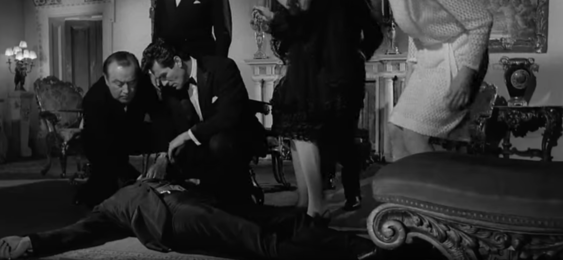
Ten little Indians went out to dine/One choked his little self and then there were nine.
And there is something else too: someone, surreptitiously, has broken off one of the ten figures on the centrepiece. It’s gone, vanished, leaving nine other figurines there.
Suddenly, the remaining people aren’t quite so blasé anymore. Mike Raven was murdered, killed in cold blood. That too in a macabre way that echoes the first line of the song. This was no accident, this was deliberate, mirrored in the way the figurine has been removed too. This means, then, that the killer, Mr Owen, will carry through with his mad threat.
The way Raven was killed: surely the killer is right here, hiding somewhere in the depths of the mansion. After much discussion, they decide it is imperative to search and run him to earth, so the remaining people split up into groups and go through the mansion with a fine-tooth comb…
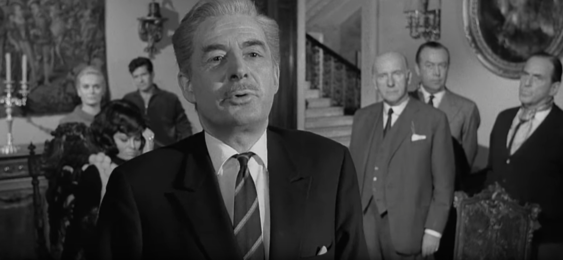
Down in the cellar, the general (who has since admitted that five men did die because of a decision he took, many years ago) is killed, stabbed to death.
And there is nobody else but these people in the mansion. The killer, the ‘Unknown’ Mr Owen, is one of them.
It’s Friday night. They have more than two full days and nights to spend here in this mansion with a demented and mysterious killer who won’t stop until (his idea of) justice has been served.
What I liked about this film:
The story, which is actually based (not that it gives credit for it) on the 1945 And Then There Were None, rather than Christie’s plot. And even though (like the 1945 film) the characters aren’t exactly as Christie planned them, and the end is based—not on the book, but on a dramatized adaptation written by Christie herself—it’s still pretty good, still suspenseful and entertaining.
There are some minor gaps, such as how the culprit could have gone around breaking off the figurines, but this was more something that wasn’t explained, rather than something that couldn’t have been explained.
What I didn’t like:
The dramatic ‘one minute to figure it out’. This is a gimmicky pause that occurs right near the end of the film, before the major reveal, in which the audience is challenged (through a voiceover) to figure out what really happened. Glimpses from the preceding scenes (largely of each murder being committed) play out while the clock ticks. It’s irritating, and I found it intrusive, especially because there was no way, just by looking at those scenes, one could have figured out who the culprit was.
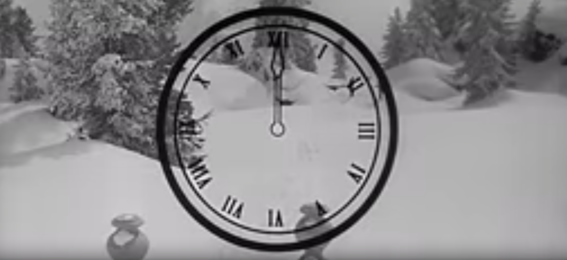
(Note: Some more of the ‘What I didn’t like’ for this film overlaps with that for And Then There Were None, which I’ve reviewed here).
On the whole, though, despite the flaws, an interesting, watchable film.
 Dustedoff
Although the endings of And Then There Were None (1945) and Gumnaam (1965) quite disappointed me, they were entertaining on their own, although they don’t stand up in comparison to the original book. Most probably the movie-makers wanted to change the ending since the 1945 audience knew the ending of the book and they wanted to offer something new.
I had started watching George Pollock’s version once, but the opening music itself sounded too frivolous and joyful for a murder mystery to my ears. Although I am all for frivolous music of the swinging 60s, it sounded more like an opening for a rom-com rather than a thriller.
Have you watched the And Then There Were None (2015)? That is in my opinion a well-made one, though it is very dark in colour as well as mood.
LikeLike
I have to admit I didn’t even notice the music here, though (later in the film) I did wonder how Hugh Lombard and Ann Clyde have the time and the inclination for all that romancing! In that sense, of course, it’s a little like Gumnaam – no worries if a killer is lurking somewhere near, we will have our fun. :-)
I haven’t seen the 2015 version – thank you for the recommendation, I’ll try and see if I can find it streaming somewhere.
LikeLike
LikeLike
I’m glad you enjoyed the book and my review! The book’s a good one – one of my favourite Christies.
LikeLike