
This is the third and final part of a three-part travelogue, about our recent travels in Karnataka. The first part, about Mangalore, is here, and the second part, about Coorg (specifically Madikeri) is here.
From Coorg, we were to drive down to Nagarhole, an approximately three-hour journey. While researching Coorg, I had marked a couple of places that seemed to be extremely popular tourist attractions, and had been wondering if either of these might be visited while we were in Coorg or midway to Nagarhole. One of these we did manage to see on a day trip from Gateway Coorg: the Dubare Elephant Camp.

About an hour’s drive from Gateway Coorg, the elephant camp is part of the Dubare Reserve Forest, and is run by the Forest Department on the bank of the Kaveri. The camp houses a few elephants, which have been captured and brought here for various reasons: according to a signboard I saw, some of these might have strayed into human habitations and caused havoc; others might be orphaned baby elephants which need a home.
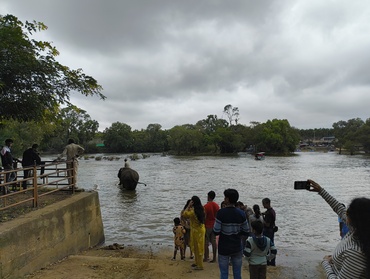
Uninjured and healthy elephants are fitted with radio collars and translocated elsewhere; blind, injured or orphaned babies are brought to Dubare until they can be rehabilitated. Everyday, the elephants at the camp are taken down to the river to be bathed; they are fed and given medicines, and then the mahouts take them into the forest to let them forage through some part of the day before being brought back to the camp in the afternoon.
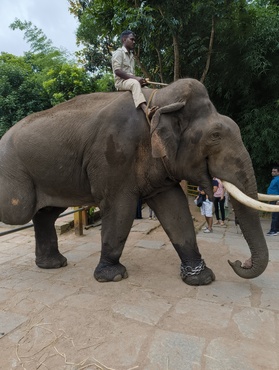
The morning bath (between 9 and 10 AM) and the afternoon return to camp (between 3 and 4 PM) are the times when visitors are allowed. We therefore timed our arrival at the ticket counter (on the main road, across the Kaveri) for 9. Tickets are dispersed very quickly, by staff moving down the queue, and each ticket entitles you to a seat in a motorboat, as well as entry to the camp.
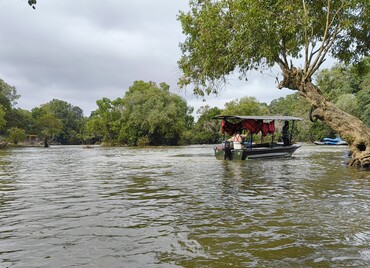
The boat ride took just a few minutes, and then we were alighting on the Dubare camp side of the river. An elephant was being bathed by its mahout, and the LO (along with dozens of other eager spectators) couldn’t take her eyes off the scene. The feeding of the elephants—medicine being administered in the form of cannonball-sized lumps being tossed into the animal’s mouth—was also, at least to the LO, pretty fascinating.
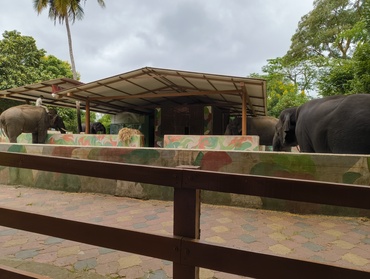
I must admit that to me this camp wasn’t very inspiring. It was all a little too commercial, the Instagrammable entrance obviously geared for tourists. The actual work done by the Forest Department may be for the welfare of the elephants, but all I could see were the heavy chains on the elephants’ ankles, the thick-logged, cramped kraal in which I saw an elephant standing, and the fact that the place was milling with tourists pushing and shoving to take photos with the elephants in the backdrop.
Nagarhole, being a national park and a tiger reserve, would (or so I hoped) be better.
From Gateway Coorg, we set off rather late in the morning (the LO is not a one to get started early when on holiday). Midway, we ended up making an unscheduled detour to see another attraction—and all because my husband saw a few maroon-robed Tibetan monks walking by the side of the road.
The sight of them reminded him that a major sight in the vicinity is what is popularly known as the ‘Golden Temple’: the Namdroling Monastery in Bylakuppe. I had heard of Namdroling and the Bylakuppe Tibetan settlement some years back. Till then, I’d been under the impression that the Tibetan exodus of the early 1960s had resulted in Tibetan settlements solely across North India (Dharamshala/McLeodganj, Dehradun/Clement Town, Delhi). But no, many Tibetans came south to this part of the country too, and they didn’t just settle here, their religious leaders also set up what came to be regarded as one of the foremost centres of theology in Tibetan Buddhism, Namdroling.
Our visit to Namdroling turned out to be a thing of pure serendipity. Here we were, not having planned this at all; and when we walked through the gate, we discovered that there was some major event in progress. A vast shamiana had been spread out across the square just inside the gate. Under this, forming a square ring, sat hundreds of visitors, nearly all Tibetans, probably lay people.

As we walked in, past beautifully maintained gardens, we came up against a long procession of robed and colourfully accoutred monks, all proceeding to the shamiana (where we later saw them playing music, acting and dancing to what I assume is a variation of the chham).
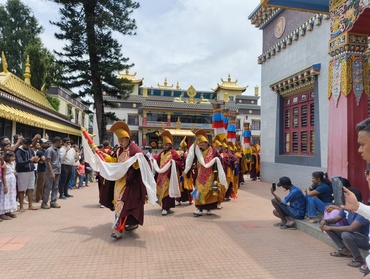
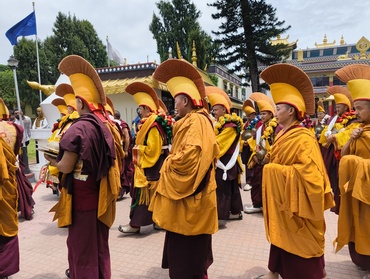
We never did discover what the occasion was, but I felt oddly blessed. What amazed me was that despite the hundreds of people around, there was a quiet serenity about the place. Even tourists like us, almost certainly not Buddhist, seemed to be affected by it.
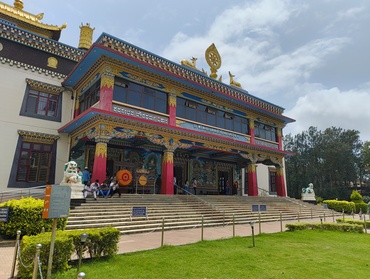
Anyhow, we went into the Padmasambhav Vihara, the shrine here that is open to visitors: a beautiful and serene prayer hall, stunningly decorated. The walls are painted with scenes from Buddhist lore, multicoloured mandalas adorn the ceiling, and huge gilded statues tower over the altar in front.

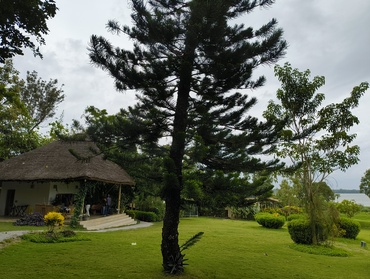
From Namdroling, it took us a little over an hour to get to our destination, a resort named Fireflies Kabini, just next to Nagarhole. Fireflies Kabini is situated on the bank of the Kabini River (which flows through Nagarhole), and is a lovely, verdant property. Each ‘room’ is an independent cabin, with its own little verandah: we ended up spending a lot of our time sitting here, peering into the trees and flowering shrubs around, watching for birds. We saw many of them, from the small pale-billed flowerpecker and purple-rumped sunbird to the ubiquitous red-whiskered bulbul.
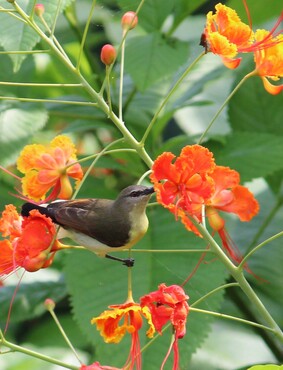
The LO’s favourite, however, was the koel. It took many tries and much patience to finally spot one (though we never did get a decent photo of one), and the LO was amazed at the bird’s persistent calling. How, she wondered, could it go on and on and on, throughout the day? (Though by the evening Fireflies’ resident koel was sounding distinctly raucous and the LO went into peals of laughter at the idea that it had lost its voice from too much calling through the day).
In between meals and Nagarhole safaris, we would walk out of Fireflies and onto the Kabini riverbank just outside. It could, I suppose, have been a more straightforward route across the field that separated Fireflies from the riverbank (and the LO, ever-ready for adventure, was more than willing), but she was persuaded that the farmer may not like us trampling all over his crops…
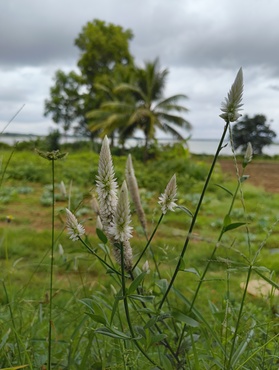
The Kabini riverbank was a place we saw plenty of birds. Herons and egrets and the occasional waterhen (more heard than seen, squawking loudly in a bamboo thicket) but also others: brahminy kites, paddy field pipits, and once—a first-ever sighting for us—a blue-faced malkoha.

For the LO, the riverside was testament to what she was firmly convinced were the depredations of a tiger: two skulls and some sun-bleached bones of what looked like cattle. I pointed out the fact that there was a village right next door, but the LO decided that my other theory (suggested, I will admit, in jest) that a tiger had swum along the river and killed a cow here, was far more appealing.
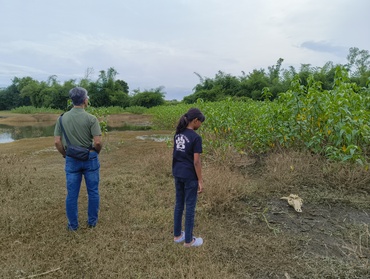
She even convinced herself that a pile of blue feathers—obviously from a kingfisher—was also the result of a tiger prowling about. A tiger killing birds, à la a domestic cat, didn’t quite ring true to me, but the LO happily collected the prettiest of the feathers to take home.

But we were here primarily for Nagarhole, and the chance of sighting something bigger and more interesting. Jeep and boat safaris operated by the Forest Department are available, both of them setting off from the Kabini Jungle Lodge/Kabini River Lodge complex. The people at Fireflies had done the bookings on our behalf and had deputed a driver for a drop and pick-up from between the resort and the safari start/end point.
The jeep safari, three hours long (as is the boat safari) begins at 7 am. We had 3 seats in a large 9-seater jeep in which the driver was also the guide. The safari made its way through the jungle, now and then swinging by the Kabini River but mostly keeping to the wooded areas further inland.
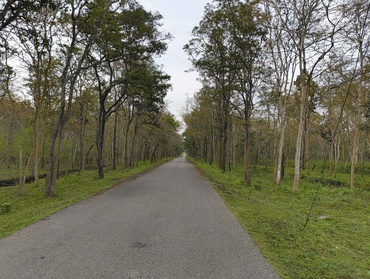
The LO, of course, was very hopeful that we might see a tiger – or if not that, a leopard (Nagarhole’s approximately 850 sq km of territory is home to some 150 tigers, 105 leopards and even a black panther). She had to be satisfied with seeing some tiger scat that our driver pointed out…
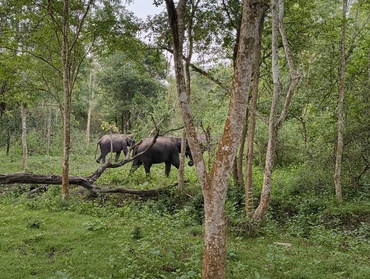
… But we saw quite a bit else. Elephants, a wild boar, stripe-necked mongoose, langurs, bonnet macaques, and many herds of spotted deer.
The LO was all for going on another jeep safari in the hope of finally spotting a tiger, but we decided a boat safari might be more fruitful: at least it would give us a view of the space from the river rather than the land.
The boat accommodated probably around 15-20 people, and was a rather more up-to-date affair than I’d imagined. There were life jackets for each of us (and kiddie-size life jackets for the children; the LO was impressed), and the huge open ‘windows’ on either side had roll-down clear plastic ‘panes’ that could be pressed into service in case of rain. These proved pretty useful for us, because midway through our safari, it did begin to rain; but we were not just shielded from the rain, we could continue to look outside fairly easily.
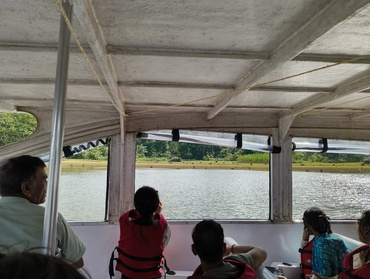
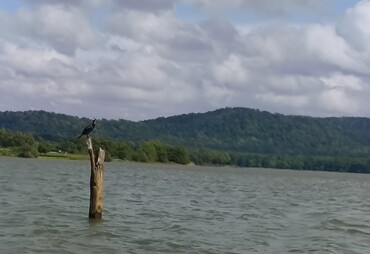
The boat safari took us about three hours, and here too the pilot was the guide. It took us the best part of an hour to go from beside shores that were cultivated, into the national park proper. Initially, we saw mostly waterbirds: various species of cormorants, darters, herons and egrets, perched on dead trees sticking up from the water, or wading along the edges of the river.
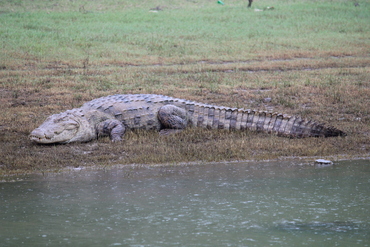
Then, as we got deeper into the reserve forest, we began to see mammals and other, bigger, species along the shores. Lots of spotted deer (chital), of course; but also a sambar deer family; a wild dog (Nagarhole has a large number of these); and a species we, at least, had never seen before: the crocodile or mugger. We saw one of these sunning itself on the Kerala side bank of the Kabini, and two others, further along on our safari.
As much time as she spent admiring the wildlife outside the boat, the LO spent glaring at two other little girls (well, not so very little, but definitely younger than the LO) who had also come along on the boat, as part of a rather large and fairly noisy group. The girls spotted a spider on board the boat, and after that, there was much shrieking and squealing every time they thought it had come near them. The LO was most disapproving. “Junglee log” was how she described them to me.
We didn’t, after all, see a tiger. Or even a leopard, though the LO had great hopes. But, as I told the LO, the experience of being in the forest is the main thing. That is what matters.
While in Coorg, we’d met a family who told us that their favourite wildlife experiences have been in Rajaji National Park, where they’ve spotted leopards (pun intended) on several occasions. The LO, that very evening, did a quick Google search and discovered that Rajaji is only about three hours’ drive from home. Now, every few days, we are asked: “So, when are we going to Rajaji?”
Let’s see.
 Dustedoff
How exciting, Madhu, and how disappointing not to catch sight of either tiger or leopard! I would love to see a black panther, for instance. Nagarhole was one of our ‘excursion’ spots from school – you know, the annual three-day trip they take you on? Mysore was another. But no, I haven’t been lucky enough to spot a tiger there either. Neither have I visited the Buddhist monastery. :( It sounded lovely the way you described it.
I did laugh out loud at the LO’s antics. :) She is unique!
LikeLiked by 2 people
You are lucky, to have been able to go to Nagarhole and Mysore on school trips! I will tell the LO, and I am sure she will be truly envious. :-) I was throughout in Kendriya Vidyalayas, which didn’t believe in taking us on school trips – the only excursion I remember was a day trip to Kokernag, from our school in Srinagar.
The LO is certainly unique. I told her, “God broke the mould after he made you” and she was in splits. Then I explained what it meant. ;-)
LikeLiked by 1 person
What a thoroughly engrossing travel post, dear Madhu. I enjoyed reading it. I knew Nagarhole but didn’t know any of the details you have mentioned. The elephant ‘farm” sounds sad indeed.
The Tibetan monastery sounded great. I think, i would love to visit it once.
I am all for LO’s version of the tiger killing the two cows, although I don’t really think a tiger would stoop so low to kill a kingfisher, which might be too fast for the tiger. But mind you big cats hunting birds is not improbable. I saw documentary of lions in the Namib desert, who had developed the skill of hunting giraffes and then their descendants wandered through the desert and came to a lake, where sea gulls rested at night. Since there were no other animals to prey on, the lions learnt to hunt sea gulls. Later on the wandered ahead to the sea coast and learnt to hunt seals.
LikeLiked by 2 people
I hadn’t known about that bit regarding the lions hunting seagulls – but I can definitely believe it, that in the absence of other, more easily accessible prey, they would be reduced to it. At Kabini, with so many goats and cattle from the local village wandering around, a tiger would have to be plain stupid to try and attack a kingfisher. On the other hand, there are raptors around – we saw brahminy kites just a 100 mt away, and crested serpent eagles further along – so it could well be that the kingfisher fell prey to one of those.
I will tell the LO about the lions, she will be very interested!
Thank you for reading, harvey. :-)
LikeLiked by 1 person
I don’t know if you can watch this video in India, but hee is the link nevertheless.
https://on.orf.at/video/14251809/universum-geister-der-wueste-die-loewen-der-skelettkueste
At 21:00 you can see the lionesses hunt the water-birds and at 32:48 is where you can see them hunting seals. If the video is not available in India, I’ll screen record it and send it to you.
LikeLiked by 1 person
No, I wasn’t able to see the video, Harvey – but don’t bother, I did believe you, you know! :-)
LikeLiked by 1 person
Enjoyed the three part travelogue. I read all the parts, though couldn’t comment on those parts.
I had been to Rajaji a couple of years back. But it rained heavily and we could see a few animals other than tiger. But I’m not a fan of these safaris.
:-)
LikeLiked by 2 people
Thank you for reading, Anupji.
I have also been out on safari during rain – at Sariska, and then during our night walk in Coorg – so I can sympathise! Not a pleasant experience. :-)
LikeLiked by 1 person
Good post 👏
LikeLiked by 1 person