
RIP, Robert Redford.
I will not pretend that Robert Redford was my favourite actor. In fact, offhand, I’d be hard put to remember how many (or, embarrassingly, how few) of his films I’ve watched. All the President’s Men, yes; A Bridge Too Far, yes. A few others, none of them (like Captain America: Winter Soldier) films for which he’s known.
Mea culpa. It isn’t a reflection on Redford, but on me, because most of my life has been spent watching Hollywood from the 30s to the 50s; my favourite era in Hollywood was over by the time Redford burst upon the scene. But it says a lot for him that despite that, I liked him in the few films of his that I watched. A great actor (and so handsome!). Deeply committed to the cause of environmental conservation, and by all accounts, a genuine, warm-hearted person.

I decided it was about time I finally watched a film I’ve been meaning to see for a long time: co-produced by (and of co-starring with him) Redford’s pal Paul Newman, directed by George Roy Hill, and a ‘mostly based on facts’ (as the credits specify) story about two American outlaws at the turn of the century.
Butch Cassidy (Newman) and his friend and fellow robber the Sundance Kid (Redford) are part of the Hole-in-the-Wall Gang, which Cassidy claims to have consolidated into a gang in the first place. When the film begins, Cassidy has just extricated the Kid from a tricky situation, with some help from the Kid himself: while gambling, the Kid was accused (by a man who didn’t know who he was) of cheating. Matters came to a head, the Kid denied any cheating, and the man challenged him.
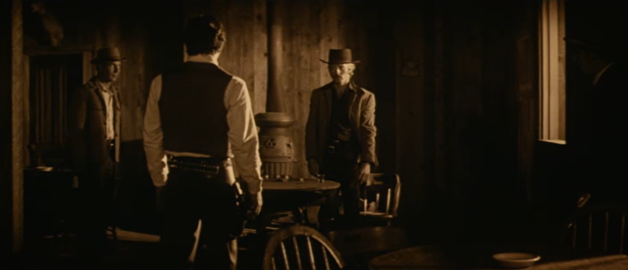
Cassidy blundered in and appraised the man of the Kid’s identity (the Kid’s reputation as a very fast draw is formidable) but even before the man could retract his accusation and apologize, the Kid had displayed some of that prowess for which he’s so well-known.
Now Butch and the Kid are back at their haunt, the Hole-in-the-Wall, where one of the gang members, Harvey Logan (Ted Cassidy) is chafing at the bit and wanting to assert his right to lead the gang. This, by insisting that they rob a train: the Union Pacific Flyer, which is due to go, up and down, twice. Both times loaded with money.
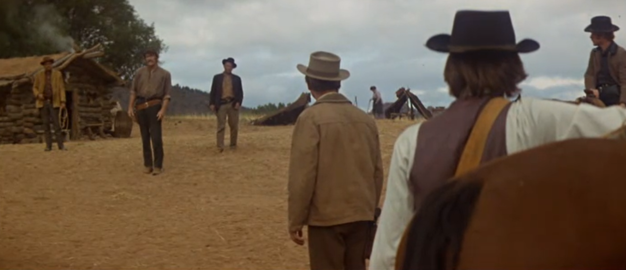
Butch disagrees. Trains are messy business; he doesn’t want to rob a train. Banks are so much better; they stay in one place. An argument erupts. Harvey challenges Butch: choose your weapon. While Butch is dithering, Harvey decides, and pulls out a whacking great knife, wicked-looking and all sharp steel. Butch—who’s already said that he doesn’t like knives, is no good with one—looks in danger of losing his place as leader of the gang (or worse, his life)…
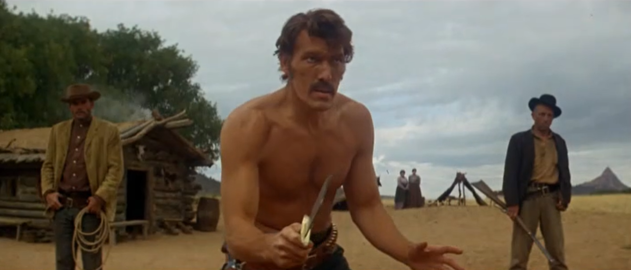
… but he knees Harvey really hard, follows that up with a punch, and while the others are attending to the fallen Harvey, Butch decides they will, after all, rob the Union Pacific Flyer.
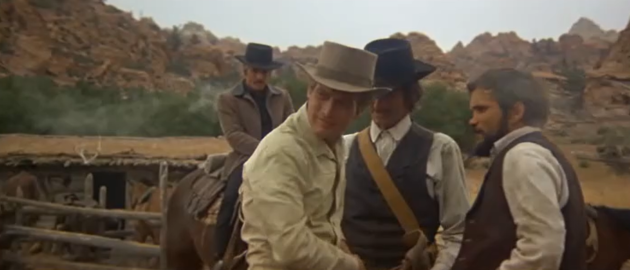
So they do. They halt the train, and make their way to the van, which is locked on the inside and guarded by a zealous man named Woodcock (George Furth). Woodcock is very aware of his duty towards the owner of the Union Pacific, and does all he can to prevent Butch & Co. making off with the money—but a little quick work with some dynamite, and the door of the van is shot to bits. Woodcock suffers minor injuries, and Butch commiserates with him while the rest of the gang gather up the money and take off with it.
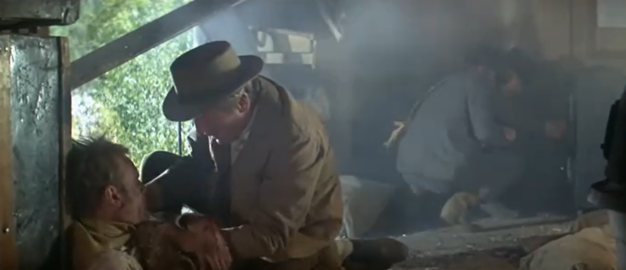
Butch decides, too, that they will follow Harvey’s advice to the T [I feel sorry for Harvey; he got bashed for no reason, given that Butch is doing exactly what Harvey suggested]. They will rob the Flyer on its way back too.
In the meantime, though, they do other stuff. Butch visits a brothel where he’s very friendly with the madam, and has a girl who seems to regard him as more than just a customer.
The Kid, meanwhile, goes and meets his girlfriend, Etta (Katharine Ross). Etta is a school teacher and lives on her own.
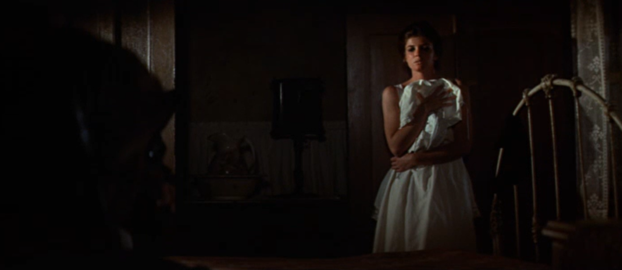
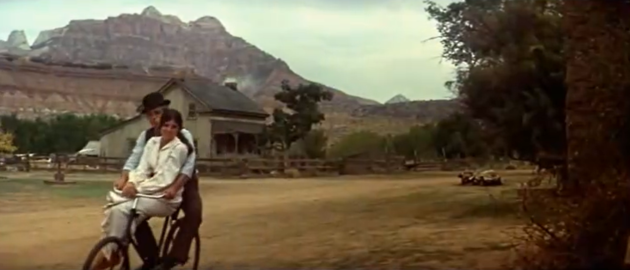
She is also good friends with Butch, thanks to the Kid. [I have to admit that from the single clip of this film that I’d seen earlier, of Raindrops Keep Fallin’ on My Head, I was under the impression that Katharine Ross and Paul Newman played lovers]. Butch comes by in the morning, waking up Etta who leaves the Kid still asleep and comes out to go off on a ride with Butch, to chat and laugh…
Meanwhile, too, things have been happening in town. The train robbery has had its effect; the local Marshall (Kenneth Mars) has been trying to rustle up a posse (though in vain), and there is a certain amount of tension in the air.
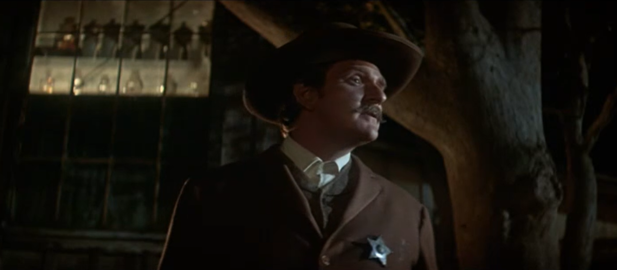
Not enough, however, to deter Butch and the Kid and their gang from carrying out the second part of their Flyer endeavour: to rob it when it’s returning. They do this (in the process knocking out poor old Woodcock once again), but the dynamite has blown a bit too hard, and the currency notes go flying all over the place. The Hole-in-the-Wall Gang’s members scurry about, gathering up their loot, and even as they’re doing that, another train comes thundering along—
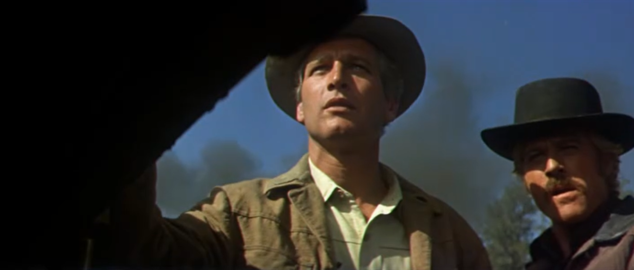
And out of it come out several riders: a posse. On fresh horses, men who look like they mean business. Woodcock’s boss has got sick of Butch and his men going on robbing him, so he’s paid good money to have the gang caught and arrested. This posse will not stop, will not let up, until Butch and the Kid are dead.
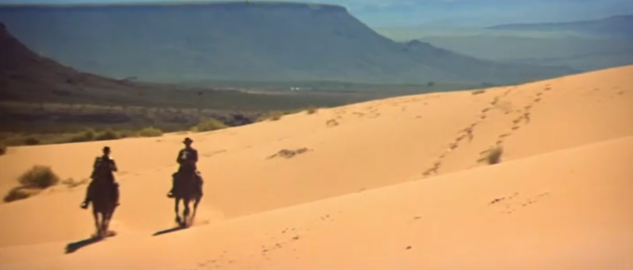
Now what? Butch and the Kid try to outrun and evade their pursuers, but it’s useless. These men have the best tracker in the area, a native American who can follow their trail across rock. They cannot hope to escape. Unless, as Butch has suggested several times to his buddy, they go off to Bolivia. Bolivia is a fine place, with gold mines and silver mines and tin mines and payrolls so huge Butch and the Kid will have trouble hauling all that money away when they steal it.
Is Bolivia on the cards, then?
Butch Cassidy and the Sundance Kid was a runaway hit from the word go. It won many awards, including four Oscars: William Goldman for Best Writing, Story and Screenplay; Conrad L Hall for Best Cinematography; Burt Bacharach and Hal David for Best Song (Raindrops Keep Fallin’ on My Head); and Burt Bacharach for Best Original Score for a Motion Picture. No Oscars (though the film was nominated) for Best Director and Best Film—but George Hill and the film ended up with other awards in those categories, including a BAFTA and a Golden Laurel.
What I liked about this film:
The wit of it. It’s a Western, yes; an action film (and the action is pretty good); but of all the themes that mesh together in the film, it’s the humour that stands out for me. Sometimes, it’s the dialogue:
Butch: “What happened to the old bank?”
Bank guard: “People kept robbing it.”
Butch: “Small price to pay for beauty.”
And this, when the two are completely surrounded and heavily outnumbered:
Butch: “Kid, there’s somethin’ I think I oughta tell ya. I never shot anybody before.”
The Kid: “One helluva time to tell me!”
Sometimes, it’s the situation. Butch having a showdown with Harvey, all that talk about knives and whatnot—and then going ahead and doing just what Harvey had been suggesting in the first place.
Also (and this is something I admired a lot, not just about the screenplay but also the direction and the acting), nothing is said, but so much is conveyed just through expressions, and it’s hilarious. The scene, for instance, where they finally land up in Bolivia. For several minutes, not a word is said; but the way the camera moves, the way the space is arranged (the sense of decrepitude, the ramshackleness of it all), the expressions and body language are such that I could feel laughter bubbling up in me well before the sentence that broke that silence.
The cinematography is excellent, and the views of the wide-open spaces stunning (this is something I end up liking in a lot of old Westerns: how beautiful the American wilderness is). Raindrops Keep Fallin’ on My Head is iconic, a song I have loved from long before I realized it was part of this film.
And Robert Redford and Paul Newman are superb as the Kid and Butch. They are pitch-perfect, their chemistry bang on: the expressions (Redford’s often deadpan in a way which especially amused me), the way they parry and thrust in their repartee. The sense you get that these two are really friends. Incidentally, while watching these two, I was reminded of Veeru and Jai in Sholay: that same bromance, deep and warm but bereft of melodrama. When I finished watching, I went off to check—and sure enough, this film was one of several Westerns from which Salim-Javed drew inspiration in their scripting of Sholay.
An enjoyable, very satisfying film, and a good showcase of the talent of Robert Redford.
 Dustedoff
Madhu,I watched the film with some effort but it didn’t excite me too much. But The Sting (1973) starring the same stars, a caper film where they lay an elaborate con-job on a mob boss was very satisfying. I would recommend this film to you. I am sure you would be impressed enough to write a comparative review.
AK
LikeLiked by 1 person
I have a soft spot for heist/con movies, so thank you for The Sting recommendation, AK. I’ve bookmarked it and hope to watch it over the weekend.
LikeLike
I have always had a soft spot for Robert Redford, not only for his good looks, but also the person he seemed to be. His smile had such a winning quality about it.
I am sure I have seen many films of his, but my memory being what it is, I can only recall The Sting (1973), which AK has already kindly recommended. That movie impressed me a lot. Everything about it is just good.
BCATSK (1969) has been a film, which I have wanted to watch for a long time, but never came across it anywhere. I was hoping that some TV channels will broadcast it, but they didn’t. Maybe some will during the weekend.
RIP Robert Redford, and thank you for your legacy.
LikeLiked by 1 person
Thank you for seconding the Sting recommendation, Harvey! Now I must try to watch it sooner rather than later. :-)
Also, if you want to watch this film, there’s a good print on Dailymotion:
https://www.dailymotion.com/video/x9h0kje
LikeLike
Thanks for the link, Madhu. Just heard that Claudia Cardinale left us today. She will be meeting Robert Redford for sure. Another one of the legends is gone. RIP!
LikeLike
That’s sad news, about Claudia Cardinale. The first film I remember watching her in was the brilliant I Soliti Ignoti, and I actually have another film already bookmarked. Maybe I will watch that next by way of tribute.
LikeLike
I knew you would review a Redford film, Madhu. So glad to see that it’s this film – it’s one of my favourites. Did you know that Joanne Woodward (Newman’s wife) was responsible for Redford being offered the role? She suggested his name to Newman.
Redford and Newman became friends during the filming of this movie. And in fact, Newman – another genuinely good fellow, by all accounts – established the ‘Hole In The Wall Camp’ for children with serious illnesses, while Redford went on to establish the Sundance Festival, which supports so many indie films.
And you’re so right about their friendship (in the film) reminding you of Jai and Veeru. It appears that way in real life, too. Newman had once related an incident where Redford sent him a Porsche for his birthday – one without a transmission and that had crashed into a tree – all tied up with a pretty bow and left on his driveway.
So Newman had the car compacted and carried into Redford’s living room. According to him, it took five men to carry it inside. Redford called a sculptor to turn the car into a garden ornament and had it placed in Newman’s garden. :)
Vanity Fair has a lovely piece on their bromance.
My tribute to Redford will come later (like you, I am ambivalent about the man, except that he was a great actor whose good looks often made people underestimate his talent). Shalini and I are having a watchalong this weekend.
LikeLiked by 1 person
Thank you for that very interesting comment, Anu! I wasn’t able to access the Vanity Fair article (it was beyond a paywall, and right now I don’t have the bandwidth to subscribe to something I may not have the time to read) – but your comment was delightful. :-)
I am looking forward to reading your post, whenever you publish it (I haven’t checked your blog yet, so if you’ve already published it, pardon this).
Interestingly enough, I’d heard of both the Hole-in-the-Wall Project as well as the Sundance Festival long before I bookmarked this film. And, also interestingly enough, NIIT here in India used to have their own Hole-in-the-Wall project, a project to introduce slum children to computers: they’d fit a computer into a neighbourhood wall where the children could access it anytime and get familiar with it. A very successful project too!
LikeLike
I came across your blog because of your review of Chintamani’s Dark Star. Happy to see you still post. Sadly, on more than one occasion, I’ve stumbled on a Hindi film blog that had been dormant or abandoned for many years.
Random q – Are there books on Hindi actors that don’t become victims of hearsay or extreme jumps in inferences? Where they have at least SOME access to the people closest to the person. Perhaps it’s true everywhere, but in India especially, people seem to not want to be open about a person’s shortcomings or flaws.
John Lennon feels like a lesson in extremes in that regard because he talked about all his many, many flaws including physical altercations and abandoning his wife and his newborn son.
it’s lamentable that people seemingly never consent to interviews because they’re basically the last primary sources. It’s all… Reconstruction after that… Limited in scope. Intellectual honesty must necessarily entail accept no person is a saint and that’s not the worst thing in the world.
LikeLike
Thank you for reading – and yes, I completely relate to you regarding those many blogs that have stopped being updated. A lot of the very best blogs I used to follow way back when I first began blogging have all shut down. Sadly, in two cases, because the blogger passed away. But mostly because other things came in the way- careers, marriage, illness…
And yes, I don’t think there are really any good biographies of people connected to Hindi cinema written by someone who actually knew (really well) the subject of the biography. Mostly it is stuff just cobbled together second-hand, which does dilute the chances of veracity, I agree. But then there are books like Jerry Pintos’ bio of Helen, or Akshay Manwani’s bio of Sahir, which are not really bios but pretty in-depth explorations of their work. Both are books I particularly like.
LikeLike