
For the first few years of blogging, I marked each Christmas with a review of a Christmas-themed film: The Shop Around the Corner, A Christmas Carol, Christmas in Connecticut, The Holly and the Ivy, and so on. Then, somewhere along the way, I fell out of the habit (I am, in some ways, not a creature of habit: I get bored too easily).
But this year, wondering what I should post next—after a slew of tributes—I decided that since Christmas was coming up, and there were several Christmas films I hadn’t yet watched, why not? Therefore, this: a film starring Cary Grant as an angel. Yes, you read that right. Cary Grant as an angel sent down on Earth at Christmastime to help out a beleaguered bishop.
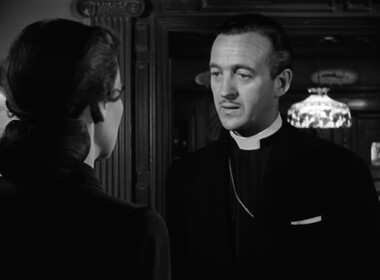
The bishop in question is Henry Brougham (David Niven), a harried man because he’s trying to raise funds for the construction of a new cathedral. As the story progresses, we learn that Henry used to once be a kinder, gentler man, the sort of man who had time to go out for walks and meals with his wife Julia (Loretta Young), who could take time to visit his old parish and listen to the boys’ choir. A man less obsessed with the grandeur of a new cathedral…
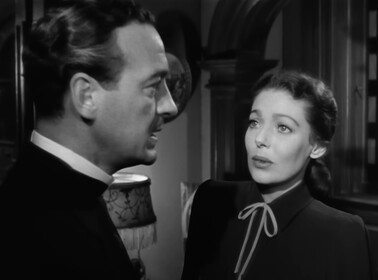
A new cathedral, obviously, will cost a pretty penny. For one, there are few people willing to shell out money for a cathedral. As Henry’s secretary Mildred Cassaway (Sara Haden) informs him drily, a certain millionaire Henry had high hopes from has donated $15.
One person who does seem to be quite willing to give a hefty donation is a wealthy widow, Mrs Hamilton (Gladys Cooper): but there is a caveat. She will give Henry a million dollars as donation for the cathedral only if he agrees that there will be a special chapel in memory of her husband. Henry cannot accept that; the cathedral is to be for the glory of God, not for the glorification of the late George Hamilton.

But he needs the money, too. Most desperately.
Meanwhile, a strange someone has been moving through the streets of this particular town. Dudley (Cary Grant), suave and ever-smiling, beams benignly on at a group of children singing carols. He helps a blind man across a street, all the while calmly flicking a hand, which bringing cars to a convenient standstill while the two men cross in front.
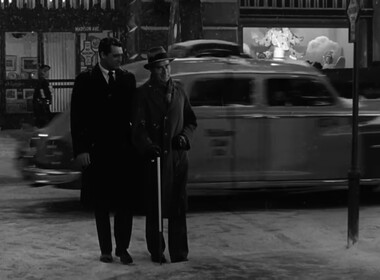
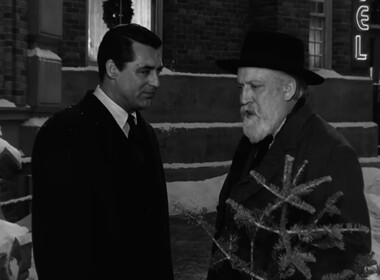
He saves a baby in a runaway pram; he bumps into an old gentleman named Professor Wutheridge (Monty Woolley) and insists that they’re old pals. Doesn’t the professor remember him? They had met in Vienna… the professor, who does have a tendency to be a little absent-minded, concedes that yes, it’s possible.
And Dudley watches as Julia Brougham, walking down the street, stops at a shop window and gazes longingly at a hat in the display.
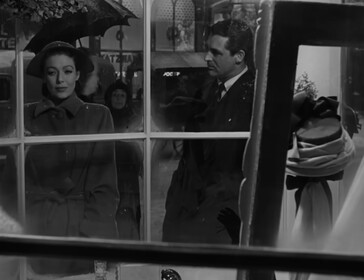
Of course, with all thoughts of money currently revolving round the cathedral that must be financed, the Broughams dare not think of frivolous things like hats. At home, Henry Brougham is driven to prayer: he looks up at the picture of the proposed cathedral that hangs on the wall of his study, and begs God to help.
… and hey presto: Dudley appears in the room.
Of course a bewildered Henry, no matter how religious, cannot bring himself to believe that this man—so obviously flesh and blood—is an angel. Dudley insists he is, and in the midst of this conversation, Julia comes home. Henry has still not quite figured out who his odd new visitor is: whether human or angel, and says the first thing that comes into his head. Dudley is his new assistant. Dudley smiles brightly at Julia, and she is immediately charmed. (She is also obviously very relieved that now that Henry has an assistant to help him out, he will have a little more time for his family).
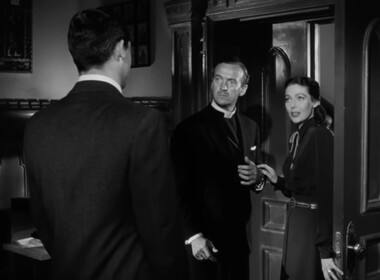
Before anybody can quite figure him out, Dudley has entrenched himself firmly at the Broughams’. With a winning smile and oodles of charm, it doesn’t take him more than a minute or so to endear himself to everybody he comes up against. The Broughams’ maid, Matilda (Elsa Lanchester), for one, who looks starry-eyed from pretty much the moment Dudley greets her.
Or even Henry’s secretary, Mildred Cassaway, who is stern-faced and unsmiling otherwise, but looks positively radiant in Dudley’s presence.
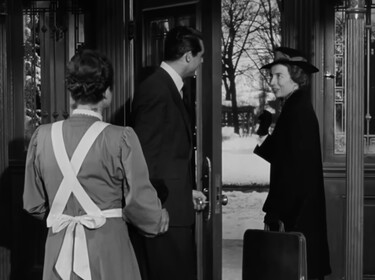
Most of all, there is Julia. Julia, tense and stressed because of Henry’s near-obsession with the prospective cathedral, has been finding herself increasingly on her own. Henry never has time for her or for their little daughter Debby (Karolyn Grimes), and when she tries to suggest some time together—they should go for a meal to a restaurant they used to frequent at one time, which they haven’t visited in eons—Henry agrees, but it later transpires that he’d forgotten he had a meeting that clashes with this lunch date…
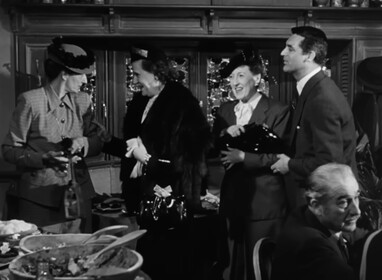
Dudley, though, swiftly takes Julia under his wing (pun intended, though Dudley insists to Henry that he is an angel, even if he has no wings). He takes Julia to that restaurant—where some acquaintances of hers look suitably scandalized at the sight of Julia dining with a strange man. Until Dudley goes over, charms the women, and gets them to join Julia and him.
He goes, too, with Julia to Professor Wutheridge’s place, where he discusses history (and encourages the professor to finally begin writing the book he’s been meaning to start for the past several decades). He also quietly works a little bit of magic on the professor’s bottle of sherry, so that it never gets empty…

Little Debby finds that Dudley is not just a very good storyteller, he is also able to get the neighbourhood boys to include her in their snowball fights. Of course, unknown to everybody, including Debby and the boys, there’s a little bit of magic involved here too.

Dudley came to Henry in response to Henry’s prayer. But is he really helping Henry? Or is he too busy helping out everybody besides Henry? Julia, Debby, Miss Cassaway, Matilda, the professor. Even a random cab-driver: all of them have Dudley to thank for bringing some light into their lives, in some way or the other. But Henry? Henry is still running from pillar to post, trying to collect funds for the cathedral, trying to reason with Mrs Hamilton.
And, watching Julia smiling and laughing as she goes about with Dudley, growing jealous.
What I liked about this film (there isn’t anything I didn’t like):
The message of it. On the surface of it, The Bishop’s Wife may seem like a sweet, feel-good film about a charismatic angel coming into a set of lives and changing them for the better—not really with magic (Dudley’s magic is all mostly quite minor)—but by being gentle and kind, but putting people first, by being open to listening. More than that, it is also a film about getting our priorities right, about understanding what Christmas is really all about. Not gifts and gaiety and booze-fuelled merriment, but a genuine sense of giving. Of seeing those who are in need, and fulfilling that need. That grand cathedral does not glorify God as much as giving to the needy does.
But there is more, too. Very obviously, there are Dudley and Julia and Henry. Is Henry being over-suspicious, imagining a relationship where there is none? Dudley, by his own admission, does feel something for Julia that he, as an angel, is not supposed to feel for any human being. But how about Julia: when she looks so warmly at Dudley, when she’s clearly enjoying his company—what does that mean? Can Henry and Julia (not by means in a bad marriage) revive the happiness they once knew through the intervention of Dudley? Is Dudley really here to only help Henry with the financing of the cathedral, or is his aim something beyond?

The cast is good; David Niven and Cary Grant are especially, I think, well-cast. But when it came to Cary Grant as Dudley, I did wonder… how would this story have panned out if Dudley was not this handsome, charismatic man? All through The Bishop’s Wife, there are women—Julia, Matilda, Mildred Cassaway, Mrs Hamilton, the ladies at the restaurant—who are quite obviously completely bowled over by Dudley. Yes, he is charming; but would another actor, one not quite so dashing, have had the same effect? Are Dudley’s looks part of his charm (and that charm is instrumental, in a big way, in him managing the ‘miracles’ he does)?
A somewhat offbeat film, in the sense that it takes an unusual route to get to its message. But the message is there, and it is, in my view, the message Christmas does stand for.
Merry Christmas, everybody who’s celebrating. And, to all of us across the world, peace and joy.
 Dustedoff
Merry Christmas and season’s greetings to you too! I have read your blog quite often, plus the comments. I sing, and sometimes make parodies or theme-based, actor-based medleys for my friends. I love your perspectives on the songs you select. Looks like I caught a ‘fresh from the oven’ piece!
LikeLike
Belated greetings for Christmas, and very best wishes for the New Year! Thank you so much for reading, and for commenting. :-)
LikeLike
Merry Christmas, dear Madhu!
May the festive season bring in joy and happiness for the whole year through.
This does sound like a good Christmas film. I am a sucker for such films. I don’t blame the women in the movie looking starry-eyed at Cary Grant, I think I would too.
When I first read the title, I was wondering, what it would mean in the film, then it dawned on me, that it is most probably an Anglican Bishop, which proved right as I read your review.
LikeLike
Thank you so much, Harvey! Belated greetings for Christmas, and best wishes for the New Year!
I have to admit, I didn’t even stop to think “How does a bishop have a wife?” – only when you pointed it out did I realize that yes, Catholic bishops would not be married.
And yes: “I don’t blame the women in the movie looking starry-eyed at Cary Grant, I think I would too.” Of course! I was not surprised at all, because so would I! :-)
LikeLike
Seems like a charming film. Where did you watch it?
Merry Christmas to you and yours.
LikeLike
Thank you, Neeru, and Merry Christmas and Happy New Year to you and yours. I watched this film on YouTube, here:
LikeLiked by 1 person
Recently watched The Bishop’s Wife on YouTube. Also watched Miracle on 34th Street about which I had read a lot. Loved both.
Perhaps Cary Grant’s charm and good looks are his superpower / angel’s special power?
LikeLiked by 1 person
I agree, even Miracle on 34th Street is a sweet, lovely little film. And yes, Cary Grant’s charm and good looks are probably his superpower. :-) I would certainly believe so@
LikeLike
Always enjoy your reviews! Loretta Young reminded me of a suggestion, perhaps for another year. Have you seen ‘Come to the Stable (1949) ? Young, and Celeste Holm play two French nuns who come to an American town on a mission to build a hospital there.
LikeLike
Ooh, thank you for the Come to the Stable recommendation – it sounds wonderful! I’ve found it on YouTube and have bookmarked it to watch soon. Thanks again, this is a film I’m looking forward to watching it.
LikeLike
Belated Merry Christmas! I’ve watched very few old Christmas movies except maybe Its’a A Wonderful Life and Shop Around the corner, so I wanted to make it a tradition to watch one every Christmas. I tried finding White Christmas and Christmas in Connecticut but I couldn’t find them anywhere, or at least a decent print of them. I’d heard of The Bishop’s Wife, but wasn’t particularly keen on watching it, until I saw you review, and then promptly gathered my parents around the TV. It was a delightful film, and Cary Grant has always been one of my favourites. So thank you for posting this review!
LikeLiked by 1 person
I am so glad you enjoyed this film! Thank you for letting me know.
I honestly think the old Christmas movies are the best. This year, we too decided to watch a Christmas movie, and ended up seeing something called My Secret Santa on Netflix, just because someone recommended it. It was just about okay. Personally, I’d much rather watch It’s a Wonderful Life, The Shop Around the Corner, A Christmas Carol, or The Holly and the Ivy – all films with so much more depth as well as just basic watchability.
LikeLike
Like you, I used to post reviews of ‘Christmas films’ earlier. And I’d reviewed The Bishop’s Wife a long time ago.
https://anuradhawarrier.blogspot.com/2012/12/the-bishops-wife.html
Like you, I adore Cary Grant in just about anything, but he was originally cast as the Bishop and Niven as the Angel. Grant switched it around. And thank heavens for that. I must watch this again.
A belated Merry Christmas and a very Happy New Year to you and yours, Madhu.
LikeLiked by 1 person
Thank you so much, Anu. Belated greetings for Christmas, and very best wishes for the rest of the year to you and your family. May it be a fruitful, peaceful, happy and healthy year for all of you.
I knew that you’d reviewed this film, but I didn’t re-read your review on purpose, so as to not get even inadvertently influenced!
I honestly can’t imagine David Niven as a suave and charming angel who would elicit the sort of reaction Cary Grant gets in this film. :-)
LikeLike