
I don’t know how many of those reading this post know about the actor James Shigeta. Shigeta, a third-generation Japanese American, was one of the first Asian-Americans to really make a mark in Hollywood, playing roles that were different from the (till then) standard supporting characters. I first saw Shigeta in the excellent noir The Crimson Kimono, and then in the delightful (and unusual) Rodgers and Hammerstein musical Flower Drum Song, but this is one film I’ve been wanting to watch for a while. I finally discovered it on YouTube, and so here’s a review.
Walk Like a Dragon is set in the 1870s, in California. Linc Bartlett (Jack Lord) owns a freight line and is headed home to the town of Jericho when he stops en route at San Francisco, to collect a consignment. The old Chinese man from whom he takes the goods asks him for a favour: with him is a young Chinese fellow, newly arrived from China, who needs to go to Jericho. Will Linc take him along?
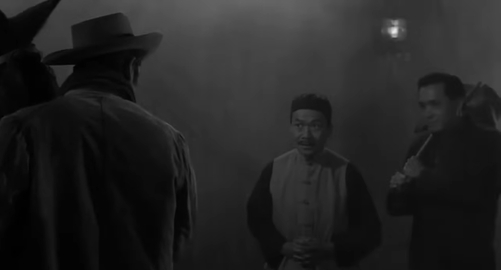
The young man, Cheng Lu (James Shigeta), to Linc’s surprise, speaks fluent English. In answer to Linc’s question, he replies that he studied in a mission school in China.
Linc is getting ready to move on when something happens. A wagon pulls up in the street, crowded with Chinese women. They look petrified, and even as Linc watches, they are pulled roughly off the wagon by (white) men who then proceed to hustle the women into a nearby building. Linc’s Chinese contact explains: the women are slaves, just brought in from China. They will be sold to whoever can pay.

Linc, who had moved forward and helped some of the women alight, is shocked and angry at this inhumanity. Curious—and annoyed—he goes into the hall, where the women are, one by one, being auctioned off. One of the women he had helped, a pretty girl named Kim Sung (Nobu McCarthy) is just being shown off to the crowd of bidders. Quite literally: she is made to pull open her jacket and show off her bosom to these leering, lecherous brutes.

The two Chinese men with Linc—Cheng Lu and Linc’s local contact—watch on, curious [and possibly aware that they have no agency here, so can do nothing to help either this woman or any of the others?]. Linc, however, is furious at the way this girl is being treated. When the bidding starts, he also bids, offering $750 in gold. He backs up that bid with a gun, drawing his revolver threateningly enough to have the auctioneer as well as other bidders decide that yes, Linc can have the woman.

So Kim Sung, now dressed again, is ushered out by Linc. She doesn’t know a word of English, so Linc has to get Cheng Lu to translate. The girl is eager to please her new master, but obviously apprehensive as well.
In fact, when they stop for the night and Linc begins to roll out his bedding near the campfire, Kim Sung hurries forward to do this work for him. And when he refuses to let her help, she sits demurely beside him, waiting to be of service. She has been ‘trained to please’, and Linc understands the nuances of that euphemism. He has a hard time making Kim Sung understand that he doesn’t want to be pleased, thank you. She looks surprised and confused; this is obviously (and sadly) an unusual new experience for her.
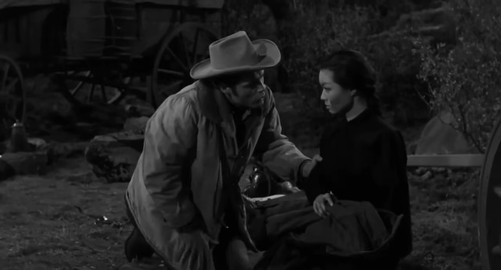
Linc being her champion, Linc buying Kim Sung not to make her a slave or a servant but to preserve her dignity: this is something not just Kim Sung will have to understand, but also the people of Jericho. And the grapevine being what it is, by the time Linc comes home, his mother (Josephine Hutchinson) already knows about this Chinese woman he’s bought…
… and she’s livid. She gives Linc what for, and is all ready to throw the unseen, unknown woman out.

Until she steps out and sees Kim Sung, who smiles shyly at her. This was not quite what Mrs Bartlett was prepared for. And it doesn’t take more than a few seconds for her to change her mind about Kim Sung. Before Linc’s amused (and relieved) eyes, his mother hustles Kim Sung into the house.
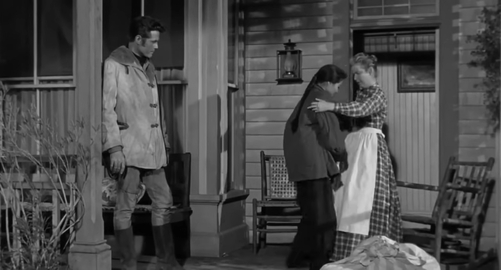
But just because his mother so quickly accepted Kim Sung, it doesn’t mean the rest of the town will. In Jericho, the Chinese live in China Town. That is where they’re supposed to be, not in the homes of the white folk. And even if everybody assumes that Kim Sung is a servant and is therefore living in the Bartletts’ home, there is other talk.
Bartlett’s girlfriend, the part French-part Native American Lili (Lilyan Chauvin), for one, is furious. She is jealous—Linc bought a woman!—and is all ready to push Linc away, but he reassures her. Lili is the only one for him, he was only doing the right thing by rescuing Kim Sung from a horrible fate. He feels nothing for her.
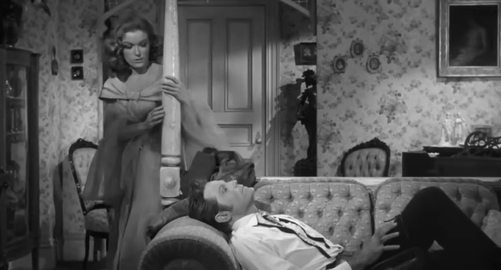
In the Chinese quarter, Cheng Lu has finally reached his destination: the laundry run by his uncle Wu (Benson Fong). Cheng Lu is going to be helping out Wu at the laundry, and since Wu does the laundry for the Bartlett household, Cheng Lu ends up meeting Kim Sung when he goes to deliver laundry. She is transforming, still shy and sweet, but more confident now. Learning English, too, thanks to Mrs Bartlett.
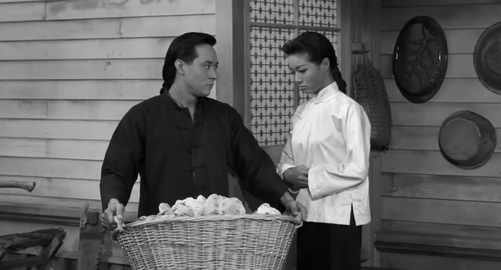
Mrs Bartlett, in fact, has taken Kim Sung firmly under her wing. Even to the extent of taking her to church with them. Kim Sung, wearing a cheongsam, her hair discreetly covered with a scarf, might be considered inconspicuous; but not here. Here, the Bartletts are regarded with outright horror, even hostility. A heathen, in church! The one person in church to whom Kim Sung’s ethnicity doesn’t seem to matter is the preacher, the Rev. Will Allen (Michael Pate), who is dismissive of the horrified remarks directed at him.

While the whites mostly treat Kim Sung with contempt, there’s one person in town who harbours a very different sort of feeling towards the girl. Cheng Lu has been drawn to her from the very beginning, when he first saw Kim Sung being put up on auction in San Francisco. Since then, he has spoken to her several times when he’s come to deliver the laundry…
… and has even told Linc that he’ll somehow get together the money and buy the girl off him. Linc has refused every single time, trying to make it clear to Cheng Lu that Kim Sung is not for sale; he paid the money for her not to ‘buy’ her, but to free her of her life of slavery. She is nobody’s possession, and never will be.
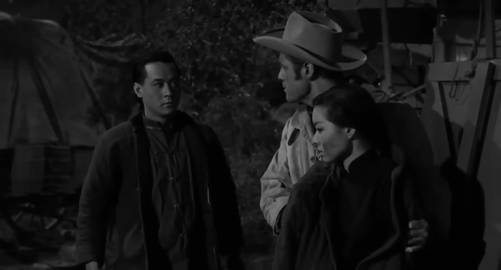
How long will this state of affairs last? Cheng Lu is growing increasingly frustrated. Kim Sung is blossoming into an alluring young woman… and that has begun to also finally shake Linc’s resolve to only ever have Lili in his life.
Written and directed by James Clavell, Walk Like a Dragon draws its name from a dialogue spoken by Cheng Lu near the beginning of the film, when he says that someday he will “walk like a dragon”: tall and powerful, not always shrinking and stepping aside and kowtowing to the whites. While Kim Sung is the pivotal character—the controversial person around whom this whole story revolves, caught between two worlds, two communities—the two men who end up wanting her (I will not say “loving her” because I have my own reservations about that) have their own angst, their own insecurities and worries.
What I liked about this film:
The depiction of race relations in late 19th century America. The bulk of the townspeople of Jericho are shown as treating the Chinese immigrants with predictable contempt and scorn: they’re happy to use their services (as is shown in the case of Wu and his laundry), but to treat them as anywhere close to equal is just not done. Of course, in the case of the auction at San Francisco, this racism reaches a brutal degree, where it’s sickeningly inhuman.
There are nuances in this attitude, though. For instance, Linc’s part-French, part-Native American girlfriend Lili is suspicious of Kim Sung, but that stems probably from her jealousy of the ‘other woman’ (as far as Lili is concerned) in Linc’s life. While Lili may not be obviously mixed race, it is not something she denies. When a man at the saloon (above which Lili lives) makes a snarky remark about keeping Chinese and Native Americans out, Lili’s retort—that she’s part ‘Indian’ too—is scathing enough to shut him up.

Then, there’s the Chinese side of it. Two sides, rather. One is the attitude of people like Wu, who have been in America long enough to have figured it out. When talking to whites, Wu (as also the Chinese man Linc meets in San Francisco) speak pidgin English. It’s only when they’re alone with other Chinese—with Cheng Lu, for example—that it becomes obvious that both men speak perfectly good English. They are expected to speak bad English, so that is the façade they adopt.
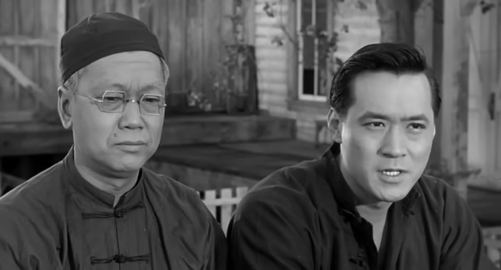
On the other hand, there are the two people newly arrived from China, both bringing with them their own baggage, their own misconceptions and fears. Kim Sung, not just ‘trained to please’, but trained to believe that the only justification for her existence is to be subservient, to obey, to kowtow. What she wants is immaterial; her master’s will is paramount.
Cheng Lu (perhaps as a result of that missionary school education?) is different. He is wilful, self-confident, even to the extent of being arrogant. If he doesn’t walk like a dragon right now, someday, he has convinced himself, he will, even in this foreign land where everybody looks down on him. Till the time he does stand tall and show Jericho what he’s made of, he will continue to wear the symbol of shame: the queue or pigtail that he refuses to cut off, even though he’s harried about it.
Given Clavell’s close association with East Asia and his understanding of both China and Japan, I wasn’t surprised at the way he is able to depict, and sensitively, the way relations play out between the whites and the Chinese in this film. All the main characters are well-portrayed too, and I especially liked the acting of James Shigeta (so handsome, by the way!) and Nobu McCarthy: both are very real.
One last bit of ‘what I liked’: Mel Tormé’s singing. Mel acts in the film as a deacon who is also a crack shot; and he sings. The title song is excellent.
What I didn’t like (minor spoilers ahead)
The love angle. Or, to be precise, the love triangle. How each of these three people—Kim Sung, Cheng Lu, and Linc Bartlett—feel about the other is not totally clear and/or believable. Linc’s sudden switch from loving Lili to loving Kim Sung is just that: too sudden, and too hard to believe. Was he flattered by Kim Sung’s shy smiles and eagerness to please? Her behaviour is flattering, but I see little there to merit love. Lust, yes; and that is what Linc’s emotion struck me as.
With Cheng Lu, it’s even more puzzling. Does he really love Kim Sung, or is this only gender politics being played out? (If there’s a Chinese woman on offer, a Chinese man must own her? Does Cheng Lu become more acceptable to the whites, does he walk like a dragon, if he has the wherewithal to buy Kim Sung off Linc?)
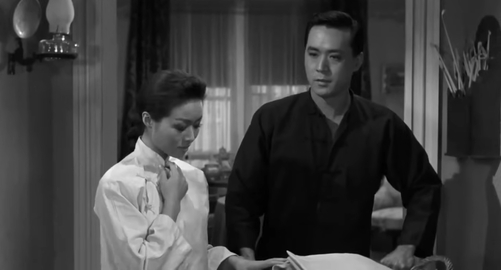
And Kim Sung. Is this really love, or has she been so conditioned, over the years, to regard her master as the be-all and end-all of her existence?
Spoilers end.
Despite that, a good film. Do watch if you enjoy Westerns with a difference.
 Dustedoff
What an interesting and bold film! I had never heard of it, although I had heard of James Shigeta, though only in passing, as a sort of exotic trivia.
Thanks for reviewing it.
I have seen a few documentaries, where the plight of Chinese in the USA was mentioned. They were mostly employed in rail construction work and after at times the work lynched or driven away.
LikeLiked by 1 person
The documentaries sound interesting, Harvey. I have only read fleetingly of the plight of the Chinese in America during the 1800s, nothing very in-depth. In that sense, this film was somewhat educational. I must see if I can find any good books about the subject…
LikeLike
I loved Clavell’s Shogun. This one was only a screenplay, so I guess I’ll have to content myself with watching the movie. Lovely review, Madhu. I did not know of the existence of James Shigeta.i am intrigued.
LikeLiked by 1 person
Do watch, Ava. I have only seen a handful of James Shigeta’s films, but I’ve enjoyed everything I’ve watched so far. Interestingly enough, he was also in Die Hard, and did a voice-over in Mulan.
LikeLike