This is the third and final part of a three-part travelogue, about our recent travels in Karnataka. The first part, about Mangalore, is here, and the second part, about Coorg (specifically Madikeri) is here.
From Coorg, we were to drive down to Nagarhole, an approximately three-hour journey. While researching Coorg, I had marked a couple of places that seemed to be extremely popular tourist attractions, and had been wondering if either of these might be visited while we were in Coorg or midway to Nagarhole. One of these we did manage to see on a day trip from Gateway Coorg: the Dubare Elephant Camp.
(The first part of this three-part travelogue, about our sojourn in Mangalore, can be found here).
The district headquarters of the hill region of Kodagu (or Coorg, as the British dubbed it) is Madikeri, and this was to be our second halt on our trip through this part of Karnataka. Strictly speaking, we weren’t going to be staying within the town of Madikeri, but just about 15- or 20-minutes’ drive from there, at the Gateway Coorg, a Taj Hotels property. It’s a resort, spreading across 45 acres of land, which—besides the usual buildings, swimming pool, gardens, children’s play area, etc—also included a coffee plantation. And much more, as we soon discovered.
A few years ago, I decided that every year we would visit at least one Indian national park (or wildlife sanctuary). We began with Corbett; then Kaziranga, Little Rann of Kutch, Sariska… and earlier this year, my daughter suggested Nagarhole. The genesis of this suggestion lay in a book, Sutapa Basu’s Murder in theJungle, which I had gifted the LO (‘Little One’, though we all agree that at 11, she’s no longer little). I had met Sutapa at the book event where I bought this book, and chatting with the author, was told that Nagarhole is one of her favourite wildlife parks in the country. A snippet I passed on to the LO, who was even more enthused after she’d read the book, which is set in Nagarhole.
So Nagarhole it was. But to go halfway across the country just to see a national park, especially when it’s in a part of the country the LO has never been to, seemed pointless. A longer trip, a more detailed itinerary, seemed logical.
I will not waste time and space describing the many iterations our itinerary went through, the many options that we considered before finally settling on a doable journey. We would fly from Delhi to Mangalore, and after staying a day there, we’d drive down to Madikeri (the district headquarters of Coorg). A couple of days would be spent exploring Madikeri and around, and then we’d go to Nagarhole, to spend three days there before heading back to Mangalore to catch the flight back home.
I will admit I knew next to nothing about Mangalore before I began planning this trip. Thanks to some research I’d done some years back on Christmas traditions and Christmas foods (for this book), I knew that Mangalore had been occupied by the Portuguese, who—as in Goa, further down the west coast—had left their mark, in the vibrant Catholic community of Mangalore. I knew, too, that Mangalore has some pretty mouthwatering food.
Mangalore buns, served with coconut chutney.
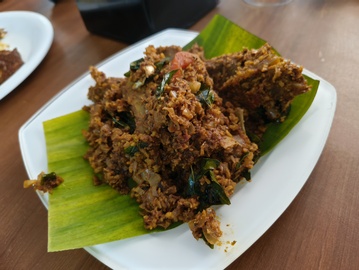
Mutton sukka, a delicious dish at Mangalore’s Shetty Lunch Home.
(This is the third and final part of a three-part Rajasthan travelogue. The first post, about our trip to Sariska National Park, can be read here, and the second part, about four forts—Bhangarh (on the border of Sariska) and Jaigarh, Nahargarh and Amber, in Jaipur—is here).
The forts of Jaipur take up a major chunk of sightseeing time, not only because they sprawl, but because of the time involved in getting to them, and then (if you, like us, happen to be visiting in peak season) fighting the crowds at each fort.
While we admired the forts of Jaipur, it was, frankly, also with a certain amount of relief that we looked forward to seeing some of Jaipur’s less touristy spots.
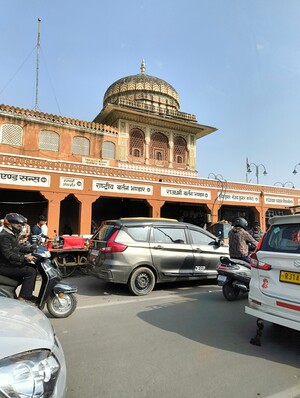
In 1876, the Prince of Wales (later King Edward VII) visited Jaipur as part of a tour of India. In honour of him, the maharaja, Sawai Ram Singh II, had the city painted a deep salmon pink. The ‘pink city’, as Jaipur came to be known after that, is still the core part of Jaipur. Driving along these roads—the shops with uniform black-and-white signboards and matching façades, the occasional temple or gate or other interesting old building still fitting in perfectly with the look—was great fun, and since many of the shop signs are in Devnagari (and the LO loves reading signs), she got to practise her Hindi.
(The first part of this series of travelogues, about Sariska National Park, is to be found here).
On our last day in Sariska, we were scheduled to go on a morning safari, and had to wake up at an unearthly hour in order to get to the park booking office by 7 AM. The previous afternoon, we’d all got wet when it rained during our safari. In any case, it was freezing and we were tired. Was it a surprise, then, that we forgot to set an alarm, and overslept?
Frankly, none of us—not even the LO, who gets into a snit about things like this—were seriously disappointed. But this meant that we’d have the day completely free. I suggested we go to Bhangarh.
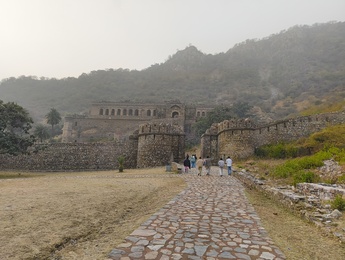
The 16th century Rajput hill fortress of Bhangarh is located on the edge of Sariska, about an hour and a half’s drive from where we were staying. It was built under the aegis of Maharaja Bhagwant Das of Amber (the father of Mirza Raja Man Singh, one of Akbar’s ‘nauratnas’). After his death, Bhangarh passed to his son Madho Singh. It’s a sprawling fortress, now alas mostly in ruins—and, according to all accounts, the most haunted place in India.
Bhangarh, supposedly the most haunted place in India.
This is part 2 of two connected blog posts. The first post, about my visit to Dehradun for a literary festival (and, more so about the sightseeing in the city) is here.
After our trip to Dehradun, we got back home on Monday—and on Friday, I took a flight to Bhubaneshwar. Odisha is a state I’ve never been to, though it’s such a historical and cultural powerhouse, I’ve been wanting to go for a long while. Both my sister Swapna and I had been invited to speak at the Odisha Literary Festival, and since we’re both keen on history, we decided we would take advantage of the few hours we’d have in the afternoon of our arrival to go around town a bit and see some of its historical sights.
September was a busy month for me. Unusually (for me) I had to travel on work; and that, not once but twice. On September 15th, I was discussing the Delhi Quartet at The Literary Table’s festival of arts and literature at Dehradun; the next weekend, on September 21st, my sister Swapna (who is a historian) and I were speaking, for the first time in a session together, at the Odisha Literary Festival in Bhubaneshwar.
Me, in conversation with Bijoya Sawian (on my right) and Jasleen Kaur, in Dehradun.
(Part 1 of this travelogue, Historic Ahmedabad, can be read here).
Our sojourn in Ahmedabad stretched across most of four days: a day and a half after we landed in Ahmedabad from Delhi, and another just-over-two days before we left again for home. In between, we did a memorable trip to the Little Rann of Kutch (about which I’ll be posting in next week’s blog post, the last of these travelogues).
Ahmedabad is a city of extremes. On the hand, there are parts of it which, frankly, looked far more upscale and posh than even Delhi: wide boulevards, stylish malls and boutiques, fancy restaurants serving global cuisines.
A couple of years ago, my husband and I took our daughter (whom I refer to as the ‘LO’: the ‘Little One’, though given that she’s now ten and no longer little, she suggests that that now be ‘Loved One’) to Corbett National Park. The LO had been on wildlife safari before, but this one was special: she was deep in the jungle, she was old enough to appreciate it all and to retain memories of it. We decided we had to notch up more wildlife adventures. ‘Visit one Indian wildlife sanctuary or national park every year,’: that was a goal we set for ourselves.
This time, I decided to do something different: not a jungle, not a place we might see a tiger. Instead, I suggested we visit the Little Rann of Kutch. And since all of us are very interested in history, we figured it would be good to combine that with a stopover at Ahmedabad: the historic walled city of Ahmedabad is on the UNESCO’s list of World Heritage Cities, and its list of stunning old monuments seemed too good to pass up.
Our flight from Delhi to Ahmedabad arrived early enough for us to be able to get to our hotel (the Taj Skyline) by noon. Since this was just a week after Christmas, the lobby was still all decked up for Christmas, with a tree, a gingerbread house, and more. The LO was in seventh heaven.
Most tourists seem to focus on the Mall and the Ridge, but there’s plenty to see beyond that as well. While I covered our forays along the Mall in Part 2 of this set of travelogues, here I’ll be describing something of what we experienced beyond the Mall.
My husband and I last visited Shimla in 2008, and one attraction I had especially fond memories of from back then was the Viceregal Lodge. Built as the residence of the Viceroy, the Viceregal Lodge was completed in 1888, built in a Scottish Baronial style. After independence, it was renamed Rashtrapati Nivas, and today it houses the Indian Institute of Advanced Studies, where scholars in the humanities can come for research and study.