A story published in Open Road Review

Open Road Review (ORR) is a brand new literary magazine in India. They’ll be publishing an online issue every three months, in three categories: short fiction, creative nonfiction, and poetry. For the first issue of ORR, its editor, Kulpreet Yadav, invited me to contribute. One look at the guidelines (“literary work that is elegant and subtle… takes the reader to a deeper level”), and I knew Muzaffar Jang, much as I love him, wouldn’t do. What was needed here was something in a very different style.

So here is what I submitted. It’s a story called Maplewood, set in a fictitious colonial bungalow (named Maplewood), where an old widow, transplanted into the middle of the sleepy backwaters of the country, passes her days. It’s a story that came deep from within my heart – not because I myself have felt what the narrator of Maplewood must feel, but I can imagine it. And I can imagine what my reaction would be if I were to find myself in her place.

Do read, and let me know what you think.


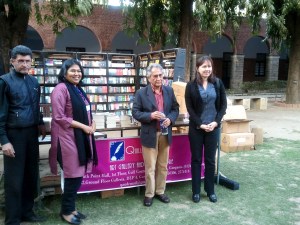
Body of Evidence: Notes from a Crime Fiction Conference

It is tough being a writer of crime fiction in India. Especially if you happen to write in English.

I have actually had other writers – of more ‘literary’ fiction, generally – look at me with faintly raised eyebrows, as if wondering if I’ll be able to respond intelligently, should they condescend to address a few sentences to me. I’ve had readers ask, “Since you’ve done so much research, why don’t you use it to write something constructive? Like a book on what India might have been like if Dara Shukoh, instead of Aurangzeb, had succeeded Shahjahan?”

(That reader actually added that crime fiction, after all, was a ‘hobby’).

So it is a very refreshing change to be part of something that doesn’t tolerate crime fiction, it celebrates it.

Continue reading

Some news, some reviews

No, I’m not vegetating somewhere. I am actually working on the fourth book in the Muzaffar Jang series (so, if you like the series, you’ll probably have guessed that the third book is already written). I’m also doing the occasional writing assignment, and some more offbeat but interesting stuff, also connected to Muzaffar Jang. Continue reading

Photos from the Muzaffar Jang Walk

As I’d mentioned earlier, we’d planned a ‘Muzaffar Jang Walk’ through parts of Shahjahanabad yesterday, December 11, 2011. It was organised by Habitat World and was led by my sister, Swapna Liddle. I won’t let the cat out of the … Continue reading

Coming Up: The ‘Muzaffar Jang Walk’ Through Shahjahanabad

When The Eighth Guest & Other Muzaffar Jang Mysteries was launched in August this year, my sister, Swapna Liddle – historian, ardent enthusiast about Delhi’s history, and a person who’s been leading heritage walks in Delhi for over a decade – said, “How about a Muzaffar Jang walk?”

I’ve been on dozens of heritage walks led by Swapna. Walks for Habitat World (at the India Habitat Centre); for the Delhi Chapter of the Indian National Trust for Art and Cultural Heritage (INTACH); even informal exploratory expeditions through the maze of bylanes and necessarily-single-file alleys of Shahjahanabad. What I love about Swapna’s style is that she knows a lot, and she knows how to tell it like a story – with delightful anecdotes, interesting facts, and little tidbits that help bring history alive. So of course, when Swapna suggested a Muzaffar Jang walk, I jumped at the offer.

Here it is.

On December 11, 2011, at 08.30 AM, the Muzaffar Jang Walk. It’s being organised jointly by Habitat World and Hachette India, and Swapna will be leading the walk. She’ll be talking about Shahjahanabad, of course, but with a special emphasis on buildings, areas, even other little details that feature in the two Muzaffar Jang books, The Englishman’s Cameo and The Eighth Guest. And no, it won’t be just the predictable Red Fort and Jama Masjid.

So come along for the walk. It begins at the Jain Digamber Lal Mandir (at the end of Chandni Chowk, opposite the Lahore Gate of the Red Fort. The walk begins at 08.30 AM. Please register with the Programmes Desk at Habitat World by phoning 011-4366-3080/90. Places are very limited, so register as soon as you can.

See you there!

Two Reviews of The Eighth Guest

My latest book – The Eighth Guest & Other Muzaffar Jang Mysteries (released in August 2011) – has already begun to receive some reviews. Read on for a couple of excerpts.

The first, by film-maker, writer and blogger Batul Mukhtiar:

“… For anyone who is fascinated by Mughal monuments, clothes, way of life, these detective stories are a pleasure to read…

Continue reading

The Eighth Guest: Book Trailer

With the launch date of The Eighth Guest & Other Muzaffar Jang Mysteries just around the corner (August 19th, 2011), here’s something to whet your appetite: the book trailer.

Here it is, in normal resolution:

And in high definition:

Enjoy!
Buy the book online at: Landmark | Flipkart | Crossword | IndiaPlaza

Short Story in the Brunch Quarterly

Although I have been busy (winding up the writing of the second Muzaffar Jang novel, finalising the cover and final text of the first set of Muzaffar Jang stories, and beginning work on the second set of Muzaffar Jang – as you can see, Muzaffar Jang more or less rules my life), I have also been doing other writing. An example of this has just been published, in the Hindustan Times Brunch Quarterly, July-September 2011 issue.

Though most people know me as the creator of Muzaffar Jang, the Mughal detective, here I’ve ventured into territory I’ve never traversed before. The editor at the Brunch Quarterly said, “Could you please write another historical detective story for us?”, but since the word limit was 3,000 – a little difficult to fit detection into, at least for me – I decided to make this a somewhat different story. No sleuthing. No Mughal India. But, yes; it’s still not contemporary – it’s set in the Calcutta of the very late 19th century, and it involves, if not a crime, at least something not very nice.

An excerpt from the story, which is named Mangoes and Indigo:

Oscar Leadbetter, after two months on board ship, followed by a cross-country journey from Bombay to Calcutta, was ushered into his cousin’s presence by a turbaned servant. The man, his white muslin jama swishing about pyjama-clad knees, bowed out. Oscar stood before the vast mango-wood desk behind which his cousin sat. Stephen’s drooping moustache and thinning hair were blond, his icy blue eyes the gift of some long-ago Nordic ancestor. He turned that frosty gaze on Oscar.

‘I have had to get rid of my last secretary to accommodate you,’ he said. There had been no invitation for Oscar to sit, no ‘Koi hai?!’ yelled to a servant for whisky.

Oscar murmured something about trying his best, and was treated to a cold stare before Stephen began listing his duties. They were many, and varied. Oscar would receive and segregate correspondence.  He would write suitable responses. He would keep the accounts for the house. He would be in charge of making large purchases – not the meat and vegetables, or the dhobi’s lye, but the substantial ones. Furniture, for instance, or mattresses.

‘Do you expect them to wear out every few months?’ Oscar asked.

Note: Although you can read Hindustan Times online, Brunch Quarterly is in the form of a magazine, available at most large newsstands. Pick up a copy and read for yourself!


 

Forthcoming books – and a contribution

Apologies for the long silence. It isn’t as if I’ve packed up pen and paper (rather, my laptop) and gone off to vegetate somewhere. There are things happening in my world of writing; the problem is that writing takes such a long time. There’s many a month between the inception of an idea and the day the book hits the shelves… I have a book coming out probably in October 2011; this will be the sequel to The Englishman’s Cameo, and I’m currently writing the sequel to that book. So, Muzaffar Jang fans have something to look forward to – both this winter, and the next.

In addition to that, Westland-Tranquebar will be releasing a collection of my short stories – all on the theme of dark humour – probably in November 2011.

And, meanwhile, here’s another book to which I’ve contributed: The Popcorn Essayists: What Movies do to Writers. It’s an anthology of film-related writing from well-known Indian writers who don’t typically write about cinema: Manjula Padmanabhan, Sumana Roy, Amitava Kumar, Anjum Hassan and others – including me.  Published by Westland-Tranquebar, compiled and edited by Jai Arjun Singh, the book will be formally released in March 2011. It’s already available online on Flipkart, though, so if you live in India, you can order it here.

The stories in this book promise to be very interesting. If you’re a cinema buff, don’t miss this one.


Oh, and yes: an excerpt from my essay for The Popcorn Essayists: What Movies do to Writers. I contributed an article on one of my favourite themes from cinema, suspense thrillers from Hindi cinema in the 1950s and 60s. The piece is called Villains and Vamps and All Things Camp, and here’s a sneak peek:

“The spy kings also seemed to command the hottest molls and the most ingenious torture equipment. I suppose finances come into that; you can’t have Helen as a ‘secretary’ who operates a machine that slowly grills the hero over a bed of coals, when all you’re doing is running a backyard bootlegging outfit. But ooh, the spy kings, with their truckloads of dirty money! They were the ones who could afford the works: the leopard skin-hot pink satin-mirrored ceiling dens, the bars crowded with bottles of Vat 69, the hordes of henchmen clad in too-tight pants and T-shirts.


There’s something so giddily, gorgeously glorious about it all.”

Happy reading!