
Not even half an hour into this 1959 British film, directed by Basil Dearden, and I was wondering: “Why isn’t this one better-known? How come I hadn’t heard of it before?”
Having finished watching Sapphire, I think I know the answers to those questions. It’s not as if Sapphire is an obscure film; in Britain, in knowledgeable film circles, it’s probably fairly well-respected, given that it won the BAFTA Award for Best Film in 1960. But here in India, while British cinema of earlier years (Hitchcock’s early cinema, the films of Laurence Olivier and Leslie Howard in the 30s and 40s, for instance) were the stuff of my childhood film-watching—thanks to Doordarshan, which would air the great classics—by the 1950s and 60s, the cinema that seemed to be most popular was Hollywood. I am not talking of what English-language films were actually screened in India back then; I am talking of the 50s and 60s English-language films that were aired by Doordarshan in the 1980s and early 90s, when much of my film-watching was on TV.
Anyway, better late than never, I guess. I finally watched Sapphire (because of a serendipitous discovery on YouTube; the film is available here). And this, I can safely say, is one of the more unusual noir films I’ve seen. While it is a solid police procedural, a whodunnit revolving round a murdered woman, it is, too, a comment on society, on norms, what is right and what is wrong.
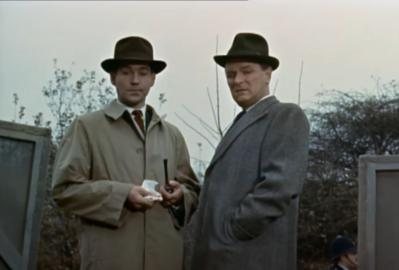
The story begins on Hamstead Heath, where two little children, playing with their ball, tumble onto the body of a young woman (Yvonne Buckingham) who’s been stabbed to death. The police are called in, and Chief Inspector Bob Hazard (Nigel Patrick) comes with his team to examine the scene of crime. The young woman’s body is taken away for autopsy.
 Dustedoff