Sapphire (1959)

Not even half an hour into this 1959 British film, directed by Basil Dearden, and I was wondering: “Why isn’t this one better-known? How come I hadn’t heard of it before?”

Having finished watching Sapphire, I think I know the answers to those questions. It’s not as if Sapphire is an obscure film; in Britain, in knowledgeable film circles, it’s probably fairly well-respected, given that it won the BAFTA Award for Best Film in 1960. But here in India, while British cinema of earlier years (Hitchcock’s early cinema, the films of Laurence Olivier and Leslie Howard in the 30s and 40s, for instance) were the stuff of my childhood film-watching—thanks to Doordarshan, which would air the great classics—by the 1950s and 60s, the cinema that seemed to be most popular was Hollywood. I am not talking of what English-language films were actually screened in India back then; I am talking of the 50s and 60s English-language films that were aired by Doordarshan in the 1980s and early 90s, when much of my film-watching was on TV.

Anyway, better late than never, I guess. I finally watched Sapphire (because of a serendipitous discovery on YouTube; the film is available here). And this, I can safely say, is one of the more unusual noir films I’ve seen. While it is a solid police procedural, a whodunnit revolving round a murdered woman, it is, too, a comment on society, on norms, what is right and what is wrong.

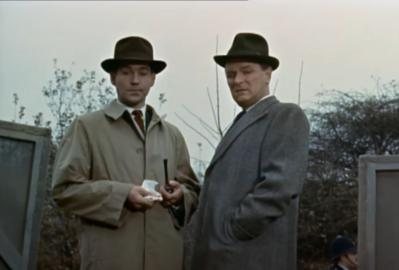
The story begins on Hamstead Heath, where two little children, playing with their ball, tumble onto the body of a young woman (Yvonne Buckingham) who’s been stabbed to death. The police are called in, and Chief Inspector Bob Hazard (Nigel Patrick) comes with his team to examine the scene of crime. The young woman’s body is taken away for autopsy.
Continue reading

Great Expectations (1946)

Charles Dickens was one of those authors whose books, I think, might be very difficult to adapt to cinema. Most of his works have a plethora of characters, and characters, too, who are described in great detail: people who play an important part in the proceedings. The books are long and involved, and there’s a style to them that would be more suited, I’ve always thought, to a television series rather than a film.

But every now and then, there comes along a fine adaptation of a Dickens novel that manages to retain the essence of the original, and translate it effectively to screen. Adapted for the screen (along with several other people) by David Lean, and directed by him, Great Expectations was a film I’d approached with some trepidation, wondering how it would work as a film.

The story begins with orphaned Philip Pirrip ‘Pip’ (Tony Wager) running along near the marshes that border the village he lives in. Pip’s parents died years ago, and Pip has been brought up by his very hot-tempered, sharp-tongued sister, Mrs Joe Gargery (Freda Jackson) and her husband, the blacksmith (Bernard Miles). What Mrs Gargery lacks by way of human kindness, Joe makes up for: he’s a sweet, gentle, wise man, who is very fond of Pip.

Continue reading

The Man Who Knew Too Much (1956)

I knew something connected to Doris Day long before I had even heard of her. When I was about six years old, my mother used to sing Que sera sera to me, and that song became such a favourite of mine that I ended up writing down the lyrics (misspelt, I admit: Kay sera sera is what I recall having written) and belting  them out, night and day.

It was only many years later that I finally watched Alfred Hitchcock’s The Man Who Knew Too Much, and got to see Doris Day sing that song onscreen, in a tense, nail-biting climax that both highlighted Doris Day’s singing ability as well as her acting prowess. By the time I watched this film, I had already seen Doris in other, more light-hearted roles, the sort of films (mostly musicals or screwball comedies, including the delightful ones which she did with good friend Rock Hudson) where she lit up the screen with the sheer joy of her presence. I had heard Wham! sing “… You make the sun shine brighter than Doris Day…” I had listened to plenty of songs Doris Day had sung, and I had fallen in love with the vivacity and good humour Doris seemed to radiate.

Continue reading