Travels in Karnataka, Part 2: Coorg

(The first part of this three-part travelogue, about our sojourn in Mangalore, can be found here).

The district headquarters of the hill region of Kodagu (or Coorg, as the British dubbed it) is Madikeri, and this was to be our second halt on our trip through this part of Karnataka. Strictly speaking, we weren’t going to be staying within the town of Madikeri, but just about 15- or 20-minutes’ drive from there, at the Gateway Coorg, a Taj Hotels property. It’s a resort, spreading across 45 acres of land, which—besides the usual buildings, swimming pool, gardens, children’s play area, etc—also included a coffee plantation. And much more, as we soon discovered.

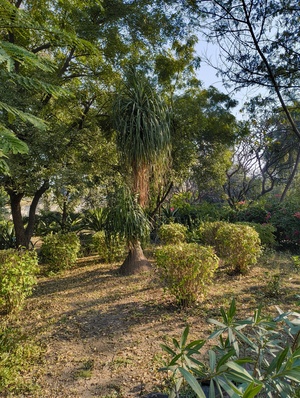
Gateway Coorg: lots of greenery.
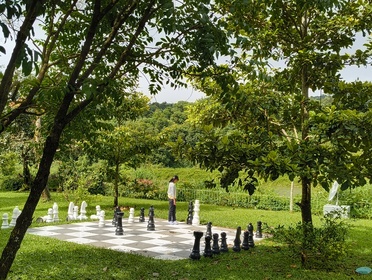
At Gateway Coorg, a giant outdoor chessboard.
Continue reading

Travels in Karnataka, Part 1: Mangalore

A few years ago, I decided that every year we would visit at least one Indian national park (or wildlife sanctuary). We began with Corbett; then Kaziranga, Little Rann of Kutch, Sariska… and earlier this year, my daughter suggested Nagarhole. The genesis of this suggestion lay in a book, Sutapa Basu’s Murder in the Jungle, which I had gifted the LO (‘Little One’, though we all agree that at 11, she’s no longer little). I had met Sutapa at the book event where I bought this book, and chatting with the author, was told that Nagarhole is one of her favourite wildlife parks in the country. A snippet I passed on to the LO, who was even more enthused after she’d read the book, which is set in Nagarhole.

So Nagarhole it was. But to go halfway across the country just to see a national park, especially when it’s in a part of the country the LO has never been to, seemed pointless. A longer trip, a more detailed itinerary, seemed logical.

I will not waste time and space describing the many iterations our itinerary went through, the many options that we considered before finally settling on a doable journey. We would fly from Delhi to Mangalore, and after staying a day there, we’d drive down to Madikeri (the district headquarters of Coorg). A couple of days would be spent exploring Madikeri and around, and then we’d go to Nagarhole, to spend three days there before heading back to Mangalore to catch the flight back home.

I will admit I knew next to nothing about Mangalore before I began planning this trip. Thanks to some research I’d done some years back on Christmas traditions and Christmas foods (for this book), I knew that Mangalore had been occupied by the Portuguese, who—as in Goa, further down the west coast—had left their mark, in the vibrant Catholic community of Mangalore. I knew, too, that Mangalore has some pretty mouthwatering food.

Mangalore buns, served with coconut chutney.
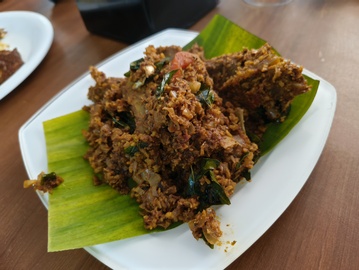
Mutton sukka, a delicious dish at Mangalore’s Shetty Lunch Home.
Continue reading

The LO Goes to Rajasthan, Part – 2: Four Forts

(The first part of this series of travelogues, about Sariska National Park, is to be found here).

On our last day in Sariska, we were scheduled to go on a morning safari, and had to wake up at an unearthly hour in order to get to the park booking office by 7 AM. The previous afternoon, we’d all got wet when it rained during our safari. In any case, it was freezing and we were tired. Was it a surprise, then, that we forgot to set an alarm, and overslept?

Frankly, none of us—not even the LO, who gets into a snit about things like this—were seriously disappointed. But this meant that we’d have the day completely free. I suggested we go to Bhangarh.

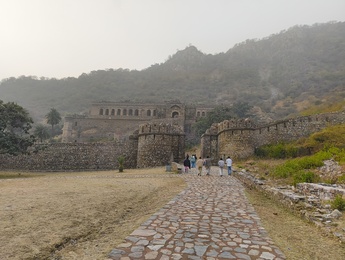
The 16th century Rajput hill fortress of Bhangarh is located on the edge of Sariska, about an hour and a half’s drive from where we were staying. It was built under the aegis of Maharaja Bhagwant Das of Amber (the father of Mirza Raja Man Singh, one of Akbar’s ‘nauratnas’). After his death, Bhangarh passed to his son Madho Singh. It’s a sprawling fortress, now alas mostly in ruins—and, according to all accounts, the most haunted place in India.

Bhangarh, supposedly the most haunted place in India.
Continue reading

Historic Hisar: A Foray

Last year, on our way back from Himachal Pradesh, we had stopped briefly at Ibrahim Lodhi’s tomb in Panipat, and, even more briefly, at a kos minar near Karnal. While it had not been especially impressive, it had, inspired me to see more of Haryana. After all, I’ve lived in Delhi and around for nearly forty years now: it’s unpardonable to have seen so little of one of our neighbouring states.

This year, we’ve realized it may not be possible—given various exigencies—to go for a week-long summer vacation. A brief road trip is all we might be able to manage. It seemed a good time to try exploring Haryana. Hisar, we decided, with a stop en route at Rakhigarhi.

Continue reading

The LO Goes to Gujarat, Part 1: Historic Ahmedabad

A couple of years ago, my husband and I took our daughter (whom I refer to as the ‘LO’: the ‘Little One’, though given that she’s now ten and no longer little, she suggests that that now be ‘Loved One’) to Corbett National Park. The LO had been on wildlife safari before, but this one was special: she was deep in the jungle, she was old enough to appreciate it all and to retain memories of it. We decided we had to notch up more wildlife adventures. ‘Visit one Indian wildlife sanctuary or national park every year,’: that was a goal we set for ourselves.

This time, I decided to do something different: not a jungle, not a place we might see a tiger. Instead, I suggested we visit the Little Rann of Kutch. And since all of us are very interested in history, we figured it would be good to combine that with a stopover at Ahmedabad: the historic walled city of Ahmedabad is on the UNESCO’s list of World Heritage Cities, and its list of stunning old monuments seemed too good to pass up.

Our flight from Delhi to Ahmedabad arrived early enough for us to be able to get to our hotel (the Taj Skyline) by noon. Since this was just a week after Christmas, the lobby was still all decked up for Christmas, with a tree, a gingerbread house, and more. The LO was in seventh heaven.

Christmas decorations at Taj Skyline
Continue reading

The LO Goes to Himachal, Part 3: Beyond the Mall in Shimla

Most tourists seem to focus on the Mall and the Ridge, but there’s plenty to see beyond that as well. While I covered our forays along the Mall in Part 2 of this set of travelogues, here I’ll be describing something of what we experienced beyond the Mall.

My husband and I last visited Shimla in 2008, and one attraction I had especially fond memories of from back then was the Viceregal Lodge. Built as the residence of the Viceroy, the Viceregal Lodge was completed in 1888, built in a Scottish Baronial style. After independence, it was renamed Rashtrapati Nivas, and today it houses the Indian Institute of Advanced Studies, where scholars in the humanities can come for research and study.

Viceregal Lodge
Continue reading

The LO Goes to Himachal, Part 2: The Mall in Shimla

(For Part 1 of this travelogue, click here).

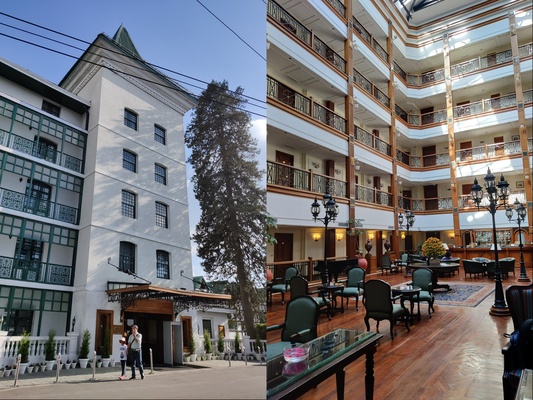
On Day 3 of our Himachal trip, we left Kasauli and drove up (with an abortive detour at Arki, as described in Part 1) to Shimla. At Shimla, we were booked to stay at The Oberoi Cecil, a hotel with a history to it. The spot where the Cecil now stands was once a home (Tendril Cottage) where Rudyard Kipling stayed while visiting Shimla in 1885. Three years later that home was torn down and another building came up in its stead. In 1902, this building was expanded, refurbished, and turned into a hotel: The Cecil, which—in 1944—was acquired by the hotelier MS Oberoi.

The Oberoi Cecil, outside and in.
Continue reading

The LO Goes to Assam, Part 1: Guwahati

Some of you may know about my now nine-year old daughter, the Little One or LO (though at her age, I guess it’s high time I thought up another epithet; she’s hardly little any more). The LO has, since she was a little mite, been keenly interested in nature; and when, last summer, we went to Jim Corbett National Park, she enjoyed it immensely. So much so that I promised her we’d try to visit at least one national park every year.

This time, we decided to go to Kaziranga, in Assam.

It was a short holiday, only six days in all, and of that the sojourn in Kaziranga was bookended by a day in Guwahati, which was where our flights to and from Delhi were connecting.

The excitement had been building up over the past several weeks, with the LO planning what she would pack (it seemed she was outfitting herself for an Arctic expedition; I had to drastically prune her list). On the day of our departure, though we had to leave home at an unearthly hour, the LO didn’t utter a squeak of protest. It was all adventure, all fun, even to leave home when it was still dark.

In Guwahati, we were booked at the Radisson Blu. This hotel is about half an hour from the airport, about 20 minutes from the city, therefore easily approachable from both directions. The only problem is the transport: Guwahati has private taxis, as well as Ola and Uber, but booking an app-based taxi, we soon discovered, was a real pain: the drivers were obstinate about how they wanted to be paid, many would refuse to go to a particular place, and it would take several tries before one could get a driver who would agree.

Anyhow, we ended up hiring a local taxi to get to the Radisson. The LO (and I must admit, me) was unimpressed by the lobby—large and bare, with one massive bit of sculpture in the middle—but our room met with the LO’s approval. Not only was there plenty of space to dance about (dancing about is important in the LO’s life), the bathroom was huge. There was a big bathtub in it (which the LO insisted she wanted to bathe in), and enough space for a luggage rack, ironing board, and more. This was the life, the LO decided, and made her father take photos so that she could show a friend back home (said friend having raved about a large bathroom in a hotel she’d stayed in in Rajasthan a couple of years back).

Continue reading

The LO Goes to Nainital and Corbett, Part I: Nainital

It’s been a long, long time since our last trip. For a family that enjoys travelling as much as we do, the past two years have been an especially tiring period. The LO (the ‘Little One’, our now eight-year old) has even forgotten much of her last journey, to Kenya, back in January 2020.

I know many people who haven’t let the pandemic interfere with their travel plans too much, especially not over the past twelve months or so. We, however, have been exercising a good deal of caution – with the result that we’ve ended up feeling really restless.

Finally, I decided we had to go. Somewhere, anywhere. Somewhere we wouldn’t need to worry about housework, somewhere cool, an escape from the heat of the NCR summer.

Nainital, not too far from Noida, was what we settled on: it’s not so very far (only about 8 hours’ drive, stops included), it’s cool, and the LO has never been here. We decided to combine that with a trip to Corbett National Park: the LO, who has aspirations of being a naturalist (a ‘wildlifer’, as she termed it till a while back) would perhaps enjoy that.

Continue reading

The LO Goes on Safari, Part 2: Masai Mara

(The first part of this travelogue is here).

On the third day after we arrived in Nairobi, we were scheduled to leave for Masai Mara. Our driver, Joseph (“Jesus’s father?” the LO asked, when she heard his name) arrived early in the morning, and we set off a little after 7 AM.

It was the first working day after the long Christmas break, so lots of people were out and about on the streets: children scurrying to school (Joseph said the usual school timings are 7 to 4: long!), people piling into minibuses called matats, and just generally a lot of bustle. We’d soon left behind Nairobi, with its skyscrapers and its tall trees, and were into the wooded mountains. The highway was lined with dense stands of trees, some crowded with yellow or pink flowers.

In between, there were villages and little towns, and so many things that reminded me of India: Ashok Leyland, Mahindra and Airtel signs, of course, but also banana plantations, brightly-painted houses, and baboons by the side of the road (Joseph said that travellers in matats pitch out ears of half-eaten maize or bits of half-chewed sugarcane, which is what attracts them). I saw little garages that simply call themselves ‘puncture’ (a step up from India, where I’ve seen them labelled ‘puncher’), hotels which are actually no more than restaurants—and ‘viewpoints’, places that offer a panoramic view of some specially spectacular landscape.

A ‘viewpoint’, on the Nairobi-Narok highway.

Continue reading