
A couple of weeks back, I’d written a post here on a little-known but lovely little medieval tomb in Delhi: that of Atgah Khan, foster-father of Akbar. This tomb—Chaunsath Khamba (literally, ‘sixty-four pillars’)—is not just in close proximity to Atgah Khan’s Tomb, but also has a connection to Atgah Khan’s Tomb: Chaunsath Khamba is the tomb of Mirza Aziz Kokaltash, the son of Atgah Khan. (Incidentally, also the man who built Atgah Khan’s Tomb).
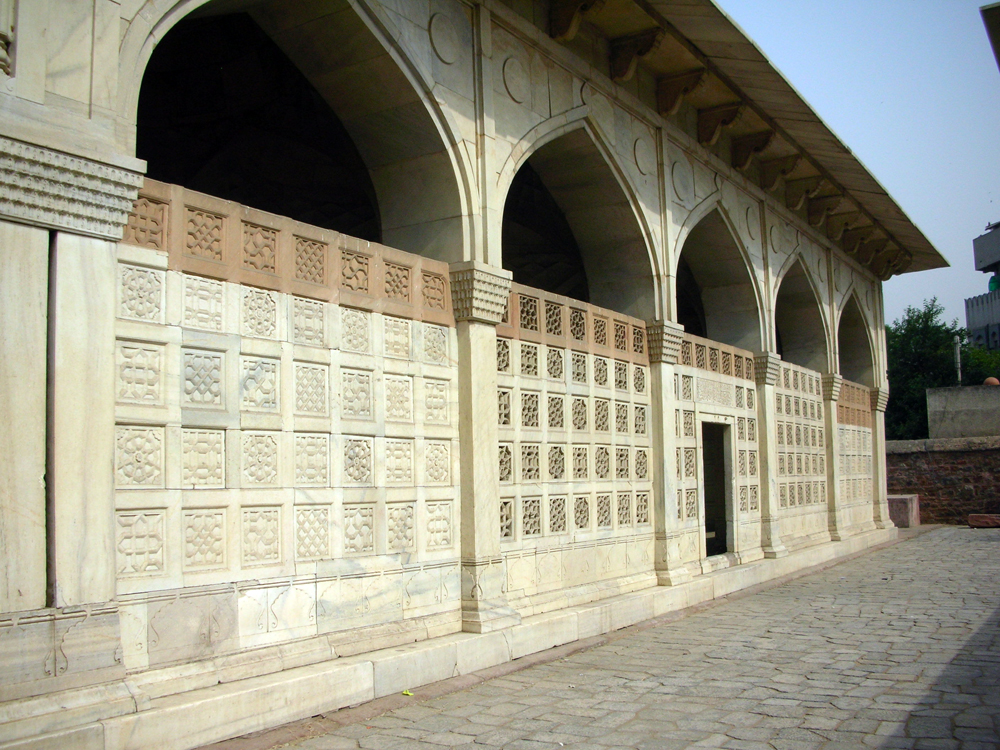
Chaunsath Khamba – a view of the tomb.
Most of the medieval tombs—both pre-Mughal as well as Mughal—that you see in Delhi look fairly similar: nearly all of them are four-sided (a few, like that of Isa Khan, are octagonal), and almost all are domed, even if in some cases—like the tomb of Iltutmish—the dome has collapsed over the years. In contrast, Chaunsath Khamba looks more like a pavilion than a tomb. It’s made entirely of white marble, and is a square hall, its flat ceiling held up by the eponymous sixty-four pillars.
The outer walls of this large hall consist of panels of carved marble screens (‘jaalis’), which end a little below the arches formed by the pillars. The result is substantially more daylight than you’ll see in most tombs.
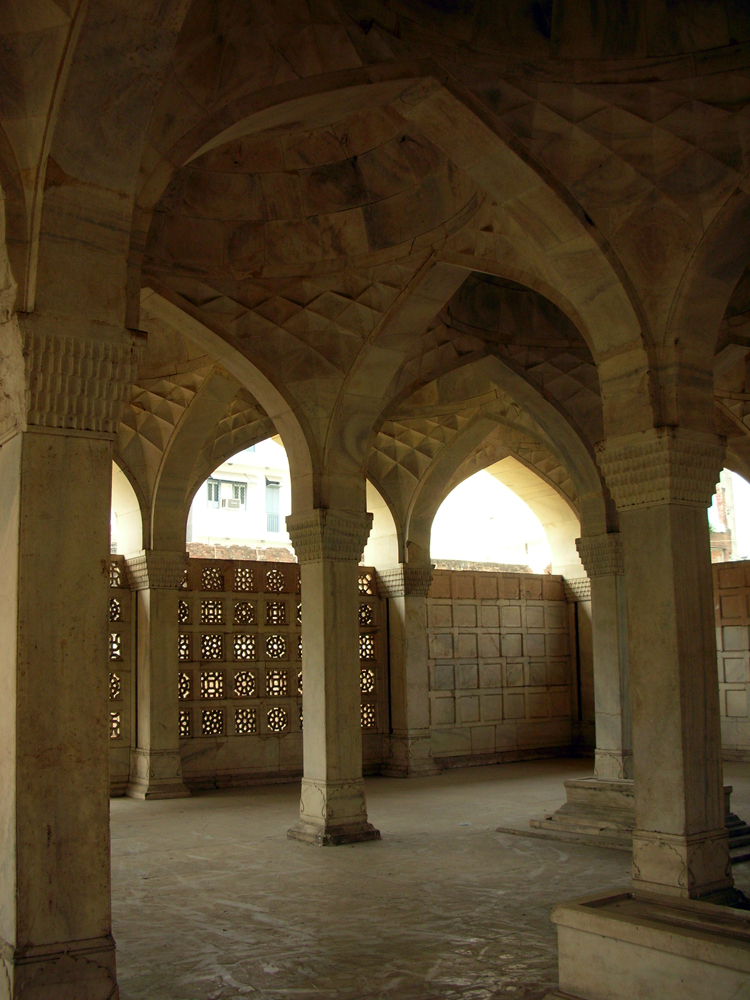
Inside Chaunsath Khamba.
Chaunsath Khamba was constructed by Mirza Aziz Kokaltash himself in about 1623-4 CE. Along with his cenotaph (which, like that of his wife—also buried here—is intricately carved from white marble), Chaunsath Khamba also houses the cenotaphs of various other people; these cenotaphs bear no inscriptions regarding the identities of those buried under. It is, however believed that these are the graves of members of Mirza Aziz Kokaltash’s family.
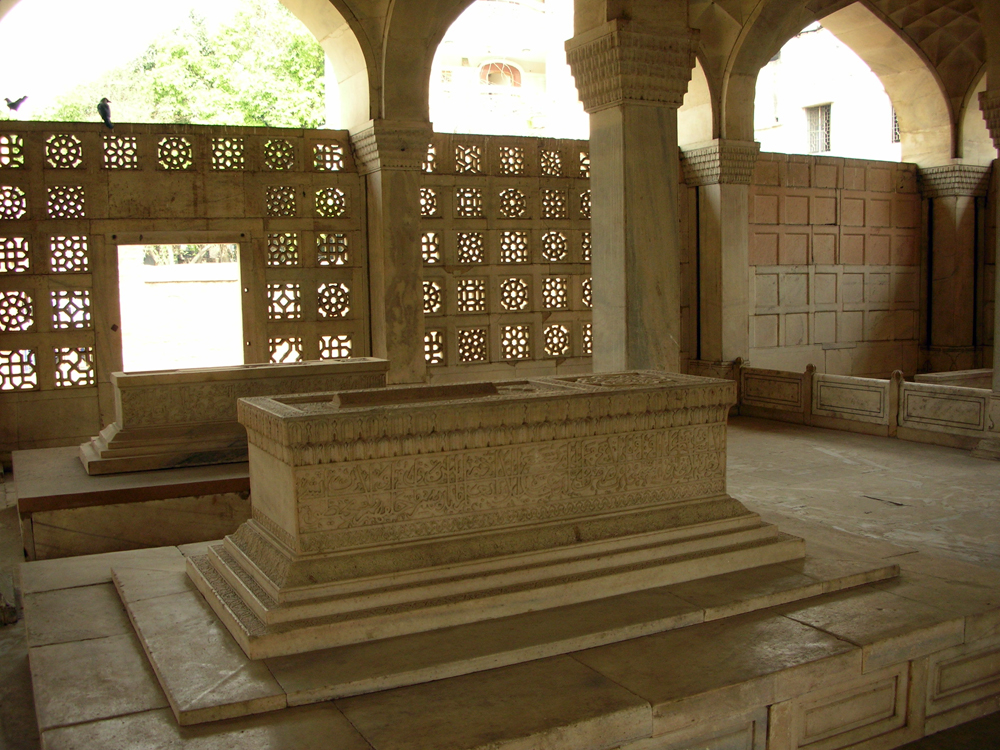
The cenotaph of Mirza Aziz Kokaltash, at Chaunsath Khamba.
Chaunsath Khamba has long been a popular subject for depictions in paintings: the British artists, Thomas and William Daniell (who were uncle and nephew) painted it in 1801, although they incorrectly labelled it as the tomb of Amir Khusrau.

The Daniells’ painting of Chaunsath Khamba, from 1801 (picture courtesy: The British Library).
In 1820, the Resident of Delhi, Sir Thomas Metcalfe, included a water colour of Chaunsath Khamba in ‘Reminiscences of Imperial Delhi’, an album of 80-odd paintings that he commissioned.
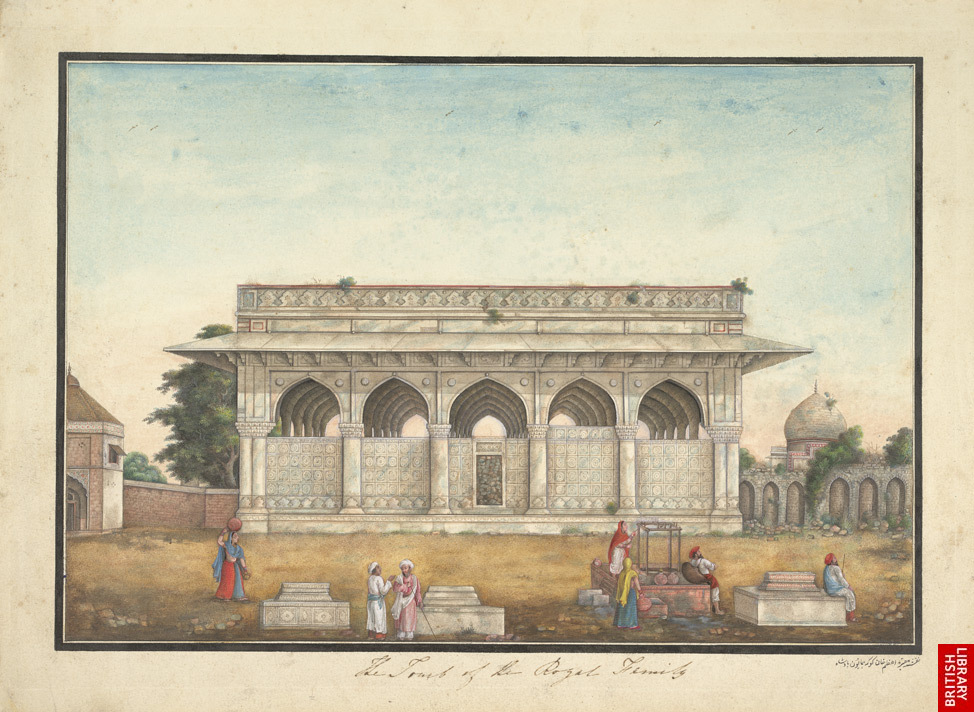
Chaunsath Khamba, depicted in Thomas Metcalfe’s album, 1820. (picture courtesy: The British Library).
Recently, the Aga Khan Trust has done extensive conservation work on the Chaunsath Khamba building, including taking down, cleaning, repairing and replacing the carved marble panels at the tomb.
 Dustedoff
Beautiful!
some graves seen in Metcalfe’s painting are missing in Daniell’s. Must be a different view. Are they still there?
LikeLike
It is a slightly different angle – the Daniells’ painting is at an angle, while the Metcalfe one is straight ahead.But if you look closely, you can see a grave at the lower right corner of the Daniells’ too. I presume the other graves would have been further to the right but haven’t been shown because that was the extent of the picture.
And yes, the graves are still there, as far as I remember. :-)
LikeLike
Thank you, Madhu!
Yeah, I saw it. It was hidden by the British Library label.
LikeLike