
Which, since I’ve not been able to find out exactly what this means, I choose to interpret from the subtitles of its title song: ‘Ram Plays a Game’.
If you’ve been following this blog for a while, you’d probably know of my near-constant mission to find subtitled Indian films. Regional films, non-Hindi ones. Sadly, not very many old films (barring Bengali) seem to be subtitled, so when I do find one that has subs, I am pleased as punch.
Especially when it turns out that it stars one of my favourite actors (Sanjeev Kumar) and that pretty much all the videos on YouTube, even the ones featuring only certain songs or scenes tag the film as a romantic comedy. I am all for rom-coms, and rom-coms that feature Sanjeev Kumar? This I needed to see.
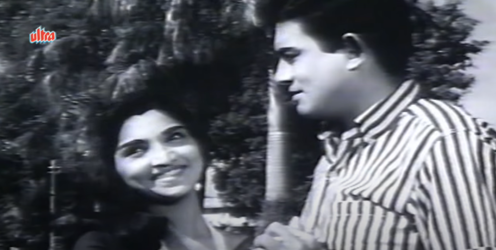
Ramat Ramade Ram begins by introducing us to Gauri (Tarla Mehta), who is in love with Shankar (Mahesh Desai, brother of film star Manhar Desai; the two brothers were from a Gujarati Christian family from Ahmedabad, and both worked in Gujarati and Hindi films). Shankar is from a wealthy family, and seems to spend all his time sitting by the lakeside, writing poetry. He and Gauri are very much in love with each other, but right now, Gauri is a little preoccupied with her elder brother Ravi, who’s leaving their village for the city later that day.
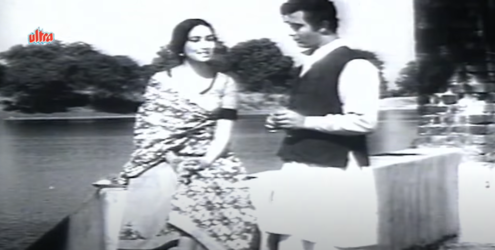
Ravi (Sanjeev Kumar) is well-educated, but fears that his education will be worthless here in the village. Their father (?) tries to reason with Ravi, even to plead with him: stay here, where there is family and home; how will you manage by yourself in the big, bad city? But Ravi is adamant: the village offers no opportunities whatsoever. He must go to the city in order to make a life for himself.
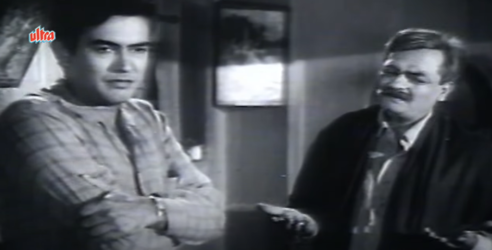
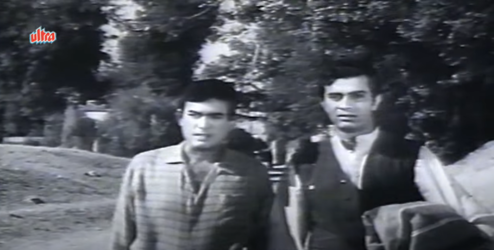
Eventually, his father, having no option but to agree, gives Ravi his blessings and lets him go. Shankar has offered to see Ravi off, so Gauri and her father bid farewell to Ravi, and Ravi and Shankar walk to the bus stop.

As they walk, Shankar too tries to gently reason with Ravi: why go away? Why not stay in the village? To him, a friend and a man of about his own age, Ravi is more brutally honest than he was with his father. He tells Shankar that he has only one ambition in life: to make a fortune. He will do anything for money, because money is essential for happiness, for contentment.
Ravi leaves for the city, and when he arrives there, is met by old classmate, and obviously old sweetheart too, Radha (Sarita Khatau, later Sarita Joshi). Radha has come in her car to pick Ravi up, and as she drives him away from the bus station, she gives him some good news: she has spoken to her father (?) to give Ravi a job. Right now, she is taking Ravi to their home, where he can relax a while.
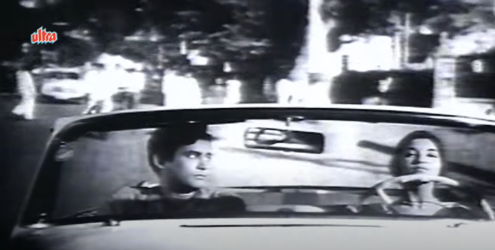
Radha has a houseful of servants, who seem to spend most of their time gossiping amongst themselves (one of these, the maid Monghi, is an old favourite from Hindi cinema: the sweet-faced Dulari). While Radha excuses herself and Ravi is waiting by himself, he happens to overhear a conversation between two of the servants: Sethji (that is, Radha’s father), since he has all that wealth and no offspring except Radha, will be happiest to find a son-in-law who has nobody else in the world. An orphan, on whom Sethji can bestow not just his daughter but everything else: his property, his business, all. A man with no other liabilities, no duties towards anybody else.

Ravi, ambitious and quick to sense an opportunity, stores that bit of knowledge away.
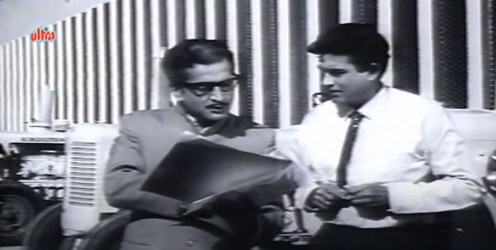
Thanks to Radha’s recommendation (and the fact that her fond father is happy to do anything to please his daughter), Ravi gets a job at the factory her father owns. Radha insists that Ravi stay with them, and her father is equally happy to agree. Things are well on the way to working out as Ravi wants: he’s soon earning well, and his romance with Radha is progressing, with lots of singing in pretty locales and such like.

Radha’s father is very happy with Ravi: he’s a good worker, efficient and capable, and Sethji wants to send Ravi overseas, to deal with their clients abroad. In conversation, Ravi has discreetly let slip the ‘fact’ that he is all alone in this world, an orphan with no siblings, nobody. Radha’s father therefore suggests that Ravi marry Radha and take over the reins of the business. To begin with, as soon as they’re married, Ravi can go off to England on work, taking Radha with him.
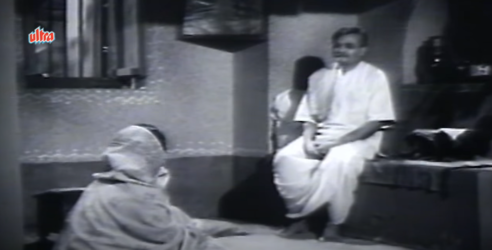
While Ravi is busy making his dreams come true, Gauri, back in the village, also seems to be one step closer to finding her happiness. Shankar’s mother, who (like Gauri’s father) has been aware all along of the relationship between their respective offspring, comes to Gauri’s father to ask for his daughter’s hand in marriage for her son. Gauri, happening to overhear the conversation, is very happy when her father agrees and the match is fixed.
Later, she meets Shankar, teases him a bit and finally confides in him, so that they can exult together over their upcoming wedding.

But neither Shankar nor his mother have reckoned with Shankar’s father (?). A wealthy man, Shankar’s father is livid when he discovers that his wife and son want an alliance with the family of the village headmaster. It’s beneath his dignity, beneath his standard. He will not have Shankar wasting himself on a woman who will bring with her no dowry, nothing.
Shankar, not one to back down, counters his father: it’s money he wants, right? Well, then: Shankar will go and earn that money. He will bring back money enough to satisfy his father’s ambition, and then he and Gauri will get married. But he will not marry anyone other than Gauri.

So Shankar goes off to the city, somewhat following in Ravi’s wake and with the same purpose: to make money, even if Shankar’s motivation behind that is far less mercenary than was Ravi’s. However, once there, Shankar realizes that there is no market for his poetry. Write detective fiction, he’s told; that’s the stuff that sells [I take exception to this!]. Shankar is affronted, and perseveres—without any success.
Meanwhile, back in the village, an old friend of Gauri’s father turns up one day. They had been friends when they were boys, so they’re very happy to meet up after so many years. The friend, having met Gauri and been impressed by her, suggests a match for her. A very good man, successful and wealthy. A widower, forty-three years old. Gauri’s father baulks at this: why will he give his daughter in marriage to a widower so much older than her?
What he doesn’t know yet, though, is just who the man is whom his friend is proposing as a potential bridegroom for Gauri: Radha’s father.
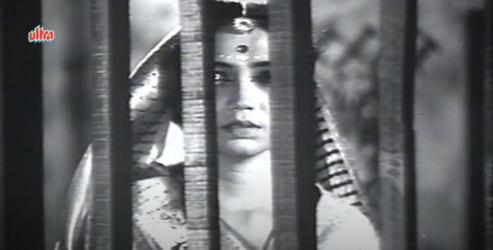
What happens next? Do Gauri and Shankar have a happily-ever-after in store for them? Or does the almighty, working in ways too mysterious for humans to comprehend—Ram, playing a game—have something else lined up for not just Shankar and Gauri, but the other major players in this drama as well?
If you want to know, ask me. I would not advise watching this subtitled version on YouTube, because it has a large chunk missing, which I think comprises an important part of the plot. This I discovered to my surprise when watching the film, and I wouldn’t want to inflict it on anybody else. What surprises me is that Ultra, whom one would expect to be a little more conscientious about such things, have happily mauled this film. And labelled it a rom-com, which it resoundingly is NOT.
What I liked about this film:
The first half of it. Perhaps even more, given that what I saw was not the entire film. This was well-scripted, well-acted, the characters and their relationships falling into place well. You could see people’s motivations, and understand why they acted the way they did (for instance, why Ravi decides to hide from Radha and her father the fact that he actually has family, arises from his burning ambition to be wealthy; he is willing to go to any lengths for it).
And, the music, by Avinash Vyas. In Hindi cinema (for which too he composed music) Avinash Vyas mostly got relegated to composing for B-grade mythologicals, but in Gujarati cinema, he seems to have gained rather more recognition. Ramat Ramade Ram has a number of lovely songs, of which the title song (sung by Mohammad Rafi) is my favourite.
What I didn’t like:
The last twenty minutes or so (which was what I was able to watch after what I mentally label the ‘Great Divide’). For most of the film, I had been thinking that while this was a ‘family drama’—thankfully—it was not one of those painfully melodramatic ones of the kind that seemed so popular in Hindi cinema through the 50s, and even into the 60s (Nutan, I’m looking at you, in Khaandaan, Meherbaan, Gauri, Devi, etc etc). Then, after that abrupt switch around half an hour from the end, when I realized a chunk of the film was missing, it went downhill… and how. There were misunderstandings, and a woman, out of love and because she had been sworn to secrecy, refused to even defend herself from suspicious and rude allegations. There was so much melodrama, so much utterly needless self-sacrifice, it made my eyes water.
(Minor spoiler ahead)
Plus, even before that happened, there was the whole thing about a young woman being married off to a much older man. True, for me, at past fifty years of age, forty-three doesn’t seem all that old, but I think it’s criminal for a woman in (perhaps) her early twenties, if not less, to be married to a man so much older than her—a man, too, whom she doesn’t know, and when she loves another. What made it worse was that she falls into pativrata mode very quickly, and the film suggests that it’s perfectly normal for this mismatched pair to experience such domestic happiness. Not as icky as Ghar ki Laaj (which had Sohrab Modi married to Kumkum), but close enough.
(End of spoiler)
Final verdict: while this one’s nice enough till a point, it’s really not worth watching unless you absolutely must see all of Sanjeev Kumar’s work.
 Dustedoff
I like Sanjeev Kumar and his films are mostly very decent. I haven’t even heard of this film. And oh God, I am imagining Radha married to Ravi, and Gauri married to Ravi’s father-in-law…that too in the same house.
LikeLiked by 1 person
I too like Sanjeev Kumar, and I agree that most of his films are quite good (barring some – like Gauri – in the late 60s, which were appallingly regressive). This one might have actually worked out pretty well if the last half-hour or so had been changed.
LikeLike