
Aka The Wedding Procession, though Hindi speakers will probably be able to relate to a more exact approximation of what barjatri means: baraati. The people who, at a wedding, accompany the bridegroom to the venue, invariably in great pomp and to be made much of. This delightfully funny film centres around a group of young men whose story begins just before all of them are to travel, as baraatis, for their friend’s wedding.
One of these is Ganesh ‘Gansha’ (Kali Bannerjee), who lives in his uncle’s home, and is unemployed. Uncle (?) has been pushing Ganesh to find a job, but Ganesh couldn’t be bothered. He would rather spend time sitting with his pals, chatting and smoking, all of them generally enjoying themselves.
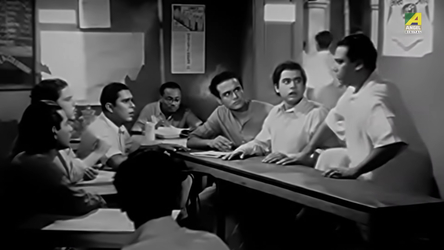
Their friend Trilochan ‘Tilu’ (also often referred to as Tile; ?) is getting married, so the entire lot travel with him, along with a few older, more ‘distinguished’ gentlemen, to the town where Tilu’s bride lives. Here, of course, they are greeted with much fanfare, and showered with much generosity. So much generosity, in fact, that soon most of the older gentlemen of the group have imbibed freely enough to be picking fights with the bride’s family.
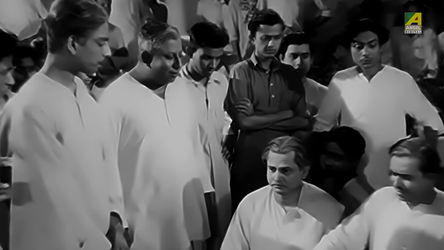
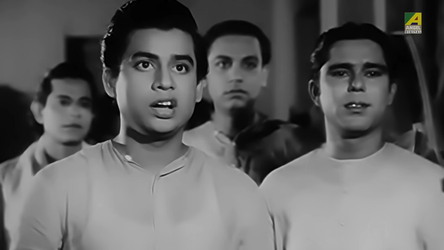
Ganesh and his friends, as a result of that altercation (in which they are not even involved), come close to missing the wedding feast, a cause for concern for one of them, Gorachand (?) who is quite a gourmet.
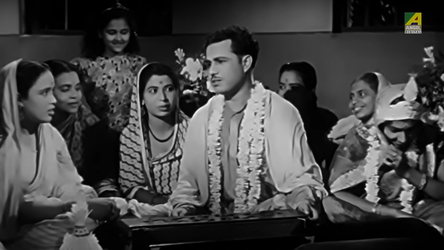
But all’s well that ends well; they have a good feed, and the old gentlemen of the baraat are pacified. Tilu is married, and after the wedding, the ladies of the household get together for some songs and ribbing of the hapless groom. Tilu has been practising a song he knows he will be required to sing for this occasion, and now finds that he’s forgotten the second stanza. None of his excuses work; a woman sitting beside him pulls his ears when he tries to get out of singing; and when he does begin to sing, his bride cannot stop her giggles.
Tilu’s friends are too nervous to try barging in on the women’s party (there’s a suspicious-eyed, lathi-wielding local nearby who looks most sceptical when he’s asked if these visitors may attend this particular function). The young men find a way out: they slip out and get to the windows of the room in which Tilu and the women are ensconced. From here, they can watch (and hear) to their hearts’ content, without anyone being the wiser…
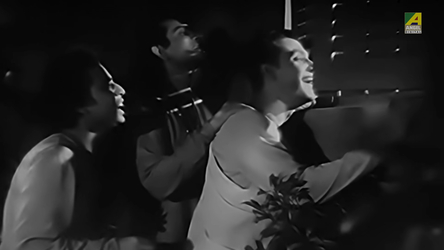
Except that, in getting to the window, Gorachand steps into a large pile of cow dung. His ankles then proceed to itch like the dickens, and Gorachand is eventually in so much distress that his friends have to break off their eavesdropping to help Gorachand. They gather around Ganesh, who gets down on his knees and is rubbing Gorachand’s legs—
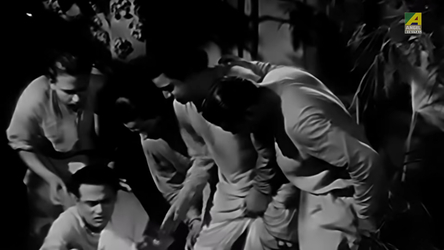
When a maid, come out to throw some rubbish, sees this group of men huddled at the back. She throws the rubbish on them, screams “thieves, thieves!” and races off. The young men panic and also take off, just as dozens of men, all gathered for the wedding, emerge, armed and raring to go, in response to the maid’s cries.
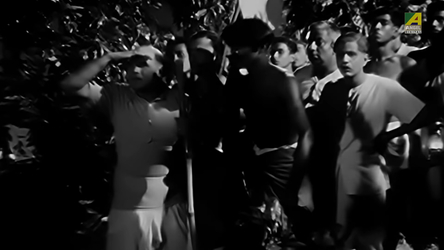
Ganesh, Gorachand and another of their friends, Rajen (?) try to escape by running across a field. Only, what they thought in the moonlight was a field turns out instead to be a pond.

Thus, our friends, neck-deep in water, with Tilu’s belligerent in-laws and their friends crowding the banks of the pond, baying for the blood of these thieves.
And when Ganesh and Co. explain that they’re barjatris, Trilochan’s friends, nobody believes them. They are finally taken back to the house, and various attempts are made to identify them. Tilu’s elderly relatives are so deeply asleep as a result of all their merry drinking, nothing can make them get up to identify these young men.
A priest who had also come along with the family is, likewise, unable to help: he’s very short-sighted, and can’t tell one man from another.
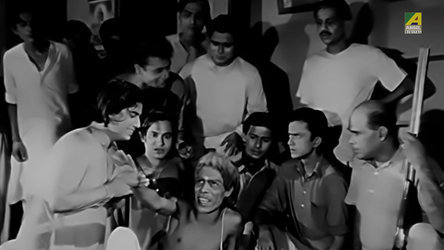
Imagine, an esteemed guest at a wedding, and accused of being a thief.
But that’s how life plays out. Because the film ends on a very similar note. Déjà vu, really.
In between those two book ends, though, there are various other shenanigans and adventures on the part of Ganesh and his friends.
Directed by Satyen Bose (and written by him, based on a short story of the same name by Bibhuti Bhushan Mukhopadhyay), Barjatri plays out more like a series of slightly-connected vignettes featuring the same central characters. These young men, and especially Ganesh among them, find themselves in a series of difficult, comic situations. Much of it is a result of their own impulsiveness, or their readiness to jump into adventures. When the world thinks of A as the logical solution to a problem, these young men invariably think of ∀. Their ideas are whacky, they come up with the most ludicrous (and/or convoluted) ways out of situations. And their luck is abysmal.
The end result is a delightful film, at times laugh-out-loud, often just amusing, but overall very entertaining. The acting is all-around excellent, and the core characters are especially well-portrayed.
I did find it a bit disturbing that Ganesh’s lady love, Puti (?) is all of fourteen years old (though it is pointed out by several people that she’s too young, it doesn’t stop her marriage being arranged, or Ganesh falling in love with her).

Also, Ganesh’s stammering is made the butt of several jokes, which is probably a reflection of less politically-conscious times, but I still found it hurtful.
Two not very major quibbles. And lots to enjoy.
Barjatri is available on YouTube, with English subtitles, here.


Damn, such a wonderful Bengali movie, and I hadn’t even heard of it till now! I will make sure I watch it as soon as I can. Thanks for the tipoff!
Incidentally, I’ve found some ’50s Bengali films similarly delightful. Kalo Chhaya (which I think you’ve reviewed) comes readily to mind; its Hindi iteration Apradhi Kaun was in my view markedly inferior. Hanabari wasn’t a bad effort either, though not as good as Kalo Chhaya was.
LikeLiked by 1 person
I feel a certain glee that you hadn’t heard of Barjatri so far! And that you have it to discover, now. I found it quite funny in a quirky sort of way.
I haven’t watched Kalo Chhaya, actually, though I have it on my list of Bangla films I need to watch – especially since I recall several people telling me that Apradhi Kaun? wasn’t a patch on it. Must look for it!
LikeLiked by 1 person
Kalo Chhaya is available on Youtube, as is Hanabari. Both films were not just written but also directed by Premendra Mitra, better known as the author of the bestselling Munchausen-esque Ghana’da stories.
LikeLiked by 1 person
Yes, I know they’re available, only not with subtitles, the last time I checked. :-) And I do need subs.
LikeLike
This is the sad part that today, even honest and educated Bengalis aren’t aware of their own (and thus Indian) cinematic heritage. Just shows how successful the distortion of our Indian cinematic history has been by certain people with vested interests of their own.
Barjatri, for example, wasn’t just a megahit, but also massively acclaimed- not by the ignorant, brainwashed or biased critic of today- but by the likes of people who genuinely understand what is cinema. And the list of such people included none other than the biggest of them all in Satyajit Ray, who just loved this film for its authentic wit and organic charm.
That the film is a superb one isn’t surprising. It’s after all directed by Satyen Bose, who was a veritable master of his craft, having doled out greatly innovative pictures in both Bangla and Hindi like this one, Bhor Hoye Elo, Paribartan, Jagriti, Parichay, Dosti, Savera, Chalti Ka Naam Gaadi, Masoom, Raat Aur Din, Ansuu Ban Gaye Phool, Payal Ki Jhankar- just to name a few. The guy’s contribution in making successful comedy and children’s films in India is second to none.
The truth is, in reality, from a cinematic perspective, Satyen Bose was and is no less than a Hrishikesh Mukherjee (if not better), but because he didn’t really worked with stars, probably meant that inspite of the audiences giving his pictures immense love (and awards), he has remained unsung due to being a non- favourite with media. But, imo, he deserves all the more credit, that without resorting to star culture that much, he was able to deliver superhits (that too in genres which didn’t really enjoyed such mass acceptance in India before his advent) which took home the best film trophy from an authority as dubious as Film Unfair, in presence of such “mighty” star favs and media “darlings “like Raj Kapoor, Mehboob Khan, Guru Dutt and Bimal Roy.
The other reason why this film is great (apart from its terrific story material) is the acting. The acting is throughout good- as you have rightly pointed out above. But then that’s not surprising, especially considering that it stars two of greatest Indian (Indian, not just Bengali) actors ever in Kali Banerjee and Anup Kumar- two guys, who just like director Satyen Bose, have remained victims of our unfortunate national bias of the media, which no matter how much one denies, simply on the basis of facts, exists. And exists big- time!!
LikeLiked by 1 person
Premendra Mitra, might be more popular today for Ghanada stories, but his real contribution in Indian literature lies in his short stories like Telenapota Abishkar, Sansar Shimante, Sagar Sangamey etc., which remain among the greatest short stories ever written in any Indian language. Indeed, he, Narendranath Mitra, Premchand, Subodh Ghosh & Rabindranath Tagore, imo, form the big five of Indian short story writing.
And yes, as Abhik Babu, has pointed out, both Kali Chhaya (it’s from 1948, not 1950s though) and Hanabari are really cool pictures – both benefiting immensely from the presence of another great actor in Dhiraj Bhattacharya.
LikeLiked by 1 person
Madhu, back after a long time, and I have so many posts to catch up on. This film seems like one that I need to watch – and it’s just the sort of movie that I need right now!
LikeLiked by 1 person
You have no idea how relieved I am to see you back, Anu! I have been very concerned about you, but didn’t want to write to ask, for fear that you would feel compelled to reply even if you didn’t have the strength to do so. So happy.
And yes, do watch this – it’s fun. :-)
LikeLike
Thanks, Madhu. It’s been a long and trying period. Still see-sawing, but keeping fingers crossed that I’ll be able to travel. 30/9-2/10 in Dilli. Hope to meet you then.
LikeLiked by 1 person
Keeping my fingers crossed for you too, Anu!
LikeLike
I have seen the film before. Shall check and send across the names of the actors that you missed. There’s an interesting story about the writing of the book. Shall mention it some other time
LikeLiked by 1 person
Thank you, I’d be grateful if you could identify the actors. And will wait for the anecdote about the book!
LikeLike