
I am always intrigued by films that have children in important roles, films like The Search or The Four Hundred Blows, which call for children to really show off their acting skills. The Bad Seed is another for the list, and an unusual film, in that it has the child (Patty McCormack) in what might have been an unsettling experience for a child actor.
The Bad Seed begins in the home of Colonel Kenneth Penmark (William Hopper), who has been transferred to Washington, DC and is just about to leave. His farewell to his wife Christine (Nancy Kelly) and their eight-year-old daughter Rhoda (Patty McCormack) is touching: these three are obviously a loving, happy family. Rhoda, in particular, comes across as an affectionate child, adored by her father.
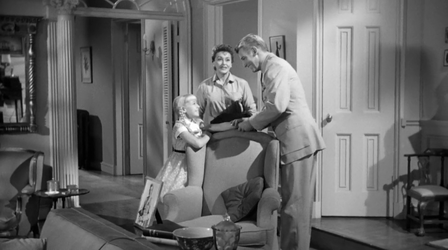
Adored, too, it seems, by several other people. Monica (Evelyn Varden), the Penmarks’ landlady, is one of those who dote on Rhoda. What a perfect child she is. How well she plays the piano. How clever, how intelligent, how well-behaved. A regular little lady, too: how beautifully she curtsies, and she’s always in skirts or dresses, not the jeans all the other girls seem to wear.
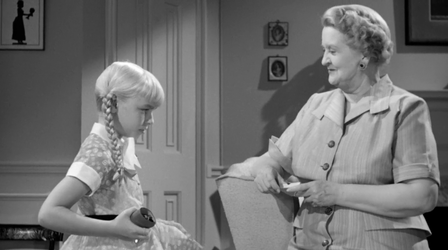
Her shoes clatter as Rhoda taps her way about the room, and when Monica comments on the shoes, it’s explained that special iron cleats have been put on Rhoda’s shoes to make them last longer. Christine explains that it was Rhoda’s idea. Rhoda, it seems, is also such a thoughtful child, aware (despite the fact that her family is obviously well-off) of being careful with money, not wasting it.
Other little details emerge in this scene. Rhoda, though an accomplished child who does well at school, gets very upset that her school’s Penmanship Medal, which she had been expecting, has been awarded to a classmate, Claude Daigle. Rhoda throws a minor tantrum, insisting that the medal is hers. Claude has no right to it.
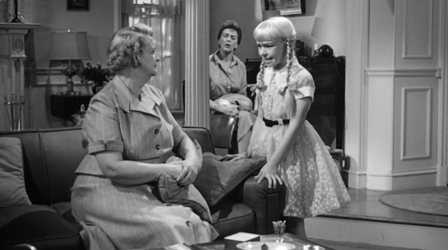
There is one other instance of Rhoda being not quite the sweetie. The apartment building where these people live has, as caretaker, gardener and general dogsbody, a man named Leroy (Henry Jones). As Monica says, Leroy may be a man, but he has the mind of an eight-year-old. Leroy is invariably sneaking up on Rhoda and passing snide remarks about her. Rhoda’s behaviour with Leroy is somewhat akin to that medal-related tantrum: suddenly she’s not the sweet little miss any more. For instance, when Rhoda comes tripping down the front steps and Leroy (who’s watering the flowers) accidentally wets her shoes, Rhoda flies into a rage and starts screaming.
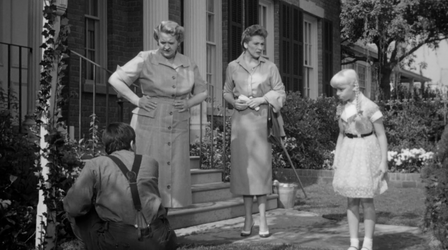
Anyhow, Rhoda is off to her school’s picnic, and Christine will be lunching with Monica and a couple of other friends, among them Reginald Tasker (Gage Clark), who, like Christine’s father, the well-known journalist and writer, Richard Bravo (Paul Fix), is keenly interested in criminology. Christine drops Rhoda off to the site for the picnic, a lakeshore site. She also meets Rhoda’s teacher, Miss Fern (Joan Croydon) and has a quick chat. Miss Fern assures Christine that Rhoda is doing well at school.
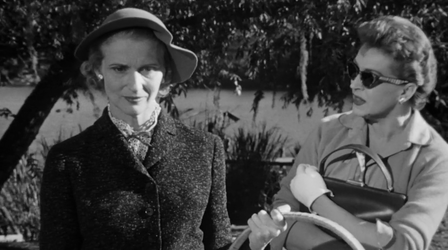
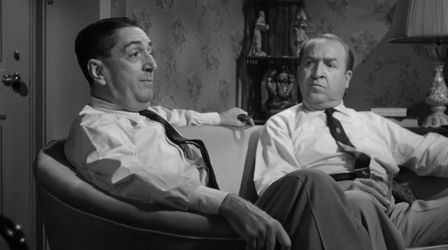
Christine goes to lunch at Monica’s. It’s an interesting conversation: the company discuss a host of topics. Reggie Tasker tells of a chilling serial killer of yore, a woman named Bessie Denker, whom everybody has heard about, but nobody seems to know very much about.
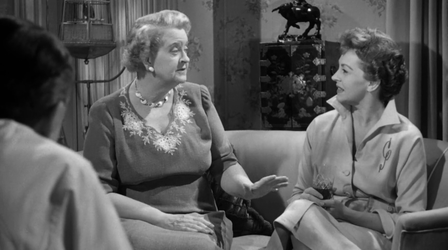
Monica is an amateur psycho-analyst, very eager to know the ins and outs of the people around her. She begins to chat with Christine, and Christine ends up telling Monica that since she was a little girl, she (Christine) has often had this feeling that she was adopted. That she’s a changeling, not really her parents’ daughter. Monica laughs it off; that must be one of the commonest childhood fantasies.
The lunch conversation is interrupted by an announcement on the radio, with a piece of local news. The Fern School picnic by the lakeshore has been struck by disaster: a child has been found dead, drowned. Christine panics, but as she’s trying to leave, to rush to the lakeshore, there’s a further announcement. The child who died was a Claude Daigle.
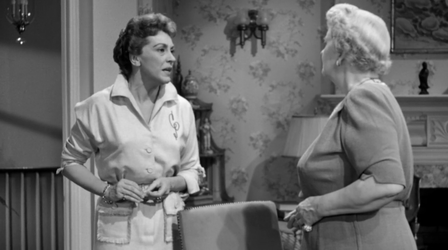
Christine is relieved, of course—it’s not Rhoda, thank goodness it isn’t her—but sorry, too, for poor little Claude.
Shortly after, the school bus arrives, bringing the children to their respective homes. Christine bustles about Rhoda, trying to comfort her, condole with her on the death of her friend, but Rhoda is oddly matter of fact about the whole thing. It’s not as if Claude was a friend, really (that medal, too, unfairly bestowed on an undeserving Claude, rankles). She is calm, unabashedly accepting of Claude’s death.
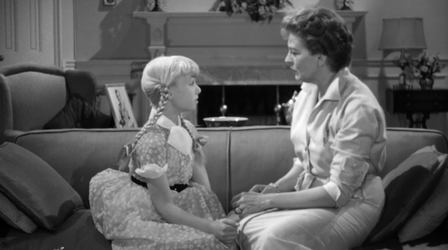
Later that evening, while a still-shaken Christine reads to Rhoda in bed, Rhoda happily takes her vitamins and falls asleep.
But the next day brings with it disturbing visitors. First, there comes to the Penmarks’ Miss Fern, who can’t seem to make up her mind whether to talk about Rhoda not fitting into school or about Rhoda being an exemplary student. Christine is confused by these conflicting signals, but comes to the (correct, as Miss Fern admits) conclusion that they don’t want Rhoda back at the school. But why?
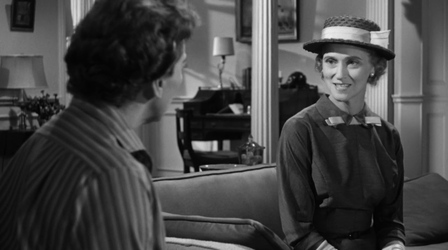
There is something very strange about it all. The guard along the lakeshore has given evidence that he saw Rhoda (the only girl in a dress, so his identification of her is irrefutable) by the lakeshore. With Claude. From what the guard said, it seems Rhoda was the last person to see Claude alive.
Miss Fern is still there when two more visitors arrive: Claude’s parents, Mr Daigle (Frank Cady) and Mrs Daigle (Eileen Heckart). Mrs Daigle is not just deeply distressed; she’s also very drunk. She wants to talk to Rhoda, to find out if she knows where Claude’s medal has disappeared. Because Mrs Daigle wants to bury him with his medal, but it’s nowhere to be found. And he had been wearing it, pinned very securely onto his lapel. She had pinned it on, attaching it with a little lock. It couldn’t have just come off. But it has, and it’s nowhere to be found.
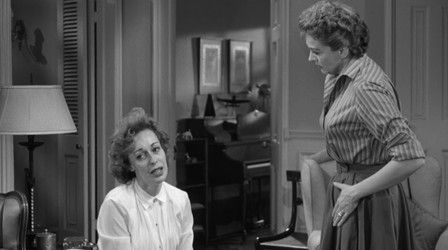
Christine, till now, has only been vaguely sad about Claude’s death, her concern more a result of a humane sense of empathy for the parents who have lost their only child. Combined with that has been a worry that Rhoda will be traumatised because of this death. That latter worry has been laid to rest; Rhoda is not in the least upset about Claude’s death. But another, horrifying thought is now beginning to worm its way into Christine’s head…

Directed by Mervyn LeRoy, The Bad Seed was based on a play by Maxwell Anderson, in turn adapted from a novel by William March. The film won Eileen Heckart a Best Supporting Actress Award at the Golden Globe Awards, and went on to be a big hit both in the US and the UK. It has been remade several times, including most recently in 2018, in the form of a TV film.
What I liked about this film:
The suspense. The idea that Rhoda may have something to do with Claude’s death—and with other misdeeds—creeps up slowly, at first only as the faintest of suspicions. Then, when it hits, the shock is that much greater. And there are twists and turns to follow, as Christine finds out even more about not just her daughter, but about herself, too.
Then, the acting. Three people in particular stand out. One, Patty McCormack as Rhoda: such a sweet smile, but every now and then, you see that it doesn’t quite extend to her eyes, and there’s something chilling about the smile itself, something unsettling and very disturbing. Two, Eileen Heckart as Mrs Daigle: a woman unravelling after the tragedy that’s struck her, trying to keep herself together by drinking, and always enough in control to know that she’s drunk. A brilliant performance. And, finally, Henry Jones as Leroy, a well-acted character who is an odd mixture of canniness and naivete.
What I didn’t like:
The far-fetched notion of criminal tendencies being a genetic trait. If it hadn’t been for this element, I would have rated The Bad Seed much higher.
As it is, though, the film is still a very good, suspenseful story. Much better, to me, than its 2018 remake, starring McKenna Grace as the little girl (in this film, Emma).
Comparisons, comparisons:
In 2018, Rob Lowe starred in, produced and directed a version of The Bad Seed for television (the film is available on YouTube, here). While the basic plot is the same, there are many differences between this one and the 1956 film. There is the single parent, but instead of a grass widow (as in the case of Christine) it’s a widowed father (played by Rob Lowe). Instead of a caretaker-janitor who is able to see the child up close and therefore sees beyond the façade, there is a nanny, played by Sarah Dugdale: a sassy, brash young woman who is not exactly scrupulous herself and so, perhaps, is able to see that Emma is not quite the perfect little miss she pretends to be.
Where the 2018 film scored for me was in that it never goes down the genetics route or tries to pretend that heredity has any part to play in Emma’s behaviour (well, obviously. I would think any film, in this day and age, that ventured down that path would find itself lambasted left, right and centre). But, unlike the 1956 film, this one doesn’t really even build up the suspense. The weirdness of the child, the fact that her superficial sweetness hides a vicious character, is introduced very early on in the film. In fact, several scenes, from the beginning, are shown from Emma’s point of view, so it’s easy to tell that this child is up to no good.

… and no good she is. Patty McCormack’s Rhoda is basically a child with absolutely no conscience—there’s a sort of clear-eyed look about her, an innocence that is shattered only occasionally when it becomes obvious that she understands that she’s doing wrong. McKenna Grace’s Emma, in contrast, comes across as a much more genuinely evil child: manipulative, indiscriminate, not even sparing her own father when it comes to how far she will go. There is a single-minded viciousness here that is somewhat muted in the character Patty McCormack played. Rhoda is brutal, but mostly not to her parents (even if her deliberate attempts to flatter her mother whenever she is in trouble come across as quite manipulative too); Emma shows herself capable of being completely heartless.
Ultimately, the two films have a different tone, even though the stories are so alike. The 2018 film is more unabashedly a horror film, while the 1956 one, though chilling, is more suspenseful than anything else. The latter is also the one I liked better: it’s better scripted, better acted, and on the whole, more satisfying.
 Dustedoff
Ooh, intriguing. Is it streaming free anywhere?
LikeLike
It’s on ok.ru:
https://ok.ru/video/3674226952884
LikeLike
Nice review! Will try to catch up with the original version.
I have seen the 2018 version and do agree that it appears more like a horror film involving a psychopath child. The girl is shown downright evil and remorseless. One feels sorry for the father. I was a bit surprised by the end but I suppose the ending is similar in the original too.
Nevertheless, I did enjoy the film.
I have also seen the sequel to the 2018 film – The Bad Seed Returns (2022), a clear-cut horror film, also for television., with Mckenna Grace reprising the role of Emma. Its a continuation of the earlier film.
And the ending leaves the option open for a third part.
You may have realized it too, that interestingly, Patty McCormack has a special appearance in the 2018 film (and then also in the 2022 one) as a doctor.
LikeLiked by 1 person
Thank you for that interesting comment. I hadn’t known there was a sequel to the 2018 version, and that there might be yet another one coming up. But yes, I did know that Patty McCormack acted the role of the doctor (very gullible and easily taken in!) in the 2018 film.
Do see the original sometime – I think the tone of it is very different from that of the 2018 film. Much more suspense, much less outright horror. And even when the horror does set in, there’s a creepiness to it that’s quite unlike the more in-your-face feel of the later film.
LikeLike
Just this week I read a review of a Turkish remake of the story, Kohu Tohum (1963) . The writer complimented the way that version opened up the story in ways that added detail and background regarding Rhoda’s relationship and competition to her peer at school. Also the mother and daughter in that film were played by a real life mom and daughter. The 1956 version followed very closely the Broadway play which had starred several of the film’s cast and has sometimes been criticised as stagy and theatrical in performance, though I always have found it very effective. When it first aired on tv here in the US in the mid 1960s I was very young and my mother thought it not suitable for me to watch so I was sent to bed though I still recall hearing some of the dialogue. I did see it in my late teens. At the time the play was running Patty McKormick was playing a role in a tv series based on ‘I Remember Mama’ that was broadcast live, and as soon as her role in the tv episode was finished she had to dash by taxi to the theatre, changing into her costume on the way to make her entrance in time. Many years later she starred in a film called ‘Mommy’ that was essentially Rhoda grown up and committing murder when her daughter was bypassed for an award. I have not seen the recent remake, but recall a weak tv remake of the ’80s with Lynn Redgrave as the mother. Thank you always for your wonderful writing, and for letting me share these thoughts!
LikeLiked by 1 person
…sorry, my typing, and memory were faulty…the Turkish version is Kotu Tohum, and Lynn Redgrave played Monica in the tv version I mentioned!
LikeLiked by 1 person
No worries. Thank you!
LikeLike
Your comment made very interesting reading – thank you so much! I hadn’t known at all about Patty McCormack starring in Mommy, or about her being in a remake of I Remember Mama (which, of course, is so ironic – another story about the bond between a mother and a daughter! – though completely different).
Kohu Tohum sounds intriguing. I must look out for it. I hope I can get it with English subtitles. Might make for an interesting comparison with this one.
LikeLike