
Fact 1: In the 1956 Hindi film CID, there was a song (composed by OP Nayyar, lyrics by Majrooh Sultanpuri) which went Jaata kahaan hai deewaane… kuchh tere dil mein fiffi, kuchh mere dil mein fiffi. The censor board pounced on the song, accusing that ‘fiffi’ word of being obscene. Sultanpuri, Nayyar, and the director Raj Khosla insisted that it was a meaningless word, just put in as a filler to help marry the tune to the lyrics. The censor board refused to change its stance, and the song remained out of the film. In the 2015 film Bombay Velvet, the song was resurrected and sung by Suman Sridhar.
Fact 2: In the 1955 French film (note the year: 1955, a year before CID) Rififi, there’s the title song, sung (and performed onscreen too) by Magali Noël. Though the French word rififi (which is military slang) can be roughly translated as ‘rough and tumble’, referring mostly to the macho strutting of toughs of the like of this film’s main characters, the song’s lyrics give it a differently nuanced spin. Innuendo, through and through.
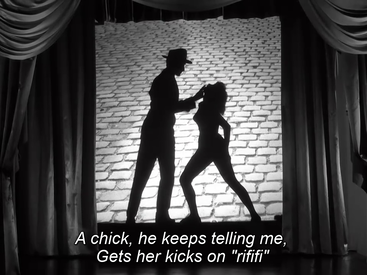
Did someone at the Indian censor board think fiffi was too close to rififi in the sense rififi is used in the song?
I wonder. And I guess there’s no way we will know.
Anyway, on to the film itself, which was an international hit (much to the satisfaction of its director/scriptwriter, the American Jules Dassin, who had been blacklisted by Hollywood for leftist leanings, and was forced to resurrect his career in Europe). It’s considered one of the classic heist movies, and it begins with its main protagonist, Tony le Stéphanois (Jean Servais) emerging from prison after having served five years for a jewel heist.
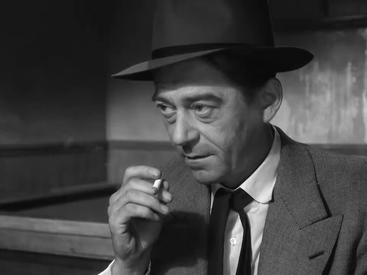
Tony comes to meet his good friend Jo (Carl Möhner), who seems like the standard ‘family man’: with a loving wife (Janine Darcy), a little son Tonio (who is godson to Tony), and a warm, welcoming home.
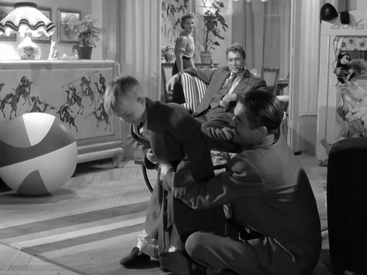
But Jo, like Tony, is a crook, and he has a proposition for Tony: come and meet Mario, a mutual friend, who has an idea.
Tony goes along, and Mario (Robert Manuel) explains. He has his eye on a very upmarket jeweller, Mappin & Webb. The plan is simple: throw a stone through the window, grab the biggest diamonds, and make a run for it. All Tony needs to do is have the getaway car ready.
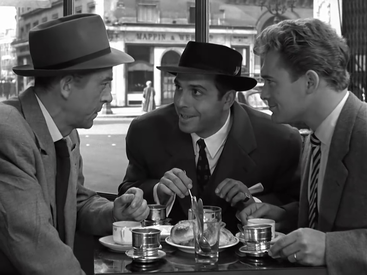
Tony refuses; his recent stint in jail has been enough for him, and he has no intention of going back in a hurry.
Shortly after, Tony discovers that his ex-girlfriend Mado (Marie Sabouret), who works at a nightclub called L’Age D’Or, has taken up with Pierre Grutter (Marcel Lupovici), the owner of L’Age D’Or. Grutter is also a thug, a disreputable and unscrupulous character: Tony knows his sort, because that is also Tony’s sort.
Tony is furious, in a cold-blooded way. He goes to Mado, takes her to his own (very seedy) flat, and thrashes her before throwing her out.
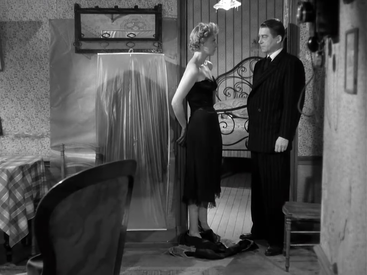
Mado goes away, and we later learn that she rang up her colleagues at L’Age D’Or soon after and told them that she wouldn’t be coming in the next few days: she was off on a holiday.
Mado disappears from the scene, and Tony goes back to Mario and Jo. He’s in for the Mappin & Webb job: but not a few paltry diamonds grabbed from the shop window; no. Tony aims for the big one: the safe in the jeweller’s office. That’s what he’s aiming for.
Together, the three men make their plans. A fence, a man in London, is identified to be approached for when they’re ready to pass on the goods. And, in Italy, they reach out to the greatest safe-breaker of them all, Cesar le Milanais (director Jules Dassin himself). There is no safe, it is said, that can resist Cesar; and no woman whom Cesar can resist.
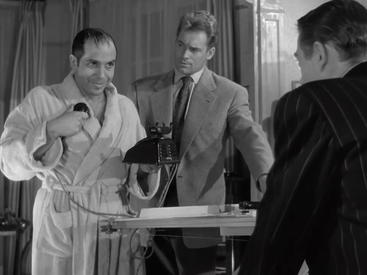
Cesar, suave and smiling, arrives in Paris, and the men have a meeting at L’Age D’Or, where Cesar, in between discussing the plan and agreeing to it, also finds himself attracted to the beautiful dancer Viviane (Magali Noël). Before the evening is out, Cesar has agreed to be part of the plan to rob Mappin & Webb—and is busy breaking down Viviane’s non-existent resistance.

The four men—Tony, Mario, Cesar, and Jo—now set about executing their plan. They memorize the layout of the street, and note down minute details: which shop opens when, which is the earliest someone from a neighbouring store might spot them. Which policeman, which nightwatchman, patrols the area at what time. What is the routine in the vicinity, when are they likely to have the largest window of time in which to break the safe.
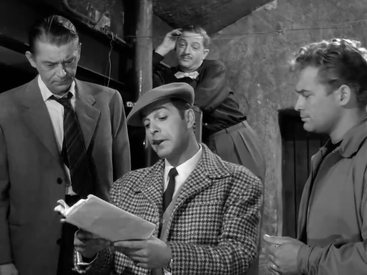
And Cesar, all togged up, walks into Mappin & Webb to buy a trinket. While he’s in there, he asks to be allowed to make a phone call, and is courteously ushered into the office. Cesar, in the few minutes he’s on the phone, quickly takes note: there’s the massive safe in the office. And there, too, is a burglar alarm. He makes a note of the make, the latest technology in burglar alarms. Even something as seemingly innocuous as a few sharp sounds in the vicinity sets it off.
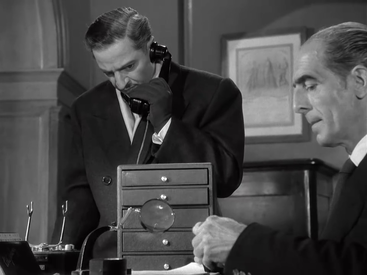
These guys are nothing if not thorough. They get a burglar alarm of the same model, and get to work on it to figure out the best way to disable it.
Finally, after much thinking, much plotting, a lot of hard work, they have it all set. They will go into action at night; they’ll work through the night and be out of there by dawn, which is when—around 6 AM—one of the nearest stores is opened by staff who arrive early.
They launch their project, therefore, and because of all that meticulous planning, it’s like clockwork.
But…
Unlike several of the other heist films I’ve reviewed on this blog (and I have reviewed quite a few of them; I have a thing for heist films), Rififi is not a comic caper, not a heist gone wrong as is (among others) Gambit or I Soliti Ignoti. This one is cold-blooded noir; it’s not pretty or funny. In part, it is an intriguing puzzle; in part, deeply suspenseful. And, eventually, both tragic as well as thought-provoking.
What I liked about this film:
The script: very taut, very precise, with no unnecessary faffing about. Pretty much everything here is on point, with no superfluous bits. Even the personal lives of the four central characters (Tonio, Jo, Mario and Cesar), wherever touched upon, ending up having a bearing on what happens with the heist and after it. The women involved with the men—Tony’s ex Mado, Cesar’s new girlfriend Viviane, Mario’s wife Ida (Claudia Sylvaine) and Jo’s wife Louise—may not be there in the plotting and execution of the heist, but in the events that take off from there, these women play an important part.
Jules Dassin’s direction, echoes the same tone: sharp, crisp, clear-cut. The acting, too (though it seems none of these people were well-known actors), is competent: Jean Servais, in particular, I found very believable as Tony: intelligent, ruthless, yet at the same time the sort of man a little boy is happy to go off with, because this is his Uncle Tony.
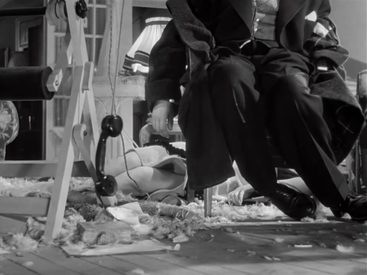
And, the ‘moments’, the impactful frames that pepper the film. One of the interesting elements of this film is that a lot of it happens without any dialogue (the entire heist sequence, which takes up a large part of the running time of Rififi, is without any dialogue), and within this, there are moments that are especially well-composed. Here, there are frames, silent and almost contemplative. A low angle shot, for instance, of a dead couple: the man in a chair, the woman lying beyond.
Or a child’s balloon drifting up into a clear sky as the child is bundled into a car.

Lastly, the subtle message at the end of it all, the futility of it. All this work, all this plotting and careful planning; all these risks taken—and for what? Also, how the toughest of toughs, the most macho men who it seems would have no chinks in their armour, end up being, after all, frail: humans, with human failings, human weaknesses. They too are brought low by emotions such as love and lust.
Plus, of course, you know what they say about the best-laid plans of mice and men.
What I didn’t like:
One thing, which really jarred. The way Tony beats Mado (not that the violence is shown graphically, but the scars are there on Mado’s back long after)—and she comes to his help, offers it of her own accord. If it had only been a case of Tony beating Mado and them parting ways as a result of that (basically, Mado showing she had some self-respect, even if she was unable to defend herself), I would have put it down to an instance of showing Tony’s character. Mado’s willingness to let this abuse be forgiven really got my goat.
But, otherwise: an entertaining, gripping film. If you like noir, put this on your list: it’s really worth a watch.
 Dustedoff
I always thought, and even the lyrics posted on ‘Giitaayan’ which is the most comprehensive hindi film song lyrics database, says ‘fifty’, kuchh tere dil mein fifty!!
https://www.giitaayan.com/viewisbsong.asp?id=10845
LikeLike
That’s interesting – I have always heard it as ‘fiffi’, and wherever I’ve seen it online too I’ve seen it being referred to as ‘fiffi’. Who knows.
LikeLike
Oh, I watched this so long ago I’d even forgotten about the film! Thank you for reminding me, Madhu. Your excellent review brought each scene to life. Perhaps it’s time for a rewatch.
p.s. It is ‘fiffy’ in the song (no matter what gitayaan says. :) )
LikeLiked by 1 person
I stand corrected!
LikeLiked by 1 person
I’m glad you enjoyed this, Anu! I learnt something interesting as a result of posting this review: blog reader Bawa told me that the Spanish referred to the Italian heist movie I Soliti Ignoti (which is also about a heist – though utterly farcical and comic – at a jewellery store) as Rufufu. :-)
LikeLike
Nice review, Madhuji!
Rififi has a special place among heist films. I remember, reading a list of Top 10 Heist Films of all times, in which Rififi was at the top list.
Did you watch it on YouTube?
Don’t know now, but previously the full movie was not available on YT. Only trailers and some scenes, in fact, the last scene was also there. I finally saw it on another site.. Enjoyed it, definitely a well-crafted, must-see film.
LikeLiked by 1 person
I watched it on ok.ru, which has lots of even fairly obscure films – and mostly with very good prints. It is certainly an excellent film, very well-crafted and impactful.
LikeLike
I love heist movies and this is one of my favorites. I have the Criterion disc. Good review.
LikeLiked by 1 person
Thank you, Soumya. Yes, this one’s an especially good heist movie.
LikeLike