
A little girl, an American newly arrived in England, goes missing from the nursery school she’s just joined. The police come to investigate, but things begin to get very puzzling soon after and the superintendent in charge of the case ends up wondering: Is Bunny Lake really missing? Does Bunny Lake even exist?
This film, produced and directed by Otto Preminger, was nominated for several BAFTA awards, and having seen it, I wonder why it didn’t win even a single award. It’s a gripping story, and moves swiftly from the very start.
It begins at a home in London, where Steven Lake (Keir Dullea) goes about picking up stuff, making sure everything is draped in covers, before he locks up the house and has a word with a couple of workmen who are there to help shift some stuff to another home. Much later in the film, when Steven and his sister Ann are talking to the police, it transpires that Steven, who is a journalist, has been working in London for some time and was staying in Frogmore End (which is the house shown in the opening frames).

Now, Ann (Carol Lynley) and her four-year-old daughter Bunny have arrived, four days back (according to Steven), to live with him in England. Steven has found another home for the three of them, and that’s where they’re shifting. Steven goes off to work, while Ann has gone to drop Bunny off to her school.
This is the Little People’s Garden nursery school, where Ann pokes her head into the kitchen to talk to the German cook (Lucie Mannheim), who appears to be the only adult around. Ann tells the cook that she (Ann) had been told to drop Bunny off in the ‘First Day’ room, which she has duly done; but there doesn’t seem to be any teacher around…? The cook, a disgruntled sort, says that the teacher should be back in another 5 or 10 minutes. Bunny will be all right; the cook will let the teacher know she’s there.

Ann is in a hurry; the workmen whom Steven had hired to move their things from Frogmore End will be waiting for her at the new house. She rushes off, lets the men in, arranges things around the house, and then goes to the shops to buy groceries. She also ends up buying a little toy house full of candies, intending to use it for a game with Bunny.
Ann is hurrying about the house, trying to get it in order before she has to go fetch Bunny from school, when the landlord, a man named Horacio Wilson (Noël Coward) turns up. While introducing himself, he potters around behind Ann, chattering incessantly, talking about himself, about the African masks he’s left in this house, still adorning it; about how he’s much loved at the BBC, where he performs frequently; and so on. He comes across as mildly eccentric, no more.

Ann shakes him off and goes to the school to get Bunny. The place (which is in a house, not a ‘proper’ school building) is chaotic, with little children milling about and mothers waiting to collect their offspring. Ann asks for Bunny, but nobody recalls even seeing her, let alone knowing where she is. Ann goes looking, but cannot find her child. When she asks for the cook, it turns out that the woman, such a grumbler, has quit the job and gone.
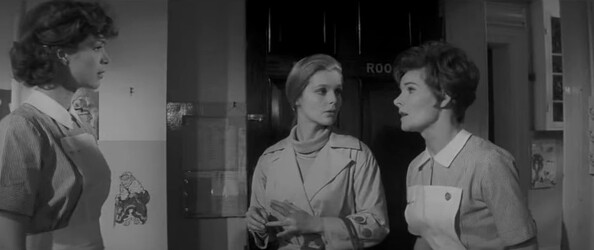
A frantic Ann phones Steven, and he rushes to the school. They ask around all over again, and explore the now mostly empty school. In the process, they even go upstairs, above the rooms given over to the school: and here they find an old lady (Martita Hunt), Mrs Ford. Mrs Ford was one of the founders of the school (along with a now-long-dead friend), and continues to inhabit these rooms, spending her time listening to recorded voices of children, because they are such good inspiration for stories.

The police, summoned by Steven, also arrive, Superintendent Newhouse (Laurence Olivier) in charge. Newhouse asks questions, finds out more about what happened, what is the relationship between these people. He initially assumes (as do most) that Steven and Ann are married, but does not bat an eyelid when he discovers that Ann is actually unmarried, and that she hadn’t even wanted to marry Bunny’s father.
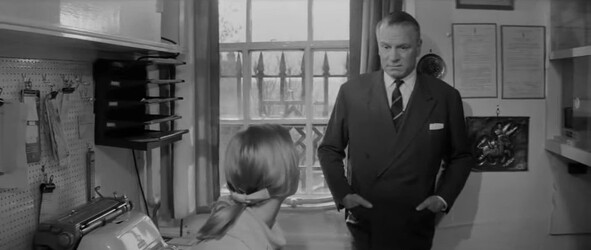
In order to get further along with the investigation, they need a photo of Bunny’s. Steven offers to go home and get Bunny’s passport. Newhouse sends his sergeant, Andrews (Clive Revill) along, and while they’re gone, Newhouse questions some of the people at the school. Miss Smollett (Anna Massey), who runs the school, immediately goes on the defensive: she remembers Ann phoning her to arrange for Bunny to join the school, but she absolutely did not see Bunny. Not this morning, not ever.
And when Newhouse goes upstairs to talk to Mrs Ford, she tells him something very odd indeed: that Steven, talking to her earlier that day while Ann was downstairs, mentioned that when Ann was a little girl, a lonely little girl, she had invented an imaginary playmate for herself. A little girl named Bunny.
There seems to be something wrong here. Newhouse asks Ann, in as matter of fact a way as he can, if anyone, in the few days they have been in England, saw Bunny. Ann flares up at this: is he suggesting Bunny is a figment of her imagination?
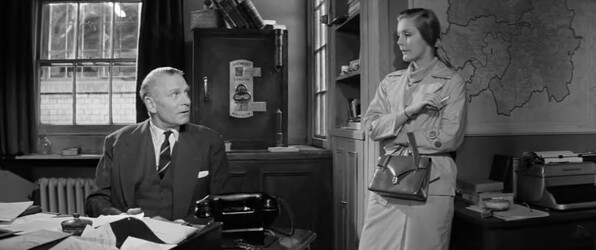
But Newhouse might be on to something. Shortly after, there comes an urgent summons from Sergeant Andrews: come to the Lakes’ new home. Because, when Steven and the sergeant got to the home (where, earlier that morning, we have been shown Ann unpacking and setting out their things), nothing of Bunny’s is to be found.
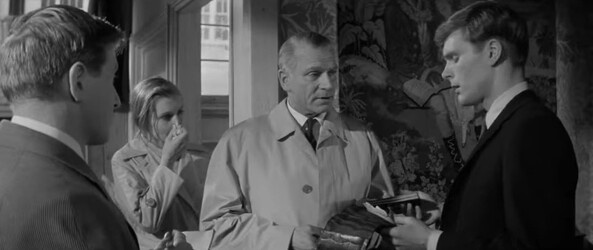
Ann, rushing about, getting increasingly panicky, affirms what her brother has already said. Yes, nothing of Bunny’s—not her clothes, her toys, not even her mug and toothbrush—are around. Someone has taken it all away. Why? Steven, later, tries to use that to reassure his sister: whoever has abducted Bunny would also take her things only if they intended to look after Bunny, to make sure she felt safe and comfortable. They couldn’t mean to harm her if they did that.
But to Newhouse, the missing items (and, of course, the missing passport; that isn’t there either) can mean only one more piece of evidence that Bunny Lake perhaps never existed after all.
What I liked about this film:
The suspense and the mystery of it. Is Bunny Lake really missing, or is she simply the product of her mother’s deeply disturbed mind? Preminger manages to work the story, showing it from Newhouse’s point of view, as well as from Ann’s, to leave the audience wondering, till the climax, what the truth actually is. The way it builds up, the twists and turns that come, heighten the mystery, now lending credence to Newhouse’s suspicion that there really is no Bunny Lake, now seeming to affirm Ann’s assertion that her daughter doesn’t just exist, she is missing.
Then, the acting. Laurence Olivier, whom I’ve seen mostly (not solely) in his early films, is superb as always, but Carol Lynley and Keir Dullea are good too. The last few scenes of the film, the nail-bitingly chilling climax, is when these two especially come into their own.
What I didn’t like:
Noël Coward as Horacio Wilson, a character who got on my nerves and whose presence I just couldn’t fathom. I didn’t have an issue with Coward’s acting; he’s good enough—but in a film that is otherwise fairly taut, what is this utterly useless character doing? Was he supposed to be a red herring, a possible suspect? Or is he there just to leer at Ann and drive her even more around the bend than she already is thanks to her child’s disappearance?
Also, the way the police procedural fizzles out. Till a certain point, Newhouse’s investigation holds centre stage, and I was looking forward to seeing how he would unravel the threads and arrive at the truth. While the shift in perspective near the climax did make sense from the point of view of the denouement, the loose thread of Newhouse’s investigation didn’t sit right with me. I would have liked to see more of him, more of his investigation.
Lastly,
Spoilers follow:
Is there a reason why there’s a suggestion (more?) of an almost-incestuous relationship between Ann and Steven? The way he holds her face and kisses her forehead when he’s trying to comfort her doesn’t come across as brotherly, but a bit more. The scene in the bathroom, too, with Steven in the bathtub and Ann bringing him a cigarette, isn’t quite what I’d have expected between a brother and sister.
I am guessing Steven’s indignation at Ann’s perfidy, so to say, stems from (on his part) a feeling not just of extreme possessiveness but perhaps also with sexual connotations to it. His anger at the ‘boy’ she deserted him for, his anger at the child she prefers over him: all suggest that Steven feels something else for Ann than the mere closeness of a man for his sister.
Which could all have been part of the story, but then, how come Ann (who is no idiot and who seems to be aware of her brother’s psychological problems) seems to go along with it? The bathroom scene, in particular, shows her as being somewhat complicit. Why does she co-operate, if she realizes the danger of it all? Or is Ann unaware, just going with the flow? Does everything actually come as a bolt out of the blue for her?
Spoilers end.
So yes, not completely clear. There are questions, mostly relating to psychology and to knotty relationships, that are hinted at (broadly hinted at), never fully answered. Or even if obliquely answered, eventually leading on to more complex what-if scenarios, why-not questions.
Despite that, though, a gripping and entertaining film. I liked this one, even if it wasn’t perfect.
Ok.ru has a copy of Bunny Lake is Missing, available for viewing here.
 Dustedoff
This one seems very intriguing. Reminds me of Charles, a short story by Shirley Jackson. It’s fascinating how psychology makes things interesting and mysterious.
LikeLiked by 1 person
Yes, it does bear a sort-of resemblance to Charles, but pans out differently. :-)
LikeLiked by 1 person
Thanks Madhu for the review and for peaking my curiosity. I will try to see this film. I am not sure for what reason – seems totally unconnected – while reading the review, I was reminded of Whatever happened to Baby Jane.
LikeLiked by 1 person
….and I need to go back to school to learn English!
LikeLike
I have never seen Whatever Happened to Baby Jane, though I’ve heard about it. Must put it on my list.
Also: very common mistake. At least you know the word (even if your brain mixed up the spellings) – it would be outside of the vocabulary of a lot of Indians.
LikeLike
I’ve never heard of the movie but it sounds very intriguing. I did not read the spoilers. I have to put it on my list. I see that it’s streaming on Tubi. Did you watch it there?
LikeLiked by 1 person
I watched it on ok.ru, Soumya, not on Tubi. Do watch and let me know what you think? I don’t think it’s perfect, but I found it quite intriguing.
LikeLike
I managed to see the movie on Tubi (somehow I’m a little suspicious of ok.ru) and I loved it. It was gripping and the acting was top-notch. The ending was a little drawn out and you’re absolutely right that the investigation was a bit of a let-down. But overall a must watch for people who like psychological thrillers. Thanks for reviewing it.
LikeLiked by 1 person
Thank you, Soumya. I’m glad you enjoyed it!
LikeLike
Haven’t heard of this film, but Otto Preminger’s movies are usually good viewing. Shall look around to see if Criterion has it. Thanks, Madhu – your review really piqued my interest.
LikeLiked by 1 person
Yes, Otto Preminger made some very watchable films. Do try and get hold of this one, Anu – I enjoyed it a good deal.
LikeLike
A nice well-written review.
I now wish I had not read the novel. The movie seems more interesting, t least from your write-up.
I read the book some years ago. I also ended up reading the Afterword which compared the novel and the film. So, I knew about the film and the ending. The ending is different and there is no brother in the book. I remember skipping portions covering the school kids and their mothers.
LikeLiked by 1 person
That’s interesting. I haven’t read the novel, but your comment makes me very curious about it. Was it otherwise good? I mean, even if one doesn’t compare it to the film?
LikeLike
I would be glad to know your thoughts on the book.
Personally, I have a mixed opinion. The book begins well, with a promising start, well-paced. It also makes pertinent comments on the gender and culture based conventions, police skepticism, city life and mainly the challenges faced by a single good looking mother in that period.
The book does keep you glued and keeps you turning pages as one wants to know the end – what happened to the girl and if she really existed.
But as the plot moves ahead, I feel, it becomes incoherent and too dramatic, I would say over-the-top. There are unnecessary side-tracks – an immigrant black family whose son also goes missing, the mothers of the school kids etc.
There is no brother in the story but a mother who also adds her bit to the mystery,
In the book, Newhouse is a psychiatrist, sent by the school head to help out the mother. But he is more interested in her looks and seemingly falls in love with her.
The climax involving Mr. Wilson and the end is disappointing. I believe the movie script made changes for the better.
These are, of course, my views. I am sure, you can provide a clearer insight.
LikeLiked by 1 person
Thank you for that insight. I will admit that it doesn’t sound that great – reading your synopsis of it, it seems like the film was better than the book. But yes, I’m putting the book on my read list. If and when I have the time, I’d like to check it out.
LikeLike