
This is one film I’ve known of for a long time, but have always had conflicting views on whether I wanted to watch it or not. On the one hand, I usually enjoy Westerns (more the escapist adventure kind, I will admit; but also, increasingly, those which go just beyond that). On the other hand, Humphrey Bogart is not one of my favourite actors. Then, again: I knew that this film (unlike another ‘seeking-gold-in-the-West’ film I love, McKenna’s Gold) was more gritty, more real. So Bogart—whom I do acknowledge as a good actor—might have done well in it.
The only way to find out, I guessed, would be to watch it for myself.
The story begins in a small Mexican town, Tampico, where a broke American, Fred Dobbs (Bogart) is wandering about, trying to make ends meet. Dobbs seems to have no set idea in mind of what he wants to do: he doesn’t seem to make any attempts to get a job, and all his energies are directed towards relatively prosperous-looking fellow-Americans who might be able to spare him some money to buy a meal.
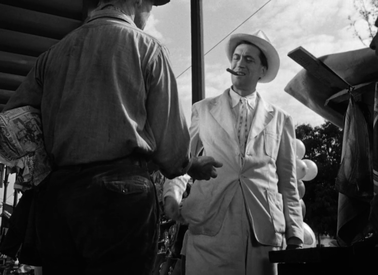
This lands him in a somewhat amusing situation: he picks the same man (the film’s director, John Huston) again and again, to beg a few pesos from. On the street; while having his shoes shined; and then once again. The man, though he’s generous enough (and well-heeled enough) to give Dobbs a coin each time, eventually gets irritated and snaps at Dobbs: How come Dobbs can’t recognize him, how come he keeps asking the same man for money all the time?
Dobbs admits that he hasn’t been looking at the face of the men he’s asked for money. All his attention has been focussed on the coin itself. That money is all-important.
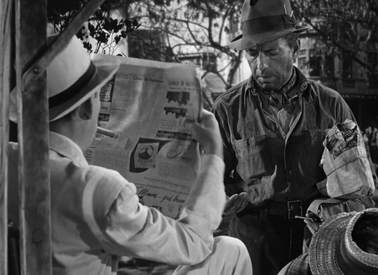
This is only the first, very minor, glimpse we have of what will emerge as Dobbs’s weakness; right now, even Dobbs does not seem to realize how much he craves money, wealth. Gold.
Wandering about town, sleeping on benches and envying local shoeshine boys (they can earn a living this way; he, because he’s a gringo, cannot). This is a conversation he has with a man who, like Dobbs, is a fellow American down and out on his luck. Curtin (Tim Holt) too is broke, and in search of a job.
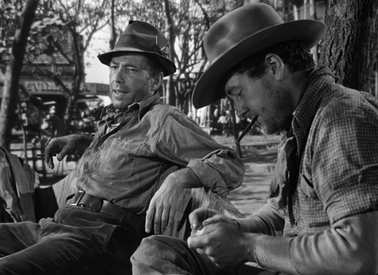
This is why, when the two of them get offered a job by another American, a man named McCormick (Barton MacLane), Dobbs and Curtin jump at the chance. It requires them to travel out of Tampico, as part of a team helping construct oil derricks. It’s gruelling work, and Dobbs and Curtin are only able to push themselves to complete it because they will be paid at the end of it.
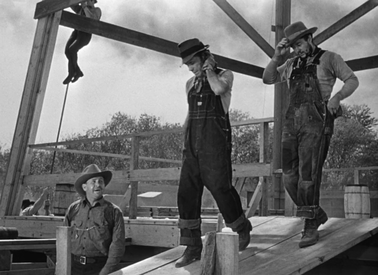
… but when the work ends, McCormick dilly-dallies and finally runs away. Dobbs and Curtin later learn that this is nothing new; he’s done this before, swindling greenhorns into doing work and then not paying for it.
That night, renting a bed at a dormitory, Dobbs and Curtin overhear a conversation: a seasoned old man, very familiar with the land and its ways, is holding forth. Howard (Walter Huston) is talking about gold, and how one might find enough up there in the mountains to set one up for a lifetime. Dobbs and Curtin are curious, but this is a matter of only academic interest to them. They don’t have even the basic capital needed to fund a gold-seeking expedition.
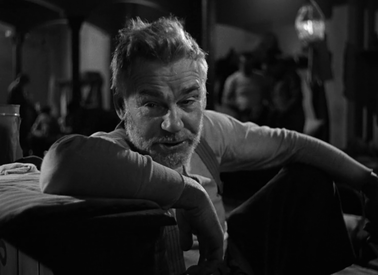
But then, one day, there’s a chance encounter: Curtin and Dobbs see McCormick in the street, and follow him into a cantina. Here they confront him, and McCormick, though he tries to wriggle out of it, cannot stand up to the combined fists and kicks of two desperate men. Dobbs and Curtin knock him out, then take his wallet and extract from it the money due to them.

They return to Howard, and Dobbs proposes that he, Curtin and Howard launch an expedition into the mountains—just the three of them, nobody else—to prospect for gold. Howard is agreeable, but points out that all their money, pooled, will not be enough to buy everything they will need: the burros, the tools, provisions and weapons. Weapons are needed, he explains when Dobbs questions him, because the area is infested with bandits.
Now comes a sign from providence, perhaps, that this expedition is destined: a young boy who sells lottery tickets sees Dobbs and comes excitedly to him. Some days back, wheedled into it by the child (who had convinced him that the ticket couldn’t lose), Dobbs had bought a ticket. It has won. Dobbs, ecstatic, finds that though the money isn’t a startlingly huge sum, it will be that much-needed addition to their funds to allow them to go on that trip in search of gold.
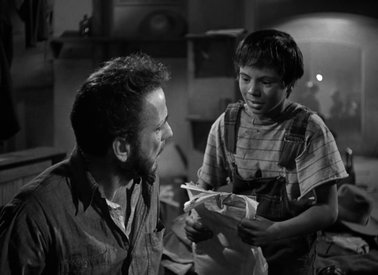
So they head up into the hills, three Americans, all by themselves. And sure enough, they find gold. Within a short time of that first sight of the yellow metal, the dynamics begin to change. Dobbs wants to know how and when they will divide it up: now, or later, right at the end, when they’re headed back? And how long will they stay up here? Till how much gold has been washed up? The greed in his eyes and in his voice is easy to see: he doesn’t care how long he is here in the mountains; all he wants is gold. More gold.
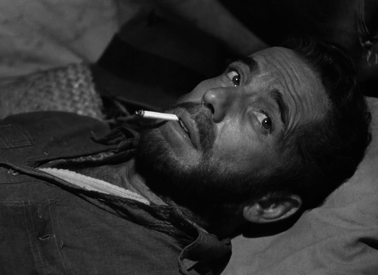
It’s not as if Curtin and Howard are completely immune, either, to the lure of the gold. The three of them share a tent at night, and each has made a cache for himself, buried his share of the gold somewhere secret, outside. One man steps out of the tent at night, and the other two also find some excuse to get up and get out: ostensibly to check on the burros or whatever, but it’s obvious it’s to make certain that his cache is intact. Suspicions run high, and none higher than Dobbs’s.
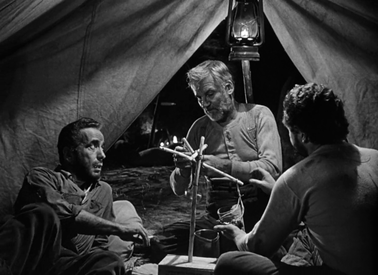
Three men, suspicious of each other (to some extent) and not quite seeing eye to eye: it doesn’t exactly make for a comfortable workplace, which is what their makeshift goldmine becomes over the course of ten months. And when it seems to be coming to the attention of others, the situation can only worsen. For example, when a group of bandits turn up, offering money for the guns Howard & Co. are carrying.
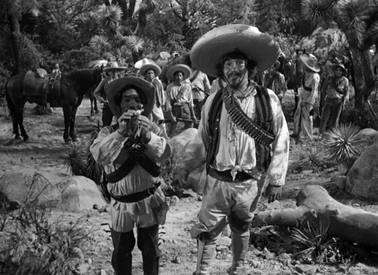
Or when another American, Cody (Bruce Bennett) turns up: he suspects that these three, though they claim to be hunters, are really prospecting for gold. They can either kill him or run him off, he says; in either of which cases they will probably end up attracting even more attention (in the latter case, he will be back with reinforcements). Or they could let him join them.
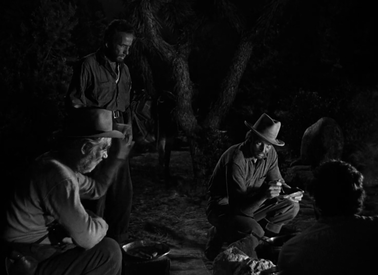
What do this trio do? Not just with Cody, but with the bandits, with the precious gold, with all that the gold is doing to them?
A highly acclaimed film, The Treasure of the Sierra Madre won three Academy Awards: Best Director and Best Screenplay for John Huston, and Best Supporting Actor for his father Walter Huston; in addition, it won many other awards both in America and internationally (Golden Globe and BAFTA Award for Best Picture included).
What I liked about this film:
The comment it makes on how wealth can corrupt. Of course we know that; it’s been the theme of many, many stories across the ages and across cultures—but the way it’s shown here, with the mere prospect of wealth corrupting, is impactful. Huston’s script and direction work subtly to build up this idea. That first glimpse, for instance, of Dobbs begging for money and admitting that he was looking only at the coin, not at the man’s face. At this point, a viewer may not realize the significance of what’s coming; right now, it seems only like a desperately poor man’s need for a little money to fill his stomach. But later, when Dobbs has that gold, all stashed away, to all purposes already a very wealthy man: then you realize that that focus on the money has evolved into a different type of desperation. It is now an obsession, a mania that grips a man, turns him completely oblivious to anything by way of ethics, morals, or even simple humanity.
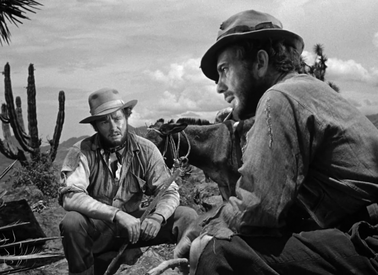
That is balanced, though, with how that same gold affects Curtin and Howard. This isn’t a simple (and what might have been melodramatic) case of diametrically opposite reactions to the same situation. Both Howard and Curtin seem more stable than Dobbs when it comes to their feelings about the gold: less obsessed, less greedy, a trend which one sees right through till the end. However, there are moments when one sees that these two, too, are human. For instance, when part of the mine caves in, there is that uncertainty, briefly glimpsed, in Curtin’s expression, as he finds himself on the horns of a dilemma: should he go in and rescue Dobbs? Or should he leave the man to die there, deep in the mine, so that his gold can be divided up between the two remaining men? Nothing is ever said about this, and the moment is fleeting, but it’s there.
And that ties in to the acting, which is also excellent. Tim Holt, Bogart (oh, yes, he’s good), and of course Walter Huston.
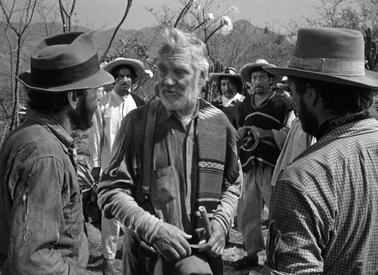
An excellent film, thought-provoking, disturbing. Philosophical, too, in its climax: what, after all, is all this gold we chase after?
Do watch, if you haven’t yet.
 Dustedoff
I must confess to liking Westerns – as books, however, not so much as movies. This is the rare Western I’ve absolutely loved, despite its grim reality. Thanks for bringing back memories – I watched this with my father who loved Westerns, both books and films, and took me to watch so many of them.
LikeLiked by 1 person
I’d forgotten you enjoyed Westerns (as books) too! I remember giving you a bunch of old Sudden novels, I think, which Tarun had pretty much not read in half a century. :-)
And yes, I agree: despite the grim reality, a film I really enjoyed. So good.
LikeLiked by 1 person
A Happy Diwali to you and your family, Madhuji!!
I too like the fun and action-adventure Western movies. But this one is different – thought provoking and more real.
Thanks for a nice review of an excellent movie. It is indeed a must watch.
I saw it just a few years back and immediately added it to my collection.
Just wondering if this is the only instance of a father-son duo winning Oscars for the same film.
And did you read the book on which the film is based on?
LikeLiked by 1 person
Thank you so much for the wishes. and very best wishes of the season to you and your family too!
As for the film – yes, it really is very different from the usual adventure style of Western, but nevertheless superb. I haven’t read the book on which it was based; have you?
By the way, to answer your question about fathers and sons getting/winning Oscar nominations for the same film, I stumbled across this interesting page on Wikipedia:
https://en.wikipedia.org/wiki/List_of_Academy_Award%E2%80%93winning_families
LikeLike
I am not a big western fan, but this sounds good or atleast your review makes me want to see the film.
Kabhi chance mile to….
LikeLiked by 1 person
This is actually one of those movies that don’t quite fit as easily into the genre they’re supposed to represent – it’s superficially a Western, but it could just as logically have been any other setting, any other time, with the story of a man’s lust for wealth taking centrestage. Do look out for it, Harvey. Definitely worth watching.
LikeLike