
YouTube suggested this film to me, and when I looked up a synopsis, it sounded fairly interesting. A man asks a favour of a friend who is ex-MI5: here is a list, of ten men, living in various parts of Great Britain, nothing seemingly to tie them together, no similar occupation, no similar background, nothing. But find them , ask each of them if all is well, whether they’re still living at the addresses given in the list.
The important word here being ‘living’. Because, when the friend—Anthony Gethryn (George C Scott) sets about tracking down the men, it doesn’t take him along to find out that most of the men on the list are already dead, killed in accidents over the past five years. They couldn’t really be accidents, could they?
Very interesting. Rather like And Then There Were None (which, by the way, is referred to more than once in the course of The List of Adrian Messenger). I decided this was a film I had to watch.
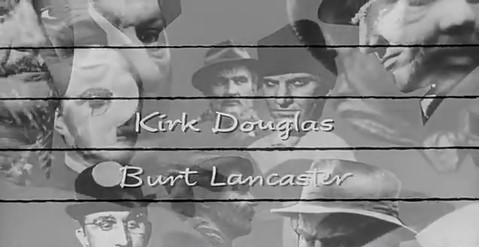
When the credits began to roll, I sat up, because suddenly here were familiar names, one after another. Tony Curtis. Robert Mitchum. Burt Lancaster. Kirk Douglas. Frank Sinatra. Why on earth hadn’t I heard of this film before, I wondered. Tony Curtis, Kirk Douglas and Robert Mitchum, especially, are among my favourites, and even if I haven’t seen all their films, I am mostly at least aware of many of the films they worked in. And one that seemed like such a casting coup? How come I hadn’t known about this?
But, to get down to the film itself, which begins with a murder. A man, his face saggy and jowly, walks down a deserted road in the night and enters a building. He goes to the lift and wedges a heavy book (Baedeker’s Great Britain) in at the bottom, so that the lift can’t close.

This stops the lift being summoned by a man on another floor, long enough for this mysterious man to quickly do some hanky-panky before he removes the book… and the lift, when operated, plummets, killing the man who has just got into it.
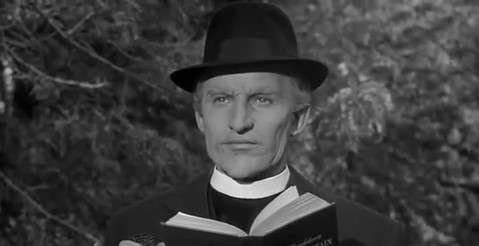
The scene now shifts to a fine country house, Gleneyre, where the local hunt is gathering, horses and riders and hounds milling around. A mysterious stranger, wearing a clergyman’s collar and referring to Baedeker’s Great Britain, watches on from the sidelines, but does not approach. [I would have thought, given the book, that this is the same man, also given that he is behaving in a similarly mysterious fashion as the murderer; but it’s a different man].

The Marquis of Gleneyre (Clive Brook) is the host here, and his grandson Derek (Tony Huston) is as excited about all of this as his grandfather. Derek’s widowed mother Jocelyn (Dana Wynter) seems resigned to it all, and therefore indulgent.

Right now she has company: her cousin Adrian Messenger (John Merivale), who is a writer and heir to Gleneyre, is here, as is their friend Anthony Gethryn. When Adrian and Anthony are alone, Adrian asks his friend for a favour…

Which is where I began this synopsis.
Adrian does ask Gethryn if he will do this work without wanting to know why. Gethryn agrees and sets about doing the work—and discovering, very quickly, that seven men on Adrian’s list are dead.
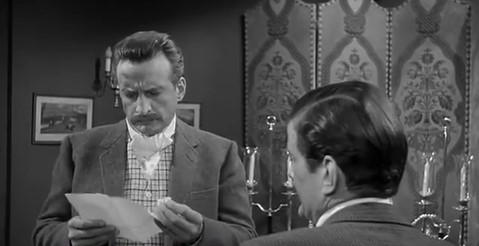

Even before he can get back to Adrian with this disturbing bit of information, something happens. Adrian is travelling, and when he’s checking in at the airline counter at the airport, the man in the queue right behind turns out to have baggage that’s over the weight limit. Adrian, ever friendly, tells the clerk at the counter that the two men are travelling together, so (since Adrian’s bags are well below the limit), that will compensate, is that right? The man is grateful, and Adrian goes off, cheery and nonchalant.
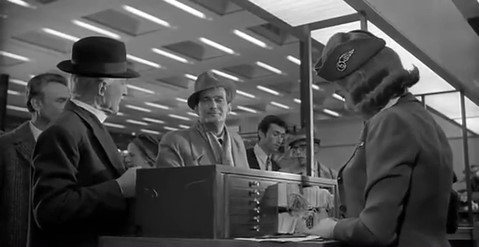
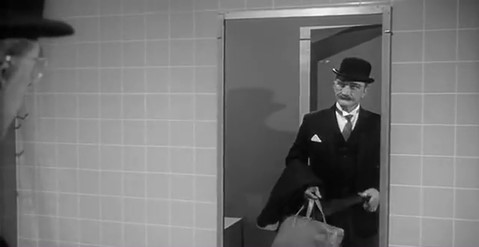
… while the man, having deposited that heavy bag, goes to the men’s and having locked himself in, starts to undergo a transformation. A wig and a mask come off; he is revealed as Kirk Douglas.

A little while later, he emerges from the restroom, looking completely different, and boards a flight other than that for which he had checked in a short while back.
Of course you know what happens. A bomb goes off on the flight in midair (over the sea), and Adrian, fatally wounded, is bobbing about on the water when a fellow passenger helps him grab on to a plank. Adrian is barely conscious, but is so driven by his need to convey something important that he repeats, again and again, a few words to this man before dying.
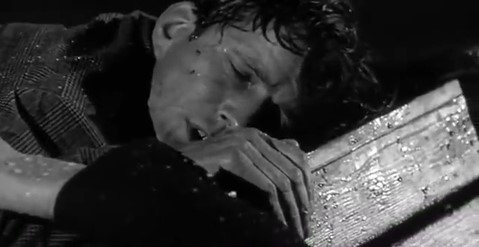
Fortunately for Gethryn, it turns out that the man—the last person to see Adrian Messenger alive—is someone Gethryn actually knows, somewhat. Raoul Le Borg (Jacques Roux) used to work in the French Resistance during World War II and was responsible for countless works of sabotage against the Nazis. He and Gethryn, though they never met, had worked very closely together.
As a result of the plane crash, Le Borg is in hospital with several cracked ribs when Gethryn goes to meet him.

The meeting energizes Le Borg to such an extent that he abandons the hospital (insisting that there’s nothing wrong with either his legs or his head) and decides to help Gethryn crack the case.
The first thing Gethryn does is to get Le Borg to recall precisely what Adrian had said. As luck would have it, Le Borg’s memory is phenomenal, and he is able to do so fairly well. Gethryn writes it all down, and in the course of this exercise, realizes that Adrian was indicating that he had been murdered (in any case, this had been suspected: Le Borg, even before he met Gethryn, had told the police that he had smelled ‘cordite’: a sure sign that the plane had been blown up).
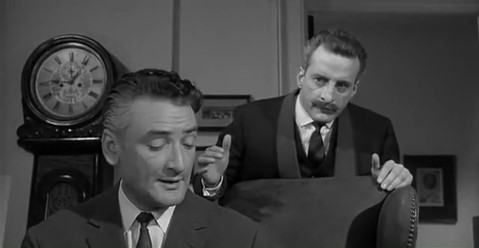
So Adrian too would have been part of the list. So many men, all dead in supposed accidents. But no; no accident. So many men, all murdered. But what did they have in common? Who would have wanted to kill all of these men? And why?
Based on a story by Phillip MacDonald and with a screenplay by Anthony Veiller, The List of Adrian Messenger was directed by John Huston. It draws its inspiration obviously from Agatha Christie’s Ten Little Niggers/And Then There Were None: a bunch of people, seemingly with little (or nothing?) to connect them, but each one being systematically killed off by someone. Here, it’s complicated by the fact that the murderer seems to be in no hurry to finish his work: he’s taking his time, letting years elapse between one killing and the other. What secret lurks beneath the list Adrian Messenger gave Gethryn?
What I liked about this film:
The overall story of it, which is intriguing. Gethryn’s investigation of it makes for a good whodunnit, the deductions often clever, the clues intriguing. The story moves fast, and the way the whodunnit segues into a cat-and-mouse game of trying to perpetrate (or stop) that one last murder is gripping. Because Gethryn and Le Borg know who is behind this, and why, and who his ultimate target is: but they have no evidence, and so nothing with which to stop what seems inevitable.
George C Scott I usually like, and he’s good here as well. As are Kirk Douglas and Robert Mitchum, though…
… what I didn’t like about this film,
Was how John Huston fitted these Hollywood greats into The List of Adrian Messenger. Kirk Douglas reveals himself fairly early on in the film, when he’s shown taking off his disguise to don another disguise at the airport. The others—Tony Curtis, Frank Sinatra and Burt Lancaster in particular (Mitchum has a somewhat longer role)—have cameo roles, mostly without even too many lines to speak. Also, they’re each of them so heavily made up to look completely different that even though I cottoned on to what Huston was doing here and was struggling to identify these actors behind all that make-up, I couldn’t. Not one of them.
Right at the end of the film, after the story itself is over, all these Americans take off their masks and make-up and show who was the man behind the character, but before that, it’s difficult to tell. More so because Paul Frees did the dubbing for most of them.
I was a little miffed by this gimmick. If I’m watching a film where Mitchum or Curtis or Lancaster have top billing, I want to see them. As they are, not so hidden, their voices not theirs, their faces not theirs, that I don’t even know it’s them. Unfair, really, for audience who’re fans.
And some of it doesn’t work even otherwise: for instance, there are places where the culprit (played mostly by Kirk Douglas) is not actually played by Douglas but by another actor (Jan Merlin). Did Huston think it was okay, because hey, who can tell beneath all that make-up? But it’s slipshod, and you can tell, and it’s confusing.
On the whole, an interesting premise for a film, and a story, in fact, that might have worked well if John Huston hadn’t tried this silly (and I bet expensive) stunt.
If you want to watch it anyway, ok.ru has a copy, here.
 Dustedoff
Why haven’t I heard of this film before either? Interesting concept and your review is intriguing as well. Thanks for the link. I’ve bookmarked it.
LikeLiked by 1 person
It’s odd, you know, that such an unusual film isn’t better known. And that too by John Huston! But I guess that gimmicky ‘all-star cast’ might have put off enough people to make the film sink into obscurity.
LikeLike
This sounded so exciting after the first few lines, that I stopped reading it and decided to watch it. Not watch it now though, but in Jan, when I will be back home again.
Thanks for putting me on this movie.
LikeLike
I’m glad you found it interesting, Harvey! I’ll look forward to hearing what you thought of it once you’ve seen it.
LikeLike