
Aka ‘Man of the Soil’ (though in the film itself, the subtitle that appears below the title of the film is ‘Two Brothers’).
This is a first for my blog: an Odia film. I remain on the lookout for old films in regional languages, and I always, too, have at least some cinema-related books to read. Recently, I read an interesting book on the cinema of Mrinal Sen (review here), and—my interest piqued—went searching for some of the films mentioned in the book. To my surprise, I came upon this film, made in Odia (Sen had a penchant for making films in languages other than his native Bangla or Hindi: he even has, to his name, a Telugu film based on Munshi Premchand’s superb short story, Kafan).
Matira Manisha, based on a classic novel by Odia writer Kalindi Charan Panigrahi, is set in a village in Odisha during World War II. The story focuses on the family of an old man named Pradhan (?), who lives with his family here, farming a small piece of land on which—like the rest of their village—they grow paddy.
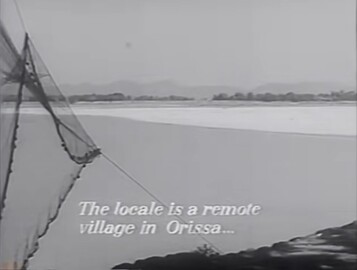
When the film opens, Pradhan is rushing about the countryside, in search: looking here, looking there, and finally finding the person he’s been pursuing: his younger son Chhakari (Prashant Nanda). Chhakari has a habit of slipping away, going off to see the fair, to enjoy himself, to gad about. This time, too, he’s lost track of time, has forgotten home and family in the quest for fun. In his absence, his mother has died; and now, when a distraught Pradhan gives his wayward son the news, Chhakari breaks down. He’s not bad; just thoroughly irresponsible.

Not like his elder brother. Baraju (Sarat Pujari) is like his father: hardworking, dependable, a responsible son of the soil. Baraju is married, has children, and is a worthy successor to Pradhan.
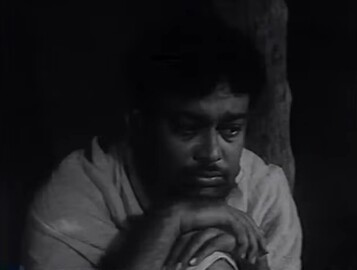
The socio-economic landscape of the village is highlighted in a few scenes.
A quarrel breaks out at the home of a neighbour, and when Pradhan goes to investigate, he discovers that it’s a family argument, over the division of property. Two brothers are at daggers drawn, wanting to divide their land and property between themselves. Pradhan is aghast, and vehement in his pronouncement that such divisions should never occur. The land is all there is; it cannot be, must not be, divided.
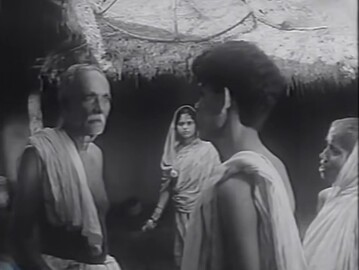
Into the midst of this hubbub comes the village headman, the Brahmin Hari Mishra (Dukhiram Swain). Mishra’s swagger as he makes his way among the lowly peasants and untouchables of the village is unmistakable. He knows his place here, and makes sure that he lets the others know it too. Left, right and centre, all of them are told exactly what they should do, and what not.

Later in the film, there’s a short but succinct scene in which Hari Mishra, chatting with one of the villagers, passes by the hut of another villager named Nitai, who is quite the gardener: the outside of Nitai’s hut is bedecked in creepers and vines. Mishra praises these, and asks for some of the fine gourds growing there. The naïve Nitai says that he has none ready for sale yet, at which a disgusted Mishra turns away and it’s left to his companion to explain: “The master would like that one”.
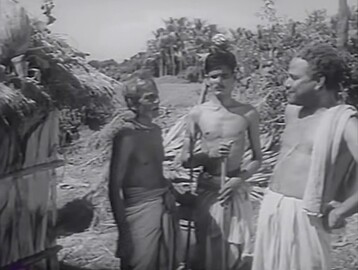
Hari Mishra isn’t just the headman; he is also the local moneylender. And, in the way of the typical moneylender, he is usurious, greedy, brutal in the way he wrenches money out of the poor peasants who come to him for loans.
Shortly afterward, Pradhan dies (and almost with his dying breath, adjourns Baraju to not divide the property, to live amicably with his younger brother and look after Chhakari). Pradhan is mourned sincerely and deeply by his family and neighbours, and then, swiftly, life goes back to the regular, humdrum routine of everyday existence. Baraju works in the fields; Chhakari spends most of his time gallivanting about, doing this and that and basically behaving like a carefree child, unburdened by the worries and responsibilities of youth.
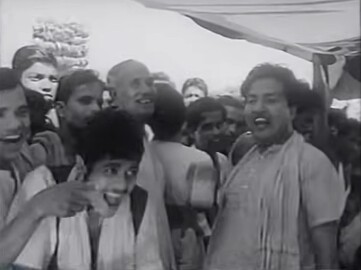
His sister-in-law, Harabou (Bhanumati Devi), when chatting with neighbours who suggest she get Chhakari married, says that she would feel sorry for the girl who would end up marrying such a good-for-nothing.
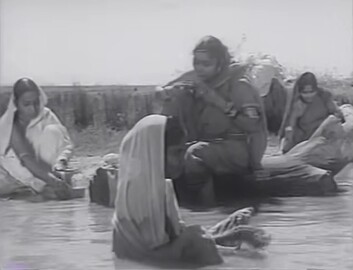
… but Chhakari does end up getting married anyway, to the lovely Netramani (Sujata Anand). If Harabou and Baraju thought marriage would result in sobering up Chhakari and making him realize his responsibilities, they are sadly mistaken. Netramani (or, as Chhakari affectionately calls her, ‘Netro’) is as immature and flighty as her bridegroom, and from very early on in their marriage, it’s obvious that Chhakari has indeed found his soulmate.

She happily obliges when he insists she dance while he sets the rhythm with his vocals. She throws a minor tantrum when confiding in him after Harabou has ticked Chhakari off for buying expensive anklets for Netro—and she happily goes along to the fair when Chhakari, to mollify her, holds out this attraction as reparation for Harabou’s perceived harshness.
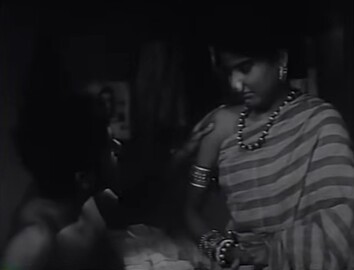
Shortly after the village is entranced by the sight of an aeroplane flying overhead, Chhakari dreams that he, too, is riding an aeroplane. Such an exciting dream, and Chhakari, on waking, is all charged up: if only he could really sit in an aeroplane, and go far! To Kolkata, to ride the tram and go to the Kali Bari, and the cinema! What fun!
He decides someday he will. With his beautiful Netro by his side.
But how is that ever going to happen? Chhakari is nothing but a poor farmer, in a land that is ruled by the nexus of the corrupt moneylender and an oppressive colonial government.
I have to admit I had never heard of Matira Manisha before I read The Cinema of Mrinal Sen: A Quest for the Unresolved. The copy uploaded on YouTube (by Kunal Sen, Mrinal Sen’s son) is a poor print, recorded from television, with hard-coded subtitles that become at times hard to read. I persevered, though, and am glad I did: this was a film worth watching.
What I liked about this film:
Matira Manisha is not so much a story as an insight into several overlapping themes. Poverty, exploitation (on various levels; Hari Mishra’s exploitation of the poor peasants on the one hand; the colonial government’s rather less obvious exploitation of India on the other). Ambition versus reality. Individual versus community/family. The entire idea of what it means to be grown-up: to take responsibility, to make sacrifices, to put away childish dreams… a sobering thought, but so real. The characters are well-etched, their dynamics and relationships mostly coming through only in an oblique way, not always through dialogue (or even when spoken, the audience is expected, at times, to read between the lines).
Even as I was watching it, I found myself unconsciously comparing Matira Manisha to Satyajit Ray’s Pather Panchali. Not in the themes and story, but in the style. Sen’s depiction of the village has that same easy, unaffected style that Ray has. It’s like the director has managed to, camera and all, blend into the backdrop while the village goes about its life. The cleaning, threshing, harvesting; the exuberance at the fair; the excitement when the aeroplane passes overhead… all of it is done so realistically that it becomes hard to believe this is all acting.
(Of course, here I must acknowledge that the actors are good. All of them, including those playing bit parts).
It’s hardly a story; more an exploration of character, of the times, the stresses, the push-and-pull that is exerted on people, especially those who are poor and downtrodden. What happens is so subtly indicated that it doesn’t seem scripted; an organic unfolding of events.
Lastly, there are the touches of humour. Very light, very subtle. For instance, in Chhakari’s dream, the aeroplane. This is the dream of a villager who has only ever seen a plane from such a distance, he has no idea what it might look like close up. But common sense suggests that since it can fly, it must resemble a bird—so a bird it is, a giant bird, rather mad-looking.

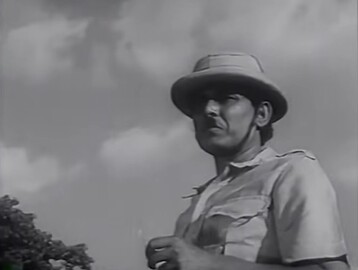
Also, when the British Indian government’s agent for purchase of foodgrain arrives in the village, he gives them a spiel about how the Brits are fighting the Nazis. Led by their ‘king’ Adolf Hitler, who is such a villain, etc etc… and the agent has an obviously Hitleresque moustache and spectacles, too, which resemble the Fuhrer’s glasses.
What I didn’t like:
I’m putting this down here, just for the record, though I’m not sure whether this is a problem with the film itself or with editing that might have been done before it was telecast (such a shame, really, that so many of the old films we see today might have been mindlessly chopped before being aired).
The somewhat ‘out of the blue’ nature of some of the events here. For instance, we are not shown how and why Pradhan ends up on his deathbed. Yes, he’s an old man; but he also seems to be a fairly agile and active old man—he rushes about the countryside searching for Chhakari, for example; and he admonishes his neighbours for wanting to divide their property. Yet, in the next scene, he’s breathing his last. What happened? How? (Yes, I know it’s not really vital, but still).
Then, there are also occasional references by Hari Mishra to some committee which Baraju apparently headed (and formed?) which (it seems) in some way opposed Hari Mishra and has therefore made him very annoyed with Baraju. What this was, what its purpose was, and why it has embittered Mishra so, is never explained. Here, at least, I would have liked some more detail.
But, despite all that, a fine film, a good example of Sen’s early work. Vidyarthy Chatterjee, reviewing the film for The Cinema of Mrinal Sen, writes: “It was a different Sen from the one viewers came to know some years later, full of a worked-up rage… In Matira Manisha, it was a quiet, almost lyrical humanist at work, strong without being self-conscious or strident in his resolve to understand changing times and evolving creatures; refusing to sit in judgement or come up with easy solutions…”
Matira Manisha can be viewed, with hard-coded English subtitles, here.


Dear Madhu,
This is not really a comment on your review of “Matira Manisha” (Odia,1966) an early film by Mrinal Sen, so you’d be right in wondering why I am posting now! By a happy coincidence, I arrived at “your review” of “The Cinema of Mrinal Sen- A Quest for the Uresolved /20 Critical Essays” Edited by Amitava Nag and Antara Nanda Mondal. And, of course, liked it.
I happened to come upon the review either as a blogpost (?) or on word.press.com, I forgot which one.. (Am NOT on FB, Instagram, X (formerly known as Twitter….etc. etc… out of choice, may I add…!).
I have requested my younger daughter Sasha, to place an order for the book, and expect to get in a couple of days.
There is one query that I do have, and I think I did write to Amitava Nag about it, a while ago, when he had sent me an Email about the book being put together…
In the context of what this book comprising of 20 critical essays on Mrinal Sen, has achieved, the query might appear a little strange…but here goes..
The cover of the book features a B/W working still from the filming of “Ek Din Prati Din”(1979), one of the films comprising “The Absence Trilogy” — photographed by K K Mahajan.
All good, except for the fact that the photo as it appears is “a truncated one”. And, I did wonder, why this happened to be the case here…
I know, this does seems an odd comment on my part…and not to take away anything from the book, and your review!
I will try to send you the “working still “. Perhaps as a separate post, here…if it helps..
Or, Madhu, if you could send me your Email Id…
To me at my HOTMAIL Id:
prabamahajan@hotmail.com
I will send the actual “working still” from the film to you.
Once, again, thanks for all that you do!
Praba Mahajan
LikeLiked by 1 person
Here is the LINK to the official site for Mrinal Sen /and his films, put together by Kunal and Nisha Sen. (…specifically to the film “Ek Din Prati Din” (1979) and the stills from the film.
https://www.mrinalsen.org/ek_din_pratidin.html
Do hope you are able to access it here…
You’d need to “scroll down” on the stills from this film,
till you arrive at the one that has the caption —
“Shooting in his neighbourhood pharmacy (Amrita)
with Mrinal Sen and K K Mahajan
And, now waiting to read this book!
And, thanks, again, for your review!
LikeLiked by 1 person
Hi Madhu,
It looks like I have erred by my posts which had no reference to the film reviewed -“Matira Manisha”. I have not repeat not recd ANY comment / responses in my Inbox. ( I thought that it had something to do the settings on my ‘phone…but even on my laptop…the silence is deafening)
Madhu, a request: to ensure that I receive the responses as they are posted.
Fingers crossed!
Praba Mahajan
LikeLiked by 1 person
Hi Praba,
Thank you for your comments and the link to that very interesting still. No, you didn’t err at all – it was just that I was travelling over the past several days and since I access my blog only through my laptop (which I didn’t carry with me) I have only seen your comments now that I’ve returned. Please don’t imagine that I was rebuffing you – not at all!
I really liked that still (and your husband looks so handsome – were you already married by then?). I guess the publishers snipped out part of that photo to keep the emphasis on Mrinal Sen.
LikeLike
Madhu,
I am an admirer of Mrinal Sen’s films. His Calcutta Trilogy stands as tall as Ray’s. But his foray into Odia films? Though linguistically close, Odia suffers from image problem. Some regional film makers have got international acclaim, I don’t recall anyone having that stature in Odia. Plus poor print deters me. But I have to thank you for the nice review and making me more aware.
AK
LikeLiked by 1 person
Yes, I don’t think I’ve heard of any Odia film-makers either (though I will admit it’s not as if I’ve ever made any effort to explore that region when it comes to cinema). A pity, because Odisha has been quite a powerhouse of culture in other fields – in architecture, for instance, or literature, textiles, handicrafts, and food.
The print isn’t all that bad, it’s just that the subtitles are hard to read now and then. To me, at least, that didn’t make too much of a difference to my appreciation of the film.
LikeLike