
In the past couple of years, I’ve read two books by Manek Premchand—Director’s Chair, and his biography of Majrooh Sultanpuri—so when he offered to send me a copy of his latest book, And the Music Lives On, I leaped at the opportunity to read yet another Premchand.
The cover of this book gives a fair indication of what And the Music Lives On is all about: those stills from Mughal-e-Azam, Awara, Guide, Madhumati, Memsahib and Dilli ka Thug are a clear pointer to the films and the era Premchand writes about here, an era in Hindi cinema’s history that may be long past, but whose music lives on.

In his introduction to the book, the author gives his rationale for choosing what he regards as the golden age of Hindi film music: from 1943 to 1973. The songs during this period, the films and the people who worked in them through these three decades, are the focus of this book.
However, unlike Director’s Chair or Majrooh Sultanpuri: The Poet for All Reasons, And the Music Lives On is not a composite book, each chapter leading logically into the next. This, in fact, is actually a collection of essays written by Premchand, most (all?) of which appeared in DNA Jaipur over a period of several years. Premchand has updated, enhanced and collated these essays into this book.
This backstory to the provenance of the essays explains several features which marks almost each of the essays:
1. They’re fairly short essays, no more than 4-5 pages long: article length, not the usual book chapter length.
2. They begin (quite often) with something topical, and that not necessarily connected with the film world. It’s the time-worn journalistic idea of using a hook to grab the reader’s attention: a news article about Narendra Modi having tea with Queen Elizabeth leads to a discussion of Hindi film songs about chai; the news of a Pakistani qawwal being murdered leads to (of course!) an essay on great cinematic qawwalis; the US-based digital magazine The Pudding’s study on male dominance in Hollywood is carried forward into a similar study of Hindi cinema through the 40s to 70s; and so on. Other essays begin with (often) something related to everyday life, helping lay readers ease into the realm of cinema.
3. These are articles geared to appeal to a somewhat wider audience than (say) Premchand’s works on Majrooh or Hindi cinema’s great directors: ‘cinema lite’, so to say. While this does not mean that he dumbs down his writing, there seems to be a marked attempt to help readers who may not be especially clued into 40s-70s Hindi cinema to appreciate it.
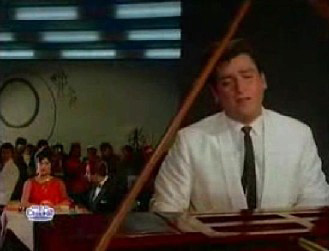
The bulk of the essays in this book centre round song lists (which, if you know my blog, is a topic of great interest to me!) Songs ‘sung’ by people rowing boats; sad songs; party songs; songs sung in a state of inebriation; songs about mothers, songs sung by children onscreen. Jeep songs, coloured songs in black-and-white films, songs where the singer plays a piano in a restaurant… there are many, many song lists here, covering a wide variety of themes and styles.
There are fewer articles, but to me more informative, about specific people in Hindi cinema. Not the more well-known figures, the ones about whom reams have been written by both authoritative writers as well as fans. For instance, there are the three sitarists Abdul Halim Jaffer Khan, Rais Khan, and Jairam Acharya; there is Bindu; Ameen Sayani, Daan Singh, and Shyam—all people who deserve more recognition than they get.
There are, in a similar vein of shining the spotlight on the oft-ignored, articles about other aspects of film-making. Two especially interesting ones are on Famous Studios, and on doo-wop, the latter explained with some good examples from Hindi film music.
The writing is chatty, friendly, easy to read, and the book is a fun, light one that I breezed through in less than a week: quite a feat, given that it’s over 400 pages long.
Yes, I will admit that for someone like me, who breathes song lists, there was (in that aspect of the book) not very much new to learn, but it was fun to see which songs Premchand included in so-and-so list, which I didn’t, or vice-versa. And there were plenty of articles, not specifically song lists, that offered something new, something I hadn’t known before.
If you enjoy the music and the films from the golden age of Hindi cinema, give this book a try: I found it quite enjoyable. Not as weighty or information-dense as the other books of Premchand’s I’ve mentioned in the introduction to this post, but well worth your time.
 Dustedoff
Thanks for your review! I’m glad you liked some aspects of this compendium. As you have said, I have taken subjects that may not seem to have anything to do with music as such, but these subjects have ended up being connected with the story. I thought of taking this route because there’s so much more to life than just music, right? For example, like most people, I didn’t have the foggiest idea of Sentinel Islands. Of its inhabitants. That they’re Indian, insulated, and dangerous to intruders.
LikeLiked by 1 person
I’m glad you liked some aspects of this compendium
That’s not quite right. I actually liked pretty much all aspects of it! It’s just a very different book from the earlier ones from you that I’ve read, but ‘different’ in this sense does not mean ‘not as good’. I thought it was a very good, light read – just what I wanted to read right now, since I’ve just finished reading an 800 page book. :-)
LikeLike
Jee jee, I should have worded my point better _()_ On a separate note, you’re quite something. Writing a valuable blog, writing books, and reading an 800 page book. Extraordinary :)
LikeLiked by 1 person
:-) I read to relax, so that is how the 400-page book is no problem! And this was an easy read.
BTW, can you please provide a link where people can buy it? Someone else has commented saying they couldn’t find it on Amazon and would like to buy. Thank you.
LikeLiked by 1 person
https://amzn.in/d/ebkUC6k That’s the link :)
LikeLiked by 1 person
thank you!
LikeLiked by 1 person
Very interesting topic, Madhulika. I was trying to see if I could order a copy of the book on Amazon, but could not find it. Please share a link if you can.
Regards,
Uday
LikeLiked by 1 person
I’ve asked Manek to let us know where it can be bought. Will share that with you once he does. I hope you will enjoy it!
LikeLiked by 1 person
Interesting coincidence here, Madhu, seeing that I’ve a book review (scheduled long ago) on my blog as well! :)
I do have Mr Premchand’s Director’s Chair with me – have had it since last September in fact – but I still haven’t completed it. You know why. And now this one… your review makes me want to read it, and soon. But… we will see.
LikeLiked by 1 person
Yes, Anu – such a coincidence that both of us should have posted a book review, simultaneously! I really liked your review – such a balanced, interesting one. But having just read this 400-pager (on the heels of an 800-page: 100 Indian Stories), I don’t think I’m ready for a 500+ page book for a while!
LikeLiked by 1 person
Soul sisters, after all. :) Thank you for the appreciation, Madhu. It’s a balancing act, especially if you kinda sorta know the author.
LikeLiked by 1 person
It’s a balancing act, especially if you kinda sorta know the author.
Very true! Tightrope walk. ;-)
LikeLike
Madhu,
Thanks a lot for a nice review. Your comment, “there seems to be a marked attempt to help readers who may not be especially clued into 40s-70s Hindi cinema to appreciate it“, is very perceptive and sums up the tenor of the book. Having said that, the book is quite enjoyable.
AK
LikeLiked by 1 person
Yes, it’s an enjoyable book, AK. I remember that you had reviewed it too, but I had deliberately not read your review to avoid inadvertently getting influenced. :-)
LikeLiked by 1 person
AK I’m grateful _()_ To people like you, Madhulika, Ms Warrier, and the few who are mad about cinema and music. You all are doing it selflessly, so clearly enjoying your journey…
LikeLiked by 1 person
‘Anu’, or ‘Anuradha’, please, Mr Premchand. : )
LikeLiked by 1 person
Anu, done :)
LikeLike
My favourite subject and music – era !
Shall certainly read the book.
LikeLiked by 1 person
Grateful _()_ :)
LikeLike
Do! I think you will enjoy it.
LikeLike
Madhu ji,
I have read his book Manek ji’s book – Yesterday’s Melodies Today’s Memories. Even this was a collection of short write ups on various film personalities, highlighting their seminal works/songs.
I should try to get a copy of this one sometime.
Anita
LikeLiked by 1 person
I haven’t read Yesterday’s Melodies Today’s Memories, but what I’ve read of Premchand’s work so far has been very readable and interesting. Would certainly recommend this one too.
LikeLike