Shahu Modak, Manhar Desai, and Secularism in Old Hindi Cinema

Some time back, I was standing at the gate of our housing society, waiting for my daughter’s school bus to arrive. A neighbour, the mother of one of my daughter’s classmates, began complaining about the poor standard (according to her) of teaching in the school, which is Christian mission-run. Her contention was that teachers who aren’t qualified, or don’t really excel, are allowed to stay on in the school simply because they’re Christian. “You see them in the school photos,” she said. “All converts, you can see by their faces.”

I pointed out gently that most Christians in India (or actually, across the world) have been converted, at some time or the other, either in their own lifetimes or through their ancestors.

“No, no, that’s not what I mean,” she said. “I mean people who have been given incentives by missionaries to convert. I have lived in South India, I have seen a lot of this.” She must have seen the look on my face, and she hurried to clarify. “You can tell they’re converts, because of their mixed names.”

“I have a mixed name,” I said. Madhulika Liddle.

And then, I think, the penny dropped. So far, she had forgotten, perhaps, that I am Christian.

She blustered. “Of course, of course. But not you. I mean people who look perfectly normal but are Christian.”

“Normal? So Christians are not normal?”

By which time the school bus had arrived and I think both of us were relieved to have an end to what had become an awkward conversation.

Continue reading

Amardeep (1958)

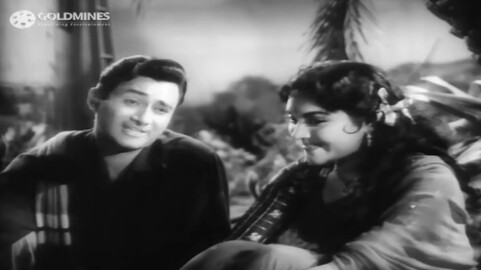
Given that I am a fan of mid-1950s-early 1960s Dev Anand, and that this film also stars Vyjyanthimala (whom I like a lot), it should come as no surprise that I’ve had this film bookmarked for several years now. Somehow it kept getting ignored, until some weeks back, when I discovered that Amardeep was a remake of the 1956 Tamil film Amara Deepam (starring Shivaji Ganesan, Savitri, and Padmini). And that Amara Deepam was based on Random Harvest.

Continue reading

Aarzoo (1965)

A couple of months back, my sister Swapna was invited to head a quiz team at a pub quiz (Jai Arjun Singh, who was also there, wrote about it here). Telling me about the quiz later, Swapna mentioned that there was one question that even Jai didn’t know. In Aarzoo, which place in Delhi does Rajendra Kumar’s character say he belongs to?

Nobody could answer that question. But the answer is Okhla Village.

… which sort of struck a chord with me, because till we shifted from Delhi to Noida, my husband and I had spent many years living very close to Okhla. And Noida, in case you weren’t aware of this, is actually an acronym for New Okhla Industrial Development Authority. Okhla follows us around. Or we refuse to really move away from Okhla.

This incident reminded me, though, that I have never reviewed Aarzoo on this blog, though I’ve watched the film at least twice. Time to amend that, I decided.

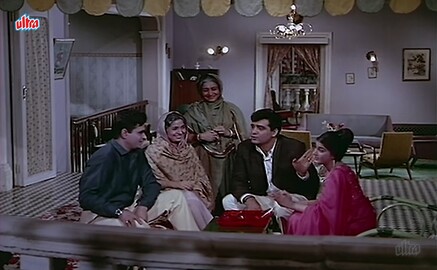
Newly-minted medical graduate Gopal (Rajendra Kumar) and his neighbour Ramesh (Feroze Khan) have been best friends since their childhood. Gopal’s younger sister Sarla (Nazima) and his widowed mother (Achla Sachdev) regard Ramesh pretty much the same as Gopal: a member of the family, a brother/son just as Gopal is.

Continue reading

Raahi (1952)

This was a film I watched by way of tribute to Nalini Jaywant earlier this year. I had initially not planned to review it, but there were several points about Raahi that I found unusual enough to make me decide it needed to be documented.

I first heard about Raahi on Anitaji’s blog, where she mentioned that it was based on Mulk Raj Anand’s novel Two Leaves and a Bud—which is where one of the songs of the film, Ek kali aur do pattiyaan, draws its inspiration. Anitaji had included this song in a list of songs picturized in tea gardens, and it intrigued me. The story, set in a tea garden where friction between the workers and a heartless, predictably colonial (money-minded, racist, contemptuous) management causes problems, sounded like something that might merit watching.

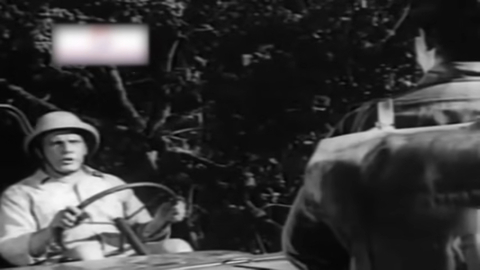
Raahi begins on a country road in Assam in 1945. A Britisher (S Michael) going by in a jeep loses his temper at Ramesh (Dev Anand), who’s walking in the middle of the road.

Continue reading

Aaya Saawan Jhoomke (1969)

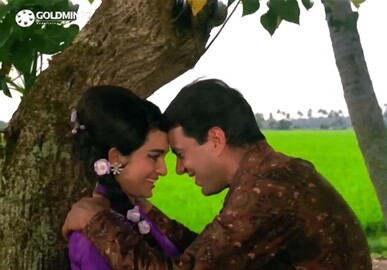
When Dharmendra passed away some months back, it reminded me that while I have seen a good bit of his filmography from the 1960s—including little-known, forgettable films like Begaana, Main Bhi Ladki Hoon, Chandan ka Palna and Jab Yaad Kisiki Aati Hai—I haven’t reviewed too many of his films. Some, yes; but plenty, even much-loved films or well-known ones, have somehow slipped under the radar. Time to correct that, I decided.

And why not with this film (directed by Raghunath Jhalani), which I had last seen perhaps a little over 20 years ago, and which I remembered vaguely. Nirupa Roy, having (once again) misplaced a child. Aruna Irani on the verge of becoming an unwed mother if some good Samaritan doesn’t come to her rescue. Asha Parekh, lower lip quivering and eyes swimming with tears. Some very well-known songs.

Continue reading

Amar Jyoti (1936)

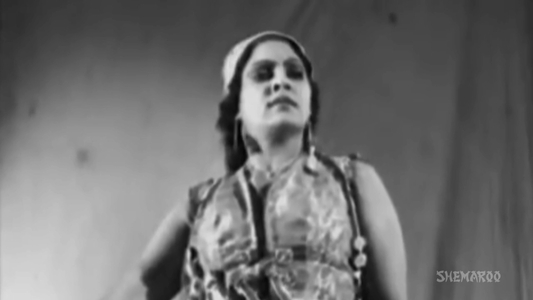
This is a film I first heard about many years ago, when Memsaab reviewed it on her blog. It’s been in the back of my mind to watch it sometime, but it kept getting put on the back burner. Then, some months back, when I was watching Baaz (1953) as part of my tribute on Guru Dutt’s 100th birth anniversary, I was reminded of Amar Jyoti. If Geeta Bali’s woman pirate in Baaz seemed a surprisingly progressive character for 1953, Durga Khote’s pirate queen Saudamini, playing the lead in V Shantaram’s Amar Jyoti in 1936, was even more progressive.

Continue reading

Shiraz (1928)

This is a film that’s been on my radar for a long time—in fact, from when I first read about it on Memsaab’s wonderful but now sadly defunct blog. As those who have read my Muzaffar Jang books might know, I find certain sections of Mughal history (especially around the reigns of Akbar, Jahangir and Shahjahan) fascinating. So rich, so interesting, a period of such efflorescence, in different ways. Spirituality; art; architecture; beauty in myriad forms. Among the greatest examples of the Mughal contributions to culture is the exquisitely beautiful Taj Mahal, ‘a teardrop on the cheek of time’, as Rabindranath Tagore put it.

The Taj has been the subject of numerous films over the year (the latest one seems to be controversial enough to have run into trouble). Arguably the most famous film on the subject is the 1963 version, starring Beena Rai and Pradeep Kumar and directed by M Sadiq; there have been more recent ones, including a 2005 one named Taj Mahal: An Eternal Love Story, supposedly the most expensive Hindi film of its time.  

Long before all of these was this silent film, directed by the Bavarian film-maker Franz Osten and produced by Himanshu Rai (who also played the titular role in the film). Himanshu Rai’s interest in cinema had led him to visit Germany, where he had spent some time with the Emelka film production company, exploring ways of getting German collaboration to produce an Indian film. When Rai returned to India, he brought with him one of Emelka’s best directors, Osten, as well as several of their top technicians. Osten went on to direct 16 films in India over the years, of which the second was this one, a story about how the Taj came to be built.

Continue reading

Kashmir ki Kali: The Shakti Samanta-OP Nayyar blockbuster

This is an important week in the history of Hindi cinema, because it marks the birth centenary of two of the industry’s most popular entertainers. Director Shakti Samanta was born on 13th January, 1926 in Bardhaman (Bengal), and three days later, on 16th January, across the country, OP Nayyar was born in Lahore. These two very different men were to come together in 1958 in the Ashok Kumar-Madhubala suspense thriller Howrah Bridge, and the magic they created between them in this tale of crime, deceit and romance set in Calcutta marked a milestone for both Samanta and Nayyar.

Continue reading

Book Review: Anirudha Bhattacharjee and Parthiv Dhar’s ‘Kishore Kumar: The Ultimate Biography’

Anirudha Bhattacharjee—who has gifted me quite a few of his books on Hindi cinema in the past—sent me this book last year. I accepted his offer of the book for two reasons. For one, there isn’t a book by Anirudha that I have not enjoyed. For another, I really like Kishore Kumar the singer.

Note that disclaimer: the singer. When it comes to Kishore the actor, I’m not so sure. While I find him quite enjoyable in films like Pyaar Kiye Jaa and Chalti Ka Naam Gaadi, his over-the-top antics in films like Half Ticket and Naughty Boy make me grit my teeth, they’re so unfunny.

Given Anirudha’s obvious expertise (and interest) in film music, I’d guessed the focus of this book would be Kishore’s music, with perhaps some attention also being given to his acting and directing.

Continue reading

On Salil’s Music for Madhumati

Last week, a little late in the day, I posted a list of my favourite Salil Chowdhury’s Hindi film songs. A ‘little late’ because the music director’s 100th birth anniversary had been on November 19. I had hoped to be on time for this one, because Salil is a favourite of mine.

Anyhow. Though I was late to the party, at least I managed to post that list. And now, here’s another post I wrote, also on Salil Chowdhury. For Learning and Creativity’s Silhouette Magazine, an article on Madhumati (1958). Madhumati is a film I’ve reviewed earlier, on my blog, but this time I look at the film primarily through the lens of the music Salil composed for it. It was a score that brought him the Filmfare Award for Best Music Director (the film itself won a whopping nine awards, a feat unparalleled until Dilwaale Dulhaniya Le Jaayenge, 37 years later). And while Madhumati is a good film, I think Salil’s music for it plays a huge part in the film’s success, and its ability to hold its own even now, close to 70 years after it was made.

Click here to read the entire article.