
Two young men in Victorian England, eager to propose to their respective girlfriends, fix up a lunch date with the ladies, expecting that the aunt of one of the young men will oblige as a chaperone for the girls. However, the aunt, who has just arrived in England from Brazil, is called away elsewhere and sends a wire pleading her inability to come. Desperate, the young men seek a substitute as chaperone—and pick a friend of theirs, who then ends up spending the day juggling costumes, personas, and more.
That is the gist of Charley’s Aunt, a three-act play written by Brandon Thomas and first performed onstage in 1892. It’s a play I’d heard about often enough, but only got around to reading a couple of years back—and once I’d read it, I wanted to watch at least one cinematic adaptation of it (and yes, there are plenty of adaptations, including silent films as well as films in various languages, ranging from English to German to Arabic, the last-named in a couple of Egyptian versions of the film). Luckily enough, the best-known English adaptation of Charley’s Aunt, starring American comic actor Jack Benny in the lead role, is available even on YouTube (here).
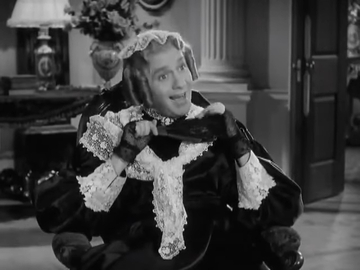
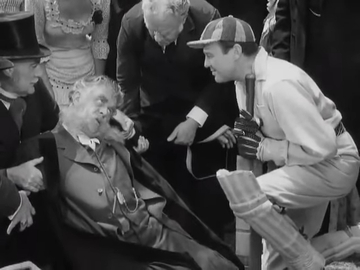
The story begins on a cricket pitch in Oxford, in 1890. Lord Fancourt Babberley ‘Babbs’ (Jack Benny) is at the crease, and in the course of a few minutes, manages—through sheer ham-handedness, combined with bad luck—to whack one of his professors, Mr Redcliffe (Reginald Owen) in the face. Mr Redcliffe is furious, and Babbs has a narrow escape: tea is announced.
But during the tea break, a prankster friend of Babbs’s trips him up, and Babbs goes sprawling—falling all over Mr Redcliffe, who is now certain Babbs is either off his rocker or out to get him, Redcliffe.
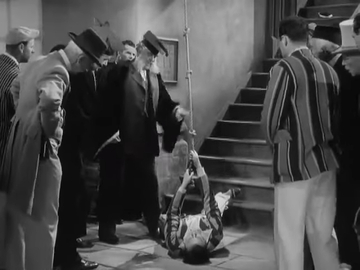
As if that wasn’t enough, shortly after, Babbs gets into yet another scrape. Chasing the aforementioned prankster in order to give him what for, Babbs accidentally ends up pulling the rope of the fire bell, raising the alarm and sending everyone into a tizzy (Redcliffe included). When Redcliffe discovers that it’s a false alarm and that Babbs is (again!) responsible, he is furious. He tells Babbs to meet him the next morning. It’s clear that Babbs is in deep trouble.
Meanwhile, though, other plans are afoot.
Babbs’s dearest friends in college are two young men, Charley Wyckham (Richard Haydn) and Jack Chesney (James Ellison). Jack and Charley are a good deal younger than Babbs, which is because Babbs has been failing these past ten years. Nevertheless, they’re great friends, and right now Jack and Charley are confiding in Babbs, telling him about the problems in their respective love lives.
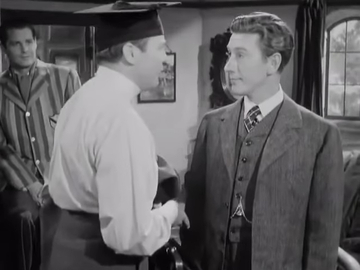
Jack is in love with Kitty (Arleen Whelan) while Charley is in love with Kitty’s friend Amy (Anne Baxter, in one of her earliest roles). Kitty and Amy have a common guardian, Amy’s uncle Mr Spettigue (Edmund Gwenn). Mr Spettigue is a right old ‘pill’, as PG Wodehouse would describe this type: suspicious, cantankerous—and intent on not letting the girls get married, because that would bring his guardianship (a paid one) to an end. He’s too greedy to let the girls’ happiness come in the way.
As much as Mr Spettigue is a thorn in their side, there’s another obstacle: the fact that these are well-brought-up young ladies, who refuse to be alone even with the men they are obviously interested in. A chaperone is essential.
Now Charley and Jack have finally screwed up the courage to invite Kitty and Amy to lunch. The person doing the chaperoning will be Charley’s Aunt, Dona Lucia d’Alvadorez. This lady is an unknown entity; she has spent all of the past many years in Brazil, where she was married to a very wealthy man. His death has left her an heiress, so she has returned to England. Charley has never met her, never seen her, but she will be coming to this lunch.
Babbs, in between trying to steal a few bottles of champagne from Jack’s and Charley’s rooms, learns all of this. He is busy: he’s going to be participating in some amateur theatricals, where he’s going to be cross-dressing, and has to go and try out the costume. But he does inform Jack and Charley that he will need a favour from them. The following day, when Babbs reports to Redcliffe, Jack and Charley should come along and testify that the episode involving the fire bell was an accident; that they were right there, eye-witnesses who saw the whole incident and can vouch for Babbs’s innocence in the matter.
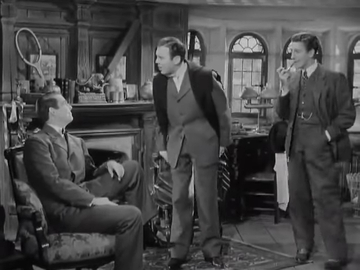
Jack and Charley think Babbs is getting unduly worried; so what if Redcliffe rusticates Babbs? It won’t be the end of the world.
But Babbs explains the matter: it will be the end for Babbs. If he’s rusticated, his uncle won’t take him on in the family’s law firm. Instead, Babbs will be shipped off to New Zealand, to become a sheep rancher. He has been there earlier as well, for two years, and the memory of those 35,000 dirty, smelly sheep is enough to make his toes curl. No, Redcliffe cannot throw him out.
Meanwhile, in the London office of the lawyers Hogarth, Hawks and Babberly, a visitor has arrived: none other than Charley’s aunt, Dona Lucia d’Alvadorez (Kay Francis). Dona Lucia meets Mr Hillary Babberley (Lionel Pape) and confesses to him that she’s a little worried about this girl her nephew Charley is in love with. In fact, both girls: are Charley and Jack certain of Kitty and Amy? Could it not be that word of Dona Lucia’s wealth has spread and these girls are gold-diggers, out to marry for money?
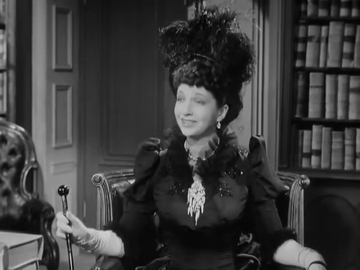
The only way to find out, Dona Lucia decides, is to meet the girls incognito. She will pass herself off as a ‘Beverly Smythe’, and, under this cover, will observe the girls, get to know them, decide whether they’re on par or not. Mr Babberley, eager to help his client, says he will give her a letter of reference. His nephew is at Oxford and will be happy to show her around, to attend to anything she might need, introduce her to the girls, etc etc.

Of course, the nephew is none other than Babbs.
Meanwhile (there are a lot of ‘meanwhiles’ in this film) Jack receives a visit from his father, Francis Chesney (Laird Cregar). Mr Chesney used to be an army officer, and has an easy, chummy relationship with his son: there’s enough informality between them for father and son to discuss a rather awkward problem that has arisen: their financial difficulties. The Chesneys are not in a good place, financially speaking, and it’s worrying Mr Chesney.

Jack, fortunately, has a brainwave. Charley’s aunt, due to arrive this afternoon for lunch, is rolling in money. Dad should woo her; marrying for money is a time-honoured way of getting out of financial difficulties. Mr Chesney is a little reluctant at first (who knows how old this aunt is? Ninety or so?), but desperation is a motivating factor, and he throws in the towel. He’ll do it. He goes away, promising to be back later, once the girls and the aunt have arrived.
Meanwhile (yes, again). A telegram arrives for Charley from Dona Lucia, letting Charley know that she has other pressing matters to attend to and so will not be coming.
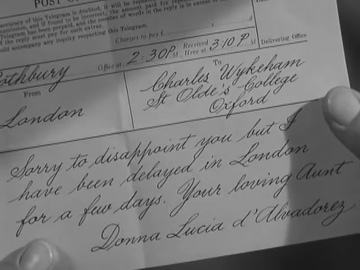
This, of course, sends the two young men into a tizzy. With Dona Lucia absent, Kitty and Amy will refuse to stay for lunch; and if Jack and Charley (who have gone through a lot of effort to summon up the courage to finally propose) lose this opportunity, who knows what will happen? Their love lives depend on this day, this date, this lunch.
Just then, who should come by but Babbs. Babbs has been trying on the dress etc for the amateur theatricals he’s preparing for. Jack and Charley see Babbs in dress, cap, petticoat et al, and there’s another brainwave: Babbs can pretend to be Dona Lucia. Babbs refuses to play ball, but Jack and Charley have an ace up their sleeves. If Babbs won’t agree, they won’t testify in his favour in front of Redcliffe the next day. Babbs can go herd sheep in New Zealand.
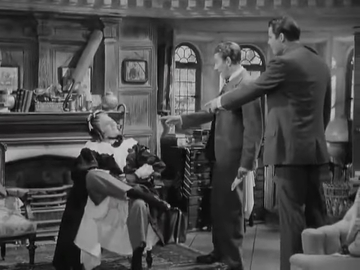
And so Babbs ends up pretending to be Charley’s Aunt.
Directed by Archie Mayo (who, according to his biography on IMDB, began a career in Hollywood directing slapstick two-reelers), Charley’s Aunt is an ode to those slapstick films of Mayo’s early career. When I’d read this play some years back, in my review on Goodreads, I’d referred to it as occasionally being ‘slapstick’, and that’s what this film is. Do not go into this expecting intellectual humour; this is total farce, absolutely impossible—but fun. There are several departures from Brandon Thomas’s play (for instance, in the play, Babbs has been in love with a woman he met long ago and whom he lost track of right after, without knowing who she is or where he can find her; this long-lost love is missing from the film).
What I liked about this film:
The sheer light-hearted fun of it all. Nothing here is grim or to be taken even vaguely seriously, and the humour permeates it all. On the one hand, there’s the physicality of it: the way Jack Benny gallops about in skirts, trying to get an all-too-ardent and unwanted suitor off his back; or the way Jack and Charley help clothe Babbs waist downwards while ‘Dona Lucia’ carries on a conversation over a wall. Or the many instances when Babbs, Jack and Charley are rushing about, pushing and pulling… this is very physical comedy, and the timing is perfect.

On the other hand, there are the dialogues. The “I’m Charley’s aunt from Brazil—where the nuts come from” is probably the most famous of them all, but there are other gems too. Like this:
Jack (re ‘Dona Lucia’) : “She isn’t what she seems.”
Francis Chesney : “No?”
Jack : “No, she isn’t. She’s—she’s a woman with a past.”
Francis Chesney : “A past? You can’t have a past with a face like that, Jack. It’s impossible.”
To me, actually, this was fairly reminiscent of PG Wodehouse (though, offhand, I cannot think of anybody cross-dressing in any of Plum’s books). The complex plotting, the fact that everything fits together, down to motivations and compulsions, and the witty dialogue: pretty much like Wodehouse.
This was a film I enjoyed a lot. Of course, Jack Benny is American, so he doesn’t make a convincing Englishman; but that’s a small, easily overlooked niggle. Watch this film if you need a good laugh.
 Dustedoff
I love Charley’s Aunt. I was first introduced to it in Bombay in the Marathi version as Moruchi Maushi. Even in Marathi there are few different versions, I think. Once I watched it on stage during the Ganapati celebrations, where the actors changed the dialogue (im promptu?) to include names of some prominent persons from the locality.
Then in the late 80s I saw an Hindi version Khalid ki Khalla with Farooque Shaikh in the title role. That was fun.
I don’t know how I would react to them if I watched them now. Most probably I would find them too loud, I think.
Then here I saw the two German versions. One with Heinz Rühmann and the other with Peter Alexander. Both were good.
If I remember right, I haven’t seen the version, which you have reviewed. It sounds hilarious and am looking forward to watching it.
I saw a silent film version once and that was so-so.
Thank you for this recommendation.
LikeLiked by 1 person
That’s a lot of versions, Harvey! Thank you for reminding me of Khalid ki Khala – I have vague recollections of watching that version and enjoying it a lot, but I have now forgotten all about it. :-( It seems playwright Qudsiya Zaidi adapted Charley’s Aunt into this version sometime in the 1950s, and it is still staged often by theatre companies. I am going to try and find the Farooque Sheikh version online – I would love to watch it again.
LikeLike
What a perfect film for me to watch now, Madhu! Just what the doctor ordered. Bless you for this timely review!
LikeLiked by 1 person
Oh, do watch, Anu! Absolutely what one needs when low and in need of some joy. Totally mad and so much fun. :-)
LikeLike