
This is a film I’ve been meaning to watch for a long time now—ever since someone told me that the 1961 Balraj Sahni Kabuliwala (in Hindi) wasn’t a patch on the Bengali version, directed by Tapan Sinha and starring Chhabi Biswas as the eponymous Afghan. I was reminded of it again last year when, for Tapan Sinha’s birth centenary celebrations, Anu (from Conversations over Chai) wrote this wonderful review of the film.
Then, some time back, I began reading 100 Indian Stories (edited by AJ Thomas, published by Aleph Book Company, 2025)—and one of the very first stories in the collection was Rabindranath Tagore’s classic The Kabuliwala.
I figured it was about time I watched Tapan Sinha’s take on the story.
The story begins with scenes (no dialogue, only somewhat sonorous singing in what seems to be Pashto) in rural Afghanistan. Peaks loom high above the valley, a train of camels moves rhythmically along a narrow mountain, and we see Rahmat (Chhabi Biswas) hard at work, but taking out time now and then to play with his little daughter, whom he’s obviously deeply devoted to.
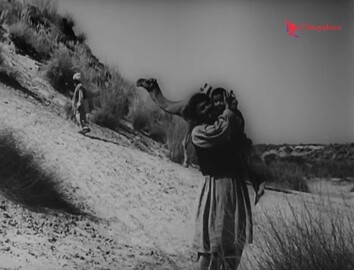
Poverty and drought force Rahmat to seek other means of livelihood: like many other Afghans, he heads for India (specifically, Calcutta), carrying with him the much-valued produce of his homeland: asafoetida and dry fruits.
In Calcutta, Rahmat washes up at a busy little hotel-cum-restaurant run by a man named Rahim (?). Rahim is a hard taskmaster, but he’s used to Afghans, and soon Rahmat has rented a room at Rahim’s. Rahim’s head waiter-cum-jack-of-all-trades, Abdul (?) is kindly disposed towards Rahmat.
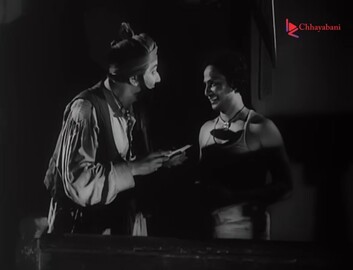
Rahmat takes to walking through the streets of Calcutta, his heavy sack on his bag, calling out “Heeng! Heeng!” [I must admit that till some years back, I hadn’t known that all of India’s asafoetida is imported from Afghanistan; I find it admirable that Tapan Sinha did enough research to ferret out this little-known fact]. Occasionally, people also want to buy nuts: almonds, pistachios, walnuts.

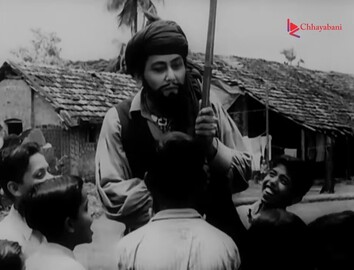
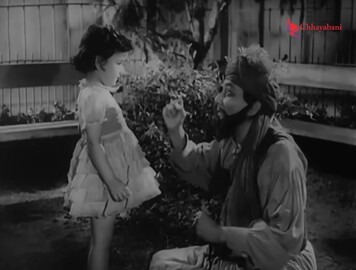
One day, Rahmat sees a crowd of children in a playground. They gather round him, calling “Kabuliwala! Kabuliwala!”, and Rahmat’s eye falls on an especially cherubic little face (Oindrilla Tagore, Sharmila Tagore’s sister, here credited as Tinku Thakur). The little girl is intimidated by Rahmat’s presence and quickly runs off…
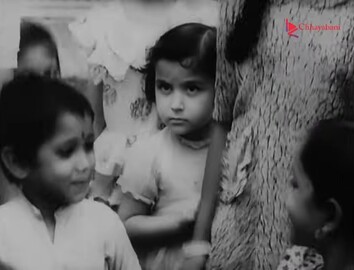
… but just a day or so later, these two meet again. This time, the scene is from another point of view: that of a writer (Radhamohan Bhattacharya; his character here is never named) who is busy trying to work on a story when his daughter Mini—the little girl of the previous scene—comes along and starts interrupting him. Mini’s father is obliged to pause in his writing and attend to his daughter, only to have her call out “Kabuliwala!” when she looks out of the window.
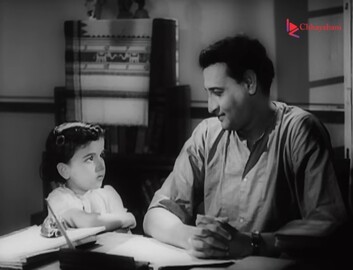
Rahmat is passing by, and Mini has recognized him as the man she saw in the park. Her momentary bravado in addressing him is just that: momentary. Mini slinks away and hides behind her father when Rahmat approaches.
But Rahmat knows how to put nervous and shy little girls at ease. Before long, he has offered Mini a handful of raisins and nuts; soon after, she is sitting beside him, deep in animated conversation. What does he carry in such a big sack? An elephant, Rahmat tells her, and Mini is all wide-eyed wonder.
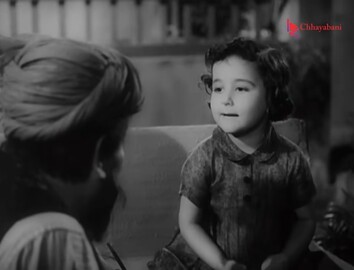
Thus begins a warm, sweet friendship. Everyday, Rahmat comes by, to play with Mini, to chat with her and give her dry fruit and nuts. When Mini’s father, uncomfortable with this largesse (and that too by a man who obviously cannot afford to distribute his wares for free) gives Rahmat money, the coin finds its way back into Mini’s pocket. Rahmat, subtly refusing to take money for a gift given in genuine affection.
Mini’s father looks on benevolently at this friendship [perhaps, as a father who dotes on his little daughter, he can see himself somewhat mirrored in Rahmat?]. But not everybody at home feels quite so charitable towards Rahmat. Mini’s mother (Manju Dey) is not at all approving of Mini’s friendship with this strange man.
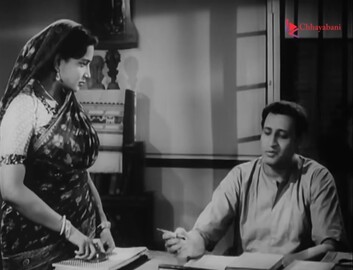
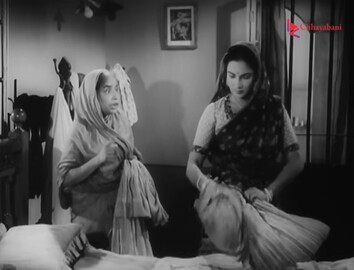
Her fears are encouraged, and added to, by their maid (Asha Devi), who keeps filling her mistress’s head with tales of burly Afghans kidnapping children and whatnot. While the maid might have Mini’s best interests at heart, she is also a paranoid and ignorant woman, besides being a thoroughly prejudiced one. Between her and the household’s manservant Bhola (Jahor Roy), who is only slightly less biased, they manage to whip up a frenzy as far as Mini’s mother is concerned.
All this while, Rahmat is getting used to Calcutta. He’s learnt some Bangla (though he still continues to speak mostly in broken Hindi). He’s also discovered that it’s a very bad idea to give credit; most of the people around him, living a hand-to-mouth existence, will not be able to pay back debts.
And, he’s discovered the truth of that old adage about absence making the heart grow fonder. So far from home, he misses his daughter desperately and longs for news of her. Even a brief letter, giving little news but at least carrying the scent of home, is enough to make him delirious with joy.
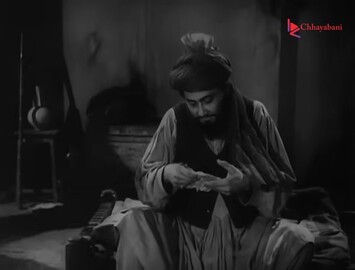
But this cannot last. One day, calamity strikes.
One of the most famous of Indian short stories, irrespective of language, The Kabuliwala has long been much celebrated. I remember having read it in school (it was in our textbook one year, if I remember correctly). It has been adapted for cinema and television multiple times.
And this, I agree, is a superb adaptation.
What I liked about this film:
The adaptation. I think adapting short stories (rather than novels) to cinema can be more satisfying, but there too, one needs finesse and a keen insight into the story to adapt it well. Tapan Sinha’s adaptation of Tagore’s story is a masterclass in adaptation, a superb example of how to take a compact story and flesh it out into a full-length film (Kabuliwala clocks in at 106 minutes, by no means short) without losing any of the spirit of the original.
What Sinha (who wrote the screenplay) does is to expand on certain critical areas that Tagore leaves slightly under-mentioned in the story. Rahmat’s relationships with those around him, for instance—Rahim, Abdul, other Afghan men who lodge with Rahmat. In the story, Rahmat is seen only through the eyes of the narrator, Mini’s father; we see only what he sees, so we do not know anything of Rahmat’s circumstances, barring what he tells (a rare moment) Mini’s father. In the film, though, this man’s perspective is shown, and you get some idea of what he’s contending with, and how the friendship of a little girl perhaps helps keep him sane and happy.
In the same context, I also appreciated the build-up to the incident that changes Rahmat’s life.
(Spoiler ahead)
In the story, we are only told that Rahmat got angry at a man who owed him money; in the film, this is turned around, and we have Rahmat getting angry at a man demanding money from Rahmat, accusing Rahmat of not paying up a debt. But that’s not all; there are other stresses that have been taking their toll on Rahmat, and the latest blow has been the worst: he has received news, through someone else, that his daughter is ill. Not desperately ill; but Rahmat is so distraught, even the slightest needling is like tinder to a match.
[Spoiler ends]
Like Rahmat, another character whose personality is more developed than in the original story, is Mini’s mother. In Tagore’s story, while she’s there, suspicious of Rahmat and protective of her child, there’s not much else about her. In the film, though, she’s much more interesting, her character more nuanced. On the one hand, she’s a somewhat bossy woman, getting after her husband (the stereotypical absent-minded writer?) to have a bath, to eat his lunch, to do this, to do that. She comes across as an emotional, a highly-strung woman whose doubts about Rahmat are quickly whipped up into something nearing prejudice because of the tirades of her maid.
However, in one telling scene, you begin to realize that she is not quite as prejudiced as one might imagine. Circumstances have led to Mini being left alone with Rahmat; when the maid discovers this, she flies into a panic, prophesying that the man will have abducted the child. They rush out, into the verandah, only to find Rahmat sitting entranced as Mini sings and dances in front of him. It’s a sweet scene, and the expression on Mini’s mother’s face speaks volumes: the glance of exasperation as she looks at the maid; the pride and affection as she smiles on Mini.
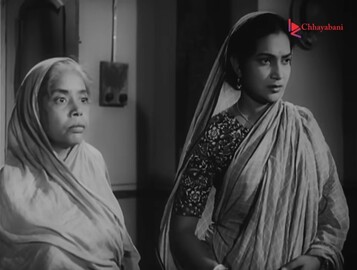
At the end of the film, Tapan Sinha builds on this glimpse of this woman’s character, offering her an important place in the narrative, more than Tagore had done.
Also worth mentioning among the elements of this film that I loved (yes, I must admit I loved it, didn’t just like it): Khore baayu boye. This is my favourite Rabindra Sangeet song, and I had no idea there was a version of it here, in Kabuliwala. It appears as a neighbourhood dance performance, with Mini and her friends dancing while a choir of older girls sings. Lovely.
Then, the acting. The cast is all-round good, but special kudos to Chhabi Biswas and Tinku Tagore. Chhabi Biswas, initially, I thought a little overdone (though I’ve seen him in other films and am generally in awe of his acting ability)—but near the end, especially, he is superb. He is able to express so much without saying anything.
And Tinku Tagore? What can I say of her that she wasn’t just adorably cute, but also did a good job of the acting. I admired also the fact that her dialogues and actions befit her age. This was not a little child mouthing the platitudes of adults; she is a small girl all through, from the wide-eyed look when Rahmat assures her he has an elephant in his sack, to the calm self-assurance with which she helps herself and her friends to the goodies in said sack.
What I didn’t like:
Though I loved Kabuliwala, one thing I found a little irritating was the long-drawn-out section regarding Rahmat’s time in jail. In Tagore’s story, the narrative steps swiftly from Rahmat’s arrest to eight years later, when he emerges from jail; in the film, the audience is shown a lot of how Rahmat’s time passes in jail, how he finds a benevolent friend in the jailor (Jiben Bose), and how he is reminded all over again of the daughter he has left behind in Afghanistan. This entire section I found a little draggy; it was unnecessary, and it could, I thought, have easily been left out.
But, despite that, a wonderful film, and one I’d recommend. A copy with hard-coded English subtitles can be viewed here, on YouTube.
 Dustedoff
I saw Kabuliwala as a child, have seen it multiple times since, and remember most of the film. My wife remembers the dialogues too :). Anyway, getting to the point. Tinku Tagore was a well knwon bridge player and represented Bengal as the 4th team during the 1980s. She was married into a famous family, the Kundus, though I do not know much about them. Her death – IIRC of cancer – came at a pretty young age.
LikeLiked by 1 person
Yes, I did read about how Tinku Tagore went on to become a famous player of contract bridge. In fact that, and that she died fairly young, were about the only things I could gather about her despite much searching online. In the process, I came upon this article, which at first glance seemed longer than the others, but has obviously been cobbled together by rehashing stuff from other sites:
https://nettv4u.com/celebrity/bengali/actress/oindrila-tagore
(Actually, don’t read that – it’s so bad).
LikeLike
I also knew a team member :). T K Das. Met him in 1987 at a colleagues place. He had a daily routine for bridge. It started with : 6 AM – jogging . I said, what???? Jogging for bridge? What are you, Omar Sharif or Everton Weekes (Both, famous in other fields, also played bridge) or what?
:D
LikeLiked by 1 person
Omar Sharif I knew was a world-level bridge champion. But I only knew of Everton Weekes as a cricketer! We live and learn. :-)
LikeLiked by 1 person
She passed away IIRC in 1992 or 1993, and I remember having asked it in a college quiz. I also wrote the IMDB part many years ago.
LikeLiked by 1 person
Madhu ji,
This story was there in our school Hindi collection of stories. I remember reading it very fondly. This story of Tagore I think is different from the usual love stories that one comes across.
By the way, I am not sure if you saw my comments on your earlier posts on the record player and Manoj Kumar….
Anita
LikeLike
I don’t know why I ended up missing your comments on the Manoj Kumar and record player posts! :-( Thank you for alerting me to them.
I think I also may have read Kabuliwala in my Hindi textbook. Very likely. It is really such a refreshingly different take on the ‘love story’. So poignant and timeless.
LikeLike
I would love to see a post comparing the Bangla and Hindi versions – I have seen the Hindi version with BalraJ Sahni and thought it just wonderful. Also that movie had the de facto NRI anthem Ae Mere Payare Watan (till Chitti Ayee from Naam usurped that!).
And special thanks for not even mentioning the Mithun version – I saw parts and it was quite execrable!!
LikeLike
I had reviewed the Hindi version many years ago, but I have to admit I haven’t seen it since, mostly because it’s such a heartbreaking film, it’s hard to watch often – though I admit that it’s a wonderful film. Perhaps I will edit rewatch it and edit this post to include a comparison.
I hadn’t known there was a Mithun version. TBH, the very thought of that puts me off!
LikeLike