
Given that I reviewed Raj Khosla’s 1958 film Kaala Paani—based on AJ Cronin’s novel Beyond This Place—last month, I thought it appropriate to also watch and review an English-language adaptation of the same book. And, as always happens when I do something of the sort, to compare the two, see what they do with the same source material. Here, I must point out that that I haven’t read Cronin’s novel, so I cannot say how much Beyond This Place (directed by Jack Cardiff and with a screenplay by Ken Taylor) resembled Cronin’s book.
But, to begin at the beginning.
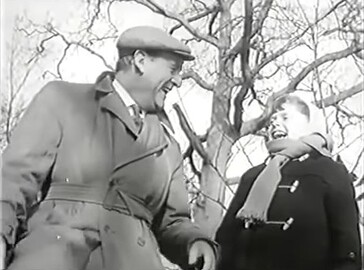
As the credits roll, we see a man, Patrick Mathry (Bernard Lee) and a boy, Patrick’s son Paul (Vincent Winter) running through the woods, laughing and obviously happy in each other’s company.
The scene switches to wartime Liverpool. The city is being bombed; Patrick, despite the danger, leaves home and walks through the streets and up the stairs in a house to a sort of bedsit. Here a woman, Louise Burt (Jean Kent) is just putting on her coat to go out; but it’s not Louise Patrick’s come to meet—it’s her roommate, Mona Spurling (Eira Heath).
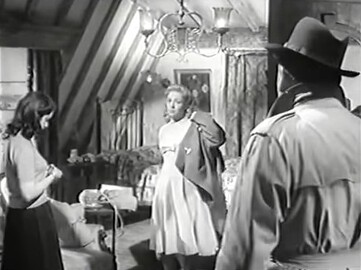
Louise leaves, and Mona says only one sentence to Patrick—that she’s going to have a baby, and needs money—before the scene switches.

It’s now some time later. Two policemen ring the doorbell at Patrick’s home. He answers the door, and they tell him that Mona Spurling has been murdered. They would like him to come to the police station, for questioning. Patrick goes upstairs to the bathroom where his wife is helping Paul bathe. Very nonchalantly, Patrick tells his wife that he will be back.

But apparently, he wasn’t back. Because in the next scene, nearly twenty years have passed and Paul (now Van Johnson) is aboard an American ship that’s about to sail into Liverpool harbour. From his conversation with a fellow shipmate (Paul’s working on the ship, not just a passenger) it emerges that Paul and his mother were evacuated to America shortly after Patrick Mathry was accused of murdering Mona Spurling. All these years, Paul has believed that his father was executed for the crime, and now, because his ship will be in Liverpool for four days, he’s decided to use those days to find out what happened.

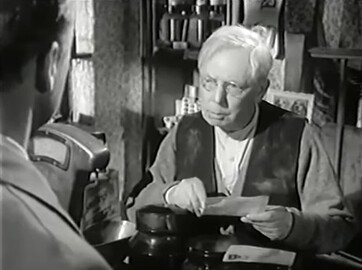
Paul has something of a lead: an old letter written by a Mr Enoch Oswald, the President of the Liverpool Welfare Association, arranging the evacuation of Paul and his mother to America. Mentioned in the letter is a certain Mr Prusty, the owner of a shop in Liverpool. Paul goes there, and finds that Mr Prusty (Oliver Johnston) is still around. Prusty remembers how Patrick Mathry was convicted for the murder of Mona Spurling. However, he drops a bombshell: Patrick wasn’t hanged. Enoch Oswald started a petition, as a result of which Patrick was remanded to custody and has been in jail ever since.
Stunned, Paul wanders about town aimlessly for a while, trying to figure out a way to find out more. Eventually, seeing a man reading a newspaper, he gets an idea: go through old newspapers to find out the story.
At the public library, where he places a request for old copies of the local newspaper, Paul finally discovers some details of the case. For instance, the fact that Mona Spurling’s roommate Louise Burt had testified against Patrick, and it was her testimony that got him convicted. He also finds out where Patrick is jailed: at Wakefield prison.
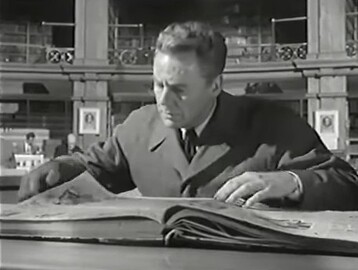
At the public library, too, Paul makes a friend. The young woman, Lena Anderson (Vera Miles), who is in charge of the reading room, sees what he’s been reading, puts two and two together (after all, his name is on the slip) and is sympathetic. Things pan out in such a way that Paul, needing a room, ends up taking the spare room at Lena’s landlady’s place.
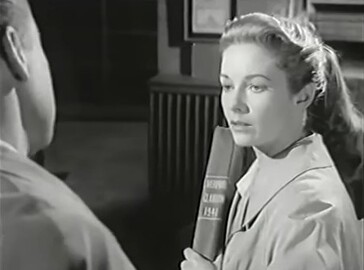
Lena and Paul become friends, though he can see that she is a little diffident, not overly friendly, though she’s kind and sympathetic. It is Lena who persuades Paul to go to Wakefield and meet his father…
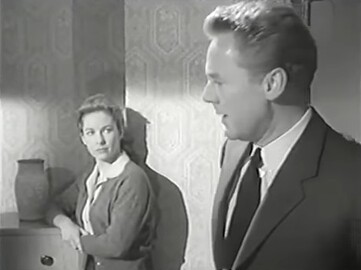
Only, Patrick Mathry cannot meet his son. As the prison superintendent (Geoffrey Keen) explains, Patrick’s a notoriously bitter, violent man. He might have been released from prison many years ago if he had behaved better; but Patrick has been so hard to get along with, he’s constantly being reprimanded—or, as now, sent into solitary confinement. He isn’t allowed to see anyone.

Paul goes back to Mr Prusty, and Prusty is able to provide another lead: the name of the police sergeant who had been on the case along with the inspector. The inspector was Dale; the sergeant was Swann. Swann may know something. So Paul goes looking for Swann, and ends up following him (Jameson Clark) into the courthouse. Not because Swann is testifying as a police officer; no, because Swann is on trial. He’s a drunk, a decrepit man who keeps getting hauled up by the law.

Paul is tenacious, and in the face of his tenacity, a rather bitter Swann explains: everything was stacked against Patrick Mathry. His claims of innocence went unheard. Prusty’s testimony, that he had seen a man coming downstairs from Mona’s room but couldn’t say who it was (because his eyesight was weak), was taken to mean that the man was indeed Patrick.
It is obvious to Paul that Swann’s boss, Dale, was in on the conspiracy to convict Patrick Mathry for a crime someone else had committed. But Swann now also lets Paul know about two other people who connived in this. One was Sir Matthew Sprott (Ralph Truman), the prosecutor; the other was Mona Spurling’s roommate, Louise Burt. Patrick Mathry went down, says Swann cynically, and little Louise Burt went up: she became wealthy, and now owns a popular club named the Grapevine.
… and thus it is that Paul Mathry goes to the Grapevine to see if he can somehow hoodwink Louise Burt into parting with her secrets.
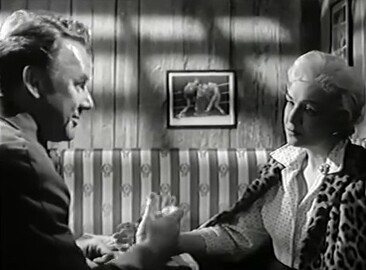
Since I’d watched Kaala Paani recently, I guessed where Beyond This Place was headed. It ended up being recognizably from the same source, but there are subtle differences between the two films.
A comparison, and some more:
On the whole, Kaala Paani and Beyond This Place are pretty much alike: a young man, who has long assumed his father is dead (in Kaala Paani, he is even unaware that his father was convicted of murder) goes to another city and sets out to unearth the truth. In the process, he discovers a sordid web of intrigue, a conspiracy that framed his father. He discovers that a woman holds a crucial piece of evidence that can tilt the scales and have his father’s case reopened, so he tries to worm his way into the woman’s confidence. Meanwhile, he has fallen in love with a woman who helps him.
But it’s interesting to see how two different directors treat the same source novel, for two different audiences. There is, of course, much song-and-dance in Kaala Paani (what would a Hindi film be without music?). And the climax in the Hindi film, based again on a song-and-dance sequence, is rather tame, an easily-accomplished bit of subterfuge that is quite different from what happens in Beyond This Place. The British film, in the last quarter of its runtime, becomes almost Hitchcockian: tense, taut, the story of the ‘good man on the run’, racing against time to clear his name and see justice done though the odds are stacked against him.
What surprised me was the character of Paul’s/Karan’s love interest. In Beyond This Place, Lena Anderson is just a library employee; in Kaala Paani, Asha is chief reporter at Deccan Times. Note that Beyond This Place actually has a reporter (played by Anthony Newlands) who helps Paul in almost exactly the same way as Asha helps Karan. That the Hindi film (which, of course, predates Beyond This Place) had the woman lead playing an exposé-chasing reporter impressed me: Asha is a gutsier female lead in that sense.
In fact, I think Raj Khosla does a better job of depicting the women of his film as more nuanced individuals than Jack Cardiff does. The other major female character—Kishori/Louise Burt—is an ambitious woman, an unscrupulous one who has no compunctions about sending an innocent man to prison (in Beyond This Place, what even might have been his execution, if he hadn’t been remanded thanks to a petition). Louise Burt is never shown to be anything more than this. But Kishori is a different kettle of fish, a woman depicted in a way that evokes sympathy even when we know what she’s done.
It is in the more mature depiction of these two women that I think Kaala Paani scores over Beyond This Place; otherwise, both films have their own merits. Kaala Paani is a solid Bollywood suspense film, good escapist fare; Beyond This Place is, likewise, good in its own genre, its own space. Incidentally, the British film also makes an impactful and pertinent point of what happens when a man stays in prison that long for a crime he didn’t commit. While Shankarlal (in Kaala Paani), is a resentful and bitter man, his resentment is contained; Patrick Mathry’s anger is much more potent, boiling over into a fury that becomes, at times, self-destructive.
A copy of Beyond This Place is available on YouTube, here.
 Dustedoff
I hadn’t known that a British film existed based on the novel. Now I will have to see it soon. It is interesting to see that the Hindi movie predates the British film.
LikeLiked by 1 person
Yes, I too was impressed that the Hindi movie predated the British film (incidentally, the Bengali version, Sabar Uparey, predates Kaala Paani – some sites say that the Hindi film was based on the Bengali one, but I will reserve my opinion on that until I’ve seen it for myself).
LikeLike
I hope you find a subtitled copy of Sabar Uparey (1955) and can write a post on it too. Of course it is difficult to find subtitled regional cinema, but who knows, you might find one.
LikeLiked by 1 person
Yes, I want to watch it too. Fortunately, Bengali films are rather easier to find with subtitles than most other regional cinema, so I am hopeful. :-)
LikeLike
I haven’t watched this film but I’ve read the book by AJ Cronin. And anyone who says Kala Pani was based on Sabar Uparey is wrong. I know the Bengali adaptation predates Kala Pani but the Anand brothers were noticeably fond of AJ Cronin’s works, and it’s safe to assume the book would be their source of inspiration. Tere Mere Sapne, in fact, was an adaptation of Citadel.
I must look this one up when I’m in a better mood to see something serious.
p.s. Tom has a cleaned-up copy of Sabar Uparey (with subs) on his channel
LikeLiked by 1 person
I must watch Sabar Uparey sometime soon – I had bookmarked it earlier (but now I will shift that bookmark to Tom’s copy; always more dependable) – to also see how it is like (or not) the British film.
Tere Mere Sapne, in fact, was an adaptation of Citadel.
I should have remembered that. Even though it’s been decades since I watched the film (and I’ve forgotten most of it), I had read that it was based on Citadel.
LikeLike