
Today, July 9, 2025, marks the 100th birth anniversary of one of Hindi cinema’s best-known film directors. Born in Mysore on this day in 1925 as Vasant Kumar Shivshankar Padukone, Guru Dutt studied in Calcutta before joining Uday Shankar’s India Culture Centre (in Almora, present-day Uttarakhand) to train in dance. By the time he turned 19, he had moved to Pune, where he began working as a choreographer for Prabhat Studios. By the time Prabhat Studios folded up (in the early 1950s), Guru Dutt had formed a close friendship with Dev Anand, because of whom he received his first break as a director: in 1951, he directed Navketan’s Baazi, starring Dev Anand, Geeta Bali and Kalpana Karthik in a noir thriller that was to become a defining film for Navketan: edgy, stylish, dark, very urban.
Guru Dutt is today revered more for the hard-hitting, cynical cinema he made: films like Pyaasa, Sahib Bibi aur Ghulam and Kaagaz ke Phool hold up the mirror to a world that is selfish, cruel and opportunistic. These are bitter films, films that plumb the depths of human nature; films that—despite following most of the standard tropes of commercial Hindi cinema (a romance between the lead couple; a fair number of songs; a comic character invariably played by Johnny Walker)—were quite different from other Hindi films.
These, too, are the films for which Guru Dutt is mostly remembered today. Is that because over the decades, people have seen how the tragedy and turmoil of Guru Dutt’s personal life was probably reflected in films like these? Is there a voyeuristic tendency to try and spot the man behind the director?
But Guru Dutt also made other films, on other subjects. This one, for instance, an adventure/patriotic film set on the high seas, with Geeta Bali starring as the eponymous ‘Baaz’ (falcon), a woman who becomes a pirate to free her land of a colonial tyrant.

The story begins in a village set in an unnamed part of Malabar. A group of Portuguese soldiers have ridden into the village and are going swaggering about, picking up whatever they fancy without paying for it. Nisha (Geeta Bali), one of the village women, sees red when an older woman, the mother of Nisha’s friend Hirani, is assaulted by the soldiers for demanding payment for the fruit they’ve nabbed from her stall. Nisha starts throwing things at the soldiers, and inspired by her, the other villagers too fight back.

In all the melee, Nisha is nearly downed by one of the Portuguese, but a stranger on horseback comes to her rescue. Ravi (Guru Dutt) sweeps Nisha off her vantage point and gallops away with Nisha sitting astride his horse, safely away from the increasing violence in the village. Once they’re out of range of the Portuguese soldiers, Ravi lets Nisha down. There’s some level of attraction here, but it’s obvious that Nisha tries to deny it, even through song.

The two of them go their separate ways after this, Nisha back to her village and Ravi back to—the palace. It turns out that he is none other than the prince, the heir to this kingdom. Ravi’s mother, the Rajmata (Sulochana aka Ruby Myers), is the regent until such time as Ravi is crowned. In the meantime, Ravi’s cousin Jaswant (?) is trying his best to wriggle his way onto the throne.

This he is attempting to do with the help of a Portuguese grandee named General Barbosa (KN Singh). Barbosa has a certain amount of say in what happens at court, because it was with Barbosa’s help that Ravi’s father, the late king, was able to gain sovereignty for his principality from the Zamorin of Calicut. Now Barbosa is pushing to have Ravi travel to the royal court in Portugal as part of his preparations to be crowned king of his principality.
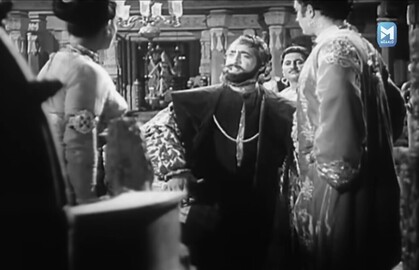
Both Ravi and his mother the Rajmata are uneasy about this. Jaswant is likely to make a grab for the throne once Ravi is out of the way. Barbosa, well aware that Jaswant will be a puppet in his hands, will of course support this. But there’s little Ravi or the Rajmata can do; they are powerless.
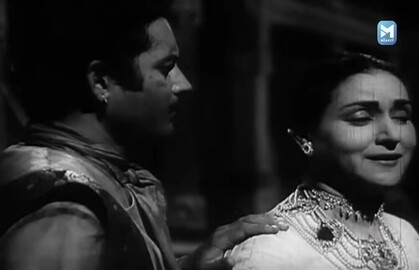
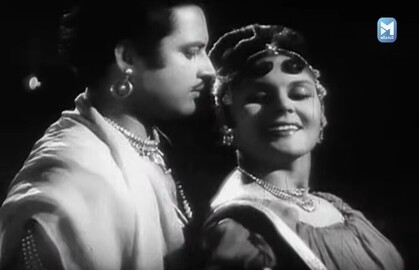
Ravi, therefore, ends up on board a ship bound for Portugal. Along with him goes the court astrologer (Johnny Walker, a standard inclusion in nearly all of Guru Dutt’s films, though here in a sadly limited role). Also on board the ship is a Portuguese woman named Rosita (Kuldeep Kaur), who had—apparently—been Barbosa’s lover, but has now tired of India and is returning home. Rosita spends her time on board ship flirting with Ravi, who seems more amused than attracted.
Meanwhile, ashore, Nisha’s village is seeing further turmoil. Nisha’s father Narayan Das (MA Latif) has a very good friend named Ramzan Ali (Janakidas); Ramzan Ali has sold his produce to the Zamorin instead of giving it to the Portuguese as tribute. For this Barbosa’s soldiers come after Ramzan Ali, and Narayan Das shelters his friend, fighting bravely to protect him. They are outnumbered, arrested, and taken to Barbosa. Narayan Das and Ramzan Ali are outspoken in their defiance of Barbosa, flinging in his face the details of all the atrocities committed by him and his men.
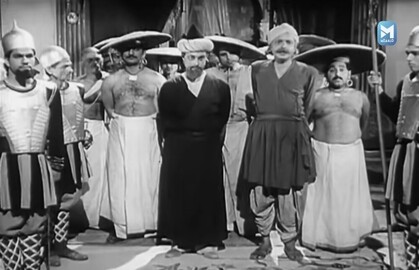
Barbosa imprisons them both, pending transportation (as slaves) to Portugal. Nisha sneaks into the Rajmata’s palace to plead with her: surely she can do something to have Narayan Das and Ramzan Ali freed? But the Rajmata, though distressed by what she hears (and knows) admits her helplessness. She can do nothing against Barbosa.
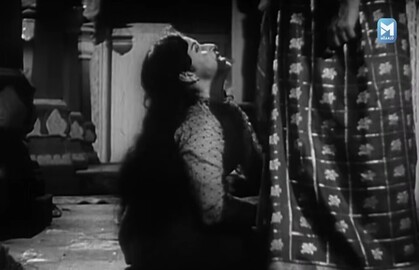
A desperate Nisha, along with her faithful friend Hirani (Yashodhara Katju) enters Barbosa’s palace by stealth. The two women manage to corner Barbosa and Nisha threatens to kill him unless he frees her father and his friend.

Alas, Barbosa’s men are too clever, and Nisha and Hirani are outnumbered and overpowered. They’re taken captive, and, shortly after, the entire group—including Narayan Das, Ramzan Ali, Nisha and Hirani—are sold off by Barbosa to a ship captain named Cabral (?). Cabral is a slave trader: he will take these people across the seas and sell them off for a profit.
He is also a nasty character, and it’s not long before he starts showing just what little respect he has for his newly-acquired ‘goods’. Nisha’s father and his friend voice their disapproval of Cabral’s ways, and a furious Cabral has them thrown overboard. Anybody else who is regarded as a troublemaker or too weak and frail to be of use is also thrown overboard. The rest are put to work at the oars.
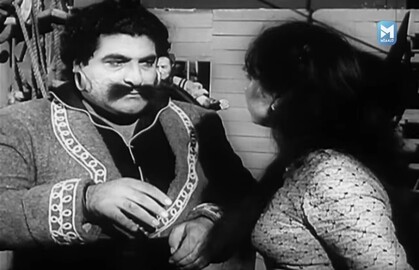
Cabral carries Nisha off to his own cabin and is about to have his way with her when she receives help from an unexpected quarter. Cabral’s first mate, an Indian named Tillu (?) has been growing increasingly angry with Cabral’s high-handed ways (especially as Cabral has no qualms about hitting Tillu, too, whenever it suits him). Now Tillu comes to Nisha’s rescue, and Nisha, helped by him, is able to overpower Cabral.
Very quickly, Nisha takes charge. She eggs the slaves on to rebel, she heads them in overthrowing Cabral and his lot, and she takes over the ship, Tillu by her side.

A falcon—a baaz—[how is a falcon flying so far out to sea?] comes and alights on her shoulder, and Nisha is dubbed ‘Baaz’. She morphs thus into a patriotic pirate, who attacks Portuguese ships, decimating them before they can arrive at Malabar and wreak havoc on her homeland.

In this endeavour, she takes over the ship in which Ravi (now dressed in European clothes) and Rosita are travelling. Nisha gets rid of most of the ship’s crew, sparing only one, an old man who is allowed to get into a boat and row away—Nisha wants him to go back to shore and to Barbosa, taking the news of this uprising.
Rosita shows great presence of mind and passes herself off as Dutch, thus escaping being flung overboard. Both Rosita and Ravi are taken prisoner, though Nisha does recognize this man as being someone she’s met before…
And so the stage is set. For a romance, and for an anti-imperialist uprising.

When I realized it was Guru Dutt’s birth centenary this year, I wondered which film of his I should review by way of tribute (there was no question, ever, about whether or not to post a tribute). I have already reviewed Kaagaz ke Phool and Sahib Bibi aur Ghulam; this post, on the songs of Pyaasa, for me encapsulated pretty much all I could say about the film without parroting all that people more worthy than I have said in connection with that film. Chaudhvin ka Chaand is a film I find extremely annoying, despite its superb music. It was then a toss-up between a few of Guru Dutt’s earlier films, and I finally settled on Baaz, his debut as an actor being one of the reasons for this choice.
What I liked about this film:
While I enjoyed Baaz, knowing how Guru Dutt’s later career as a film-maker panned out, I couldn’t help but see similarities in themes and elements, as well as dissimilarities. For instance, there’s the focus on the powerful central female character. In later films, the idea of a ‘powerful’ female is restricted to a powerful, nuanced depiction, even if the woman (Chhoti Bahu in Sahib Bibi aur Ghulam, Jameela in Chaudhvin ka Chaand) has little agency. In Baaz, Nisha is an undeniably strong-willed woman. This is a feisty woman, one who forges her own path—and she inspires others. There are moments, yes, when she is overpowered by men who are bigger and stronger than her (Barbosa’s soldiers, Cabral), but they cannot suppress her spirit.
While on the subject of female characters, I must make a mention of Rosita. An interesting woman, Rosita comes across as an opportunist: a woman trying to make her way through a world ruled by men, using whatever she has at hand to guard her own interests. She is hard-hearted at times, but there’s a sense of humour, too, to this character that made me like her, even admire her hard-headedness. I liked, as well, the fact that she doesn’t come to a terribly sad end: it’s not as if Rosita gets her come-uppance (or, conversely, dies a heroic death while saving the hero, thus redeeming herself).
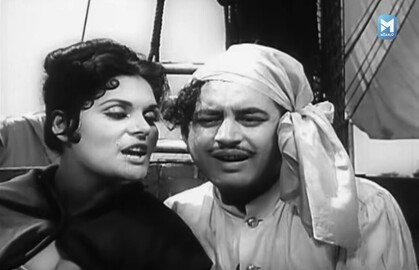
Both Geeta Bali and Kuldeep Kaur do justice to their roles, which of course goes a long way in making these characters who they are.
While on the topic of female characters, I was a little surprised by the casting of Sulochana as the Rajmata; Sulochana’s features and diction, I would have thought, would be more suited to a role (as she often played) of someone either European or Anglo-Indian. As the Rajmata of a Malabar principality, she didn’t come across as very convincing to me.
Other than the women characters, I found in Baaz the presence of Johnny Walker and Tuntun (the latter as an unnamed masseuse in the service of Barbosa; she doesn’t get even one line to speak, sadly) as an echo of Guru Dutt’s later films. Also, of course, Johnny Walker provides the occasional bit of comic relief—though, unlike in grimmer films like Pyaasa and Kaagaz ke Phool, it’s not really needed here.

Plus, like most of Guru Dutt’s better-known films, Baaz has very good music (composed by OP Nayyar, to lyrics by Majrooh Sultanpuri). My favourite is the lovely Taare chaandni afsaane, but there are other good songs too, including Zaraa saamne aa zaraa aankh mila, and Maanjhi albele chalo re haule-haule.
On the whole, a light film, very different in tone and texture from Guru Dutt’s later, more brooding films. In fact, along with films like Aar-Paar, Jaal, CID and Mr & Mrs 55, this forms a bunch of early Guru Dutt films that are markedly different from the grimmer cinema he made in later years (and for which he is primarily known). What might Guru Dutt’s career have been like if he had lived on? Would he have circled back to directing these light-hearted entertainers? Would he have stuck to darker, more sombre films? Would his cinema have been a mix of styles?
I suppose we will never know.
Thank you for the cinema, Mr Padukone.
 Dustedoff
I have got the honour to be the first commenting person on this post. Guru Dutt was the genius in the world of cinema who knew the art of depicting the society as the villain on the silver screen. Thanks for posting the review of Baaz which I would like to watch in future. Guru Dutt must have acted well in the movie as he was not only an extraordinary filmmaker but also an excellent actor. The society seldom understands a genius and a genius is seldom able to go along with the ways of the world. Perhaps that happened with Guru Dutt and he left the world so early. Yeh Duniya Agar Mil Bhi Jaaye To Kya Hai.
LikeLiked by 1 person
Yes, indeed. Yeh duniya agar mil bhi jaaye toh kya hai is such a singularly apt reflection on Guru Dutt’s own life. Pyaasa itself, I think, is that – such an ironic reminder that yes, one’s greatest fame may come after one’s death, one’s talent may be recognized fully only when it is too late.
Thank you for reading, Jitendraji. If you do watch Baaz, let me know what you think of it.
LikeLiked by 1 person
Seen Baaz and found it an entertaining movie. It’s a different and pleasant experience to see Guru Dutt in a costume drama.
LikeLike
This is quite a different film by Guru Dutt. It is sort of a historical and then also a pirate film, which sets it apart from his other films, since he never dabbled in it later on. Since the Padukones also basically come from the coastal region, this film brings him near to the land of his ancestors.
I think this is also the first (and only?) film which Geeta Bali produced, thus she got a juicy, central role to play in it. This film also marks Guru Dutt’s debut as a hero. All in all quite an entertaining and a landmark film.
LikeLiked by 1 person
Along with Jaal (1952) this film makes two films that Guru Dutt made about people living in the coastal region and where the sea plays an important role.
Otherwise the stories of Hindi films are mainly based inland and if the sea plays a role it is mainly marginal as a backdrop for songs or for minor smuggling scenes. Somehow ironic since most Hindi films were produced in Bombay. But most probably since the story writers, producers and directors were mostly from elsewhere the sea got neglected terribly. Kerala has a different tradition in that aspect I think, or am I prejudiced by Cheemen… ? All the Malayalam films I have seen are from the time, when I saw them on DD in the 80s. I faintly remember that the waterways of the backwater played in many movies a role. But then are the backwaters a part of sea? Now I have started wondering, in which Hindi movies the sea plays a role like in Baaz and Jaal. Would 5-6 scenes playing on a sea-shore qualify it to be having sea play a major role in the story? In many Hindi pirate films the action may play out in the sea, but you hardly see the sea except maybe for long shots. So wonder, wonder…
Pyar Mohabbat (1966) plays, they say, on a cruise ship. I remember watching the trailer of Samrat (1982), where they claimed that it was the first Hindi film to have underwater shots. Anyway, I think I have more questions than answers.
LikeLiked by 1 person
I have to admit, apart from Chemmeen and Kannur Deluxe, I haven’t seen any other Malayalam films from the 60s (and Kannur Deluxe didn’t have any sea scenes). But I agree with you that both Baaz and Jaal are off-beat Hindi films in being set by the sea and having the sea play a major role in the film. Seashores were often shown not just in the context of smuggling but also as places to sing romantic (or angsty, a la Jaayein toh jaayein kahaan) songs, but usually that was it – the sea wasn’t really part of the film.
I have seen Pyar Mohabbat, though many years back. And yes, a good bit of it was set on board a ship. Other films of that kind include two Dharmendra films – Tum Haseen Main Jawaan (he’s a naval officer but comes onshore pretty quickly), and Kab? Kyon? Aur Kahaan?, a suspense thriller with Babita.
Another suspense film that includes the sea – quite a bit, actually – is the 1967 Mala Sinha-Biswajeet starrer, Jaal. It’s set beside the sea, there’s a lighthouse, a boat tossing on the waves, etc.
LikeLike
P.S. She also produced Faraar, aka Dev Anand in Goa.
LikeLike
Arre, I realised I forgot to reply to your earlier comment. I didn’t know Padukones came from a coastal region, so thank you for that! And yes, I was so happy to have Geeta Bali play a feisty character; she did, of course, have several other films in which she wasn’t the usual wilting and demure female, but her Nisha was special. :-) Incidentally, I just learnt that Geeta Bali was actually trained in the Punjabi martial art of gatka, which probably accounts for the ease and grace with which she carries off her more physical scenes in Baaz.
LikeLike
Visiting your blog after so many weeks, Madhu, and I have so much to catch up on. Baaz was a revelation when I first watched it many moons ago – for one, it felt really strange to see a story set in Kerala with Malayali characters as protagonists. Strange, for a Hindi film, I mean. But I love Geeta Bali, and I found that I actually liked Guru Dutt in this one. He was pretty decent when he was not being angsty!
It’s rather strange but Guru Dutt, right from the beginning, was clear that one commercial film should follow one artistic one. So I’m guessing if it weren’t for his depression and suicide-prone, he would have gone ahead and made another light entertainer after Kaagaz ke Phool.
Thank you for this review, though. I must revisit this film. And now, to catch up with your other posts.
LikeLiked by 1 person
You’re right. It did cross my mind that it was unusual to have a Hindi film set in Kerala; offhand I can’t think of even any newer Hindi films that are set there…
I hadn’t known Guru Dutt intended to alternate between commercial and artistic films. He was so good at both styles, I would have loved to see what else he came up with. I wonder, for instance, what Picnic might have been like.
LikeLiked by 1 person