
RIP, Connie Francis, the voice of my teenage years.

No; I wasn’t a teen in the 50s and 60s, when Connie was all the rage. By the time I was in my teens, in the 80s, it was Michael Jackson and George Michael, Tina Turner and Billy Joel. But my mother had grown up in the 50s and 60s, and she introduced my sister and me to all those whom she had admired so: Elvis Presley and Jim Reeves, Pat Boone and Perry Como—and Connie Francis. I had fallen in love with Connie’s voice very early on (I think it was the sheer pep in songs like Stupid Cupid and Lipstick on Your Collar that won me over), and—as it happened—All India Radio back then had several very popular shows that focused on the American and British music of the 50s and 60s. Connie’s voice was a familiar one on radio too.
And what a range she had. What a range in notes and scales and octaves, of course; but also what a range of emotions, of styles. Romance, sorrow, fun, pain. English and Italian (Connie’s father was Italian, and her Italian heritage was an important part of her life, both personal as well as professional). From O sole mio to The wayward wind, from Al di la to Where the boys are.
… and that last song, of course, is also the name of a film, a film that was her first appearance onscreen as an actress. I don’t do non-film music on this blog, but this film seemed like a good way to pay a tribute to Connie. She passed away on July 16, 2025; I am over a week late in my tribute, but better late than never, I guess.
The film begins with views of Florida’s Fort Lauderdale, while a voiceover explains how, every spring break, this beach town is inundated with boys from colleges up north. In their wake come the girls, because that’s where the boys are.
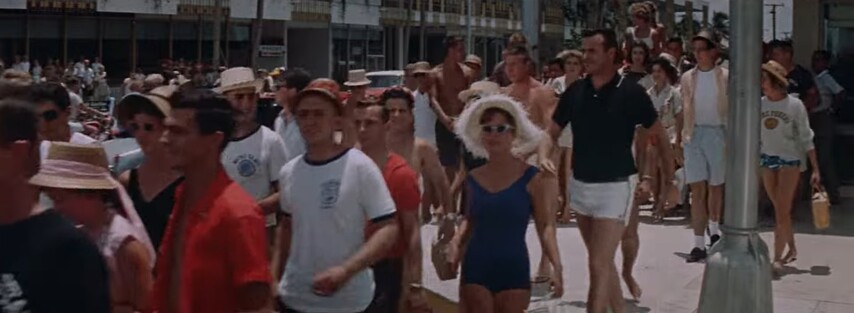
We now basically follow the lives, over the course of a few days, of four girls, all classmates, who have decided to go to Fort Lauderdale this spring. Partly to escape the frightful winters up north, where they’re right now all bundled up in layers of woollens (and still getting bad colds), partly hoping to fall in love, to find romance; if nothing else, to have some adventures.
Of this quartet, the one whom we get a somewhat substantial glimpse of at the beginning is Merritt Andrews (Dolores Hart). In a class on Courtship and Marriage, a very forthright Merritt bluntly tells the teacher that all college-going young people have sex on their minds (I paraphrase, but that’s close enough).

This might have got Merritt a demerit, but instead she gets sent to the dean, who is rather more understanding of the relatively bold and brash ideas of the younger generation. She hears Merritt out, and refrains from passing judgement. To her question about Merritt being ‘overly concerned about sex’, Merritt laughingly admits that so are half a million other college freshmen, so in that respect, she’s probably quite normal.
… and now Merritt and her gal pals are off to Fort Lauderdale to find out more. They’re car-pooling, the four girls in the car being Merritt; the tall and statuesque, very practical Tuggle (Paula Prentiss, in her debut role); Melanie, shy and demure and aching to be in love (Yvette Mimieux), and the delightfully funny Angie (Connie Francis).
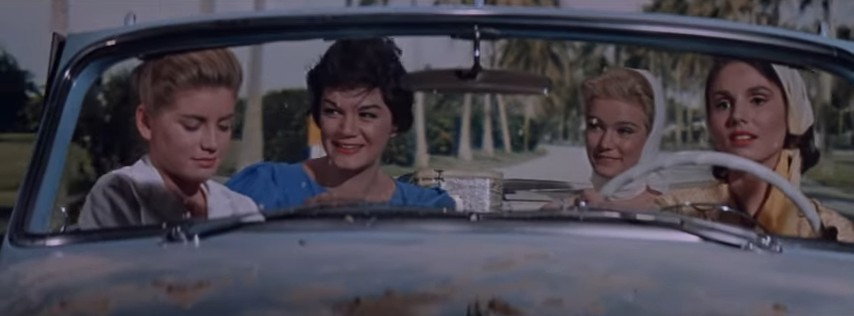
They’re all looking forward to all the men they’ll meet in Fort Lauderdale, but well before they get there, Tuggle finds her man. This is TV (Jim Hutton), a whacky character who towers even taller than Tuggle and is standing by the roadside looking for a lift to Fort Lauderdale.
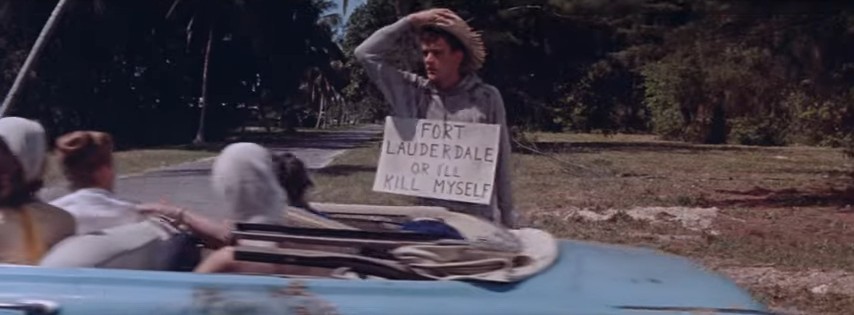
Tuggle agrees to take him along when he agrees to drive; and he soon wins her over by showing her just how whacky he is. There’s a certain ingenuousness to him that Tuggle finds quite endearing, so that by the time they reach Fort Lauderdale, Tuggle and TV have pretty much decided that they’ll be seeing a lot of each other while on spring break.
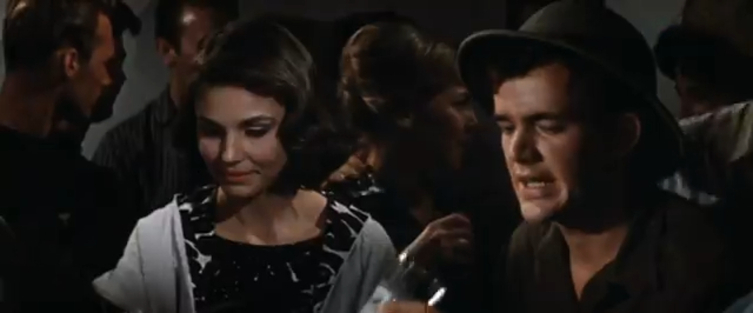
In Fort Lauderdale, the girls manage to find a room to share at a small hotel. They’re given strict instructions—a list of dos and don’ts—by the owner/manager, and then they’re free to make this space their own for the few days they will be in town.
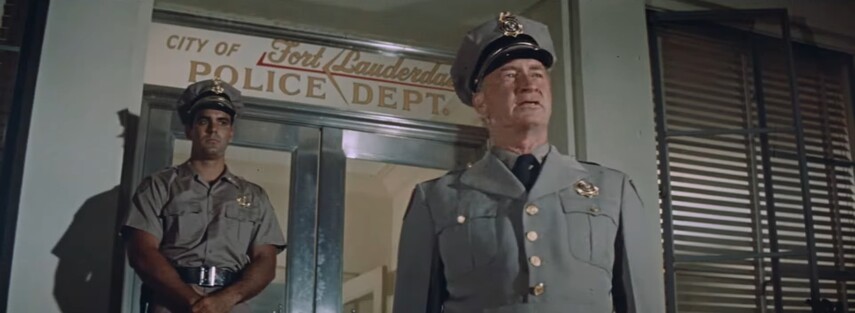
Across town, the police chief (Chill Wills) is holding a briefing session for all his men. It’s that time of the year again, he tells them, when Fort Lauderdale is flooded with thousands of college-going youngsters who think of this particular vacation as a rite of passage, and demand it as their right to get drunk, to behave stupidly, and to basically make a nuisance of themselves. But the chief cautions his men: these are young people, and they’re not deliberately out to break the law. Go easy, don’t arrest them left, right and centre.
And people in Fort Lauderdale, it seems, are forgiving, in general, of all these young people with “more hair than wits” as Shakespeare put it. For instance, there’s the man at the diner counter where Merritt and Angie go for a meal. Angie calmly orders two cups of hot water, then—under the counter—passes Merritt a tea bag and some crackers. The man knows what’s going on: he sees the hot water turn to tea, he sees Merritt with a cracker that she swiftly gulps down. But he doesn’t force them to pay anything; all he does is beg them to go, next time, to his competitor.

Pretty much most of the young visitors to Fort Lauderdale seem to be in the same boat as these four girls: with dreams in their eyes, the hope of adventure and thrill in their hearts, but very little in their pockets. Very soon, three shame-faced girls turn up at Merritt and her friends’ room, asking if they may sleep there too: they just don’t have the money to be able to afford a room of their own.
Even Merritt and Co. have to be careful. Not just with the teabags and the crackers, but with suntan lotion, and with food (they agree that if a boy takes any of them out to dinner, the SOP is to order a steak but eat only half of it: bring the rest home in a bag for friends). But anything is acceptable, as long as they make these days count.
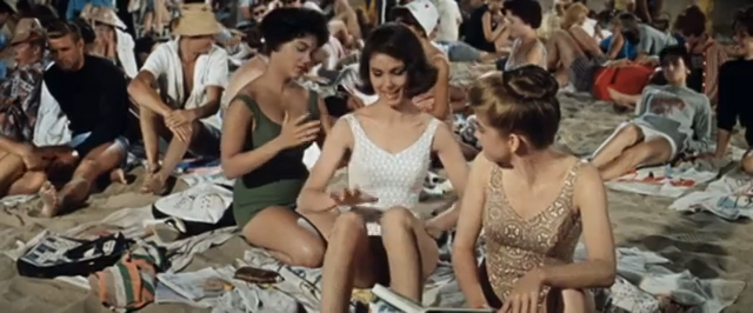
Soon enough, the girls all seem to have found their matches. Tuggle and TV, of course, are an item; but Melanie too quickly starts dating a man named Dill (John Brennan), a relationship that appears so steamy, it makes Melanie rather begin to ignore her friends and spend all her time only with Dill…
…until one day, all of a sudden and with no reason that she is willing to share with her pals, Melanie is dating Dill’s friend Franklin (Rory Harrity).
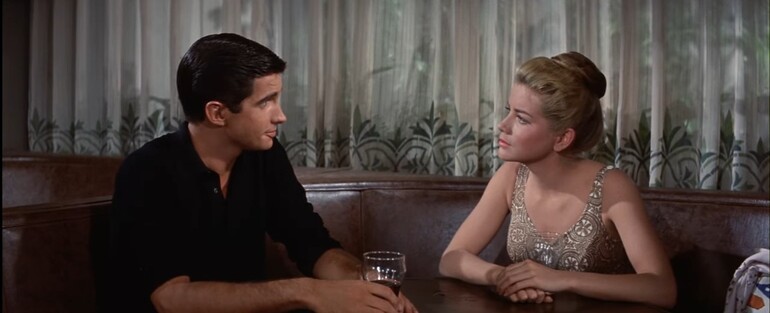
Merritt is now friends with a young man named Ryder Smith (George Hamilton) who turns out to be the scion of an extremely wealthy family.
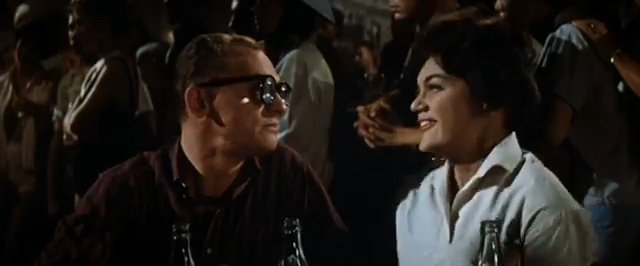
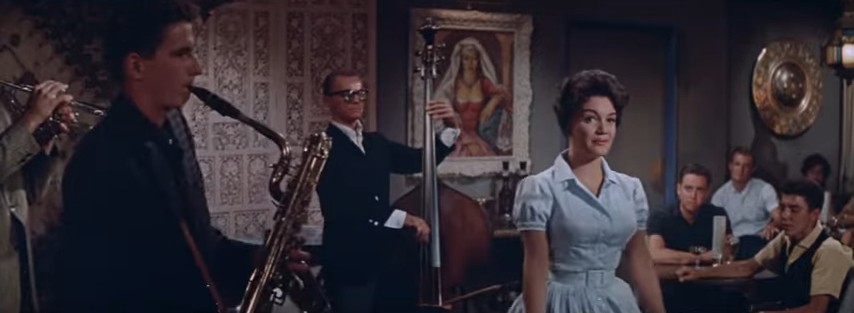
Angie finds herself unable to find a single man who’s interested in her—until she runs into the terribly short-sighted Basil (Frank Gorshin), a musician who plays ‘dialectic jazz’. Basil isn’t particular which girl he’s hanging out with, but Angie soon makes it clear to him that it’s her he’s going to be with.
So that’s the set-up. It looks, initially, as if at least some of these girls are wanting a good time (read premarital sex), unfettered by commitments and so forth. But in between, there’s lots of other stuff happening. There are some pretty funny escapades, vignettes that tie into the whole thing of thousands of over-excited, none-too-rich outsiders descending on a town. There is laughter, there are tears, and there’s some learning.
What I liked about this film:
The overall story, the theme of young people setting out to have fun, but learning something along the way. At the outset (and till well into the film), Where the Boys Are is all about young people being themselves: excited, often juvenile, eager to savour it all, at whatever cost. But nearing the climax, the exuberance begins to sober down into something beyond. The girls begin to (perhaps) understand their men better, to understand themselves better too. In that sense, this is not quite the straightforward ‘beach film’ which is light and frothy throughout.
Overall, the acting is good, but I do wish to call for a special round of applause for Connie Francis’s Angie. Angie is such a delightful character: so full of pep, so uninhibited and genuine. The easy matter-of-fact way in which she does everything—whether saving them some money at mealtimes, or snagging Basil—is immensely endearing. Connie Francis plays her wonderfully, and of course Angie gets to sing onscreen as well, a wonderful song, Turn on the sunshine. Plus, there’s the title song, one of my favourite Connie Francis songs since I was pretty young.
What I didn’t like:
The way the film chickens out. At the beginning, what with Merritt talking about sex being on every young American’s mind, etc etc, we get the impression that ‘playing house’ (as it’s described at one point) is perfectly all right, and that marriage is for fuddy-duddies. Rather bold, I thought: Hollywood was pretty progressive by 1960. But no, that’s only done to make Merritt look progressive. When it’s down to brass tacks, director Henry Levin (and writers George Wells and Glendon Swarthout) ascribe to the belief that a ‘good girl’ has sex only after marriage (for men, of course, sleeping around or asking repeatedly for a girl to sleep with him is absolutely all right).
I won’t go into detail about how this is emphasized, because that would be a spoiler, and it would make this review overlong, but take it from me: that’s the end message of it. Good girls don’t sleep around. And if they do, bad things happen to them. I wouldn’t have minded that message if it wasn’t so completely at odds with how this film started off. The contrast between the two ends of the film (and in fact most of the film, versus the end) was somewhat jarring.
Still, a fairly entertaining film. And Connie Francis is wonderful, such a joy to watch and to listen to. Vai con Dio, Ms Francis. May your voice live on.
 Dustedoff
Beautiful review! And you took me back to my younger years. Oh yes Connie was so popular :)
LikeLiked by 1 person
I am so glad you enjoyed this! Thank you for reading. Yes, indeed – Connie Francis used to be so popular. I remember a cousin of mine actually taking the trouble to get a Connie Francis compilation audio cassette made for me because she knew I liked CF so much. :-)
LikeLike
Madhu, the Hays Code was still in effect in Hollywood through the 60s. The film would have had to present the ‘good’ (sex only after marriage for women) to offset the ‘bad’ (teenagers are horny). Spring Break in Florida is still a thing, by the way; droves of collegians drive or fly down to Florida for Spring Break every year. And yes, most of them go for the no-strings-attached sex. (Only to realise that, well, yeah, there are always strings attached!)
Haven’t watched this film but it sounds rather nice. I will put it on my too-too-long ‘yet to watch’ list.
LikeLiked by 1 person
Anu, when I was writing this review, it crossed my mind that that ‘we have to be good’ business was tied in to the Hays Code, so I searched to see till when Hays was in effect – and I don’t know what happened (perhaps I was in a hurry, or perhaps my brain is packing up), but I could swear I saw something that said it was out by 1960. Now I peer more closely, and of course you’re right. Also, of course, that explains why this film does chicken out.
I hadn’t realized the ‘heading south for the spring break’ was still a big thing! And that it implied pretty much the same stuff. :-)
LikeLike
Ooh yes it’s still a huge right of passage around here! I, in a rather disappointing way, always used that time to catch up on work and household chores. Haha
LikeLiked by 1 person
always used that time to catch up on work and household chores.
LoL! I call that a very good use of time. ;-)
LikeLike
Aah, Connie Francis. Brings back fond memories. My teen years were in the 70’s and my dad bought several records that had some lovely tracks – Pretty Little Baby, Stupid Cupid, Lipstick on your Collar, Who’s Sorry Now. We sang them all the time especially Pretty Little Baby. We still have the records but sadly they are unplayable now.
LikeLike
I don’t remember whether my parents had any Connie Francis records, but I wouldn’t be surprised if they did. She was such a favourite in our home! (Incidentally, just the other day I was singing Pretty Lady Baby, and my eleven-year-old daughter was very surprised: “Where did you learn that?!” – because, as it turned out, she knows the song too, but didn’t realize it was so ancient.
LikeLike
Connie Francis had such an interesting voice! I grew up in the early 2000s but I love music from the 1950s and 60s! Now, this particular song, ‘Where the boys are’, always makes me sad and I can’t say I love it because of that. Maybe it’s because of a particular incident that happens in the movie which took me aback. Or how Connie Francis’ own life turned out. Perhaps it’s because of how my own life has been. I can’t say. But I can’t deal with this song or the movie because of how sad it makes me. I am glad though that Francis’ music is seeing a resurgence in popularity because of TikTok.
LikeLiked by 1 person
Actually, if this were Facebook, my ‘like’ would have been a ‘care’ emoji. Hugs for how this song – and therefore the film – makes you feel, no matter what the reason behind it.
Connie Francis did have an interesting voice – and she sang some songs that are real earworms. I hadn’t realized Tiktok suddenly brought her back into fashion, but I guess that’s why Pretty Little Baby has become all the rage in my daughter’s class!
LikeLike