
AKA Mafia, the singularly apt title of this Franco-Italian film for its release in America. Based on a novel by Leonardo Sciascia, the film was directed by Damiano Damiani and starred Claudia Cardinale, Franco Nero, and Lee J Cobb.
Claudia Cardinale was the reason I watched this film: she passed away on September 23, 2025. I had just paid tribute then to Robert Redford, and coming on the heels of his death, Cardinale’s death was even more saddening. Two greats of Golden Age cinema, one after the other. Two people who were contemporaries (though they didn’t co-star in any films). Two people who left a mark.
Claudia Cardinale was born in Tunisia and made her debut in 1958 opposite Omar Sharif in the French-Tunisian film Goha. She went on to act in several Italian films, and then moved to Hollywood—for a few years, after which she returned to Europe and resumed work in French and Italian films.

One of my favourite Italian films (I Soliti Ignoti, aka Big Deal on Madonna Street) stars Cardinale, and I’ve seen a couple of other films of hers, including The Pink Panther. But which one, I wondered, should I watch by way of tribute? I dithered between this, 8½, The Leopard, and Once Upon a Time in the West, and then—mostly because I find it difficult to pass up a murder mystery—I chose The Day of the Owl.
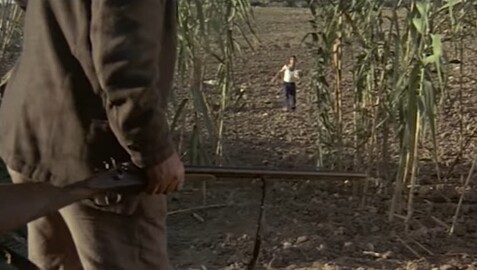
The murder here happens right at the beginning of the film; in fact, the credits roll to a backdrop of the murderer lying in wait. Beside a road, hidden by tall grass, he smokes a cigarette, loads his gun—and as a laden truck appears around the bend, he takes aim and fires. At no time during the entire episode do we get a glimpse of the man’s face, but as he’s running away after killing his man, another man—running, approaching the scene of the crime—sees the killer. There’s a moment of startled surprise, and then the killer turns and runs off.
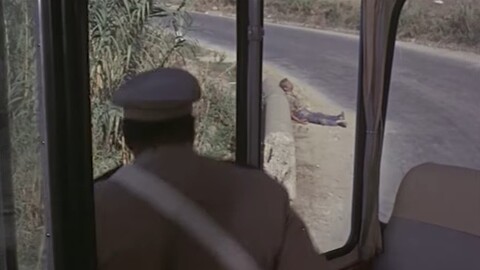
The dead man is found some time later by a policeman who’s going past, in a public bus. This isn’t the only vehicle that’s gone by since the man was murdered; in fact, even the bus driver drove past, conveniently averting his eyes, before the cop made him stop. This is Sicily, and nobody wants to be the one to discover a murder.
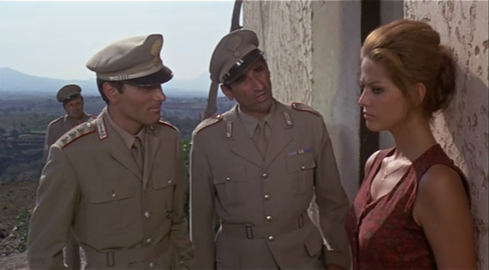
The Carabinieri arrive shortly after, led by Captain Bellodi (Franco Nero) and his second-in-command, the marshall (Giovanni Pallavicino). It turns out that the dead man’s name was Colasberna, and his death is almost certainly connected to the construction of a new road nearby. Colasberna owned a construction firm and was at work on a construction site (towards which he was headed, his truck loaded with cement). He had not been a popular man because he’d refused to be part of the rampant corruption all round.

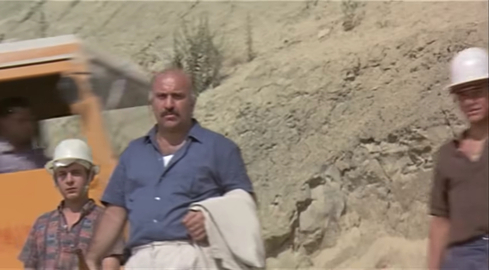
As they’re headed towards the scene, the marshall points out another construction firm owner: an obviously unscrupulous character named La Stella (Giuseppe Lauricella)—who built farmhouses on marshlands, and a house that was smashed by a cow… Bellodi is beginning to get a flavour of just what goes on around here.
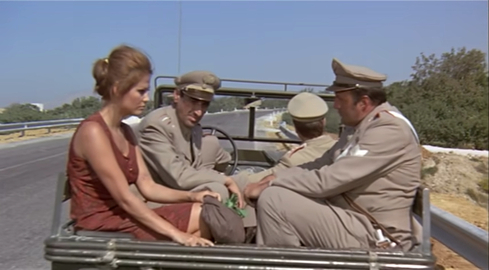
On the way, the marshall sees a young woman walking along. Rosa Nicolosi (Claudia Cardinale) claims she’s been foraging for chicory and cabbages, and stubbornly denies any ulterior motives. The cops give Rosa a lift to her home, which is just uphill from where Colasberna was shot. Surely they must have heard the shots?
Rosa is wary, very close-mouthed and suspicious. On being questioned, she admits that her husband Tano Nicolosi doesn’t have a steady job; he works at whatever he can get. His timings seem to be erratic. She doesn’t know what time he left home in the morning the day Colasberna was killed. He hasn’t been home since.
Her caginess is frustrating, but Bellodi tries his best to convince her that he is on the side of justice, that she has no reason to be afraid.
But there are wheels within wheels, as they say.
Right across the small square where the Carabinieri have their office is the mansion of the wealthy and powerful Don Mariano Arena (Lee J Cobb). The captain spends at least some time everyday focussing his binoculars on Don Mariano’s house: a place where it seems the bigwigs of the region congregate.
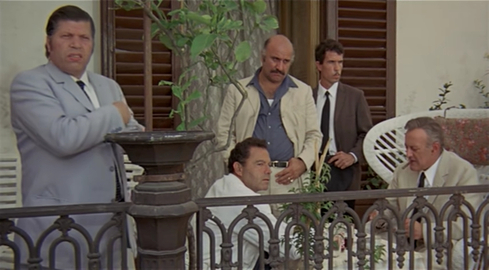
One day, Rosa Nicolosi comes to meet the captain. Tano Nicolosi has still not come home, but Rosa is unwilling to answer Bellodi’s questions. She tries to fob off Bellodi by saying that when they heard the shots fired, they thought it was hunters; there are always hunters around…
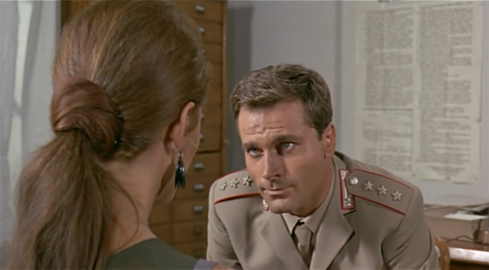
Later, the marshall tells Bellodi that local gossip has it that Rosa is an unfaithful wife; she has a lover. They don’t know who. And Rosa has an unsavoury sort of reputation: she got pregnant at 16 and that’s why she had to get married. She must be a frustrated woman, says the marshall, so beautiful and married to such a no-good idler as Tano Nicolosi.
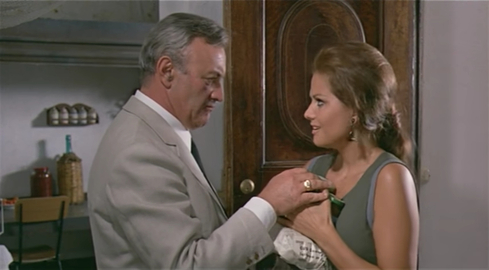
But Rosa seems to be sincerely attached to her missing husband. She even goes to Don Mariano and introduces herself before asking him to look into her husband’s disappearance. She also proceeds to pass a veiled hint: she will keep quiet if he will help. Don Mariano seems to get a bit flustered, and piles various gifts into Rosa’s arms: a chicken, several jars of marmalade; assuring her all the while that it will all turn out well.
This is only the beginning, the setting of the stage, so to say. Bellodi is only starting to get acquainted with the players on this complicated stage, and as the story proceeds, he will become more and more frustrated, more and more desperate. Don Mariano is a formidable opponent. But even if he is responsible for Colasberne’s death, he could hardly have done the deed himself; he’s too dignified to bloody his hands—so who actually pulled the trigger? And where has Tano Nicolosi vanished? What does Rosa know?
From what I had read (admittedly cursory, because I didn’t want to accidentally read the solution to the mystery), The Day of the Owl sounded like it might be a police procedural, a story of a cop carrying out an investigation to unearth the culprit. However, this isn’t a whodunnit at all; it is, instead, a story about crime, about fear and the all-pervasive reach of the mafia.
Interestingly, this film reminded me fairly strongly of the sort of honest-cop-versus-rampant-corruption film one saw (still sees? I don’t know; I don’t watch too many new films) in Hindi cinema. The nexus between politics and big business, the elite who don’t get their own hands dirty but employ gangsters and have no scruples about anything. And there’s a cop, an outsider who refuses to look away, refuses to be cowed, and is intent on seeing justice served… very reminiscent of many, many Hindi films.
What I liked about this film:
The sense of you-can’t-escape-the-mafia that builds up as the story progresses. Bellodi looks, at times, as if he is finally going to break through; this is a dedicated man, an honest and efficient cop who will stop at nothing (including using rather unorthodox, creative means to extract a confession) to find the culprit and have justice served. But can Bellodi and his loyal marshall really win? There’s a scene near the end of the film when Don Mariano walks out on to the street, and everybody is greeting him. Old women are beaming, blessing him; men, old and middle-aged and young, even teenagers—are smiling, bowing, saluting him. Whether they genuinely respect and love him or not is a moot point; but you can see that Don Mariano rules this space.
Even Rosa, who seems to be able to hold her own, and who doesn’t shy away from saying it like it is, is helpless. Or complicit. Or just too aware of how impossible it is to go up against the mafia.
The acting is uniformly good, but a special shout-out is needed for Lee J Cobb and Claudia Cardinale, both of whom portray their characters with convincing veracity.
In fact, I was too busy watching what was happening in the background when the credits were rolling and as a result, I missed the names that followed Claudia Cardinale’s (she has top billing) and didn’t know that Lee J Cobb was in this film. So when Don Mariano put in an appearance, I ended up thinking the actor looked very familiar. The dubbing is so well done that I never even realized, till the end of the film, that this was an American I have seen in several films.
What I didn’t like:
The rather vague ending. Yes, it is effective in conveying a sense of the power the mafia wields in Sicily, and how the only way to survive them is to go with the flow—but I would have liked something more, something tangible.
Still, a hard-hitting film, and worth a watch. Worth watching, too, as a tribute to Claudia Cardinale. Like Robert Redford, she too was often shortchanged because of her looks. This film, which won her a David de Donatello Film Award for Best Actress, is a very good showcase of her acting ability. She is able to portray, very effectively, a woman who tries to stand up for herself and her missing husband, but cannot help but be frightened of those she must go up against.

RIP, Ms Cardinale. Thank you for the cinema.
(Note. A copy of The Day of the Owl is available on YouTube, here, with hard-coded English subtitles).
 Dustedoff
A very fitting tribulte to La Cardinale.
I don’t know this movie and am looking forward to watching it. I am very curious about the vague ending now, although they quite typical for the European films of that era.
RIP Claudia Cardinale. Thank you for your legacy.
LikeLiked by 1 person
Yes, you’re right, Harvey – of the (admittedly very few) European films of that era that I’ve seen, now that I think of it, many had this vague sort of end. Not the neatly tied up ends of both Hollywood as well as most Indian cinema.
LikeLike
A fitting tribute, indeed, to Claudia Cardinale. I watched this many moons ago, but as Harvey once said, “My memory is very kind to me; I’ve forgotten everything about it and so I can watch it again.” :)
I’d reviewed Il Gattopardo many years ago. And if you haven’t watched it yet, please do. And do watch the Criterion version – the English version is terribly truncated. The official version was 205 minutes long; the Criterion version is 185 minutes – and the one that the director himself preferred.
LikeLiked by 1 person
I have actually been meaning to watch Il Gattopardo – but after reading the book (which I found listed on a ‘100 Greatest Novels’ list, through which I make my way very slowly). Will try to do that sooner rather than later, Anu! Thank you for the recommendation and for warning me off the English version.
LikeLike
“My memory is very kind to me; I’ve forgotten everything about it and so I can watch it again.”How sweet of you to remember! My memory was again very kind to me and I had forgotten all about it. Thanks to its kindness I could enjoy it once again.What I have not forgotten is, that I attempted watching Il Gattopardo at least twice. Somehow I lost interest in between. Maybe I should give it a try once again.
LikeLike
I haven’t seen this. Sounds intriguing. Adding it to my list.
LikeLike
It’s an interesting film. So different, really, from the close-all-loose-ends style of Hollywood around the same time.
LikeLike