
This is an important week in the history of Hindi cinema, because it marks the birth centenary of two of the industry’s most popular entertainers. Director Shakti Samanta was born on 13th January, 1926 in Bardhaman (Bengal), and three days later, on 16th January, across the country, OP Nayyar was born in Lahore. These two very different men were to come together in 1958 in the Ashok Kumar-Madhubala suspense thriller Howrah Bridge, and the magic they created between them in this tale of crime, deceit and romance set in Calcutta marked a milestone for both Samanta and Nayyar.

Samanta was to work with other music directors, among them Shankar-Jaikishan, SD Burman and RD Burman. OP Nayyar was to work with a number of directors: Guru Dutt, BR Chopra, Raj Khosla… Samanta and he, however, worked together in only four films. After Howrah Bridge, there was Jaali Note (1960), Kashmir ki Kali (1964) and Sawan ki Ghata (1966). For me, the songs (as well as the film itself) in the case of Jaali Note and Sawan ki Ghata, while good, are not as memorable as those of Howrah Bridge or Kashmir ki Kali.
It is in Kashmir ki Kali that both Samanta and Nayyar are at the top of their game. Everything comes together in this film—the picturesque locales of Kashmir, a stellar cast, an entertaining (even if predictably far-fetched) story—and one of the most fabulous overall scores that OP Nayyar ever composed. For me, at least, Kashmir ki Kali is one of those few films in which I like every single song. Some I like more than others, but there is not a song in this soundtrack which I would fast-forward.
The very first song comes fairly early on in the story. Raju (Shammi Kapoor) is driving into Kashmir, and (inspired by the beauty of the surroundings) bursts into song, singing of his hope of falling in love. The tune of Kisi na kisi see kabhi na kabhi is lilting and tuneful, a slightly reverberating echo-like effect softening Rafi’s voice further into the song as Raju, getting back into his jeep, drives off again. Kaun woh kismatwaale hain jo log yahaan rehte hain sings Raju…

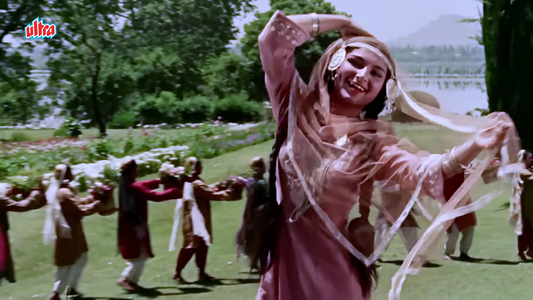
… And the next song, had it been retained in the film, would have given us a preview of the fortunate soul who lives here, and who is destined to be Raju’s love: the very pretty Champa (Sharmila Tagore). Balma khuli hawa mein, Asha Bhonsle sings; and in an interesting female echo of Rafi’s earlier song, this one too talks of beautiful surroundings and the hope for a true love to enter one’s life.
According to Karan Bali (in this article on Upperstall), the song had not only been recorded and shot, it had also been part of the film when it was first released, but some fashion and/or moral policing by the Indian Censor Board resulted in it being pulled from the film. A little bit of it, just Asha doing an aalaap and some instrumental music (in which one can identify an echo of the interludes in Yeh chaand sa roshan chehra), remains.
There was yet another song, sung by Asha Bhonsle, that was recorded for Kashmir ki Kali but which has since disappeared. Phir thes lagi dil ko is a lovely, gentle tune, poignant and with especially good lyrics. I love that OP Nayyar gives Asha this song, melodious and requiring the sort of restrained singing that most composers would have associated with Lata. It’s not very clear why this one was removed from the film, but some have conjectured that it might have been because the film was over-long and needed to be shortened.
(Many thanks to Ava for reminding me of this song, which I had forgotten about).
It doesn’t take long for the story to be set up. For Raju and Champa to meet; for Mohan (Pran), who has his lecherous eye on Champa, to warn Raju off; and for Champa’s over-protective father (Nazir Hussain) to be introduced. In between a comic side plot (heavily drawing from Come September) and Raju’s deception of Champa—in order to break down barriers, he convinces her he’s a poor man—the story progresses. Their romance progresses.
And, as in pretty much every other Hindi film of this period and of this era, the romance develops primarily through songs. It’s as if film-makers decided it would be too boring to have love blossom through long conversations and getting to know each other. So much more enjoyable to have them sing their way from first sight to happily ever after.
I agree, actually. Especially when the songs are so good, and so varied, too.
First up is the song that introduced me to OP Nayyar: Yeh chaand sa roshan chehra. The opening guitar notes here were played by my uncle Sammy Daula, though this was something I learnt much later in life. As a child (and hearing this song on radio; I didn’t see it on Chitrahaar till I was about eleven years old), what attracted me was the infectious tune, the pep and flirtatiousness in Rafi’s voice, and the puzzling (to me) lyrics: I couldn’t think of many Indians who might have golden hair and blue eyes. SH Bihari, the oft-overlooked lyricist for Kashmir ki Kali, was being metaphorical here, but the words work wonderfully with the tune and Rafi’s vocals to create a serenade like none other.

The romance of these two progresses swiftly, and from the one-sided serenade to the mutual admiration doesn’t take long. Soon after, an unexpected (on Champa’s part; Raju has this all planned out) meeting in the mountains ends in a sudden wetting when they’re caught in a thunderstorm. Champa and Raju take shelter in an old woman’s hut, and she—charmed by them, and believing them to be a married couple—lends them clothes to wear while their own garments dry. Of course, this takes time; and what better way to pass the time than to sing a song? Ishaaron-ishaaron mein dil lenewaale is a shy, sweet song that marks Champa’s explicit acceptance of their love. The languid music of this song, the soothing and quiet pace is quite different from some of the other songs of Kashmir ki Kali…

For instance, the next one: Subhaan Allah haseen chehra yeh mastaana adaayein. Raju has discovered that Champa and her friends are going off to a mela, and so he—in disguise, wearing a burqa to dupe the nasty Mohan—hitches a ride too. The fact that the back of the truck contains only Champa and her friends means that the ‘Pathan ki biwi’ (as Raju is pretending to be) is able to throw back that burqa and serenade Champa. In tune with the singer’s purported Afghan antecedents, the music shows an appropriately Arabian/Central Asian influence.
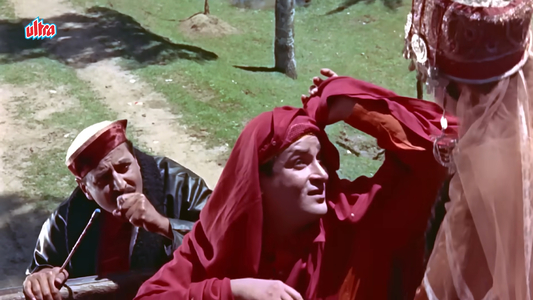
At the mela, to fob off Mohan (who has discovered the man behind the burqa, and is livid), Raju switches disguises. A bhangra troupe from Punjab is at the mela, and Raju—now made up as a bhangra dancer, with fake beard etc—and Champa sing and dance Haai re haai ke mere haath mein tera haath. There’s a story behind this song: OP Nayyar had composed the tune without having been given a specific situation for which to compose. He pointed this out to Shakti Samanta (who had liked the tune a lot when Nayyar showed it to him): what would such an obviously Punjabi song be doing in Kashmir? Samanta’s admiration for the song was such, though, that he told Nayyar he would find a way to fit the song in.
And what a song this is, what a fine tribute to Nayyar’s native Punjab. The rhythm and the energy are infectious, and the way the beat spirals up, becoming faster and more upbeat even after the words have ended—unusual, and delightfully folksy.

The energy dissipates, the tone and the rhythm changes (how underrated is OP Nayyar when it comes to versatility?!) in the next song, Deewaana hua baadal. If I had to name one song as my favourite one from a film of many great songs, it would be this. The tune; the way Asha’s and Rafi’s voices meld together; the lyrics: everything is just right, so gloriously romantic and so beautiful.

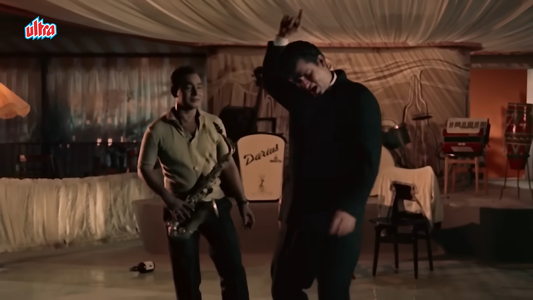
But that is the last of the ‘happy songs’. Everything falls apart for Raju and Champa right after this, with Champa’s father Dinu forbidding her love; Champa discovering that Raju has been fooling her all this while, and more. Raju (like many other heartbroken heroes in the Hindi cinema of this era) drowns his sorrows in drink—and in song. Hai duniya usi ki zamaana usi ka is set in a dark, atmospheric bar where Raju slurs out this song while a saxophonist (played onscreen by the choreographer Surya Kumar) plays along. This is one of the very few sombre songs Rafi sang for Shammi Kapoor, but it works every bit as well as any of the effervescent or romantic songs they made together.
And that is it, the last of the songs of Kashmir ki Kali.
Eight songs (including Balma khuli hawa mein), and not one of them a dud.
What makes these eight songs extra-special is the close attention Shakti Samanta pays to their picturization. With every song, there’s the sort of minute attention to detail that recognizes the beauty of the song and matches it with the visuals. In the way a character moves, in tune with a song; in a gesture, an expression, a picturesque backdrop. The dark gloom of a mostly-empty bar, echoing the sorrow of the man who’s singing.
For me, the only song which is somewhat let down by its picturization is Ishaaron-ishaaron mein dil lene waale, where the ‘pine forest’ is quite patently fake, a film set and not the real thing.
One film, eight songs, two men who brought it all together into a memorable package. Kashmir ki Kali is a good film, an all-round entertainer, but honestly, if you took all the songs out of it, it would be nowhere as entertaining a film as it is. Kudos goes to OP Nayyar for the songs, and to Shakti Samanta for recognizing them, for fitting them into the film in a way that couldn’t be bettered.
(Note: If you want to read a rather more conventional review of this film, click here).
 Dustedoff
A nice round up of the songs, Madhu. I got a mini preview of the movie here.
Even ‘Phir thes lagi dil ko’ was omitted from the movie. It is ‘listed’ as one of the songs of KKK. I am quite sad that they didn’t include Balma Khuli hawa me. It’s such a pretty song.
If I need my mood uplifted, I turn to an O.P. Nayyar playlist, never fails.
LikeLiked by 1 person
Ava, thank you for reminding me about Phir thes lagi dil ko – I had completely forgotten about that. Another lovely song.
Yes, OP Nayyar is a very reliable mood-lifter. So many delightful, happy, peppy songs.
LikeLiked by 1 person
Doesn’t Pran look a bit too old for the young (I think it was her first Hindi movie) Sharmila? Of course, age is no bar for lechery!
it would be nice if you were to compare the songs of Junglee with KKK. I think it would be hard to say whether Ehsaan Tera hoga mujhpar (Male version) is superior to Ye duniya usi ki! And speaking of the latter, it would be great if you write a blog on the all time ‘drinking’ songs in Hindi cinema (where a drunk hero/heroine croons his/her heart out for a lover).
Nitin
LikeLiked by 1 person
Pran had debuted in the 1940s, so he was definitely much older – but then, worse matches (or hoped-for matches) have appeared in Hindi cinema. My pet peeve is Om Prakash paired with Mumtaz in Mere Humdum Mere Dost. That is appalling!
(Of course, by the late 60s, even Shammi Kapoor was looking overweight and puffy-faced, and too old to be paired with the much younger actresses he worked with. The same with Dev Anand).
I have made a list of daaru songs, long back. Not specifically just this situation, though the heartbroken hero is a common trope when it comes to songs like these.
https://madhulikaliddle.com/2009/09/14/ten-of-my-favourite-daaru-songs/
LikeLike
Long-time lurker and a fan here 🙂 Fantastic post, as always.
I’ve always wondered about the lyrics of “Yeh Chand Sa Roshan Chehra” too. After a lot of thinking, I’ve landed on a theory: I imagine the lyricist was inspired by a blue-eyed, blonde beauty he happened to see, and the song was written in a sudden burst of inspiration. They loved it so much that they didn’t want to modify it – and that’s how I finally made peace with it 😄
LikeLike
LoL! That’s an imaginative guess at what happened. :-D Good one.
LikeLike
Madhuji,
The songs feature at regular intervals and sometimes one close on the heels of the earlier one and still, you are not one bit bored! That is perhaps the best part of O.P.Nayyar’s music! Though he rehashed tunes, one still enjoyed his old wine in a new bottle!
Anita
LikeLiked by 1 person
Very true! There are so many other films I can think of where the songs come one after the other, and I tend to either fast-forward through some of the songs or do other work while a song is happening. But not in this film; here I actually wait with eager anticipation for the next song.
LikeLike
Kashmir Ki Kali does indeed have a good score and I like all the songs particularly balmaa khuli hawa me and ye duniya usiki.
LikeLiked by 1 person
Yes, they are among the best songs in the film. I think as a whole the film shows up OP Nayyar’s versatility quite well – such different songs, from madcap to dreamily romantic to folksy to melancholy…
LikeLike
Shammi Kapoor in one of his interviews talks about the care that OP Nayyar took to compose tunes for this film. OP Nayyar kept Shammi Kapoor and Md Rafi in mind while composing. There were over 14-15 tunes composed.
Shammi Kapoor and Director Shakti Samanta were given a choice to review the songs. The tunes that were dropped were later included in Shakti Samanta’s next movie – Savan ki Ghata – which itself had wonderful songs.
Clearly OP Nayyar was at the top of his game for Kashmir ki Kali.
LikeLiked by 1 person
I’d read that there was a total of 12 songs, of which most were used here and the rest Samanta used in Saawan ki Ghata. Personally, I prefer the songs of this film over the later one, though I do like Zara haule-haule chalo more saajna a lot.
LikeLike
Beautiful film with great songs. Sharmila Tagore looked like a diva in her first film. Shakthi Samantha films had great songs. Another film of his with all songs that were super hits is Aradhana. I think that is pending in your list of films to be reviewed, and meets the criteria of being within 1970. Some other films of his with beautiful songs and music were Katipatang and Amar Prem. Being a Rajesh Khanna fan, my play list has these on a loop.
LikeLiked by 1 person
Yes, indeed I haven’t yet got around to reviewing Aradhana! I was reminded of that when I was looking at Shakti Samanta’s filmography in preparation for this post. Must do that one of these days… what a superb score that one was too, so many great songs.
LikeLike
There can’t be a better tribute to the two legends of Bollywood. Loved every bit of your article. Hats off !
LikeLiked by 1 person
Thank you so much, Jitendraji. You are very kind.
LikeLiked by 1 person
I meant to comment on this article a few days ago when I first read it, but…
If I recollect right, you first started with this deep dive into the songs of a film with Pyaasa. I also read your article on Salilda’s music for Madhumati with great interest. (WordPress wouldn’t let me comment on it, so let’s see if this works, or I’m persona non grata forever.)
You’re right about Kashmir ki Kali being the best Shakti Samanta-OP combination. And like Jitendra [above] said, this article analysing the film’s music, is perhaps the best tribute that could be paid to the two men.
I’m really enjoying this series, Madhu. :)
LikeLiked by 1 person
Anu, I am very impressed with your memory! You actually remember each of the films I’ve approached in this way. Wah. :-)
I must admit that the idea for looking at a film through Salil’s music was Antara’s. She wanted me to write for Salil’s birth centenary, and when I expressed an inability to write persuasively about music as such (my knowledge of the technicalities is zero), she suggested I look at a film through the lens of his music. Madhumati, then, was my idea.
And then when these two birth centenaries came one after the other, I thought why not combine them?
I am so glad you enjoyed this post. Thank you!
(Also: your comment on the Salil post did get posted and approved, thank goodness).
LikeLike
It was indeed a lovely collaboration. You can pick up any song, any time and it will make a mood, even if it’s sombre one for yeh duniya usi ki.
Very difficult to chose from album but S H Bihari’s lyrics, Rafi’s rendition (Actual drunk person won’t sound this perfect drunk) and Shammi lip-synching (Most of the Kapoors were musically talented), tilt in favor of Yeh Duniya Usi Ki. Saxophone is the cherry on the top.
Similarly it’s the lyrics & Asha’s rendition that makes Isharon Isharon Mein stand out.
मुहब्बत जो करते हैं वो
मुहब्बत जताते नहीं
धड़कने अपने दिल की कभी
किसी को सुनाते नहीं
My only grouse is in their obsession of portraying fair Kashmiri lady, they have put so much grease paint on Sharmila that she looks chalky, ashy ghost.
She was absolute lovely without it. Wonder if it has anything to do with equally lovely (and unfortunately for Sharmila, fair) Saira’s debut in Junglee earlier.
LikeLiked by 1 person
I agree with you about poor Sharmila’s makeup being overdone – they’ve really gone over the top there. She was gorgeous without it, all she needed was something very light (and anyway, it’s not as if she’s too dark to pass for Kashmiri – even without the makeup, I still she’s fair enough to look the part).
LikeLike