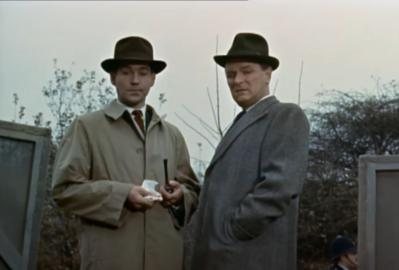
Sapphire (1959)

Not even half an hour into this 1959 British film, directed by Basil Dearden, and I was wondering: “Why isn’t this one better-known? How come I hadn’t heard of it before?”

Having finished watching Sapphire, I think I know the answers to those questions. It’s not as if Sapphire is an obscure film; in Britain, in knowledgeable film circles, it’s probably fairly well-respected, given that it won the BAFTA Award for Best Film in 1960. But here in India, while British cinema of earlier years (Hitchcock’s early cinema, the films of Laurence Olivier and Leslie Howard in the 30s and 40s, for instance) were the stuff of my childhood film-watching—thanks to Doordarshan, which would air the great classics—by the 1950s and 60s, the cinema that seemed to be most popular was Hollywood. I am not talking of what English-language films were actually screened in India back then; I am talking of the 50s and 60s English-language films that were aired by Doordarshan in the 1980s and early 90s, when much of my film-watching was on TV.

Anyway, better late than never, I guess. I finally watched Sapphire (because of a serendipitous discovery on YouTube; the film is available here). And this, I can safely say, is one of the more unusual noir films I’ve seen. While it is a solid police procedural, a whodunnit revolving round a murdered woman, it is, too, a comment on society, on norms, what is right and what is wrong.

The story begins on Hamstead Heath, where two little children, playing with their ball, tumble onto the body of a young woman (Yvonne Buckingham) who’s been stabbed to death. The police are called in, and Chief Inspector Bob Hazard (Nigel Patrick) comes with his team to examine the scene of crime. The young woman’s body is taken away for autopsy.
Continue reading

Point and Line (1958)

In the original Japanese, Ten to Sen. The English title is also often translated as Points and Lines, which was how I originally saw it being referred to.

In a cinema that—at least to the outside eye—seems to be dominated by the works of directors like Akira Kurosawa and Yasujiro Ozu, films that are rather more ‘pure entertainment’ tend to get overlooked. The amusing yet insightful little look at childhood, Ohayo (1959), for example; or this classic noir, a police procedural that revolves around trains: their schedules, their stations, their networks… and how they (along with a ferry and various aeroplane routes) might have been instrumental in helping a murderer pull off a crime.

The story begins on a bleak and deserted seashore, where two dead bodies have been found. The cops from the Fukuoka Police Department have come to investigate, and seem to have reached a consensus that this is a case of a double suicide: everything points to it. A man and a woman, her head sweetly pillowed on his arm, lying stretched out beside each other. The police doctor comes to the conclusion that they’ve died of cyanide poisoning.

Continue reading

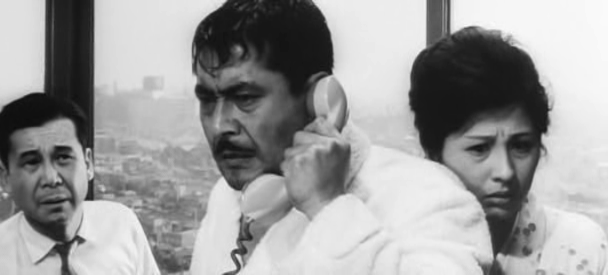
Tengoku to Jigoku (1963)

This blog’s been focussing on Hindi cinema for a while now, so I decided it was time to get back to being a bit more diverse. And this time with a film from one director whose work I admire a lot: Akira Kurosawa. If all you’ve seen of Kurosawa are his samurai films, I’d recommend Tengoku to Jigoku (High and Low) as a good way of getting introduced to the films he made in other genres. If you’ve never watched a Kurosawa, this is still one of his best films – and one of the best classic crime films I’ve seen.

Loosely based on King’s Ransom, a novel by American crime writer Ed McBain, Tengoku to Jigoku is about a kidnapping and its repercussions. The result is an unforgettable film that brilliantly combines the personal, the social, the psychological, the dramatic and the mundane, with the sheer sweat-and-drudgery of the police procedural.

Continue reading